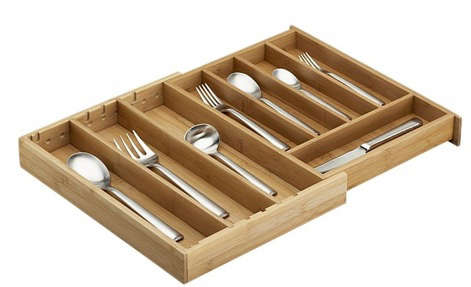

An expandable renewable bamboo cutlery tray may not be the loudest product in your kitchen, but it can quietly rescue a drawer from complete utensil anarchy. Instead of opening a cabinet and hearing forks, spoons, measuring cups, and mystery gadgets perform a metal percussion concert, you get tidy compartments where everything has a sensible home.
The expandable design is especially useful because kitchen drawers are not standardized nearly as well as people assume. One drawer may be narrow enough to challenge a sandwich, while another could practically rent itself out as a studio apartment. An adjustable bamboo organizer bridges that gap by changing width to match the available space.
Beyond organization, bamboo brings natural warmth to a kitchen. Its clean grain looks more like furniture than storage equipment, making it an appealing alternative to ordinary plastic trays. However, appearance is only part of the story. A good expandable bamboo cutlery tray should also be correctly sized, smoothly finished, easy to clean, stable inside the drawer, and divided according to the utensils you actually use.
What Is an Expandable Renewable Bamboo Cutlery Tray?
An expandable renewable bamboo cutlery tray is an in-drawer organizer designed to separate flatware, serving pieces, cooking tools, and other small household items. Its central section usually contains several fixed compartments. Sliding panels on one or both sides extend outward, revealing additional storage areas and increasing the total width.
Depending on the model, a tray may expand from five or six compartments to seven, nine, or even more. Some designs include removable dividers, while others use long, uninterrupted side compartments for spatulas, whisks, reusable straws, chopsticks, or serving utensils.
The term “renewable” refers to bamboo’s plant-based origin and relatively rapid growth compared with many traditional hardwood resources. Bamboo is technically part of the grass family rather than a tree. Manufacturers process mature stalks into strips or panels that can be laminated into strong household products.
That does not mean every bamboo product has an identical environmental profile. Adhesives, coatings, shipping distances, manufacturing methods, packaging, and sourcing practices all matter. Shoppers interested in responsible purchasing should look beyond a vague green leaf printed on the box and examine material descriptions, third-party certifications, construction details, and expected product life.
Why Expandability Makes a Real Difference
A More Customized Drawer Fit
A fixed tray may leave several inches of unusable space beside it, or it may be too wide to enter the drawer at all. Expandable organizers solve this problem by adapting to a range of drawer widths. Once extended, the sides can make productive use of space that would otherwise become a breeding ground for loose bottle openers and rogue takeout chopsticks.
The result resembles a semi-custom drawer insert without the cost or commitment of permanent cabinetry. This is helpful for renters, frequent movers, and homeowners who may reorganize their kitchens later.
Flexible Storage for Changing Needs
Household storage needs rarely remain frozen in time. You may buy a new flatware set, begin using reusable straws, inherit serving spoons, or suddenly discover that you own seven vegetable peelers. An expandable cutlery tray gives you room to adjust without immediately replacing the entire organizer.
The side compartments can also be closed when they are not needed. This prevents small collections from spreading across an oversized drawer simply because empty space exists. Kitchen tools behave a little like teenagers: give them unlimited territory, and they will occupy all of it.
Better Visibility and Faster Access
Well-defined compartments make it easier to see what you own. Instead of digging beneath a pile of utensils to locate the measuring spoon you need, you can assign each category a specific zone. Daily tasks become faster, and duplicate purchases become less likely because items are no longer hiding under the garlic press.
Benefits of Bamboo for Drawer Organization
A Naturally Warm Appearance
Bamboo introduces texture and warmth without appearing heavy or overly decorative. Its neutral finish works with white, gray, black, stainless-steel, traditional wood, and colorful kitchen interiors. Even though the organizer spends most of its life inside a drawer, the attractive finish makes every opening feel a little more intentional.
Strength Without Excessive Bulk
Properly manufactured bamboo panels can create a sturdy organizer with relatively slim dividers. This allows the tray to provide useful compartment space without consuming an unreasonable amount of the drawer.
Construction quality still varies. Examine joints, corners, panel thickness, and the sliding mechanism before buying. A tray made from weak composite panels with a decorative bamboo veneer may perform differently from one built with substantial laminated bamboo components.
A Renewable Material Option
Bamboo can reach usable maturity more quickly than many tree species, making it an attractive renewable material for household goods. A long-lasting bamboo tray may also reduce the need to replace cracked or poorly fitting organizers repeatedly.
Longevity is an important part of sustainability. A supposedly eco-friendly item that warps after six months and heads directly to the trash is not winning any environmental trophies. Durable construction, responsible sourcing, repairability, and realistic care requirements all deserve consideration.
A Quieter Drawer
Bamboo compartments can soften the sound of metal utensils compared with hard plastic or bare drawer surfaces. The effect is not complete silence, but it can reduce the sharp clattering that occurs when a drawer opens or closes quickly.
How to Choose the Right Bamboo Cutlery Tray
Measure the Drawer in Three Directions
Measure the interior width, front-to-back depth, and usable height of the closed drawer. Do not rely on the cabinet’s exterior dimensions. Drawer walls, slides, screws, and curved corners can reduce the actual space available.
Measure the width near the front and back because some older drawers are not perfectly square. Check the height under any countertop lip or frame as well. A deep organizer is not useful when the drawer cannot close over your stacked serving spoons.
Check Both Closed and Expanded Dimensions
Product descriptions commonly list a minimum and maximum width. Confirm that the tray fits when closed and that it can expand without pressing tightly against the drawer walls. A small amount of clearance makes installation, removal, and cleaning easier.
Also consider where the expandable wings are located. A tray that opens on both sides may provide balanced storage, while a one-sided model may work better when plumbing, drawer hardware, or an unusual cabinet shape limits space.
Study the Compartment Layout
Count your major utensil categories before shopping. Most households need separate sections for dinner forks, salad forks, tablespoons, teaspoons, and knives. Additional areas may hold steak knives, serving utensils, chopsticks, straws, measuring spoons, or small cooking tools.
Long compartments are useful for whisks and spatulas, but they can waste space if you primarily need flatware storage. Short compartments may organize teaspoons beautifully yet frustrate anyone attempting to fit a twelve-inch turner inside them.
Look for Smooth Edges and Secure Joints
Run your fingers carefully along exposed surfaces when examining a tray in person. The finish should feel smooth, with no splinters, sharp corners, dried adhesive, or uneven joints. Utensils are handled every day, so rough edges quickly become annoying.
The expandable sections should move without excessive force but remain stable after positioning. Loose wings may slide each time the drawer opens. Overly tight panels may become difficult to adjust, especially if humidity causes slight material movement.
Consider Nonslip Features
Some bamboo organizers include silicone feet, rubber pads, cork backing, or textured bases. These details help prevent the entire tray from shifting backward whenever the drawer closes.
If the model you prefer has no nonslip base, a washable drawer liner or small removable grip pads can provide stability. Avoid permanently gluing the tray into place because you will eventually need to remove it for cleaning.
Review Material and Finish Information
Look for clear descriptions of the bamboo components, base material, adhesives, and protective finish. Some trays combine bamboo walls with engineered-wood bases. This construction is not automatically undesirable, but buyers should know what they are purchasing.
A protective finish can make routine wiping easier and help reduce moisture absorption. When the manufacturer identifies a coating as food-safe, remember that cutlery trays are storage products, not cutting surfaces. Follow the company’s care directions rather than assuming the organizer can be soaked, scrubbed aggressively, or treated like a dishwasher-safe plate.
How to Organize a Cutlery Drawer Efficiently
Declutter Before Installing the Tray
Remove everything from the drawer and place similar items together. Discard broken tools, dried rubber bands, expired coupons, unidentified plastic parts, and utensils you never use. Donate safe duplicates that remain in good condition.
Do not organize clutter merely to make it more symmetrical. The goal is to give useful items a logical home, not to create a retirement community for sixteen takeout forks.
Place Everyday Flatware in the Center
Frequently used forks, spoons, and knives should occupy the easiest-to-reach compartments. Less common items, such as seafood forks or specialty serving pieces, can go along the sides or toward the back.
Arrange utensils consistently so handles point in the same direction. This improves visibility and reduces accidental contact with knife blades. Sharp kitchen knives should ideally use a dedicated in-drawer knife holder, sheath, magnetic storage system, or block rather than sharing an open compartment with ordinary flatware.
Use the Expandable Sections Strategically
Side compartments are excellent for longer tools that do not fit standard flatware slots. Group them by purpose: baking tools in one section, serving utensils in another, and reusable dining accessories in a third.
Avoid packing compartments so tightly that tools interlock. If removing one whisk lifts three spatulas and a pastry brush into the air, the drawer is offering feedback.
Keep Rarely Used Tools Elsewhere
The most accessible kitchen drawer should support everyday cooking and dining. Turkey basters, specialty graters, holiday serving utensils, and novelty gadgets can live in a secondary drawer or labeled container. Reserving prime storage for frequently used items keeps the tray functional.
Cleaning and Maintaining a Bamboo Cutlery Tray
Begin by removing all utensils and shaking loose crumbs into the trash. Use a soft brush, handheld vacuum, or dry cloth to clear corners and sliding channels.
For routine cleaning, follow the manufacturer’s instructions. Many bamboo organizers are intended to be wiped with a soft, slightly damp cloth rather than submerged. A small amount of mild dish soap may be appropriate when permitted by the care label. Remove soap residue with a clean damp cloth and dry the tray promptly.
Avoid leaving the organizer in standing water. Prolonged moisture exposure may affect bamboo, adhesives, engineered-wood bases, and surface coatings. Unless the manufacturer explicitly identifies the exact model as dishwasher-safe, hand cleaning is the safer default.
Allow the tray to dry completely before returning it to the drawer. This is particularly important after spills. Moisture trapped beneath an organizer can create odors, stain the drawer, or damage the tray’s base.
Inspect the expansion channels occasionally for crumbs and debris. Food particles can make sliding panels feel stiff. Do not force them; clean the tracks and try again after the tray is dry.
Other Uses Beyond the Kitchen
An expandable bamboo drawer organizer can work wherever small items need separation. In a home office, it can store pens, markers, scissors, charging cables, sticky notes, and rulers. In a bathroom vanity, it may organize combs, brushes, cosmetics, grooming tools, and unopened personal-care items.
Craft rooms can use the compartments for paintbrushes, sewing supplies, cutting tools, stamps, and adhesives. A bedroom drawer can hold watches, belts, sunglasses, and accessories. Before using the tray in a humid bathroom or near wet craft materials, verify that the finish and construction are suitable for those conditions.
Common Mistakes to Avoid
- Guessing the drawer size: A beautiful organizer is not helpful when it is half an inch too deep.
- Ignoring drawer height: Tall dividers and stacked utensils can prevent smooth closing.
- Expanding the tray too tightly: Leave enough clearance for removal and natural material movement.
- Overloading every compartment: Organization should improve access, not compress utensils into decorative traffic jams.
- Soaking the tray: Use minimal moisture unless the manufacturer provides different instructions.
- Assuming all bamboo products are identical: Construction, coatings, base materials, sourcing, and durability vary by brand.
- Storing sharp knives loosely: Use appropriate knife storage to protect both blades and fingers.
Real-World Experiences With an Expandable Renewable Bamboo Cutlery Tray
The greatest change usually occurs during the first installation. A drawer that previously contained a single plastic tray, three loose spatulas, a corkscrew, and a suspicious number of soy-sauce packets suddenly becomes understandable. After measuring the drawer, the organizer can be expanded until the sides use most of the available width. The extra compartments immediately absorb tools that once rolled around whenever the drawer moved.
In a small apartment kitchen, the tray can eliminate the need for a countertop utensil crock. Daily flatware stays in the center, while a narrow expandable compartment holds measuring spoons, a vegetable peeler, a can opener, and a compact whisk. Moving those items into the drawer frees valuable preparation space. The countertop does not become enormous, of course, but it may finally have enough room for a cutting board without negotiating with fourteen wooden spoons.
Families often discover that categorizing utensils changes how quickly children can help set the table. Forks, spoons, and dinner knives remain visible and consistently positioned. Because the organizer has clear boundaries, returning clean silverware becomes a simple matching task rather than an archaeological dig.
An expandable tray can also reveal which utensils are unnecessary. During installation, duplicates become impossible to ignore. Four nearly identical can openers look less reasonable when lined up together than when scattered throughout two drawers. Many households end the process with a small donation box and considerably more usable space.
The natural bamboo appearance tends to feel more permanent than a lightweight temporary insert. This can encourage users to maintain the drawer instead of allowing it to return immediately to chaos. However, the best experience comes from treating the tray as a system rather than a miracle. New utensils still need assigned locations, crumbs still need cleaning, and overcrowded compartments still require occasional editing.
One practical challenge appears when the organizer lacks nonslip feet. A tray may gradually slide toward the back of a smooth drawer, leaving a narrow gap at the front where crumbs and bottle caps collect. A removable nonslip liner usually solves the problem without altering the tray.
Another lesson involves moisture. Placing slightly wet flatware directly into the compartments can leave water beneath the utensils. Drying cutlery before storage and wiping spills promptly helps preserve the finish. During deeper cleaning, removing the tray and letting every surface dry fully is more effective than wiping only the visible top.
The expandable design proves especially useful after a move. Instead of buying a new organizer for a differently sized drawer, the same tray can often be narrowed or widened. A side compartment that once stored serving spoons may become a home for office scissors and pens if the tray moves from the kitchen to a desk.
Over time, the most successful arrangement is usually the simplest one. Frequently used flatware occupies the central slots, longer tools live in the expandable wings, and specialty items are stored elsewhere. The drawer opens quietly, each utensil is visible, and nothing launches itself across the kitchen when someone reaches for a teaspoon. For a product with no electronics, subscription plan, or blinking status light, that is an impressive amount of daily improvement.
Conclusion
An expandable renewable bamboo cutlery tray combines adjustable storage, natural style, and everyday practicality. Its sliding design can fit a wider range of drawers than a fixed organizer, while divided compartments keep flatware and kitchen tools easy to see and retrieve.
The best choice is not automatically the tray with the most compartments. It is the one that fits the drawer, accommodates the household’s real utensils, uses smooth and durable construction, remains stable during use, and can be cleaned without complicated maintenance. Responsible material information and credible sourcing claims add further value.
Measure carefully, declutter before installation, avoid excessive moisture, and give each category a clear home. Do that, and a once-chaotic drawer can become one of the most efficient spaces in the kitchenalthough the junk drawer down the hall may become jealous.


