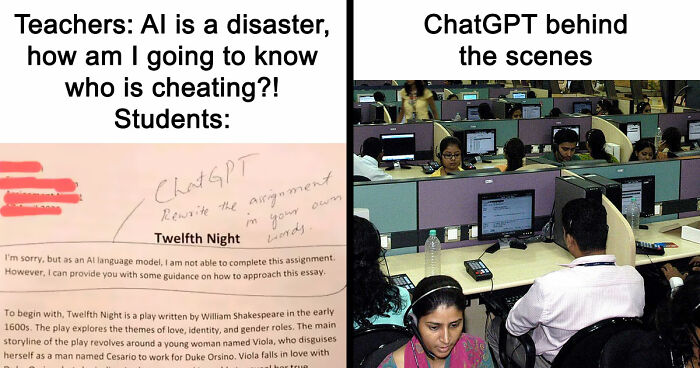

There is something uniquely modern about asking an artificial intelligence tool to improve your résumé while quietly wondering whether that same tool is the reason you need a better résumé. Welcome to the ChatGPT era, where productivity, panic, curiosity, and comedy are all competing for space in the same browser tab.
ChatGPT can brainstorm campaign ideas, explain complicated subjects, generate code, rewrite emails, create images, and confidently suggest a dinner recipe involving ingredients you definitely do not own. Generative AI has moved rapidly from experimental novelty to an everyday assistant for work, research, and entertainment.
Meanwhile, employees are experiencing an emotional software update of their own. Surveys have found growing workplace adoption alongside real concern about job opportunities, changing expectations, and the speed of AI development. That combination creates perfect meme material: useful enough to keep open all day, unsettling enough to joke about during lunch.
So take a break from optimizing your workflow, pretending to understand your company’s AI strategy, and rewriting the same prompt nine times. These 50 original ChatGPT meme ideas capture what it feels like to work, study, create, and procrastinate beside a digital coworker that never sleeps.
Why ChatGPT Memes Are Taking Over the Internet
ChatGPT memes work because almost everyone recognizes the same situations. The chatbot gives a brilliant answer to a difficult question, then becomes strangely confused by a request such as “make this sentence two words shorter.” It can summarize an enormous report in seconds but may need four reminders not to begin every paragraph with “In today’s rapidly evolving landscape.”
The humor also reflects a genuine contradiction. Research suggests generative AI can improve speed and quality on certain writing and knowledge tasks, especially when people understand where the technology performs well. But AI can also create additional checking, editing, and cleanup when its polished output is inaccurate, generic, or disconnected from the assignment.
In other words, ChatGPT is sometimes a brilliant assistant and sometimes an extremely confident intern who has misunderstood the project but already presented it to the board.
50 Funny ChatGPT Memes About Work, Prompts, and AI Panic
ChatGPT Memes About Office Life
-
The Monday Morning Miracle
Me at 8:59 a.m.: “I have no idea what this meeting is about.” Me at 9:00 after asking ChatGPT: “Let’s begin with the strategic implications.”
-
The Five-Minute Expert
Boss: “Does anyone understand blockchain logistics?” Me, opening ChatGPT under the table: “Define understand.”
-
The Productivity Upgrade
ChatGPT saved me three hours of writing, which gave me three additional hours to obsessively edit what ChatGPT wrote.
-
The Corporate Translation Tool
Prompt: “Rewrite ‘This idea makes no sense’ in professional language.” Result: “This proposal may benefit from further strategic alignment.”
-
The Meeting Survivor
Everyone discussing quarterly synergies while I ask ChatGPT, “What is a synergy, and why does everyone keep making more of them?”
-
The Suspiciously Polished Email
My coworker who usually writes “k” suddenly sends a six-paragraph message beginning with “I hope this correspondence finds you well.”
-
The New Team Member
Company directory: 47 employees. Actual workload distribution: 46 employees, one manager, and ChatGPT doing everybody’s first draft.
-
The AI Training Session
Instructor: “AI will not replace you.” Slide two: “Here are 38 tasks we no longer need you to perform manually.”
-
The Deadline Negotiation
Boss: “This normally takes two days.” Me after discovering ChatGPT: “Excellent. I will still submit it in two days.”
-
The Performance Review
Manager: “Your writing has improved dramatically.” Me: “Thank you.” ChatGPT, glowing silently in another tab: “Our writing.”
Funny ChatGPT Prompt Memes
-
The Simple Request
Me: “Make it shorter.” ChatGPT: produces a new introduction, historical background, FAQ section, appendix, and suggested reading list.
-
The Prompt Engineer
Day one: “Write an email.” Day thirty: “Assume the role of a senior diplomatic communication strategist with expertise in mildly annoyed follow-ups.”
-
The Endless Revision
“Make it friendly.” “Not that friendly.” “More confident.” “Less aggressive.” “Professional, but like a human professional.”
-
The Forbidden Phrase
Me: “Do not say ‘game-changer.’” ChatGPT: “This transformative solution represents a paradigm-shifting evolution.”
-
The Word-Count Battle
Me: “Exactly 100 words.” ChatGPT: “Certainly. Here is your concise 147-word response.”
-
The Context Window
After explaining my entire project in twelve detailed paragraphs, ChatGPT asks, “What project are you working on?”
-
The Tone Experiment
Prompt: “Make this sound casual.” ChatGPT: “Hey there, valued stakeholder! Let us circle back on this delightful operational challenge.”
-
The Unnecessary Disclaimer
Me: “Write a birthday message for my dog.” ChatGPT: “While I cannot personally verify your dog’s date of birth…”
-
The Prompt That Became a Novel
I spent 20 minutes describing the output so precisely that writing it myself would have taken approximately seven minutes.
-
The Magic Word
First nine prompts: disappointing. Tenth prompt with “Please”: suddenly the machine remembers every book ever written.
ChatGPT Hallucination Memes
-
The Confident Historian
ChatGPT explains a historical event with complete authority. The event, location, and three participants have never existed.
-
The Imaginary Source
“According to a landmark 2017 study by Dr. Benjamin Researchman…” Well, that certainly sounds like a real person.
-
The Wrong Answer, Beautifully Written
Factually incorrect, logically impossible, grammatically flawless. A true corporate communication masterpiece.
-
The Citation Adventure
Me clicking the source ChatGPT provided and arriving at a plumbing supply website from Ohio.
-
The Digital Poker Face
ChatGPT after inventing five statistics: “These figures demonstrate a clear and well-documented trend.”
-
The Apology Loop
“You are correct, and I apologize.” Immediately repeats the same mistake using slightly more respectful punctuation.
-
The Fact-Checking Department
My new workflow: ask ChatGPT, doubt ChatGPT, research the answer, discover ChatGPT was half right, then rewrite everything.
-
The Restaurant Recommendation
ChatGPT recommends a charming neighborhood café. It closed six years ago and appears to have been a dentist’s office.
-
The Coding Solution
The code looks elegant, passes no tests, and somehow attempts to import a library that exists only in ChatGPT’s imagination.
-
The Ultimate Confidence
Humans when uncertain: “I think.” ChatGPT when uncertain: “The answer is unquestionably Tuesday.”
These jokes point toward a real limitation. NIST describes confidently produced false or erroneous content as a significant generative AI risk. Fluent language can make an answer appear more reliable than it is, which is why important claims still need human verification.
Memes About AI Stealing Your Job
-
The Reassuring Headline
Article: “AI will not replace workers.” Next paragraph: “Workers who use AI may replace workers who do not.” Very comforting.
-
The Career Counselor
Me: “Which careers are safe from AI?” ChatGPT: “Have you considered maintaining the servers?”
-
The Resume Paradox
Using AI to write a résumé for a job that requires me to evaluate résumés written by AI.
-
The Entry-Level Problem
Job listing: “Entry-level position.” Requirements: five years of experience, seven software platforms, and the productivity of three robots.
-
The Helpful Replacement
Manager: “Think of AI as your assistant.” AI assistant: completing my tasks while the manager studies the staffing budget.
-
The New Promotion Path
Old career ladder: junior, senior, manager. New career ladder: prompt writer, output checker, person blamed when AI is wrong.
-
The Workplace Revolution
We automated the boring parts of work. Management celebrated by giving everyone twice as much interesting work.
-
The Human Advantage
ChatGPT can write 500 emails per minute, but only I can spend 45 minutes deciding whether “Thanks” sounds passive-aggressive.
-
The Future-Proof Skill
My greatest professional strength is identifying which AI-generated paragraph contains the completely fabricated sentence.
-
The Robot Uprising
We expected laser-eyed machines. Instead, the uprising began with an automatically generated meeting summary.
The job picture is more complicated than the phrase “AI is stealing your job” suggests. Researchers have identified substantial exposure across many knowledge-work tasks, but exposure does not automatically equal complete job replacement. Evidence so far includes productivity gains, changing task boundaries, pressure on some freelance work, and uneven effects across industries and experience levels.
ChatGPT Memes for Students, Writers, and Coders
-
The Student Research Method
Professor: “Explain your sources.” Student: “My source was a conversation.” Professor: “With whom?” Student: nervous modem noises.
-
The Essay Introduction
Every AI-generated essay begins by announcing that the topic has fascinated humanity since the dawn of civilization.
-
The Writer’s Block Cure
ChatGPT gives me 30 ideas. I dislike all of them but suddenly know exactly what I want to write.
-
The Programmer’s Assistant
Developer: “Fix this bug.” ChatGPT fixes the bug, creates two new bugs, and adds comments praising the improved architecture.
-
The Code Explanation
Me asking ChatGPT to explain the code that ChatGPT wrote because neither of us remembers why it works.
-
The Originality Check
Writer: “Make it unique.” ChatGPT: “In today’s fast-paced digital world…” Writer: slowly closes laptop.
-
The Homework Shortcut
I asked ChatGPT to simplify the chapter. It produced a longer chapter with additional learning objectives.
-
The Debugging Ritual
Copy error into ChatGPT. Copy solution into code. Receive new error. Copy new error into ChatGPT. Repeat until retirement.
-
The Creative Partnership
I provide the vision. ChatGPT provides the draft. I remove 14 uses of “delve.” Teamwork makes the dream work.
-
The Final Boss
After AI writes the report, designs the slides, and summarizes the research, a human still asks, “Can you make the logo bigger?”
Why Laughing at AI Anxiety Feels So Good
Humor gives people a manageable way to discuss changes that otherwise feel enormous. A meme can compress a complicated workplace fear into one image: an employee smiling nervously beside a robot that has just learned Excel. The joke does not solve the uncertainty, but it makes the uncertainty easier to share.
That shared recognition is essential. One person may worry that AI will eliminate a role. Another may worry that refusing AI will make them less competitive. A third may be delighted that a chatbot can draft routine messages while still feeling uncomfortable about privacy, accuracy, or management expectations. The meme allows everyone to laugh before returning to a very serious spreadsheet.
Even professional comedy reflects this tension. Comedians experimenting with AI have described it as useful for execution, illustration, and iteration, while emphasizing that point of view, timing, judgment, and the central comedic idea still come from people.
That may be the secret behind the best ChatGPT memes. They are not funny simply because a machine makes mistakes. They are funny because humans recognize themselves in the interaction: impatient, ambitious, confused, lazy, creative, skeptical, and willing to spend 40 minutes automating a five-minute task.
How to Create Your Own Funny ChatGPT Memes
Begin With a Familiar Frustration
Start with an experience your audience immediately understands. Examples include receiving an overly formal email, correcting a hallucinated fact, asking for a shorter answer, debugging AI-generated code, or hearing management describe layoffs as “workflow optimization.” Familiarity makes the setup fast, leaving more room for the punch line.
Use Contrast
Many successful AI jokes contrast impressive capabilities with ridiculous failures. ChatGPT can analyze thousands of words but misunderstand “remove one sentence.” It can generate an entire marketing strategy but suggest a slogan that sounds like it belongs on a discount mattress commercial.
Keep the Caption Short
A meme should not require onboarding documentation. Use one sentence for the setup and one for the punch line. When the caption resembles a corporate policy manual, the audience may assume it was generated by the very technology being mocked.
Make the Human Part Specific
The funniest jokes usually include recognizable behavior: hiding an AI tab during a meeting, pretending to understand generated code, or quietly removing phrases such as “in the ever-evolving landscape.” Specific details make the joke feel observed rather than manufactured.
Choose Original or Properly Licensed Images
For publication, combine your caption with an original illustration, a licensed stock image, a public-domain visual, or a meme template you are permitted to reuse. A funny idea does not become less funny merely because the copyright department is not chasing it down the hallway.
Personal Experiences From the ChatGPT Meme Era
Living through the rise of ChatGPT feels like joining an enormous workplace experiment without receiving the consent form. One week, people are using it to rewrite awkward emails. The next week, executives are discussing “AI-first transformation” while half the employees are still trying to determine whether company policy allows them to paste meeting notes into a chatbot.
One of the most relatable experiences is the first genuinely impressive result. You enter a messy set of notes, and ChatGPT transforms them into a clean outline in seconds. For a brief moment, it feels like discovering electricity. You imagine a future without blank pages, repetitive formatting, or emails beginning with “Just following up again.” You may even announce to a coworker that everything has changed.
Then comes the second stage: overconfidence. You give the chatbot a larger assignment and accept the answer because it looks professional. The paragraphs flow. The headings are organized. Every sentence wears a tiny business suit. Only later do you notice that one example is impossible, two statistics have no source, and a quoted expert appears to have been assembled from spare fictional characters.
This is where the relationship becomes less like owning a magic machine and more like supervising a talented but unpredictable assistant. The assistant works quickly, never complains, and occasionally places a fictional research paper in the middle of your presentation. You learn to ask for alternatives, provide context, check important claims, and remove sentences that sound polished but say almost nothing.
Another common experience is prompt escalation. At first, a request might be six words long: “Write a product description for this chair.” After several disappointing outputs, the prompt becomes a miniature legal contract specifying the audience, reading level, sentence length, prohibited phrases, brand personality, emotional objective, desired structure, and acceptable number of adjectives. By the time the instructions are complete, the chair has developed a backstory and retirement plan.
Workplace reactions are equally entertaining. Some employees treat AI as a secret competitive advantage and minimize the browser window whenever someone approaches. Others reject it loudly, then ask a colleague to “quickly generate a few ideas.” Managers may encourage experimentation while offering no guidelines, producing an environment where everyone is innovating cautiously and deleting their chat history enthusiastically.
The funniest moments often happen when AI exposes how strange human work already is. We ask machines to make emails sound less robotic because office language has become robotic. We use AI to summarize meetings created to discuss documents that nobody had time to read. We automate repetitive tasks, then fill the saved time with more repetitive tasks. ChatGPT did not invent corporate absurdity; it simply added faster processing.
There is also a surprisingly positive side. Used carefully, AI can help people get past a blank page, understand unfamiliar terminology, compare ideas, practice communication, and explore possibilities they might not have considered. It can reduce the intimidation of beginning a difficult assignment. The first draft no longer has to be good; it only has to exist so a human can improve it.
That is why the best experience is neither complete trust nor complete rejection. It is learning when ChatGPT is useful, when it needs supervision, and when closing the tab is faster. The technology may change job descriptions, productivity expectations, and creative workflows, but human judgment remains the person holding the steering wheeleven when the navigation system confidently recommends driving through a lake.
Conclusion: The Robots Can Have the Spreadsheet, but Not the Punch Line
ChatGPT memes capture a peculiar moment in history. We are impressed by what artificial intelligence can do, irritated by what it cannot do, and nervous about what it might learn next. Instead of choosing between excitement and fear, internet culture has selected a third option: make a meme about it during working hours.
AI will continue changing how people write, code, research, communicate, and organize tasks. Some jobs may shrink, others may expand, and entirely new responsibilities will emerge around verification, integration, governance, and creative direction. The practical response is to develop adaptable skills, understand the technology’s limits, and keep human judgment involved wherever accuracy or consequences matter.
Until then, enjoy the jokes. ChatGPT may draft your emails, summarize your reports, and recommend a suspiciously nonexistent restaurant, but it still needs a human to recognize when the situation is funny. At least for now, sarcasm remains safely employed.
Note: The 50 meme captions and scenarios in this article are original text concepts inspired by common experiences with generative AI. Publishers should use original, public-domain, or properly licensed images when turning these ideas into visual memes.


