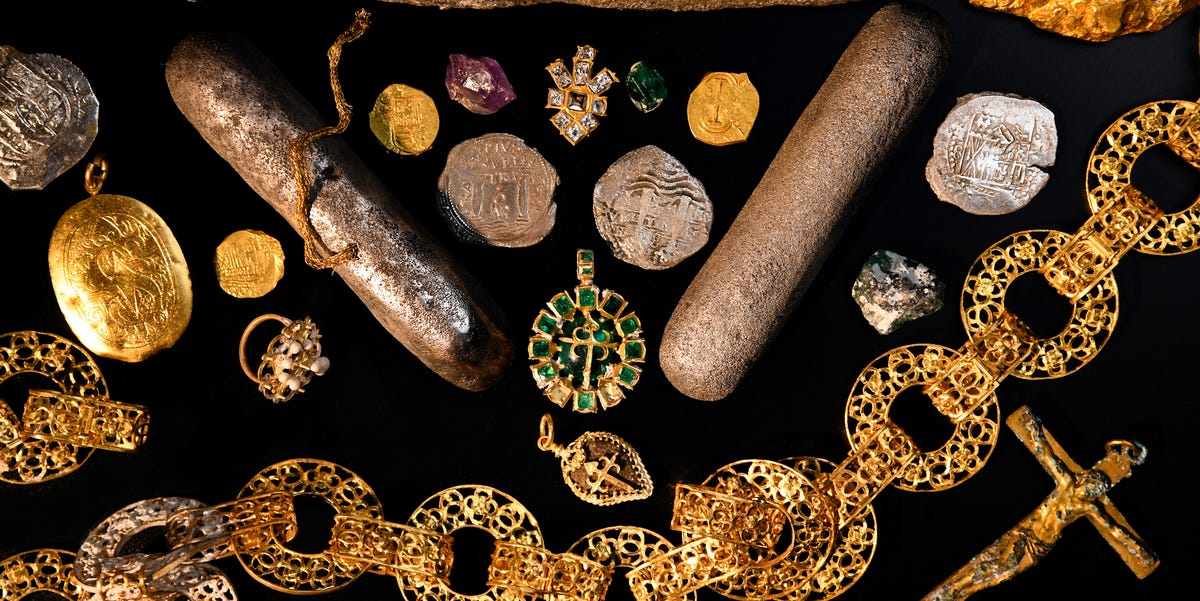

Most of us consider it a win when we find a forgotten $20 bill in an old coat.
Now imagine stumbling across the marine equivalent of a billionaire’s safe:
a Spanish galleon shipwreck, loaded with gold, silver, and gemstones,
quietly waiting on the seafloor for more than 300 years. That’s not just a
good day at the beachthat’s the kind of discovery that rewrites history books,
ignites international legal battles, and makes every metal detector hobbyist
briefly reconsider their career choices.
Recent expeditions to a long-lost Spanish treasure galleonsimilar to legendary
wrecks like the San José, the 1715 Treasure Fleet off Florida, and the
famous Nuestra Señora de Atochahave finally begun to bring real,
physical treasure back to the surface. After roughly 360 years underwater,
cannons, coins, porcelain, and other artifacts are emerging from the deep,
providing a rare glimpse into the golden age of the Spanish Empire and its
risky, treasure-laden voyages across the Atlantic.
The Golden Highway of the Spanish Empire
To understand why a single Spanish galleon shipwreck can be worth billions,
you have to picture the 17th and 18th centuries as a kind of high-stakes
international shipping lane. Spain’s empire stretched across much of the
Americas, and every year fleets of “treasure ships” loaded up with precious
metals and luxury goods for the journey back to Europe.
These galleons weren’t just cargo haulers. They were floating fortresses,
packed with guns and guarded by warships because their holds contained the
economic lifeblood of an empire:
tons of silver and gold coins, gold bars, emeralds, and fine goods
like Chinese porcelain and South American gemstones. One famous galleon,
the Nuestra Señora de Atocha, carried around 40 tons of gold and silver
and high-quality Colombian emeralds when it sank in a 1622 hurricane near
Florida. Modern estimates put its recovered treasure in the hundreds of
millions of dollars.
Another example: the 1715 Treasure Fleet, a group of 11 Spanish vessels
destroyed by a hurricane off Florida’s east coast. Modern divers have
pulled up more than a thousand silver coins and rare gold artifacts from
those wrecks, and experts estimate the original cargo at hundreds of
millions of dollars in today’s money. In other words, these weren’t
small change runs. They were more like vaults on the waves.
The “Holy Grail” Galleon and Its Long Sleep
Among all these lost ships, one stands out as the poster child for
sunken Spanish treasure: a heavily armed galleon that went down in the
early 1700s during a conflict between Spain and Britain. Packed with gold,
silver, and emeralds from New World colonies, it was reportedly carrying
cargo worth tens of billions of dollars at modern prices when its powder
magazine exploded during a sea battle, sending it and roughly 600 people
to the bottom of the Caribbean.
For centuries, the wreck lay hidden far below the surfaceso deep that
traditional divers could never reach it. Locals knew the story, treasure
hunters dreamed about it, governments argued over it in theory, but the
exact location stayed stubbornly secret. Only in the 21st century did
advanced sonar, high-resolution mapping, and remotely operated vehicles
(ROVs) finally locate the remains of the ship, largely intact, resting
on the seafloor.
Archaeologists and officials quickly began calling it the “Holy Grail of
shipwrecks.” Not only because of its estimated monetary valuewhich
headlines often peg in the tens of billions of dollarsbut because it
promised a uniquely well-preserved snapshot of maritime, economic, and
colonial history. Every cannon, coin, shard of porcelain, and weapon on
board is a data point in the story of how global trade and empire-building
actually worked.
First Treasures Brought Back to the Surface
After years of survey work and political wrangling, researchers have
finally started to recover physical artifacts from the wreck. Using ROVs
capable of operating at depths of roughly 2,000 feet, teams have carefully
lifted:
- A bronze cannon, heavily encrusted but still recognizable in its general shape.
- Several gold and silver coins scattered near the wreck, some minted in colonial mints like Lima and other New World cities.
- A delicate porcelain cup, probably part of a larger collection of imported Chinese ceramics carried as high-end cargo.
- Fragments of ceramic jars, weapons, and other shipboard equipment.
None of these are the giant chests of gold that movies like to show,
but they’re the crucial first step. Salvage teams have to prove they can
safely lift small objects and keep them from disintegrating when exposed
to air. Saltwater-soaked artifacts can literally crumble if they’re not
stabilized quickly in conservation labs.
High-resolution video footage from the site shows coins sprinkled around
cannons, piles of encrusted cargo, and sections of the hull still standing.
It’s like looking at a time capsule frozen in mid-sinking: a moment of chaos
turned into a static, eerie underwater museum.
Treasure, Science, and a Three-Way Tug of War
Of course, when a shipwreck might hold tens of billions in treasure,
not everyone is thinking purely about science. Governments and private
salvage companies have clashed for years over who owns the loot.
In this case, the coastal nation where the wreck lies asserts sovereignty
over any archaeological material found in its territorial waters, framing
the galleon as part of its national heritage. Spain, as the original flag
state of the warship, has argued that the vessel was part of its navy and
therefore should be protected as a sovereign immune ship. Meanwhile, a
U.S.-based salvage company claims it found the general area decades ago
and has pursued massive compensation in international courts.
This fightheritage vs. salvage, museums vs. bullionhas parallels in other
famous wrecks. When American treasure hunter Mel Fisher’s team located the
Nuestra Señora de Atocha in 1985 after a 16-year search, Florida tried
to claim a large cut of the treasure. The legal battle went all the way to
the U.S. Supreme Court, which ultimately awarded Fisher’s company full
rights to the trove. That case still shapes how shipwreck treasure disputes
are argued today.
In contrast, the modern approach to the “Holy Grail” galleon emphasizes
archaeology over instant cash. Officials have framed the current recovery
operations as scientific missions, focused on documenting and preserving
history rather than melting down gold bars. The plan is to put recovered
artifacts in national museums, turning a once-secret wreck into a public
story rather than a private jackpot.
How Modern Tech Finally Found the Treasure
So why did it take roughly 360 years for serious recovery to begin?
Blame depth, technology, and politics.
Earlier treasure hunters were limited to relatively shallow water.
Many famous wrecks like the 1715 Fleet and the Atocha sit in diving range
off Florida, which is why modern salvage companies have been able to work
them for decades. But a galleon resting around 2,000 feet down is in a
completely different league.
The breakthrough came with:
-
Advanced sonar and mapping: Modern survey ships can map the
seafloor with incredible detail, spotting shapes that hint at wrecks
beneath layers of silt. -
ROVs and underwater robotics: Remotely operated vehicles
equipped with cameras, robotic arms, and even AI-assisted navigation can
carefully explore and excavate without putting human divers at risk. -
Improved conservation science: Museums and labs now know how
to desalinate and stabilize fragile artifacts so they don’t fall apart
after centuries underwater.
Put together, these advancements transformed a legendary “maybe it’s out there”
story into a concrete archaeological project. The wreck hasn’t just yielded
treasure; it has rewritten our understanding of what’s technically and
ethically possible in deep-sea archaeology.
Why These Shipwreck Treasures Still Matter
It’s easy to get caught up in the big numbers$400 million here,
$20 billion therebut the real value of these shipwrecks is in the details.
A single coin can reveal where it was minted, which tells us how Spanish
colonial economies were structured. A porcelain cup can trace trade routes
stretching from China to Latin America to Europe. The way cargo is stored,
the types of weapons on board, even the wood used in the hull all help
historians reconstruct how empires functioned.
They also highlight the human cost. Behind every treasure manifest are
enslaved people, Indigenous labor, sailors who never made it home, and
coastal communities drawn into imperial trade. Recovering artifacts with
proper context allows archaeologists to tell those stories, not just
auction off shiny objects.
That’s why many experts now talk about “sunken cultural heritage” rather
than just treasure. A Spanish galleon shipwreck isn’t merely a jackpot;
it’s a floating (and now sunken) archive of global history.
Visiting the World of Spanish Galleon Shipwrecks: of Real-World Experience
Reading about sunken Spanish galleons is fun. Standing face to face with
their artifacts is something else entirely. If this story has you daydreaming
about treasure chests, there are a few real-world places and experiences
that bring the saga of Spanish shipwrecks to lifeno pirate hat required.
1. Museums Where the Treasure Resurfaces
The easiest way to “visit” a Spanish galleon shipwreck is by walking into a
museum that houses its recovered artifacts. In the Florida Keys, for example,
maritime museums display coins, bars, and everyday objects from wrecks like
the Atocha and the 1715 Fleet. Up close, those famous gold coins are surprisingly
small and often irregular, hammered by hand centuries ago. It’s a nice reminder
that the legends are huge, but the objects themselves are very human-sized.
Future exhibits planned around the newly recovered galleon artifacts will likely
showcase cannons, coins, porcelain, and possibly 3D visualizations of the wreck
site. Expect interactive displays that let you “dive” the site virtually, plus
conservation labs where visitors can see how muddy lumps of metal are coaxed
back into recognizable historical pieces.
2. Walking the Beaches of the Treasure Coast
If you’re more of a “boots in the sand” person, Florida’s Treasure Coast
(named for a reason) is home to beaches where artifacts still occasionally
wash up after storms. Licensed salvage companies actively work offshore
on some of the 1715 Fleet wrecks, and every so often, a powerful storm
stirs the seafloor enough to push small coins or fragments onto the beach.
Realistically, you’re more likely to find a bottle cap than a gold escudo,
but the experience of scanning the surf line with a metal detector at sunrise
while pelicans glide overhead feels like stepping into your own low-budget
treasure movie. Just be sure to follow local lawssome areas near active
archaeological sites are off-limits without permits, and anything major you
uncover might come with paperwork attached.
3. Diving (Responsibly) on Historic Wreck Sites
For certified divers, wreck diving offers the closest thing to time travel.
Around the Caribbean and Florida, charter operators run trips to historic
shipwrecks and artificial reefs created from old vessels. While most official
Spanish treasure wrecks are protected and off-limits for souvenir hunting,
you can still explore nearby sites and get a feel for how quickly the ocean
reclaims human creations.
Responsible operators follow “look but don’t touch” ethics. You’ll see coral
growth, schools of fish weaving through gun ports, and maybe old anchors or
cannons that have become part of the reef. It’s humbling to realize that the
same sea that swallowed imperial treasure now serves as a wildlife sanctuary.
4. What to Keep in Mind as an Aspiring Treasure Hunter
If this Spanish galleon story has you thinking, “I should buy a boat and some
sonar,” it’s worth remembering that modern treasure hunting is heavily regulated,
expensive, and often more archaeology than adventure movie. Finding a wreck is
only half the challenge. You also need legal rights, conservation plans,
and enough patience to sit through meetings that might feel longer than the
actual 360-year wait.
A more realistic approach is to combine curiosity with respect. Visit museums,
read up on shipwreck archaeology, maybe take a course on underwater heritage
if you’re serious. The more you learn, the more you realize these wrecks are
not just pots of goldthey’re complex stories about trade, power, technology,
and people.
So yes, a Spanish galleon shipwreck yielding sunken treasure after 360 years
is thrilling. But the best part isn’t just the gleam of recovered coins.
It’s the way a silent ship on the seafloor, untouched for centuries, suddenly
starts talking againthrough every cannon, cup, and coin brought gently back
into the light.
SEO JSON META


