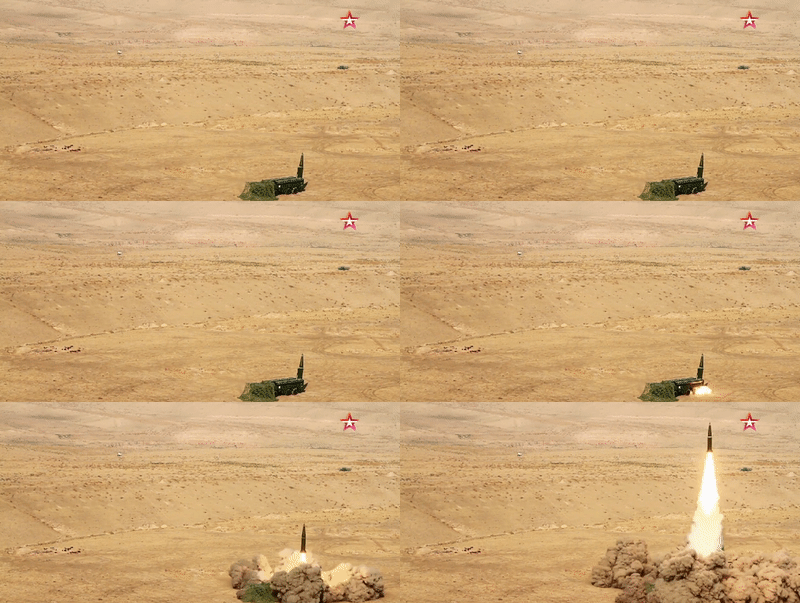

Some headlines arrive wearing combat boots, and this one absolutely stomps into the room. The Russian short-range missile that has kept NATO planners, border-state officials, and defense analysts unusually alert is the Iskander-M, a mobile missile system that has become one of Moscow’s most recognizable symbols of pressure, intimidation, and regional military leverage. It is not the biggest missile in Russia’s arsenal, and it is not the newest toy in the Kremlin’s display case. But in Europe, “most unsettling” and “largest” are not the same thing. The Iskander matters because it sits at the uncomfortable crossroads of speed, mobility, geography, and uncertainty.
That last word is the real troublemaker. NATO does not worry about missiles only because of raw firepower. It worries because systems like the Iskander compress decision time, complicate air and missile defense, and raise the stakes during already tense standoffs. A weapon does not have to cross an ocean to change strategy. Sometimes it only has to sit in the right place, on the right launcher, near the right border, and suddenly every military planner in the neighborhood starts drinking coffee like it is a professional obligation.
The original headline about the missile focused on one blunt truth: this short-range system can threaten parts of NATO’s eastern flank. That remains true. But the story in 2026 is bigger than one dramatic headline from years ago. Today, NATO’s concern is about the Iskander and the wider Russian missile picture surrounding it: deployments in Kaliningrad, military cooperation with Belarus, the collapse of old arms-control guardrails, and lessons learned from Russia’s missile campaign in Ukraine. So yes, this is a story about one missile. It is also a story about why Europe’s security map feels less stable than it did before.
The Missile Behind the Headline: Russia’s Iskander-M
The missile system most commonly connected to this headline is the Russian Iskander-M, known by NATO as the SS-26 Stone. In broad terms, it is a mobile short-range ballistic missile system designed for fast deployment and difficult targeting. “Mobile” is doing a lot of work in that sentence. A launcher that can move, hide, reposition, and remain hard to track is far more stressful than a fixed site everyone can stare at on a satellite image. Fixed targets are problems. Mobile targets are headaches with wheels.
The Iskander is especially significant because it is not just a battlefield prop rolled out for parade footage. It sits inside Russia’s broader precision-strike architecture and has been used in real conflict. That gives it strategic weight. NATO is not guessing in the dark about whether this kind of system matters. Analysts have watched Russia use missiles in Ukraine, combine them with drone attacks, adjust tactics, and continue relying on ballistic strike capability even as the war has evolved. In that sense, the Iskander is not merely a piece of hardware. It is a window into how Russia thinks about pressure, punishment, signaling, and escalation.
There is another reason the Iskander draws attention: it belongs to a family of systems that has long been linked to concerns over launch-platform flexibility and treaty-era disputes. In European security, technical questions quickly become political questions. Once a launcher can be associated with multiple missile types, the alliance’s anxiety is no longer about a single vehicle on a road. It becomes about what exactly is loaded, how fast it can be fired, and what assumptions leaders would make during a crisis. None of that is calming.
Why NATO Worries So Much
1. Geography Turns “Short Range” Into a Very Big Deal
“Short-range missile” sounds oddly modest, almost like a military version of “starter home.” In practice, geography makes that label misleading. From Russian territory positioned near NATO’s eastern members, especially Kaliningrad, a short-range system can still place key parts of the alliance under pressure. That is why the Iskander has long punched above its category. It does not need intercontinental reach to alter the balance in northeastern Europe. It just needs to be close enough to matter, and it is.
Kaliningrad is central to the story. This Russian exclave sits between Poland and Lithuania like a geopolitical stress knot. When Moscow deploys advanced missile systems there, the effect is not merely military. It is psychological and political. It signals that Russia can hold nearby infrastructure, reinforcement routes, and military nodes at risk. NATO planners then have to think about how quickly they can move forces, how exposed logistics hubs might be, and whether reinforcements can arrive without major disruption. Suddenly, a map that looked manageable on paper starts looking like a timed exam written in permanent marker.
2. Mobility Makes the System Harder to Counter
The second big reason is mobility. NATO has spent years improving intelligence, surveillance, and missile defense, but a road-mobile missile system remains a difficult challenge. The more a launcher can move, disperse, and reduce warning time, the harder it is to neutralize before launch. In strategic terms, that means even a relatively limited number of systems can generate outsized concern. If you cannot be certain where the launcher is, you cannot be certain when the threat becomes immediate.
This matters even more in a crisis atmosphere. Military and political leaders rarely make decisions with perfect information. They make them under stress, amid incomplete data, and while everyone on every side insists they are merely being “defensive.” A mobile missile unit entering an exercise area might be routine. It might also be a signal. It might also be the start of something worse. That uncertainty is exactly why systems like the Iskander are so useful for coercive diplomacy. They create tension before a shot is ever fired.
3. The Nuclear Shadow Changes the Calculation
Another reason NATO takes the Iskander seriously is the long-running concern that parts of the system are associated with nuclear-capable roles. Even when a missile is not armed that way, the ambiguity itself is destabilizing. In a crisis, the alliance may have only seconds or minutes to assess what kind of strike is underway. That is a terrible environment for calm judgment. It is one thing to face a conventional military challenge. It is another to face a system wrapped in uncertainty about payload, intent, and escalation.
This is why European missile discussions so often sound more nervous than glamorous. The central issue is not fascination with hardware. It is the fear of miscalculation. When a system can blur the line between conventional and nuclear signaling, leaders must consider worst-case outcomes much earlier. That pushes everyone toward higher readiness, more aggressive assumptions, and more expensive preparations. No alliance enjoys planning around “What if we guessed wrong?” but that question is baked into the Iskander conversation.
The Belarus Factor and the Wider Eastern Flank
If Kaliningrad is the classic flashpoint, Belarus is the newer amplifier. Russian military cooperation with Belarus has changed how NATO thinks about depth and exposure along the eastern flank. When advanced missile systems, nuclear signaling, and joint exercises move westward, the alliance’s sense of strategic distance shrinks. That does not automatically mean war is around the corner. It does mean more capitals feel like they are sitting closer to the front edge of uncertainty.
For NATO members on the eastern flank, this is not an abstract think-tank debate. Poland and the Baltic states, in particular, view Russian missile deployments through the lens of reinforcement timelines, air-defense coverage, infrastructure vulnerability, and public resilience. These countries do not have the luxury of pretending geography is optional. Their concern is simple: if Russia can threaten transport corridors, military staging areas, and critical sites early in a crisis, then the alliance has to compensate with faster decision-making and stronger defenses long before that crisis begins.
That is one reason NATO has leaned harder into integrated air and missile defense, forward posture, exercises, and regional coordination. The alliance’s answer is not to panic; it is to reduce openings for intimidation. But that response is expensive and never fully complete. Missile defense is not a magic umbrella you snap open over Europe on a rainy Tuesday. It is a layered system of sensors, interceptors, command networks, hardened facilities, and readiness standards. And even then, it is about reducing risk, not deleting it.
Ukraine Changed the Conversation
The war in Ukraine has added a fresh layer of urgency to NATO’s concern. Before 2022, some missile debates in Europe could drift into the abstract. Since then, they have become brutally concrete. Russia’s use of missiles and drones in repeated strike campaigns has shown how modern warfare can mix terror, coercion, and operational pressure in one package. NATO has learned from Ukraine that missile threats are not isolated incidents. They can be part of sustained, adaptive campaigns designed to drain defenses, stress infrastructure, and test political resolve.
Short-range ballistic missiles remain especially troubling in this context because they are difficult to defend against and often arrive with little warning. Even successful air defense does not erase the pressure such attacks create. Every interceptor fired must be replaced. Every alert drains attention. Every siren changes civilian life. NATO has watched these dynamics closely because they offer a preview of what pressure tactics could look like on or near alliance territory in a future crisis.
Ukraine has also shown that Russian missile forces are not invincible. Air defenses can intercept missiles. Better warning systems can save lives. Hardening infrastructure can reduce damage. Dispersing assets can complicate enemy targeting. That is the good news. The bad news is that all of these improvements require time, money, training, industrial capacity, and political will. Missiles like the Iskander worry NATO not because they cannot be countered, but because countering them at scale is hard, costly, and never perfect.
This Is Also an Arms-Control Story
Part of NATO’s concern is rooted in the slow collapse of arms-control confidence in Europe. For years, disputes surrounding Russian missile programs, especially those linked to banned ranges under the old INF framework, fed a larger erosion of trust. Once treaty restraints weakened and eventually fell away, Europe lost more than paperwork. It lost predictability. And in military affairs, predictability is underrated right up until it disappears.
The result is a more dangerous strategic environment in which missile deployments, exercises, and public signaling all carry more weight. NATO now has to think not only about existing short-range systems like the Iskander, but about how they fit into a broader Russian posture that includes other missile types, escalating rhetoric, and attempts to intimidate European governments. More recently, Russia’s use of other ballistic systems near NATO territory has reinforced the wider lesson: the alliance is facing a missile problem that is layered, evolving, and very much alive.
That is why it would be a mistake to read this issue as a narrow “weapons profile” story. The Iskander matters, yes. But it matters most as a symbol of a larger shift in European security: fewer arms-control guardrails, more military signaling, more stress on the eastern flank, and more urgency around air and missile defense. In other words, the missile is the headline, but the real article is about the system around it.
What NATO Is Doing About It
NATO’s response has focused on deterrence, readiness, and integrated defense. The alliance has strengthened its eastern flank, increased exercises, improved coordination, and emphasized air and missile defense as a standing mission rather than a niche specialty. It has also drawn heavily on battlefield lessons from Ukraine, where practical experience has rewritten old assumptions about interception, alerting, and the sheer volume of modern strike campaigns.
There is also a growing recognition that missile defense is not enough by itself. Resilience matters. That means backup power, protected command networks, redundant transportation links, hardened facilities, dispersal plans, and faster repair capacity. The glamorous version of defense policy is all jets and interceptors. The real version includes a lot more engineers, logistics officers, and people who spend their days asking awkward but necessary questions like, “What happens if this rail junction is unavailable for forty-eight hours?” It is not flashy, but it keeps alliances standing.
In plain English, NATO is trying to make Russian missile pressure less effective. That is the core objective. If Moscow wants these systems to create fear, hesitation, and political division, then the alliance’s job is to demonstrate that pressure will not produce the results Russia wants. Deterrence works best when the other side believes intimidation will fail. Easier said than done, of course, but that is the mission.
So, Should NATO Be Worried?
Yesbut “worried” should not be confused with “helpless.” The Iskander-M deserves serious attention because it combines mobility, regional reach, political signaling, and nuclear ambiguity in ways that complicate defense and shorten reaction time. It is one of those systems that can influence strategy even when it is sitting still. For an alliance built on reinforcement, credibility, and collective defense, that is a meaningful problem.
At the same time, NATO is not caught napping in a folding chair. The alliance has adapted, expanded its eastern posture, improved missile defense thinking, and absorbed hard lessons from Ukraine. The concern surrounding the Iskander is real, but it is part of a broader contest in which defense, resilience, and industrial capacity matter as much as missile specifications. Europe’s security challenge is not to admire or fear the missile in isolation. It is to make sure the missile does not achieve its political purpose.
That is the clearest way to understand the headline. The Russian short-range missile that has NATO worried is the Iskander-M. But NATO is worried not because the missile is mythical, unstoppable, or cinematic. It is worried because the Iskander sits inside a strategic environment where warning times are shorter, borders feel tighter, arms-control trust is weaker, and coercion has become part of the regional playbook. In that environment, even a “short-range” missile can cast a very long shadow.
Experiences From Living Under the Missile Shadow
To understand why this topic lands so heavily in Europe, it helps to think beyond military doctrine and imagine the lived experience around it. Not in a dramatic movie-trailer way, but in the slow, ordinary rhythm of public anxiety. A missile threat changes how governments brief citizens, how mayors think about emergency services, how rail planners protect routes, how airports review contingencies, and how families on the eastern edge of NATO hear the evening news. The effect is rarely one giant moment. More often, it is a steady accumulation of tension.
For policymakers in Warsaw, Vilnius, Riga, or Tallinn, the missile conversation is not theoretical wallpaper. It shapes meetings about procurement, civil defense, infrastructure protection, and alliance coordination. A port is no longer just a port. It is also a reinforcement node. A highway is no longer just a highway. It is also a route that may matter under pressure. A warehouse, a rail yard, an energy substation, a command posteverything acquires a second identity once missile vulnerability enters the discussion. Ordinary geography starts wearing a security badge.
There is also the public dimension, which is harder to measure but impossible to dismiss. People living closer to the eastern flank do not need a lecture on maps to understand proximity. They understand it instinctively. They notice new defense spending, larger exercises, more political messaging about preparedness, and more reminders that Europe’s security order is no longer comfortably post-Cold War. Even when daily life continues normallyand it usually doesthe background awareness remains. Stability starts to feel less like a permanent condition and more like something that has to be actively maintained.
Military personnel experience the issue differently, but no less intensely. For them, missile threats are about readiness standards, radar coverage, fuel, dispersal, interoperability, maintenance cycles, and the ugly mathematics of interception. It is professional, technical, and often unglamorous work. Yet behind every checklist sits the same human fact: if deterrence fails, these preparations become the thin line between disruption and disaster. That awareness sharpens the seriousness of the job. No one in an air-defense unit is daydreaming about aesthetics.
Then there are the lessons drawn from Ukraine, which have made the experience feel even more immediate across Europe. Officials no longer have to imagine how missile pressure affects a society over months and years. They have watched the evidence unfold in real time: repeated alerts, strained infrastructure, frantic repair cycles, constant adaptation, and a population trying to keep daily life moving under conditions no modern society should have to accept. For NATO members, those observations have been clarifying. Missile defense is not only about protecting military assets. It is about protecting the continuity of ordinary life.
That may be the most important experience tied to this topic. The fear surrounding systems like the Iskander is not rooted in abstract fascination with military hardware. It is rooted in the recognition that missiles can turn routine life into a permanent exercise in contingency planning. They can make schools review emergency procedures, utilities rethink resilience, and governments reconsider what “prepared” really means. The deepest shadow cast by a missile is not just over military targets. It is over the idea that modern civilian life should feel normal. That is why NATO worries. And that is why Europe keeps paying attention.
Conclusion
The Iskander-M has NATO worried for good reason. It is mobile, regionally significant, politically useful to Moscow, and wrapped in exactly the kind of ambiguity that makes crises harder to manage. Add Kaliningrad, Belarus, Ukraine-war lessons, and the erosion of old treaty confidence, and the concern becomes easy to understand. Europe is not staring at one missile in isolation. It is responding to a larger security environment in which short warning times and strategic signaling have become central features.
That does not mean NATO is powerless, and it does not mean every tense headline signals immediate catastrophe. It means the alliance has to stay serious, coordinated, and realistic. The age of assuming that missile pressure belongs to history books is over. In that sense, the Iskander is more than a weapon. It is a reminder that Europe’s security architecture now depends on readiness, resilience, and credibility every single day.


