
Venice Beach has never been shy. This is a neighborhood where skateboarders, surfers, artists, architects, tech founders, incense sellers, and people walking dogs in sunglasses all somehow agree to share the same ocean breeze. So when Moroccan design shows up herearched doorways, layered tribal rugs, lanterns that throw shadows like poetry, and a courtyard that whispers “take your sandals off and relax”it does not feel random. It feels inevitable.
“Haute Moroccan Stylein Venice Beach” is more than a pretty design phrase. It describes a rare collision of two seductive worlds: the refined, craft-heavy atmosphere of a Moroccan riad and the casual, sun-drenched cool of coastal California living. Think Marrakech soul wearing Venice Beach linen pants. It is luxurious, but not stiff. Exotic, but not costume-party exotic. Bohemian, but thankfully not the kind that thinks one sad floor cushion makes a room “global.”
The best version of Moroccan style in Venice Beach is not about copying a riad tile by tile. It is about translating the mood: privacy, texture, shade, handmade imperfection, low seating, sculptural plaster, patterned rugs, and spaces designed for long conversations. In a city famous for indoor-outdoor living, Moroccan design feels surprisingly at home.
Why Moroccan Style Works So Well in Venice Beach
Venice Beach began as an eccentric dream. Abbot Kinney imagined a California version of Venice, Italy, complete with canals, bridges, amusements, and a resort-town sense of theater. More than a century later, the neighborhood still has that experimental streak. The boardwalk is loud, the canals are quiet, Abbot Kinney Boulevard is polished, and the residential pockets hide some of Los Angeles’s most personal houses.
Moroccan interiors thrive in exactly that kind of contrast. Traditional Moroccan homes, especially riads, tend to turn inward. Their exterior walls can feel quiet and reserved, while the interior opens into a courtyard, garden, fountain, tiled passage, or shaded lounge. Venice Beach homes often perform a similar trick. From the street, they may look modest or mysterious. Inside, they become private worlds where sunlight, plants, art, and furniture tell the real story.
The Venice Beach Mood: Relaxed but Designed
Venice is casual, but it is not careless. Its design scene has long favored custom furniture, vintage finds, artisan ceramics, hand-knotted rugs, gallery pieces, reclaimed wood, concrete floors, and objects that look like someone had to cross at least one desert or flea market to find them. That makes it a natural setting for Moroccan-inspired interiors.
On Abbot Kinney, boutiques and design shops have helped turn the neighborhood into a destination for people who want their homes to look collected rather than delivered by a truck labeled “Instant Personality.” Moroccan style fits this attitude because it rewards patience. A good Moroccan room is layered over time: a carved table here, a vintage rug there, a lantern from a souk, a plaster wall that looks better when the light hits it at 4:37 p.m. and everyone suddenly becomes quiet.
The Case Study: A Moroccan Retreat Near Abbot Kinney
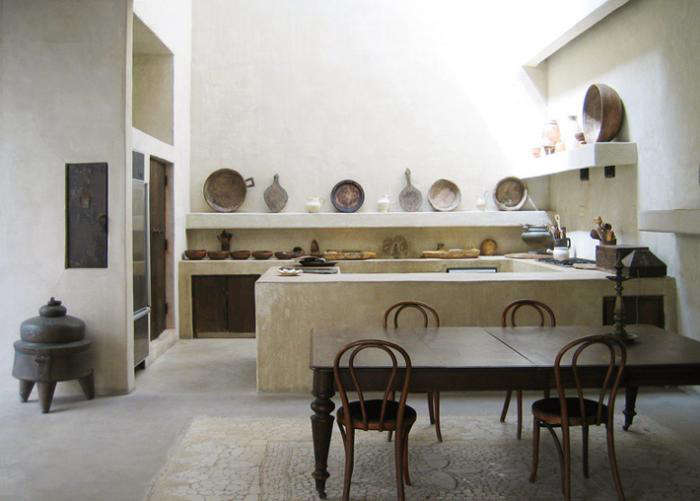
One of the most admired examples of this style is the Moroccan-inspired Venice Beach retreat associated with photographer Philip Dixon. Located near the pulse of Abbot Kinney, the house has been celebrated in design circles for its walled-compound feeling, vintage Moroccan furnishings, patterned stone inlays, layered tribal rugs, and almost cinematic calm. It is the kind of property that makes you forget Los Angeles traffic exists, which is perhaps the highest compliment a house in Los Angeles can receive.
The genius of the space is not that it screams “Morocco!” at every corner. It is that it borrows Moroccan spatial intelligence. The rooms feel grounded and tactile. Concrete floors are softened with rugs. White walls are warmed by shadows. Arches frame views. Net-draped sleeping areas create romance without needing twelve decorative pillows named “Sahara Mist.” The design is restrained enough to feel sophisticated and textured enough to avoid looking like a museum where nobody is allowed to spill mint tea.
What Makes It “Haute”?
The word “haute” suggests high style, but in this context it does not mean shiny excess. Haute Moroccan style is about elevated craft. It favors real materials over printed imitations, handwork over mass production, proportion over clutter, and atmosphere over obvious decoration.
There is a big difference between a room inspired by Morocco and a room attacked by a catalog with tassels. Haute Moroccan style knows when to stop. It might use one dramatic zellige wall instead of tiling every surface in sight. It might feature one exceptional Beni-style rug rather than five competing patterns having a family argument. It might choose a carved wood door, brass lantern, or tadelakt wall as the star and let the rest of the room breathe.
Key Elements of Haute Moroccan Style
Moroccan design is famous for its richness, but the best spaces are not simply “more pattern, more color, more lanterns, more everything.” They are carefully balanced. In Venice Beach, where natural light is abundant and the ocean air softens hard edges, Moroccan elements can be edited into something modern, warm, and deeply livable.
1. Zellige Tile: Perfectly Imperfect Glamour
Zellige tile is one of Morocco’s great design gifts to the world. Traditionally made by hand, these tiles are known for their irregular surfaces, tonal variation, and glossy depth. No two pieces are exactly alike, which is precisely the point. In a Venice Beach interior, zellige can bring a handcrafted shimmer to kitchens, bathrooms, fireplaces, fountains, or outdoor showers.
The trick is to use it with confidence but not panic. A single-color zellige wall in white, cream, deep green, blue, or terracotta can feel both ancient and fresh. The glaze catches the California light beautifully, creating movement without shouting. If subway tile is a polite handshake, zellige is a charming person who tells great stories and probably knows where to find the best coffee.
2. Tadelakt Walls: Soft, Sculptural, and Sensual
Tadelakt is a traditional Moroccan lime plaster finish often associated with hammams, bathrooms, and riads. It has a smooth, slightly polished surface that can be water-resistant when properly applied and sealed. In high-end interiors, tadelakt offers an elegant alternative to standard tile or flat paint.
In Venice Beach, tadelakt makes perfect sense. It feels organic, not glossy. It can soften bathrooms, powder rooms, niches, fireplaces, and even built-in seating. Its gentle sheen works beautifully with sunlight, candles, and brass. A tadelakt wall does not beg for attention; it simply stands there looking expensive in a spiritual way.
3. Courtyards and Privacy
The riad concept is built around inward-focused living. Instead of making the street-facing facade the main event, traditional Moroccan homes often reserve their drama for the inside: a courtyard, garden, fountain, or open-air gathering space. This idea works beautifully in Venice Beach, where privacy is valuable and outdoor living is practically a local religion.
A Moroccan-inspired Venice home might use high walls, mature plantings, carved screens, or arched openings to create a sheltered retreat. Add a fountain or reflecting pool, and suddenly the noise of the street fades. The result is not just decoration; it is emotional architecture. The house says, “Come in, exhale, and please stop checking your email for seven minutes.”
4. Layered Rugs and Low Seating
Moroccan rugs bring warmth, pattern, and history to a room. Beni Ourain-style rugs are loved for their creamy wool and simple geometric motifs, while Boujad, Azilal, and Boucherouite pieces can introduce stronger color and expressive patterns. In a Venice Beach setting, rugs soften concrete, stone, and wood floors while adding the “collected over time” feeling that coastal homes crave.
Low seating also matters. Floor cushions, poufs, built-in benches, and deep sofas encourage lounging. This is a style designed for lingering, not perching nervously with a drink while pretending to understand a gallery opening. Add a low table, a tray of tea glasses, and a few mismatched textiles, and the room immediately becomes more human.
5. Lanterns, Brass, and Shadow Play
Moroccan lanterns are not just light fixtures. They are shadow machines. Punched metal, colored glass, and sculptural forms create patterns across walls and ceilings, especially at night. In Venice Beach, where days are bright and evenings can turn soft and cinematic, lanterns add atmosphere without needing much else.
Brass works particularly well against plaster, tile, and natural wood. It brings warmth without the slickness of chrome. Used in moderationsconces, trays, mirrors, faucets, or lanternsit adds a refined glow. Used everywhere, it starts to look like a very glamorous pirate ship. Balance is your friend.
Color Palette: From Marrakech Heat to California Calm
Classic Moroccan interiors can be intensely colorful: cobalt blue, saffron, crimson, emerald, ochre, terracotta, and deep indigo. Venice Beach, however, often leans lighter and more sun-washed. The best Moroccan-California palette combines both worlds.
Start with warm whites, sand, clay, plaster, stone, and weathered wood. Then add saturated accents: a blue tile wall, a rust-colored rug, a green glazed vessel, a black iron lantern, or a mustard textile. This approach lets Moroccan craft stand out while keeping the home breathable. The goal is not to recreate a Marrakech market indoors. The goal is to make a Venice Beach house feel soulful, shaded, and alive.
How to Bring the Look Home Without Overdoing It
You do not need a walled compound near Abbot Kinney to borrow this style. You do need restraint, curiosity, and a willingness to choose real texture over quick visual tricks.
Start With Architecture, Not Accessories
The strongest Moroccan-inspired rooms begin with form: arches, niches, courtyards, plaster walls, tiled surfaces, wood doors, and built-in seating. Accessories should support the architecture, not carry the entire performance. A room with plain drywall, a plastic lantern, and three random poufs may technically contain Moroccan references, but it will not feel “haute.” It will feel like a dorm room that studied abroad for six days.
Choose Handmade Pieces
Handmade objects are central to Moroccan style. Look for wool rugs, hand-thrown ceramics, carved wood, woven baskets, metal lanterns, and real tile. Imperfection is not a flaw here; it is the charm. A slightly uneven glaze or irregular weave adds depth that machine-perfect objects often lack.
Mix With California Materials
To make Moroccan style work in Venice Beach, mix it with local ease. Pair zellige with white oak. Add linen curtains, vintage leather, sculptural plants, and casual outdoor furniture. Use plaster with concrete. Let a Moroccan rug sit under a modern sofa. Combine a carved door with a minimalist kitchen. The tension between ornate craft and relaxed California restraint is where the magic happens.
Why This Style Feels So Current
Modern homeowners are increasingly drawn to spaces that feel personal, grounded, and tactile. After years of gray floors, flat-pack sameness, and interiors that looked like they were designed by a very anxious spreadsheet, Moroccan style offers relief. It brings back touch. It celebrates artisans. It allows asymmetry, shadow, history, and mood.
At the same time, Venice Beach has become a symbol of creative California living: casual but curated, beachy but global, wellness-minded but still a little weird in the best possible way. Haute Moroccan style fits because it offers sanctuary. It creates homes that feel removed from the noise without becoming precious. It is luxury with dust on its sandals.
Design Lessons From Haute Moroccan Style in Venice Beach
The biggest lesson is that great style is translation, not imitation. A Moroccan-inspired Venice Beach home should not feel like a theme restaurant or a movie set. It should feel like a conversation between place and memory: North African craft meeting Pacific light, courtyard privacy meeting California openness, old-world pattern meeting modern simplicity.
The second lesson is that mood matters. A home can be beautiful and still feel cold. Moroccan style, when handled well, creates warmth through texture, enclosure, light, and ritual. It makes space for sitting, talking, resting, hosting, bathing, reading, and staring dramatically into a fountain as though you are about to make a life-changing decision.
The third lesson is to invest in fewer, better details. One real zellige backsplash is better than ten fake Moroccan accessories. One beautiful rug is better than a pile of trendy textiles. One well-placed lantern is better than turning your ceiling into a metal fruit basket convention.
Experience Section: Living the Feeling of Haute Moroccan Style in Venice Beach
To understand this style, imagine arriving at a quiet Venice Beach home after walking past the bustle of Abbot Kinney. Outside, there are bicycles, coffee cups, palm shadows, and someone discussing cold plunge benefits with alarming confidence. Then a wooden gate opens, and the mood changes completely. The street noise softens. The air feels cooler. A tiled path leads toward a courtyard where plants lean toward the sun, and a small fountain makes the kind of sound that immediately improves everyone’s personality.
The first experience is visual, of course, but not in a loud way. The plaster walls have movement. They are not flat white boxes; they hold light differently at every hour. Morning makes them creamy. Afternoon turns them golden. At night, lanterns draw lace-like shadows across the surface. You begin to realize that Moroccan style is not just about objects. It is about how surfaces behave when light touches them.
Then comes the texture. Bare feet meet cool stone or concrete. A wool rug softens the seating area. A leather pouf has creases from actual use, not showroom posing. A carved table holds a tray with tea, citrus, or maybe just the mail, because even dream houses receive boring envelopes. The space feels elegant, but it does not demand perfect behavior. You can sit low, lean back, stretch out, and talk for hours. That is one of the quiet luxuries of this design: it makes lingering feel natural.
Hosting in a Moroccan-inspired Venice Beach home also has a particular rhythm. Guests do not gather stiffly around a formal dining table while wondering which fork will expose them as uncivilized. They drift between courtyard, kitchen, lounge, and terrace. Someone sits on a built-in bench. Someone else claims the best cushion and pretends it was accidental. Food appears on platters. Drinks gather on trays. The house encourages movement but also intimacy. It creates small pockets where conversation can happen without shouting over the entire room.
The scent experience matters too. Moroccan style pairs beautifully with sensory details: mint, orange blossom, cedar, warm bread, grilled vegetables, sea air, and sun-warmed plaster. In Venice Beach, that sensory mix becomes even more layered. The Pacific breeze slips through the courtyard. Jasmine or bougainvillea may climb a wall. A candle flickers in a lantern. Suddenly the home feels far from Los Angeles and completely of Los Angeles at the same time.
Bathrooms are another memorable part of the experience. A tadelakt-style bath or shower can feel like a private hammam, especially when paired with brass fixtures, niche storage, handmade tile, and soft towels. It is not about making the bathroom look like a spa brochure. It is about turning an everyday routine into a small ritual. Even brushing your teeth feels more sophisticated, though unfortunately it still does not make flossing exciting.
Living with this style also teaches patience. Handmade tile varies. Vintage rugs are not perfectly symmetrical. Plaster develops depth. Brass changes with time. These materials refuse the sterile perfection of mass-produced interiors, and that is their gift. They age with grace. They collect stories. In a fast-moving neighborhood like Venice Beach, a Moroccan-inspired home becomes an antidote to speed. It asks you to notice the angle of light, the feel of a wall, the pattern under your feet, and the pleasure of a shaded seat on a warm afternoon.
That is the real experience of haute Moroccan style in Venice Beach: not just looking at beauty, but living inside atmosphere. It is a design approach that understands privacy, hospitality, craft, and ease. It gives a home mystery without making it impractical, luxury without making it uptight, and global influence without losing its California soul. In other words, it is exactly the kind of stylish contradiction Venice Beach was built to appreciate.
Conclusion
Haute Moroccan style in Venice Beach is not a trend that can be reduced to lanterns, rugs, and archesthough yes, those are delightful and we will not be rude to them. At its best, it is a design philosophy. It values handmade surfaces, layered textiles, privacy, sunlight, shade, and rooms that invite people to slow down. It takes the timeless intelligence of Moroccan riad living and adapts it to the coastal creativity of Los Angeles.
For homeowners, designers, and dreamers, the lesson is simple: choose atmosphere over clutter, craft over imitation, and comfort over performance. Whether you live near the Pacific or far from any beach at all, Moroccan-inspired design can bring depth, warmth, and soul into a home. Just remember: the goal is not to make your living room look like a souvenir shop. The goal is to make it feel like a place where life becomes richer, slower, and a little more beautiful.
Note: This article synthesizes real design, architecture, travel, and interiors information from reputable U.S. publications and public tourism resources, rewritten in original language for web publishing.


