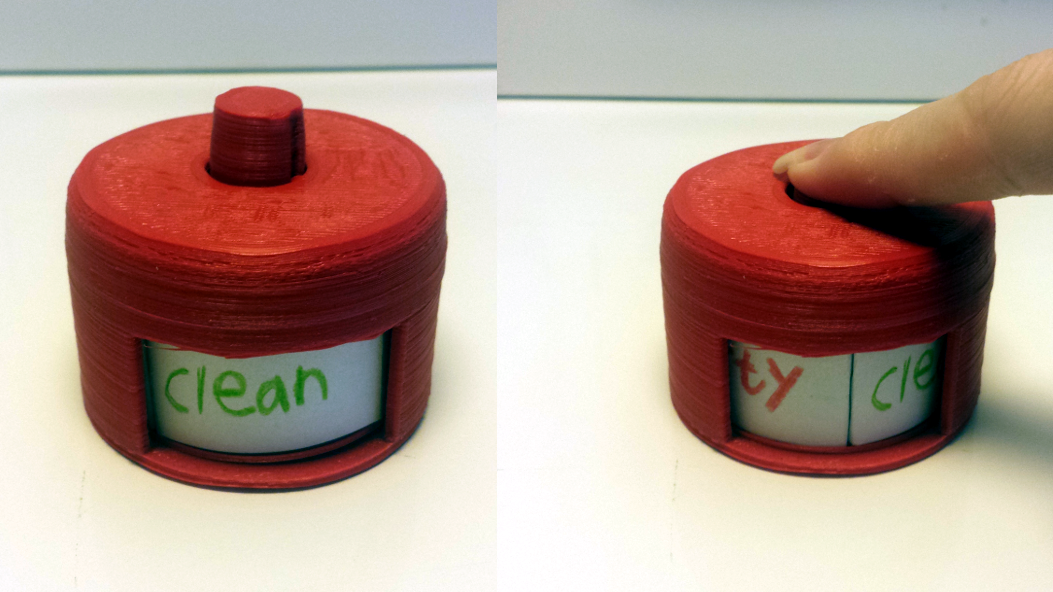

The best little inventions are usually the ones that make you say, “Wait, why is that so satisfying?” The Clicky Signspinner is exactly that kind of object. At first glance, it sounds like a novelty desk toy or something a bored office worker invented between meetings. In reality, it is a clever 3D-printed rotating sign that works much like a retractable pen: press the plunger, hear the click, and the display rotates to the next position.
Originally made as a clean/dirty dishwasher indicator, the Clicky Signspinner uses a compact mechanical system to turn a circular label by one-quarter of a rotation with each press. Instead of sliding a magnet, flipping a card, or shouting across the kitchen like a medieval town crier, you simply click the button. Clean becomes dirty. Dirty becomes clean. Household confusion drops by roughly 87%, according to the very scientific measurement known as “fewer people yelling, ‘Are these dishes done?’”
But the charm of this gadget goes beyond kitchen organization. The real magic is the mechanism. It borrows from the same basic idea that powers the retractable ballpoint pen: a spring-loaded, cam-guided, click-to-index system that turns a simple push into a controlled change of state. That sounds fancy, but the idea is beautifully simple. Push down, something rotates, a spring resets the motion, and the device locks into its next position.
What Is the Clicky Signspinner?
The Clicky Signspinner is a small mechanical indicator designed to display different labels through a window. In its most common use, it shows whether a dishwasher contains clean dishes or dirty dishes. The user presses a plunger, and the sign inside rotates to the next label.
Unlike a basic two-sided magnet, the Signspinner has four possible label positions. Even if the dishwasher version only needs two words, the mechanism can support more states. That makes it useful for other everyday indicators such as “fed/not fed” for pets, “open/closed” for small workspaces, “ready/not ready” for equipment, or “coffee/tea/emergency chocolate” for highly advanced office environments.
How It Works Like a Retractable Pen
A retractable pen feels simple from the outside. You press the top button, the writing tip comes out. Press it again, the tip disappears. Inside, however, several parts cooperate: a spring, a plunger, a cam, a follower, and locking surfaces. The pen does not merely move up and down; it also rotates slightly inside the barrel so it can stop in one of two stable positions.
The Clicky Signspinner uses a related concept. Every press of the plunger advances the internal label wheel by a fixed amount. The mechanism converts a straight downward push into a short rotational movement. Once the click is complete, the sign rests in its next indexed position. The result feels familiar because your fingers already know the rhythm from every click pen you have ever nervously abused during a math test.
The Basic Motion
Here is the simplified sequence:
- The user presses the plunger.
- The internal mechanism moves downward under pressure.
- Cam-shaped surfaces guide the rotating part into the next position.
- The spring stores energy during the press.
- When released, the spring pushes the mechanism back while the label remains indexed.
- The visible sign now shows the next label.
That is the beauty of mechanical indexing. The input is messy human behaviorsomeone poking a button with a finger while holding a plate. The output is precise: a quarter-turn rotation and a clear status display.
Why a Dishwasher Indicator Needs This Much Engineering
At first, a dishwasher sign may seem unnecessary. After all, can’t you just open the dishwasher and look? Technically yes. You can also walk to the library every time you forget a word, but we invented search engines for a reason.
Dishwashers create a common household problem because different people interact with them at different times. One person starts the cycle, another comes home later, and a third person opens the door just long enough to grab a fork. Suddenly, no one knows whether the dishes are clean, dirty, half-clean, suspiciously wet, or part of a social experiment.
A clicky dishwasher sign solves that problem with a simple rule: update the sign when the state changes. If it says “dirty,” add dishes. If it says “clean,” unload them before adding more. The mechanism does not wash anything, dry anything, or shame anyone into emptying the top rack. But it makes the correct action obvious.
Why the Click Feels So Good
The most underrated feature of the Clicky Signspinner is the tactile feedback. A sliding magnet tells you something. A clicky mechanism tells your hand something. That tiny snap confirms that the action happened. It is the mechanical equivalent of a checkmark.
Good product design often relies on feedback. Door latches click. Light switches snap. Keyboards tap. Car buttons resist just enough to feel intentional. The Clicky Signspinner benefits from the same principle. It does not merely change the sign; it makes the change feel complete.
That satisfying click also encourages use. A dishwasher sign only works if people actually update it. If the action feels boring, people forget. If it feels oddly fun, people are more likely to press the button. This is where the Signspinner quietly outsmarts a plain magnet. It turns a tiny chore into a tiny reward.
The Role of 3D Printing
The Clicky Signspinner is especially interesting because it can be made with 3D printing. Desktop 3D printers are excellent for small, functional household tools, especially when the goal is not mass production but practical customization.
For a project like this, 3D printing offers several advantages:
- Custom labels: The sign can be adapted for different words, icons, or household systems.
- Small-batch manufacturing: One person can design and print a device without needing injection molds.
- Iteration: If a part sticks, slips, or feels too loose, the design can be adjusted and printed again.
- Material choice: Different plastics can be used for the body, spring, or moving parts.
In the original spirit of the design, the body can be printed from a common material like PLA, while the spring benefits from a tougher or more flexible material such as PETG. That material split makes sense. PLA is easy to print and holds shape well, but it can be brittle under repeated compression. PETG is generally tougher and better suited for parts that need a bit of flex and resilience.
PLA, PETG, and the Printed Spring Problem
A printed spring is a bold little creature. It lives a stressful life. It gets compressed again and again, and everyone expects it to bounce back without complaining. That is why material choice matters.
PLA for the Body
PLA is popular because it prints easily, produces clean details, and works well for rigid parts. For the Signspinner’s housing, label wheel, and structural components, PLA can be a practical choice. It is stiff enough to hold the form and accurate enough for small printed features.
PETG for the Spring
PETG is often preferred for functional parts that need more toughness. A printed spring must survive repeated compression, and PETG’s flexibility gives it an advantage over PLA in that role. The spring does not need to behave like a metal coil, but it does need to store and release energy reliably.
ABS as an Alternative
ABS may also work for certain mechanical parts because it has better heat resistance and durability than PLA in many applications. However, ABS is more demanding to print. It can warp, smell unpleasant during printing, and often benefits from an enclosed printer. For many hobbyists, PETG is the friendlier compromise.
Design Lessons From the Clicky Signspinner
The Clicky Signspinner is small, but it teaches big lessons about design. The best gadgets do not always need electronics, apps, batteries, or a cloud account that emails you three times a week. Sometimes, a spring and a clever cam are enough.
1. Mechanical Simplicity Can Be Powerful
The device solves a communication problem with a purely mechanical action. There is no screen, no charging cable, and no setup wizard asking for your Wi-Fi password. The Signspinner is ready when your finger is.
2. Feedback Improves Behavior
The click makes the action memorable. That matters because the main failure point in any household indicator is not the object. It is the human. We forget. We rush. We pretend we did not see the clean dishes. A satisfying click nudges people to participate.
3. Multi-State Indicators Are Underrated
Because the internal label can rotate through four positions, the Signspinner can do more than show clean or dirty. It could show “empty,” “running,” “clean,” and “dirty.” It could track chores, feeding schedules, tool status, or shared office equipment. A four-state sign has more potential than a simple flip label.
4. Good Design Makes Boring Tasks Less Boring
Most people do not dream about dishwasher management. If they do, they probably need a vacation. Yet the Clicky Signspinner makes the task slightly more enjoyable. That is a real design win.
Practical Uses Beyond the Dishwasher
Although the dishwasher is the most obvious use case, the Clicky Signspinner concept can be applied anywhere a small, visible status indicator helps people avoid confusion.
- Pet feeding: Show whether the cat or dog has already been fed.
- Laundry: Mark a washer or dryer as “available,” “running,” “done,” or “claimed.”
- Office rooms: Display “free,” “busy,” “recording,” or “do not disturb.”
- Workshop tools: Indicate whether a tool is ready, cooling, charging, or needs maintenance.
- Classroom stations: Help students know whether supplies are ready, used, missing, or waiting for reset.
- Home routines: Track medication reminders, plant watering, trash day, or coffee status.
The key is not the word “dishwasher.” The key is state tracking. Any situation with multiple users and a changing condition can benefit from a clear indicator.
What Makes It SEO-Worthy and Shareable?
From a content perspective, the Clicky Signspinner has all the ingredients of a shareable maker story. It is visual, simple to understand, and powered by a mechanism people already know. The retractable pen comparison is especially strong because it gives readers an instant mental model.
That is why phrases like Clicky Signspinner, retractable pen mechanism, 3D printed dishwasher indicator, clean dirty dishwasher sign, and clicky rotating sign fit naturally into the topic. They describe the object, the mechanism, and the use case without forcing awkward keyword repetition.
For readers interested in 3D printing, the project is a functional print. For readers interested in engineering, it is a miniature cam mechanism. For household organization fans, it is a clean/dirty sign with personality. For people who click pens until everyone in the room develops a twitch, it is basically a new career path.
Things to Consider Before Making One
If you plan to print or design a similar clicky sign, a few details matter. Small mechanical parts need careful tolerances. If the gaps are too tight, the mechanism may bind. If they are too loose, the label may wobble or fail to land neatly in position.
The spring also needs attention. A printed spring is not as forgiving as a metal one. It may weaken over time, especially if the material is not suited for repeated flexing. Printing orientation, layer adhesion, infill, and wall thickness all affect performance.
Label readability matters too. A sign is only useful if people can read it quickly. High contrast, large lettering, and clear orientation help. If the sign is placed on a dishwasher, it should also attach securely without scratching the appliance. Magnets, adhesive pads, or removable mounting tape may work depending on the surface.
Experience Section: Living With a Clicky Signspinner Concept
Imagine this very normal domestic scene: someone opens the dishwasher, sees sparkling plates, grabs one spoon, closes the door, and walks away with the confidence of a person who has created no future problems. Ten minutes later, someone else arrives with a bowl covered in oatmeal cement and tosses it inside because the dishwasher “looked available.” Congratulations, the clean load has entered its villain era.
A Clicky Signspinner changes that moment. Instead of relying on memory, guesswork, or the ancient art of sniffing steam, the sign gives a clear answer. The best part is that using it feels less like updating a chore chart and more like clicking a giant pen with a purpose. That tactile moment is surprisingly important. It makes the action feel official, like stamping a passport for dishes.
In a shared home, the experience becomes even more useful. One person may run the dishwasher before leaving for work. Another may come home later and wonder whether the plates are ready. A child may want to help but not know whether to unload or add dishes. The sign quietly speaks for everyone. No group chat. No sticky note. No kitchen detective work.
There is also something delightful about using a mechanical object for a modern household problem. So many small problems now get “solved” with apps, sensors, and notifications. The Clicky Signspinner goes the opposite direction. It says, “Relax. We can handle this with a spring.” That simplicity feels refreshing. It is low-tech, reliable, and visible at a glance.
In a workshop or office, the same experience applies. A clicky rotating indicator can show whether a 3D printer is available, whether a meeting room is occupied, or whether a tool battery is charged. The user does not need to explain anything. Press the plunger, change the status, move on with life. It is the kind of tiny system that reduces friction without demanding attention.
The Clicky Signspinner also makes people curious. Visitors may ask what it is. Someone will press it just to feel the click. Someone else will immediately suggest a ridiculous use case, such as tracking whether the office plant has been emotionally supported today. That playful quality matters. Objects that invite interaction are more likely to be used, remembered, and shared.
The biggest experience lesson is this: a small mechanism can improve a routine when it is clear, satisfying, and easy to operate. The Clicky Signspinner does not need to be revolutionary. It simply makes one everyday action more obvious and more enjoyable. And sometimes, that is exactly what good design should do.
Conclusion
The Clicky Signspinner is a perfect example of clever mechanical design hiding inside a humble household tool. By using a retractable-pen-style mechanism, it turns a simple button press into a rotating status display. It is practical enough to prevent dishwasher confusion, fun enough to invite repeated clicks, and flexible enough to inspire other uses around the home, office, classroom, or workshop.
Its appeal comes from the combination of function and feeling. The sign communicates clearly, while the click gives satisfying confirmation. Add 3D printing to the mix, and the result is a customizable, low-tech, high-charm gadget that proves small inventions do not need to be complicated to be brilliant.
In short, the Clicky Signspinner works like a retractable pen, behaves like a tiny mechanical traffic light, and solves the kind of household confusion that has haunted kitchens since the first person asked, “Wait, are these clean?”
Note: This article is written in original American English for web publishing and is based on synthesized information from real maker, engineering, 3D-printing, and product-design references without inserting source links into the article body.


