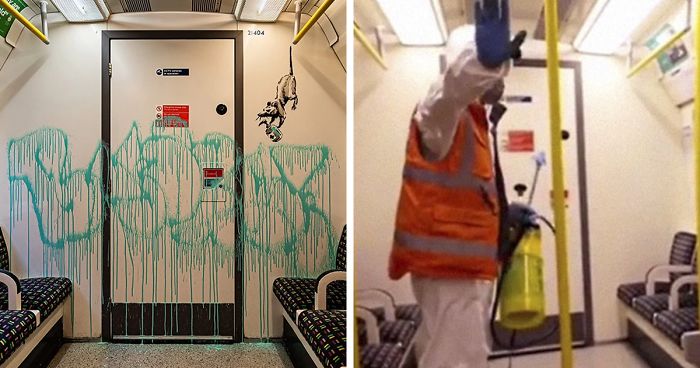

Banksy transformed a London Underground carriage into a traveling pandemic cartoon filled with masked rats, airborne sneezes, and hand sanitizer. The artwork carried a serious public-health message, but Transport for London cleaned it away before realizing who had created itadding one final, wonderfully Banksy-like layer of irony.
A Public-Health Announcement With Whiskers
During the summer of 2020, public transportation had become one of the strangest stages of pandemic life. Trains were quieter, commuters were cautious, and a forgotten cough could make an entire carriage stare in synchronized horror. Into that tense environment stepped Banksy, the famously anonymous British street artist, armed with stencils, spray paint, and a group of unruly rats.
In mid-July, Banksy released a short video showing a person believed to be the artist entering the London Underground disguised as a member of the cleaning staff. Wearing protective coveralls, goggles, gloves, a face covering, and an orange safety vest, the figure looked official enough to avoid attracting much attention. He carried equipment onto a Circle Line train and began decorating the inside of the carriage with Banksy’s familiar rodent characters.
The resulting installation was titled or captioned If You Don’t MaskYou Don’t Get, a cheeky variation on the phrase “If you don’t ask, you don’t get.” It was simple, memorable, and considerably more entertaining than a laminated safety notice telling passengers not to lick the handrails.
Although Banksy’s London Underground artwork lasted only briefly, it became one of the most widely discussed examples of COVID-19 street art. It combined public-health messaging, performance, humor, political commentary, and an almost perfectly timed bureaucratic punchline.
What Banksy Painted Inside the London Underground
The installation featured several stenciled rats behaving like miniature pandemic-era Londoners. One rat sneezed dramatically across a train window, releasing a trail of pale blue spray. Another appeared to struggle with a face covering. A third used a mask like a parachute, while another handled a bottle of hand sanitizer.
The rats were not exactly models of calm, responsible citizenship. They were messy, energetic, and slightly ridiculouswhich was precisely why they worked. Banksy did not create a solemn medical poster. He turned the pandemic into a slapstick rodent emergency.
The Sneeze That Traveled Across a Window
The most striking image showed an unmasked rat sneezing a stream of blue droplets. The paint stretched across the train window, making an invisible transmission risk suddenly visible. Anyone who had spent the previous months learning about respiratory droplets did not need an art-history degree to understand the joke.
At the time, scientific and public-health guidance increasingly emphasized that masks could help reduce the release and inhalation of infectious respiratory particles. Research later summarized by the CDC and scientific reviews supported masking as a form of source control, particularly in crowded indoor settings where people share air for extended periods.
Banksy converted that technical explanation into one unforgettable image: a rat sneezes, and suddenly half the train appears to be inside the splash zone.
Masks as Protection, Burden, and Playground
The face coverings in the artwork served several purposes. They represented protection, but the rats also turned them into props. One wore a mask, another became tangled in one, and another used one as a parachute. This made the imagery playful without weakening the message.
The visual comedy reflected how unfamiliar masks still felt to many people in 2020. They fogged glasses, slipped below noses, tangled with headphones, and occasionally launched themselves from pockets along with loose coins and old receipts. Banksy acknowledged the awkwardness while still making the central instruction clear: wear one.
A Soundtrack With a Lockdown Twist
The video used Chumbawamba’s “Tubthumping” and concluded with the altered line, “I get lockdown, but I get up again.” The wordplay connected a familiar pop chorus to the stop-and-start rhythm of pandemic restrictions. It also gave the piece a note of optimism. Lockdown could interrupt daily life, but it did not have to define the future.
The pairing of graffiti, music, disguise, and edited video demonstrated that the project was more than a few quick stencils. It was a carefully staged piece of performance art designed for social media. The train carriage was the physical canvas, but the video was the version intended to travel around the world.
Why Banksy Chose the London Underground
The setting was essential to the message. A mask mural painted on an isolated wall could encourage responsible behavior, but placing it inside a subway carriage transformed the artwork into a direct intervention.
Public transportation presented an obvious pandemic concern. Passengers shared enclosed spaces, touched common surfaces, moved through crowded stations, and sometimes spent long periods sitting or standing near strangers. The Tube therefore became both the subject of the warning and the place where that warning mattered most.
Face coverings had become mandatory on public transportation in England on June 15, 2020, roughly a month before Banksy revealed the installation. The official rule applied to trains, buses, and the Underground, with exceptions for certain young children and people with relevant health conditions or disabilities.
By painting directly inside a train, Banksy turned a government requirement into a visual story. Instead of another official announcement, passengers saw mischievous rats dramatizing the consequences of careless behavior.
The Underground also suited Banksy’s artistic identity. It was public, heavily regulated, visually recognizable, and protected by strict rules. In other words, it was almost begging to be temporarily invaded by a man with a stencil.
Why Rats Keep Appearing in Banksy’s Art
Rats have long been central characters in Banksy’s work. They live beneath cities, move through overlooked spaces, survive hostile environments, and are frequently treated as unwanted intruders. Those qualities make them natural symbols for rebellion, marginalization, and persistence.
They also offer an obvious linguistic joke. “Rat” is an anagram of “art,” a connection that fits an artist who enjoys turning language inside out. Banksy’s rats may be small, but they rarely behave as though they are powerless. They paint walls, organize, protest, play, and disrupt the clean surfaces designed to exclude them.
The pandemic gave the animals another layer of meaning. Rats have historically been associated with disease, whether fairly or not. Placing them inside a modern transportation network allowed Banksy to reference public fear without creating a grim or literal scene of human suffering.
The rodents had already appeared in another Banksy lockdown project. In April 2020, the artist shared images of rats causing chaos in what appeared to be his bathroom. They squeezed toothpaste, unrolled toilet paper, marked the days of confinement, and generally behaved like roommates who had misunderstood the security deposit.
The London Underground piece took those restless lockdown rats out of the bathroom and released them into the city.
Transport for London Removed the Artwork
The installation had one major problem: Transport for London maintains a strict anti-graffiti policy. Cleaners removed the images from the carriage before the organization realized that the mysterious person with the spray equipment had been Banksy.
Transport officials explained that the work had been treated like other graffiti. Reports indicated that the cleaning team did not know the identity of its creator when the carriage was cleaned. From an operational perspective, the response was routine. From an art-world perspective, it was roughly equivalent to using a priceless sketch as a napkin because nobody had checked the signature.
The removal created an irresistible paradox. The transportation authority erased an artwork encouraging passengers to follow transportation rules because the artwork itself violated transportation rules.
TfL’s decision was not presented as opposition to the pro-mask message. The organization publicly supported face coverings and pandemic safety measures. The issue was unauthorized paint inside an operational train, where graffiti could not simply be preserved whenever it looked important.
That distinction matters. Calling the removal censorship would oversimplify what happened. Banksy created art in a system built to remove unauthorized markings quickly. The possibility of erasure was not an unfortunate surprise; it was part of the risk and arguably part of the point.
Did Cleaning It Away Make the Banksy Message Stronger?
For conventional artwork, destruction is usually the end of the story. For Banksy, destruction often becomes another chapter.
Once the Tube piece disappeared, news coverage multiplied. People debated whether TfL should have recognized it, whether unauthorized street art should receive special treatment when created by a celebrity, and whether the work belonged to the public, the artist, or the transportation authority.
The artwork’s physical life was short, but its digital life was enormous. Banksy’s video preserved the creative process, the finished rats, the music, and the slogan. Millions of people could experience the project without ever boarding the train.
This outcome reveals an important feature of modern street art: the original location may be temporary, while the documentation becomes permanent. A mural can be removed in minutes, yet photographs and videos can keep circulating for years.
In this case, the cleaning may even have sharpened the meaning. The erased artwork reflected the uncertainty of the pandemic itself. Rules changed, routines vanished, businesses closed, and familiar spaces were repeatedly transformed. Banksy created a public message that disappeared almost as quickly as normal life had.
Street Art, Vandalism, and the Celebrity Exception
The incident also raised an uncomfortable question: when does graffiti become valuable enough that officials should stop cleaning?
If an unknown teenager had painted rats inside the same train, few commentators would have demanded preservation. Banksy’s fame changed the reaction. The stencil was unauthorized before the artist claimed it, and unauthorized afterward, but its perceived cultural and financial value suddenly increased.
This celebrity exception illustrates one of the contradictions surrounding Banksy. His work challenges authority, private ownership, and the commercial art market. At the same time, authenticated Banksy pieces can become highly valuable objects. A mark that would normally trigger a cleaning crew may inspire protective glass, security cameras, and auction estimates once his name is attached.
Transport for London could not realistically ask cleaners to perform instant art authentication before wiping every tag. Its anti-graffiti rule had to be applied consistently. Yet the loss still felt painful because the work captured a unique moment in public life.
That tension is not a flaw in the story. It is the story. Banksy operates precisely where art, property, regulation, commerce, and public space collide.
Why the Mask Message Worked
Public-health campaigns often struggle to make familiar advice feel urgent. Repetition can cause audiences to tune out, especially when every store entrance, station platform, and television broadcast carries similar instructions.
Banksy avoided that problem by making the message funny. Humor lowered the audience’s defenses. The work did not lecture commuters or bury them beneath statistics. It asked them to watch badly behaved rats demonstrate why masks mattered.
The installation also used contrast effectively. Face coverings were associated with fear, illness, and restriction, but the artwork presented them through visual jokes and energetic characters. The tone was light enough to attract attention while the sneezing rat kept the underlying risk impossible to miss.
Most importantly, the message appeared in the environment where people had to make an immediate behavioral choice. A person viewing the video before entering a subway might check a pocket, pull up a mask, or reconsider boarding with an uncovered face. That proximity between message and action is one reason public art can sometimes communicate more effectively than a distant official campaign.
Experiencing Banksy’s Lockdown Art: Lessons Beyond the Train
Even people who never saw the original carriage could recognize the experience Banksy was depicting. Public transportation during lockdown was not merely a way to travel. It became a test of trust between strangers.
Every passenger had to make small decisions that affected other people: whether to wear a mask correctly, whether to create distance, whether to travel while feeling sick, and whether to treat transportation workers with patience. The Banksy rats turned those decisions into characters. The masked rat represented caution. The sneezing rat represented carelessness. The sanitizer-wielding rat represented the strange new rituals everyone was attempting to master.
The Experience of Finding Art Where an Advertisement Should Be
A subway carriage is normally filled with practical visual information: maps, warnings, advertisements, emergency instructions, and reminders to keep personal belongings nearby. Encountering unauthorized artwork in that setting changes the atmosphere immediately.
Instead of being treated only as a customer or passenger, the viewer becomes part of a cultural moment. The ordinary commute is interrupted. A familiar wall suddenly asks for interpretation.
Banksy understood the power of that interruption. A gallery visitor arrives prepared to examine art. A commuter does not. Reaching an unprepared audience can make an image more memorable because it enters daily life without an appointment.
The Experience of Watching Something Disappear
The removal also offers a lesson about impermanence. Viewers often assume meaningful art should be protected forever, but street art is shaped by weather, construction, cleaning, repainting, vandalism, and changing neighborhoods. Its temporary nature can make the encounter more intense.
Knowing that a piece might vanish encourages people to look carefully, photograph responsibly, discuss what they saw, and remember the surrounding place. The experience becomes less like owning an object and more like witnessing an event.
Banksy’s Tube artwork was especially suited to this temporary existence. A moving train is already an unstable exhibition space. It changes stations, passengers, lighting, and location throughout the day. The work did not belong to a fixed wall; it traveled until the cleaning crew brought the journey to an abrupt end.
The Experience of Conflicting Reactions
The incident allowed several reasonable reactions to exist at once. A viewer could admire the artwork and still understand why TfL removed it. A transportation worker could support the mask message while objecting to unauthorized spray paint. A street-art fan could regret the loss while recognizing that temporary intervention is part of Banksy’s method.
This complexity is useful. Public art does not always need to produce agreement. Sometimes its value lies in forcing people to discuss who controls shared spaces and whose messages deserve to remain visible.
The Experience of a Digital Afterlife
Finally, the project demonstrated how public art now lives in two places at once. The physical work existed inside one London train. The recorded performance existed on phones, websites, television screens, and social platforms around the world.
The majority of the audience experienced Banksy’s lockdown message as video rather than paint. That did not necessarily make the encounter less authentic. The disguise, the passengers, the moving carriage, and the eventual removal all became part of a story that no static mural could communicate alone.
For artists, the lesson is that documentation can be part of the artwork rather than an afterthought. For cities, the lesson is that removing a piece does not erase its influence. For viewers, the lesson is simpler: pay attention. The most interesting thing on the train may not remain there for long.
Conclusion: A Message That Survived Its Own Removal
Banksy’s London Underground lockdown art succeeded because it delivered a serious message without behaving like a serious announcement. Masked rats, airborne sneezes, sanitizer, music, disguise, and wordplay made public-health guidance feel immediate and culturally alive.
The artwork also captured the contradictions of 2020. People wanted freedom but needed collective responsibility. Public spaces were reopening while remaining heavily controlled. Art offered connection, yet its creation could violate the rules governing the very place it hoped to improve.
Transport for London removed the physical stencils, but the message continued traveling. The video circulated globally, the rats became part of the visual history of the pandemic, and the accidental cleaning gave the episode an ending no publicity team could have designed better.
Banksy entered the Underground dressed as someone responsible for removing graffiti, created graffiti encouraging responsible behavior, and then had it removed by the actual cleaners. As pandemic stories go, it was unusually neatand considerably funnier than another video conference with someone accidentally transformed into a potato.


