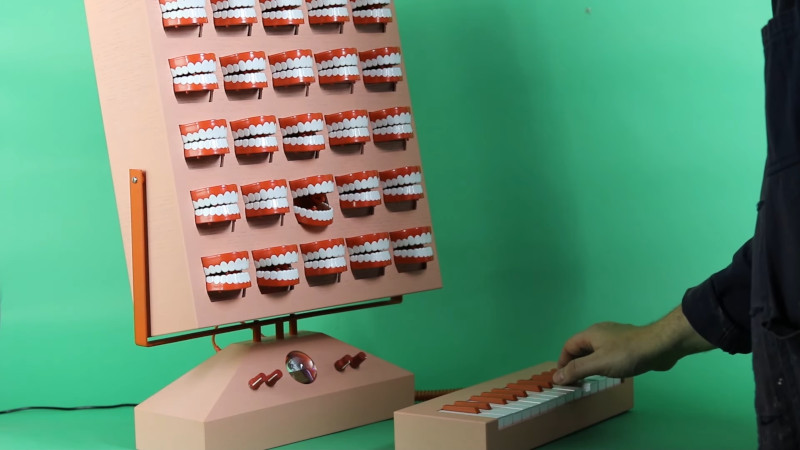

Meet the VOC-25: a pastel pink, teeth-clacking, voice-sampling instrument that looks like a retro computer got hired to haunt a dental office.
What Is a Pink Denture Synth, Exactly?
Every so often, an instrument appears that makes musicians, engineers, designers, and unsuspecting internet browsers say the same thing: “I’m sorry, what am I looking at?” The pink denture synth belongs proudly in that category. More specifically, it refers to the VOC-25, a conceptual vocal synthesizer created by Swedish audiovisual artist and designer Love Hultén.
The VOC-25 is not just a synthesizer with a strange paint job. It is a fully realized art object built around a 25-key keyboard, a sound engine based on the Axoloti Core, and a display packed with 25 sets of hinged plastic teeth. Each set of teeth represents a note. Press a key, and one small mouth opens. Press a chord, and congratulations: you have summoned a plastic dental choir.
That description may sound like a prank, but the VOC-25 is a serious piece of creative hardware. It combines vocal samples, MIDI control, solenoids, mechanical movement, built-in effects, and handmade enclosure design. It is part synthesizer, part kinetic sculpture, part retro-futurist desktop computer, and part object you should absolutely not leave running in a dark room unless you enjoy questioning your life choices.
The Artist Behind the Teeth: Love Hultén
Love Hultén is known for crafting objects that feel as if they escaped from a parallel timeline where arcade cabinets, synthesizers, computers, and luxury furniture evolved together. His work often blends woodcraft, electronics, retro computing, gaming nostalgia, and musical experimentation. The result is not simply “custom gear.” It is gear with a personality, a backstory, and usually a look that makes people hover over the share button.
The VOC-25 fits neatly into that design universe. Its three-part wooden setup resembles a vintage desktop computer: a keyboard section, a main console, and a monitor-like display. But instead of a screen full of pixels, the display is full of teeth. The pastel pink enclosure softens the horror just enough to make it charming. It is cute, creepy, and oddly elegantlike a 1950s appliance designed by someone who had just discovered experimental noise music.
Why the VOC-25 Feels So Memorable
Many synthesizers are visually impressive, but most still follow familiar shapes: knobs, keys, sliders, screens, patch cables, metal panels, wooden cheeks. The VOC-25 breaks the pattern. The teeth are not decorative stickers or a novelty grille. They are part of the performance. They move. They clack. They react to the player. In a world where so much music technology is hidden behind glass touchscreens, this instrument gives sound a facewell, technically 25 mouths.
How the VOC-25 Pink Denture Synth Works
Underneath the strange exterior is a practical signal chain. The VOC-25 uses the Axoloti Core, a compact audio platform designed for digital sound projects. Axoloti provides audio input and output, analog-to-digital and digital-to-analog conversion, MIDI connections, and a microcontroller capable of real-time audio processing. In simple terms: it is the brain that helps turn musical input into expressive output.
Players can feed raw vocal audio samples into the main console through USB. These samples form a personal voice bank, giving the instrument its vocal character. When the player presses keys on the 25-key keyboard, MIDI information is sent to the Axoloti-based system. That data does two things: it triggers the corresponding vocal sound and activates the mechanical mouth associated with that note.
The motion comes from solenoids. A solenoid is an electromagnetic actuator that can create fast, simple movement. In the VOC-25, each solenoid is connected to one hinged set of plastic teeth. Press a note, and the solenoid moves the teeth. The result is a tiny physical mouth opening in time with the sound. Add multiple notes, and the instrument becomes a synchronized choir of chattering dentures.
Built-In Effects and External Output
The VOC-25 includes built-in reverb and delay, two effects that make perfect sense for a vocal instrument. Reverb gives the sound space, making the teeth choir feel as though it is singing from inside a tiled bathroom, a cathedral, or possibly the waiting room of a very experimental orthodontist. Delay repeats the sound over time, which can turn short vocal phrases into rhythmic patterns.
The instrument can be used through its built-in speakers, but it also offers mono output on the back. External monitors help reduce the mechanical noise from the teeth and solenoids. That detail is important because the VOC-25 is both an electronic instrument and a mechanical object. The clatter is part of the experience, but if you want cleaner audio, external speakers are the civilized option. If you want maximum chaos, let the dentures chatter proudly.
Why Teeth Make the Instrument So Unsettling
Humans are wired to notice mouths. A mouth is expressive, social, musical, and occasionally full of lunch. When an object has a mouth-like movement, our brains immediately try to interpret it as alive. That is why the VOC-25 feels so strange. The teeth move like they are speaking or singing, but there is no face, no body, and no familiar performer behind them. The instrument sits somewhere between machine and character.
This is where the pink denture synth becomes more than a gadget. It taps into the uncanny valley: that weird psychological space where something is almost human, but not quite. A singing keyboard is normal. A sampler is normal. A robotic mouth is less normal. Twenty-five robotic mouths in a pastel wooden display? That is where normal puts on a tiny hat and runs out the emergency exit.
The Power of Mechanical Sound
One reason the VOC-25 works so well as an art piece is that it does not hide its mechanics. The opening teeth add visual rhythm. The solenoids add physical timing. The clacking gives the performance an acoustic layer that digital instruments often lack. Even if the samples are electronic, the movement makes the sound feel embodied.
This is similar to why people love mechanical keyboards, tape machines, modular synthesizers, and old drum machines. The little imperfections matter. A perfectly silent controller can feel sleek, but a machine that clicks, thumps, breathes, and misbehaves can feel alive. The VOC-25 takes that idea and gives it a dental plan.
The Inspiration: From Tooth-Clacking Concept to Vocal Synth
The VOC-25 was inspired by an earlier musical teeth concept from inventor and maker Simone Giertz. Her project explored the absurd but fascinating idea of building an instrument out of teeth. Hultén’s version expands that concept into a polished, highly designed, self-contained vocal synthesizer with a complete visual identity.
That relationship between rough concept and refined object is common in the maker world. One person has a wonderfully strange idea. Another person interprets it through a different skill set. The result is not a replacement for the original, but a continuation of the conversation. In this case, the conversation happens to involve plastic dentures opening and closing like a tiny choir that knows too much.
Conceptual Instruments Have a Long Tradition
The VOC-25 may look wildly new, but experimental instruments have always pushed beyond practical expectations. Artists and engineers have built instruments from circuits, toys, motors, game consoles, household objects, tape loops, radio signals, and physical mechanisms. The point is not always to create the most efficient tool. Sometimes the goal is to challenge what “instrument” means in the first place.
That makes the pink denture synth part of a larger tradition: musical machines that are memorable because they combine sound, motion, design, and humor. It is not trying to replace a professional workstation or a stage piano. It is trying to ask a better question: what happens when music looks back at you?
Vocal Synthesis, MIDI, and the Weird Beauty of Control
To understand why the VOC-25 is more than a visual joke, it helps to know a little about vocal synthesis. Electronic voice creation has a long history, from early speech synthesizers and vocoders to modern sample-based instruments, voice banks, plug-ins, and AI-assisted vocal tools. Musicians have always been fascinated by the idea of making machines sing.
The VOC-25 approaches that fascination in a physical, theatrical way. Rather than hiding the voice inside software, it gives each note a mouth. MIDI makes the coordination possible. MIDI is not audio; it is a communication system that lets instruments and devices exchange performance information. When a key is pressed, MIDI can transmit data such as note value, timing, and control changes. In the VOC-25, that performance information helps coordinate both sound and motion.
This is what makes the instrument clever. It does not simply play a sample when you press a key. It connects the note to a visible mechanism. The player is not just triggering audio; they are conducting a little mechanical choir. The teeth become a performance interface, a visualizer, and a punchline all at once.
Design Analysis: Why the Pink Color Matters
The pink enclosure is not just cute packaging. Color shapes the emotional effect of the instrument. A black metal VOC-25 might feel like horror-movie laboratory equipment. A chrome version might look like a cyberpunk dentist’s trophy. The pastel pink version feels stranger because it softens the object. It adds sweetness to something unsettling.
That contrast is the secret sauce. Pink suggests candy, toys, retro appliances, beauty products, and soft design. Plastic teeth suggest dentists, discomfort, and the deep human fear of things that should not be singing. Together, they create tension. The instrument is playful enough to invite curiosity, but eerie enough to be unforgettable.
The Retro Computer Shape Adds Another Layer
The three-part desktop computer form also matters. It gives the VOC-25 a familiar silhouette. You understand the keyboard. You understand the console. You understand the monitor-like display. Then your brain notices that the “monitor” has teeth. That slow reveal is part of the fun. It is not random weirdness; it is carefully staged weirdness.
Good design often depends on contrast: familiar and unfamiliar, soft and sharp, funny and frightening, functional and absurd. The VOC-25 balances those opposites with surprising discipline. It is not messy. It is not overloaded. It is clean, intentional, and deeply odd.
Could a Pink Denture Synth Be Used in Real Music?
Absolutely, though probably not in every genre. The VOC-25 would be right at home in experimental pop, dark cabaret, art rock, film scoring, theater sound design, Halloween performances, avant-garde installations, and any music video that needs one unforgettable visual hook. Imagine it in a track built around whispery vocal samples, slow minor chords, and a drum machine that sounds like it lives in a basement. Perfect.
It could also work as a live performance centerpiece. Many electronic musicians struggle with the problem of stage presence. Turning knobs can be musically complex, but from the audience’s perspective it may look like someone adjusting a complicated microwave. The VOC-25 solves that instantly. Press a key, and the teeth move. The crowd understands that something is happening.
For producers, the instrument also suggests a useful creative lesson: sound design is not only about tone. It is about context. A vocal sample played from a laptop might sound ordinary. The same sample triggered by a row of chattering teeth becomes a scene. It gains humor, unease, and theatrical identity.
Specific Examples of Creative Uses
1. A Haunted Choir Intro
Load soft vowel samples into the VOC-25, add reverb, and play slow chords. The result could introduce a track with a ghostly choir effect. The teeth movement would make the performance visually surreal, especially under dim lighting.
2. A Comedy Music Video
The instrument is naturally funny because it takes the idea of “vocal performance” far too literally. A songwriter could use it for a chorus where the backing vocals appear to be sung by dentures. It is the rare instrument that comes with its own visual joke.
3. A Museum or Gallery Installation
Because the VOC-25 is as much sculpture as instrument, it would make sense in a design exhibition. Visitors could see how MIDI, sampling, solenoids, and physical form interact. It teaches technology through surprise, which is usually more effective than a wall label written in academic fog.
4. A Sound Design Tool for Film
Mechanical chatter plus processed vocal tones could fit animated horror, surreal comedy, or experimental cinema. Even if the final soundtrack did not use the raw output, the instrument could inspire textures that are hard to imagine with a normal controller.
Why the Internet Loves Weird Synths
The pink denture synth became memorable because it checks several internet-friendly boxes without feeling disposable. It is instantly understandable in one image. It has a strong title. It combines two things that normally do not belong together. It is funny, but it is also well made. Most importantly, it rewards a second look.
Weird synths succeed online when they are not merely weird. They need craft. A messy gadget can be amusing for a minute. A beautifully built strange instrument keeps people talking because it creates a stronger reaction: admiration mixed with confusion. The VOC-25 does exactly that. You laugh first. Then you notice the woodwork, the signal flow, the sample system, and the careful layout. Then you laugh again because the keyboard still has teeth.
Experience Notes: Living With the Idea of a Pink Denture Synth
Spend enough time thinking about the VOC-25, and a funny thing happens: it stops feeling like a joke and starts feeling like a reminder of what creative technology can be. Most people interact with electronics as sealed rectangles. Phones, laptops, tablets, streaming boxes, smart speakerssmooth objects that hide nearly everything. The pink denture synth goes in the opposite direction. It makes the machine visible, theatrical, and a little ridiculous.
That is a valuable experience for anyone who makes music, writes about technology, builds DIY projects, or simply enjoys creative tools. The VOC-25 suggests that the interface can be part of the art. A keyboard does not have to be just a row of keys. A sampler does not have to be just pads and a screen. A vocal synth does not have to pretend to be invisible. It can have a body, a gesture, and a sense of humor.
Imagine sitting in a small studio with the VOC-25 on a desk. At first, you would probably play it like a novelty. One note. One tooth opens. You laugh. Then you press two notes and hear a tiny choir. Then you try a chord with delay, and suddenly the instrument becomes less silly and more atmospheric. The mechanical clack adds timing. The teeth make the notes feel like characters. You begin composing around the object rather than merely using it.
That is often how unusual instruments earn their place. They force different decisions. A standard MIDI keyboard encourages familiar habits: chords, basslines, melodies, pads. A denture synth asks different questions. What kind of sample sounds best when a mouth opens? Should the teeth move on every note or only accents? Is the mechanical noise a flaw, or should it become part of the rhythm? Can a creepy object produce something beautiful? The answers may surprise you.
There is also a lesson here for content creators and designers. The VOC-25 is unforgettable because it has a clear concept. “A vocal synthesizer with 25 sets of plastic teeth” is simple enough for anyone to understand and strange enough for everyone to remember. That combination is rare. Many creative projects fail because they are either too ordinary or too complicated to explain. The pink denture synth is neither. It is weird with discipline.
As an experience, the VOC-25 sits somewhere between performance, comedy, engineering, and sculpture. It proves that musical tools can be playful without being shallow. It shows that hardware can tell a story before a single note is played. And it reminds us that the best experimental instruments do not merely ask, “What sound can I make?” They ask, “What feeling can I create before the sound even begins?”
That may be the real charm of the pink denture synth. It is not just a machine that plays vocal samples. It is a tiny stage. The keys are the script, the teeth are the actors, the solenoids are the stagehands, and the player is the slightly concerned director. The result is funny, unsettling, and genuinely inspiring. In a world full of polished tools chasing perfection, the VOC-25 proudly chooses personality. And yes, it has plenty of bite.
Conclusion: The Pink Denture Synth Is Strange for All the Right Reasons
The VOC-25 proves that experimental instrument design still has plenty of room for surprise. It combines real audio technology with handmade visual storytelling, turning vocal samples into a mechanical performance. Its Axoloti-based sound system, MIDI keyboard, solenoid-driven teeth, built-in effects, and retro wooden enclosure all work together to create something that is not merely playable, but unforgettable.
Calling it a pink denture synth sounds like a punchline, and honestly, it is a very good punchline. But beneath the joke is a thoughtful design object that explores how sound, motion, and human perception overlap. The VOC-25 is creepy, charming, funny, functional, and oddly elegant. It reminds us that music technology does not always have to chase clean minimalism. Sometimes it can grin at you with 25 sets of plastic teeth.


