
Eczema has a talent for making simple things complicated. A harmless-looking sweater becomes sandpaper, a warm shower becomes an itch festival, and a new skin cream can turn into an expensive lesson in contact dermatitis. It is no surprise that many people search for gentler options, including turmeric for eczema.
Turmeric contains curcumin, a plant compound studied for anti-inflammatory and antioxidant effects. Those properties sound promising because eczemaespecially atopic dermatitisinvolves inflammation, itching, dryness, and a weakened skin barrier. However, promising chemistry is not the same as a proven eczema treatment. Human research remains limited, and the small studies available often used turmeric alongside several other ingredients.
This guide explains what turmeric may do, what the evidence does not yet prove, how topical and oral products differ, and how to experiment without turning your bathroom, towels, and elbows bright yellow.
What Is Eczema?
Eczema is a group of inflammatory skin conditions that can cause dryness, redness or discoloration, scaling, cracking, swelling, and intense itching. Atopic dermatitis is the most common form. It is chronic, meaning symptoms may improve for a while and then return during a flare.
The condition is associated with problems in the skin barrier and an overactive inflammatory response. When the barrier does not work properly, moisture escapes more easily and irritants, allergens, and microbes can enter more readily. This is why standard eczema care focuses on restoring moisture, avoiding triggers, controlling inflammation, and treating infections when they occur.
Common eczema triggers
Triggers vary widely. Common examples include fragrances, harsh soaps, detergents, sweat, wool, dry weather, heat, stress, and irritating skin-care products. Turmeric itself can become a trigger for some people, particularly when it is mixed into a homemade paste containing essential oils, citrus juice, fragrance, or other aggressive ingredients.
Why Is Turmeric Considered a Possible Eczema Remedy?
Turmeric comes from the rhizome of Curcuma longa, a plant related to ginger. Its golden color is largely associated with curcuminoids, including curcumin. Laboratory and animal research suggests that curcumin can influence inflammatory pathways and oxidative processes involved in several skin disorders.
Potential anti-inflammatory activity
Eczema inflammation involves chemical messengers that keep the immune system activated. Curcumin has been studied for its ability to affect some of these signals. In theory, reducing excessive inflammatory activity could help calm redness, swelling, or itch.
The important phrase is in theory. Many positive results come from laboratory experiments rather than large, well-controlled studies involving people with eczema. Curcumin also has poor natural absorption, so an effect seen in a test tube may not occur when someone eats turmeric or spreads kitchen spice on the skin.
Antioxidant properties
Oxidative stress may contribute to inflammation and skin-barrier damage. Curcumin can act as an antioxidant under certain experimental conditions, which has led researchers to explore it for inflammatory and dermatologic conditions. This mechanism is scientifically interesting, but it does not establish that turmeric powder can clear an eczema flare.
Possible antimicrobial effects
People with atopic dermatitis have an increased risk of bacterial, viral, and fungal skin infections, particularly when scratching creates cracks or open areas. Laboratory research has reported antimicrobial activity for curcumin, but turmeric should not be used as a substitute for an antibiotic, antiviral medication, or medical examination when infection is suspected.
Does Turmeric Actually Help Eczema?
At present, there is not enough high-quality clinical evidence to recommend turmeric as a primary eczema treatment. The National Eczema Association has noted that only a small number of human eczema studies have examined turmeric-containing topical products. Although improvements were reported, the formulations included other herbal ingredients, and some studies lacked a placebo group or other strong controls. That makes it impossible to know how much benefit came from turmeric itself.
One older study followed people using a multi-herbal cream that contained turmeric. Participants reported improvements in symptoms such as scaling and itching after several weeks. However, because the product was not turmeric alone and the study design had substantial limitations, the results should be viewed as preliminary rather than conclusive.
Reviews of turmeric for skin health have found encouraging signals across conditions such as psoriasis, itching, photoaging, and atopic dermatitis. Researchers repeatedly reach the same sensible conclusion: curcumin is interesting, but larger randomized trials are necessary before clinicians can determine the right formulation, concentration, dose, treatment period, and long-term safety.
The practical verdict
Turmeric may eventually become a useful ingredient in specially formulated dermatologic products. For now, it is best considered an optional complementary ingredientnot a cure, not an emergency treatment, and not a replacement for moisturizers or prescribed eczema medication.
Possible Benefits of Turmeric for Eczema
Based on its biological properties and early research, a properly formulated topical turmeric product might offer several potential benefits:
- Temporarily calming the appearance of mild inflammation
- Reducing sensations of itch or irritation in some users
- Supporting antioxidant activity in the skin
- Complementing a moisturizing skin-care routine
- Providing a plant-derived ingredient for people who prefer botanical products
These are possibilities, not guarantees. A turmeric cream may feel soothing because its base contains glycerin, petrolatum, ceramides, or plant oilsnot necessarily because of the turmeric extract. Reading the complete ingredient list matters more than admiring the golden packaging.
How to Use Turmeric for Eczema Safely
Choose a formulated topical product
A professionally manufactured cream, balm, or gel is generally a more predictable choice than a homemade turmeric mask. Formulated products can distribute an ingredient evenly, control its concentration, and combine it with a suitable moisturizing base.
Look for fragrance-free products with short ingredient lists. Avoid formulas containing perfume, citrus oils, menthol, strong exfoliating acids, or large numbers of botanical extracts. A label that says “natural” does not mean the product is hypoallergenic, gentle, or clinically effective.
Patch-test before wider use
Apply the product to a small, unaffected area rather than covering an active rash immediately. The American Academy of Dermatology recommends testing a new skin-care product on a small spot twice daily for seven to 10 days. Stop if the area becomes itchy, swollen, painful, blistered, or more inflamed.
A quick 20-minute patch test may catch an immediate reaction, but it can miss delayed contact dermatitis. Patience is less exciting than a viral skin-care hack, but considerably more comfortable.
Do not apply it to broken or infected skin
Avoid turmeric products on bleeding, weeping, blistered, or crusted areas unless a clinician has specifically recommended the product. Broken skin is more vulnerable to irritation and contamination. Seek medical care for rapidly spreading redness, increasing warmth, pus, severe pain, fever, honey-colored crusts, or groups of painful blisters.
Keep the rest of the routine simple
Introduce one new product at a time. Continue using a gentle cleanser and a thick fragrance-free moisturizer unless your clinician advises otherwise. If five new remedies are started on Monday and the rash explodes on Wednesday, identifying the offender becomes dermatologic detective work.
Should You Make a DIY Turmeric Paste?
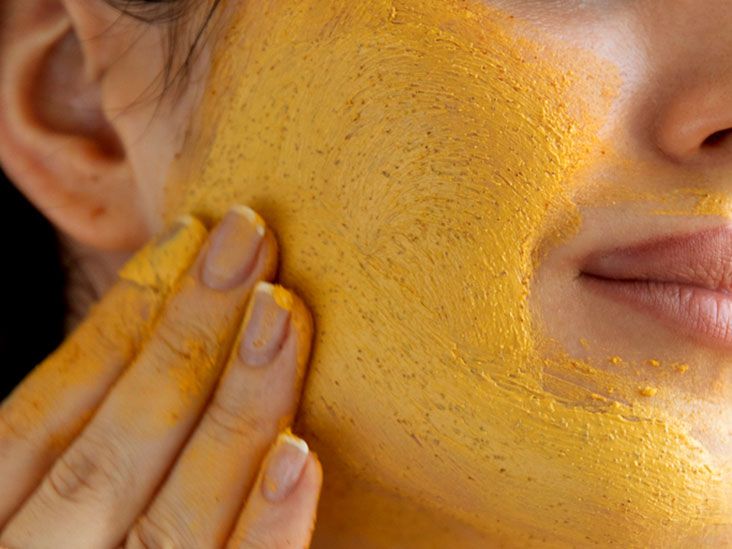
Mixing turmeric powder with water may look harmless, but raw kitchen spice is not designed as a sterile or standardized medicine. The concentration varies, it does not penetrate the skin predictably, and the gritty texture may aggravate sensitive areas.
Popular recipes sometimes combine turmeric with lemon juice, baking soda, apple cider vinegar, essential oils, honey, or yogurt. Several of these ingredients can sting, alter the skin’s normal acidity, cause allergic reactions, or worsen an already damaged barrier. Food ingredients are excellent at being food. They are not automatically qualified for a second career in dermatology.
Turmeric also stains skin, fingernails, counters, clothing, and bedding. The discoloration is usually temporary on skin, but your favorite white towel may begin a permanent new life as a mustard-yellow towel.
What About Turmeric Supplements?
Taking turmeric or concentrated curcumin by mouth is different from using turmeric as a cooking spice. Food-level amounts are generally smaller, while supplements may contain concentrated extracts or ingredients designed to increase absorption.
No standard oral turmeric dose has been established for treating eczema. The National Center for Complementary and Integrative Health states that there is not enough evidence to make definite conclusions about turmeric for most health conditions. Oral products can cause nausea, reflux, stomach discomfort, vomiting, diarrhea, or constipation. Topical curcumin may cause itching or hives.
Liver-related concerns
Cases of liver injury have been reported in some people using curcumin products designed for enhanced absorption. Stop taking the supplement and seek medical advice if you develop dark urine, yellow skin or eyes, unusual fatigue, nausea, or loss of appetite.
Medication and surgery concerns
Supplements can interact with medicines, affect laboratory tests, or create problems around surgery. Speak with a physician or pharmacist before taking concentrated turmeric if you use prescription drugs, take multiple supplements, have liver or gallbladder disease, have a bleeding disorder, or are preparing for a procedure.
Turmeric supplements should not replace prescription eczema medication. The FDA does not approve dietary supplements for safety and effectiveness before they reach the market in the same way it approves medications. Manufacturers are responsible for product safety and labeling, while much of the FDA’s oversight occurs after products are being sold.
Pregnancy, breastfeeding, and children
Turmeric used as a normal culinary spice is not the same as a high-dose extract. Turmeric supplements may be unsafe during pregnancy, and there is limited information about supplemental amounts during breastfeeding. Parents should consult a pediatric clinician before giving curcumin supplements to a child or applying botanical products to infant eczema.
Proven Treatments Should Remain the Foundation
The most reliable eczema plan usually begins with regular moisturizing, gentle bathing, trigger management, and medication appropriate for the person’s age, rash location, and disease severity. Dermatologists may recommend topical corticosteroids, nonsteroidal prescription creams, wet-wrap therapy, phototherapy, injectable biologic medicines, or oral treatments.
Moisturizer is not merely cosmetic. Keeping eczema-prone skin hydrated helps reduce cracking and may lower the risk of worsening irritation or infection. Prescription anti-inflammatory treatment can then be used as directed to bring active flares under control.
Turmeric should sit beside these measures only when it is tolerated and approved by the person’s cliniciannot shove them off the table and declare itself king of the bathroom cabinet.
Who Should Be Especially Cautious?
Ask a healthcare professional before trying a turmeric skin product or supplement if you:
- Have severe, widespread, or rapidly worsening eczema
- Have open wounds, weeping skin, crusting, or suspected infection
- Have previously reacted to turmeric, ginger, spices, or botanical cosmetics
- Take prescription medicines or several dietary supplements
- Have liver, gallbladder, bleeding, or digestive problems
- Are pregnant, breastfeeding, or planning surgery
- Are considering turmeric for a baby or young child
A Practical Experience With Turmeric and Eczema
The following is a realistic composite scenario based on common product-use experiences. It is not a personal medical claim or proof that turmeric works.
Imagine someone with mild eczema on the hands who sees a turmeric mask online. The recipe looks charmingly simple: turmeric powder, lemon juice, and a splash of essential oil. Unfortunately, “simple” is not always a synonym for “gentle.” Within minutes, the mixture stings. By the following morning, the hands are redder and itchier, while the kitchen counter appears to have been decorated by a very enthusiastic mustard artist.
After the irritation settles, the person tries a more cautious approach. Instead of using a kitchen recipe, they choose a fragrance-free moisturizer containing a small amount of turmeric extract. They review the ingredient list and notice that the formula also contains glycerin and barrier-supporting emollients. That matters because any improvement could come from the moisturizing base rather than turmeric alone.
The product is tested on a quarter-sized area inside the arm for more than a week. There is no burning, swelling, or new rash. Only then is a small amount applied to one mild eczema patch once daily. The person continues the usual thick moisturizer and does not stop the prescription cream previously recommended for flares.
During the first few days, the treated area feels comfortable but not dramatically different. This is an important real-world lesson: skin-care products rarely perform movie-trailer miracles. There is no swelling vanishing in three seconds while inspirational music plays. After two weeks, the patch may appear slightly less dry, but it is impossible to determine whether turmeric, the moisturizer, fewer hand-washing exposures, or the natural rise and fall of eczema symptoms deserves the credit.
The experiment becomes more useful when symptoms are recorded. The person photographs the area in similar lighting, rates itching from zero to 10, and notes exposure to soap, gloves, weather, stress, and medication. This prevents a common mistake: assuming that every good skin day was caused by the newest product.
A second lesson arrives when the product is applied too close to a cracked knuckle. It burns, so it is washed off immediately. The reaction is not treated as evidence that toxins are “leaving the body.” Burning is treated as burning. The person returns to a plain ointment on the cracked area and contacts a clinician when yellow crusting appears.
The overall experience is neither a glowing endorsement nor a disaster. The turmeric product is tolerated on intact skin and may be pleasant as an optional moisturizer, but it does not replace established eczema care. The biggest benefits come from the boring habits: consistent moisturizing, gentle washing, avoiding fragrance, using medication correctly, and seeking treatment when infection is possible.
That may be less exciting than announcing that one golden spice has conquered a chronic inflammatory condition. It is also much closer to responsible skin care. A successful turmeric experiment is not measured by how natural the product sounds. It is measured by whether the skin remains comfortable, the eczema stays controlled, and proven treatment is not delayed.
Frequently Asked Questions
Can turmeric cure eczema permanently?
No. Eczema is a chronic condition, and there is no evidence that turmeric cures it. Symptoms can usually be controlled with skin-barrier care, trigger management, and appropriate medical treatment.
Can I put turmeric powder directly on eczema?
Direct application is not recommended. Raw powder can be gritty, irritating, staining, and difficult to dose. A patch-tested, fragrance-free formulated product is a more cautious option.
How long does turmeric take to work?
No clinically established timeline exists because turmeric has not been adequately proven as an eczema treatment. Stop promptly if symptoms worsen rather than continuing in the hope that irritation means the product is working.
Can I take turmeric capsules for eczema?
There is insufficient evidence to recommend curcumin supplements specifically for eczema. Concentrated products can cause side effects and interact with medicines, so discuss them with a healthcare professional first.
Is turmeric safe for facial eczema?
Facial skin can be especially sensitive. Avoid homemade masks, essential oils, lemon juice, and abrasive powders. Ask a dermatologist before applying turmeric near the eyes or to inflamed facial skin.
Conclusion
Turmeric has genuine scientific interest because curcumin demonstrates anti-inflammatory and antioxidant activity in laboratory research. However, evidence for turmeric as an eczema treatment remains preliminary. Existing human studies are limited, and several tested products containing multiple active ingredients rather than turmeric alone.
A fragrance-free, professionally formulated topical product may be reasonable as a carefully patch-tested addition to an established routine. Homemade pastes and concentrated supplements require more caution. Neither approach should replace regular moisturizing, trigger avoidance, prescribed medication, or medical care for severe or infected eczema.
The most sensible position is neither “turmeric is useless” nor “turmeric cures everything.” It is a promising ingredient with unanswered questionsand a remarkable ability to stain nearly every object it meets.
SEO Information