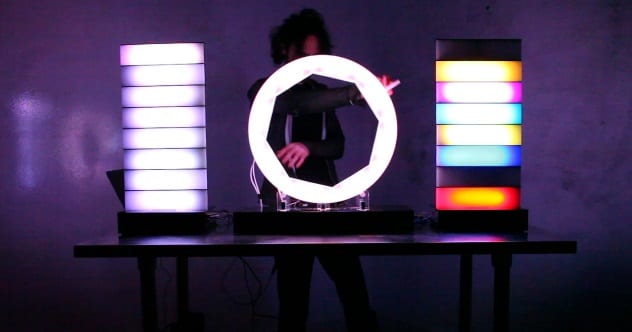

For thousands of years, musical instruments followed a familiar recipe: stretch a string, strike a surface, blow through a tube, or shake something until the neighbors complained. The instruments of tomorrow are rewriting that recipe. They can read gestures, respond to brain activity, reshape themselves, collaborate with artificial intelligence, and place sounds anywhere in a three-dimensional space.
Many of these future musical instruments already exist as commercial products, university prototypes, or experimental performance systems. Technologies such as MIDI Polyphonic Expression, wearable sensors, machine learning, robotic musicianship, and haptic feedback are gradually turning electronic instruments into more expressive physical experiences. Tomorrow’s orchestra may still include violins and trumpets, but it could also feature gloves, robots, virtual drums, and a synthesizer that politely suggests a better chord.
What Makes an Instrument “From the Future”?
A futuristic instrument is not simply a synthesizer wearing extra blinking lights. The most promising designs solve a musical problem. They may give performers more control over individual notes, make music accessible to people with limited mobility, combine acoustic resonance with digital processing, or introduce entirely new relationships between movement and sound.
The following ranking considers expressive potential, accessibility, technical maturity, compatibility with existing music systems, and the likelihood that the technology will influence mainstream performance. Some entries are established products. Others remain experimental. All of them offer a credible preview of how musicians may create, practice, and perform in the years ahead.
1. Multidimensional MPE Instruments
Every Note Becomes a Living Object
Traditional electronic keyboards usually treat each key as an on-or-off switch with velocity attached. Multidimensional controllers go much further. Using MIDI Polyphonic Expression, or MPE, performers can independently bend the pitch, alter the timbre, and change the pressure of each note in a chord.
In practical terms, a musician can hold three notes, slide one upward, soften another, and add vibrato to the third without disturbing the rest. The ROLI Seaboard demonstrates this approach with a continuous, pressure-sensitive playing surface that responds to striking, pressing, sliding, gliding, and lifting gestures. Other expressive keyboards preserve familiar piano-style keys while adding per-note movement and pressure.
MPE instruments are likely to become increasingly important because they combine electronic flexibility with the physical nuance musicians expect from acoustic instruments. A synthesizer no longer has to sound like a polite office machine. It can growl, sigh, wobble, and occasionally behave like it skipped breakfast.
2. Wearable Gesture Instruments
Playing Music With the Entire Body
Wearable musical instruments transform natural movement into sound control. Instead of standing behind a keyboard or tapping a rectangular controller, a performer can open a hand to trigger a chord, rotate a wrist to change an effect, or move an arm through the air to shape a melody.
MiMU Gloves are a leading real-world example. Their sensors track hand orientation, posture, and motion, while dedicated software maps those gestures to MIDI commands and sound parameters. The instrument grew from musician Imogen Heap’s desire to create and perform without being visually trapped behind conventional equipment.
The next generation of musical gloves may become lighter, less expensive, and easier to configure. Smart clothing could add sensors to sleeves, shoes, or entire stage costumes. Concerts would become more theatrical because audiences could see the physical cause of every sonic change. The performer would not merely play an instrument; the performer would become the instrument.
3. AI Co-Creative Instruments
A Musical Partner That Never Asks for a Coffee Break
Artificial intelligence is often discussed as a system that generates finished songs. Its more interesting role, however, may be inside instruments that respond to musicians in real time. An AI instrument can study a melody, continue a rhythm, transform a recorded sound, suggest harmonies, or generate musical material that changes with the performer’s decisions.
Google’s Magenta research has explored machine learning as a creative tool rather than merely an automatic content factory. Experimental systems have generated and modified melodies, rhythms, and timbres, while newer real-time music models can produce continuously controlled musical streams from text or audio guidance. These systems point toward instruments that listen before they answer.
The best AI musical instruments will not replace human taste. They will function more like unpredictable collaborators. A guitarist might play a phrase and receive three variations. A drummer could create a groove that the instrument expands into an evolving arrangement. Sometimes the AI will be brilliant. Sometimes it will suggest musical lasagna. The artist still decides what reaches the audience.
4. Brainwave and Biofeedback Instruments
Composing With Signals From the Body
Brain-computer musical interfaces use physiological signals as performance data. Electroencephalography can measure patterns of electrical activity from the brain, while other sensors can monitor heart rate, muscle tension, breathing, or changes in skin conductivity.
Georgia Tech’s Brain Music research facilities, for example, support the recording of EEG, ECG, and electrodermal activity. These measurements can be mapped to tempo, harmony, dynamics, texture, or sound effects. A rising heart rate might increase rhythmic density, while slower breathing could gradually open a filter or reduce musical tension.
Controlling a precise melody with brain activity remains difficult because biological signals are noisy and vary considerably between individuals. The near-term opportunity is therefore not mind-reading piano solos. It is adaptive music that reacts to concentration, relaxation, rehabilitation exercises, or emotional states. Biofeedback instruments may become especially valuable in therapy, accessibility, meditation, and interactive installations.
5. Haptic Virtual-Reality Instruments
Touching Instruments That Do Not Physically Exist
Virtual reality can display almost any instrument imaginable, but convincing musical performance requires more than graphics. Players need to feel resistance, impact, texture, and position. Without tactile feedback, striking a virtual drum can feel like aggressively waving at invisible furniture.
Haptic gloves, force-feedback controllers, wearable actuators, and mid-air tactile systems are beginning to address this limitation. Researchers have demonstrated virtual musical interactions involving plucking, striking, and touching simulated surfaces. Other work has explored tactile cues that help musicians understand timing or finger placement.
Once the hardware becomes lighter and more affordable, virtual instruments will no longer need to imitate physical ones. A player might stretch a floating string across an entire room, drum on a cloud, or rotate a three-dimensional chord to change its harmony. Students could practice silently in small apartments while still receiving physical feedback. Touring musicians might carry an entire interactive orchestra in a headset and a pair of gloves.
6. Shape-Changing Musical Surfaces
When the Instrument Rearranges Itself
Most musical interfaces have a fixed layout. Piano keys stay where the manufacturer put them, even when a composition would benefit from a different arrangement. Shape-changing instruments challenge that assumption by using movable pins, flexible materials, or actuated surfaces that physically reconfigure themselves.
MIT Media Lab researchers have explored pin-based shape displays as platforms for creating tactile musical controls and acoustic structures. A surface could raise a group of controls for one song, flatten them for another, or produce different physical forms according to the selected sound.
This technology could make electronic instruments more adaptable and accessible. Beginners might use a simplified layout with only the required notes raised. Advanced musicians could load custom geometries for microtonal scales, unusual tunings, or complex rhythmic patterns. Instead of scrolling through a screen to find a parameter, the instrument could place that parameter directly under the performer’s fingers.
7. Robotic Musical Instruments
Machines That Listen and Perform
A robotic instrument is more than a player piano following stored instructions. Modern robotic musicianship focuses on systems that listen, analyze, respond, and interact with human performers. Georgia Tech researchers have developed projects involving robotic percussion, robotic strings, and machines capable of reacting to melody, harmony, and rhythm.
Robots offer physical abilities that human musicians do not possess. A robotic percussionist can maintain extreme speed and precision. A robotic string system can repeat difficult gestures consistently. More importantly, an interactive robot can improvise with a human instead of simply reproducing a fixed sequence.
Future robotic instruments may appear in concert halls, theme parks, recording studios, and music classrooms. They could perform acoustic sounds that remain difficult to synthesize convincingly while also attempting patterns that would require a human musician to grow several additional arms. The goal is not to fire the drummer. It is to give the drummer an extremely punctual mechanical bandmate.
8. Hybrid Acoustic-Digital Instruments
Real Wood, Real Strings, Invisible Electronics
The future does not belong exclusively to screens and sensors. Some of the most convincing innovations preserve the physical character of traditional instruments while embedding digital capabilities directly into their bodies.
Yamaha’s TransAcoustic guitars illustrate this hybrid approach. An actuator inside the guitar transfers processed vibrations back into the wooden body, producing effects such as reverb and chorus without requiring a conventional external amplifier. Newer models extend the concept with onboard looping, additional effects, app-based editing, and wireless connectivity.
High-resolution player pianos provide another example. Steinway’s Spirio systems can capture and reproduce performance information through an acoustic grand piano rather than ordinary speakers. Future hybrids may include violins with body-resonant effects, drums with programmable acoustic chambers, or brass instruments that change their virtual dimensions while preserving real breath and lip technique.
These instruments have an important advantage: they still feel alive when the battery dies. That may be the most futuristic feature of all.
9. Intelligent Digital Wind Instruments
One Mouthpiece, Hundreds of Voices
Digital wind instruments combine breath sensing, familiar fingering systems, onboard sound engines, and electronic connectivity. A player can use the physical gestures of a saxophone or flute while controlling orchestral sounds, synthesizers, basses, or experimental textures.
Roland’s Aerophone family shows how mature this category has become. Models use breath-responsive mouthpieces, portable power, headphone support, and extensive internal sound libraries. Some preserve saxophone-style fingering, while others are designed around flute or recorder-like playing.
The instruments of tomorrow will likely analyze more than breath pressure. They may detect tongue position, embouchure, bite force, airflow direction, and subtle movement. Intelligent fingering assistance could help beginners play in tune, while advanced mapping could allow one performer to control several synchronized sound layers. The result would preserve the physical pleasure of blowing into an instrument without restricting the musician to one acoustic identity.
10. Spatial-Audio Performance Instruments
Playing the Room Instead of Just Playing Notes
Most instruments traditionally control pitch, rhythm, loudness, and timbre. Spatial instruments add location and movement as equally important musical dimensions. A performer can place one sound behind the audience, move another overhead, or make a melody circle the room.
Immersive audio systems already let artists mix music in three-dimensional formats, while spatial-computing platforms can position responsive sounds within virtual and augmented environments. The next step is to make spatial movement playable in real time rather than treating it as a studio adjustment added after recording.
A future spatial instrument might resemble a motion controller, camera-tracked baton, spherical touch surface, or wearable system. A gesture could throw a note across a theater. Turning the body could rotate an entire choir. Closing both hands might pull distant sounds toward the center. Composers would begin writing not only which note should be heard, but where that note should travel.
What Will It Feel Like to Play the Musical Instruments of Tomorrow?
A Practical Player-Experience Guide
The first surprise will probably be how little many future instruments resemble traditional musical equipment. A gesture controller may look like a glove. A handheld synthesizer may look like a smooth household gadget. A virtual instrument may have no visible hardware beyond a headset. This unfamiliarity can be intimidating for an experienced pianist or guitarist because decades of muscle memory suddenly provide fewer answers.
After the initial confusion, exploration becomes the main attraction. On a multidimensional surface, pressing a note is only the beginning. Sliding sideways may bend its pitch, moving upward may brighten its tone, and adding pressure may increase intensity. A basic chord can become a miniature performance because each finger controls an independent musical voice. The experience is closer to shaping soft material than operating a row of switches.
Wearable instruments create an even stronger connection between movement and sound. The player must learn which gestures are reliable, comfortable, and visually understandable. A tiny wrist rotation may be perfect in a studio but almost invisible to an audience. A dramatic arm movement may look wonderful onstage but become exhausting during a 90-minute performance. Designing a personal gesture vocabulary becomes part of learning the instrument.
AI-assisted instruments introduce a different skill: musical negotiation. The player provides a phrase, pattern, or sonic direction, then evaluates the machine’s response. Good results require judgment rather than passive acceptance. A generated idea may contain one excellent rhythm hidden inside eight measures of digital confusion. The musician’s job is to identify that useful fragment, reshape it, and make it sound intentional.
Haptic and virtual instruments may initially feel less precise than acoustic ones. A real drumhead communicates tension through the stick, while a virtual drum depends on sensors and tactile simulation. Even small delays can affect timing. As the technology improves, however, virtual instruments could offer physical behaviors impossible in the real world. A drum might become softer as it grows larger. A string could continue stretching until it reaches across a virtual landscape. Gravity could become an optional setting.
Hybrid acoustic instruments may provide the easiest transition because the familiar object remains intact. A guitarist still feels vibrating strings and resonant wood, but the body can produce spacious effects or record loops without a pile of pedals. This combination encourages experimentation without forcing the musician to abandon established technique.
Accessibility may ultimately be the most meaningful part of the experience. A performer who cannot use a standard keyboard might control music through head movement, pressure sensors, eye tracking, or limited hand gestures. A beginner could use a shape-changing surface that displays only the required notes. A student could practice a digital wind instrument through headphones without launching a household debate about whether 1:00 a.m. is an appropriate time for saxophone scales.
The learning process will also change. Instead of mastering a single fixed interface, musicians may design their own. They will decide which movement controls pitch, which sensor changes timbre, and how strongly the system reacts. Instrument building and instrument playing will increasingly overlap. Tomorrow’s virtuoso may be part performer, part sound designer, part programmer, and part patient troubleshooter who knows that turning Bluetooth off and on is sometimes the final movement of the symphony.
Conclusion: The Future Will Expand Musicianship, Not Replace It
The top musical instruments of tomorrow will not succeed merely because they contain advanced technology. They will succeed when the technology disappears into the act of playing. Musicians need instruments that feel responsive, understandable, expressive, and dependable under the bright lights of an actual performance.
MPE surfaces, musical gloves, AI collaborators, biofeedback systems, haptic environments, robotic performers, digital winds, and spatial controllers all challenge the old definition of an instrument. Yet their purpose remains wonderfully familiar: turning human decisions into meaningful sound.
The piano, guitar, violin, and drum are not heading for retirement. They are gaining unusual new relatives. The next great instrumentalist may perform on an object that has not yet been named, using gestures that do not yet belong to any musical tradition. Somewhere, perhaps in a university laboratory or a teenager’s bedroom, that instrument may already be making its first strange and promising noise.
Note: This article includes both commercially available instruments and developing research concepts. Specific features, compatibility, and availability may change as the technologies evolve.


