
Editor’s note: This article separates documented military marine-mammal programs from the unproven claim that any individual whale carried out espionage. The story is strange enough without giving a beluga a tiny trench coat and a briefing folder.
It began with a white whale, a mysterious harness, and a question that sounds like it escaped from a late-night movie pitch: could the Russian Navy be recruiting whales as spies?
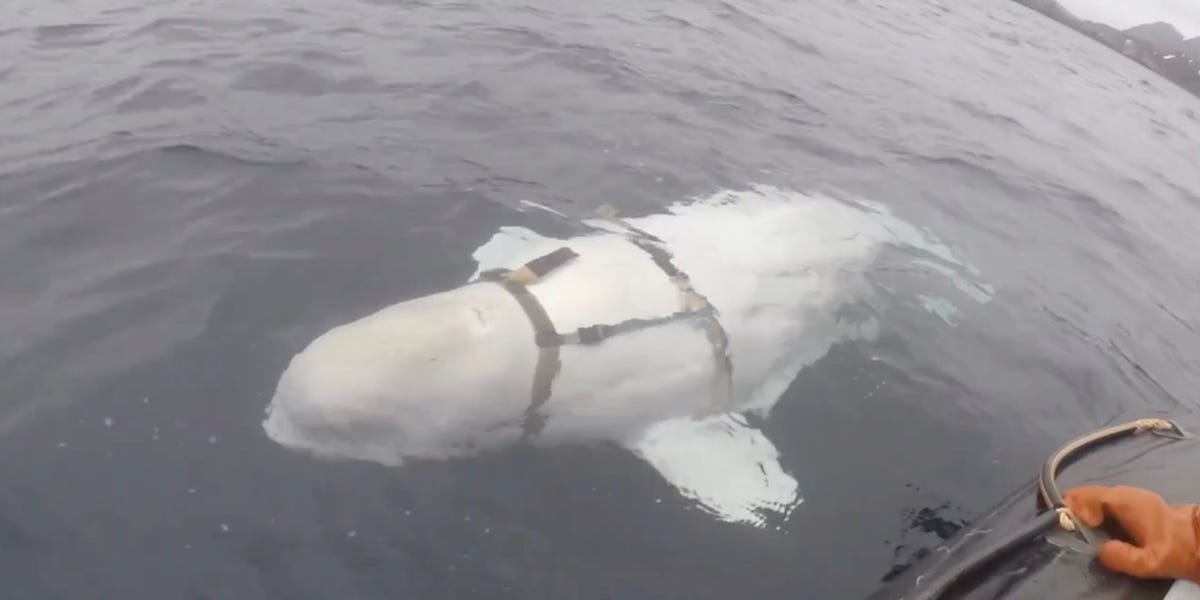
In 2019, fishermen near northern Norway encountered a remarkably friendly beluga whale wearing a harness marked “Equipment St. Petersburg.” The animal appeared accustomed to people, approached boats, and responded unusually calmly to human interaction. The harness seemed to include a mount that could potentially hold a camera or other equipment. Suddenly, the world had a new Cold War mystery: was this a lost pet, an escaped research animal, or an aquatic intelligence operative with better sonar than most submarines?
The beluga became known as Hvaldimir, a mash-up of the Norwegian word for whale, hval, and Vladimir. The nickname was funny, but the questions behind it were serious. Russia has a long history of military marine-mammal programs, and the United States has operated its own marine-mammal program for decades. That does not prove Hvaldimir was a spy. But it does explain why the idea was not as absurd as it first sounded.
Why the “Russian Spy Whale” Story Took Off
The original mystery had three ingredients that practically begged the internet to lose its mind: a tame whale, an unusual harness, and a location near strategic Arctic waters. Hvaldimir was discovered near Norway, not far from Russian territory and important naval activity in the far north.
Belugas are not ordinary-looking animals in the first place. They are bright white, round-headed, highly vocal, and expressive enough to look like they are constantly preparing to tell you a secret. NOAA describes belugas as highly social animals with a wide range of sounds, which is why they are often called “canaries of the sea.” Their intelligence, communication abilities, and trainability make them fascinating to researchersand potentially useful for specialized tasks.
Hvaldimir’s behavior also raised eyebrows. He was comfortable around boats and people, showed signs of prior training, and appeared familiar with interaction cues. Wild belugas can be curious, but a whale that approaches humans as though it expects a snack, a head scratch, and perhaps a performance review naturally invites questions.
Still, the leap from “trained whale” to “spy whale” requires caution. There was never public proof that Hvaldimir gathered intelligence, transmitted data, photographed military sites, or carried out a covert mission. The harness was suspicious, but suspicious equipment is not the same thing as confirmed espionage.
Russia Really Has Used Marine Mammals for Military Work
Here is the part that makes the story more than a silly headline: military marine-mammal programs are real.
During the Cold War, both the United States and the Soviet Union explored how dolphins, sea lions, seals, and other marine mammals could assist naval operations. Their underwater senses are extraordinary. Dolphins can use echolocation to detect objects in murky water. Sea lions can recover equipment. Some animals can recognize patterns, follow training signals, and work in environments where divers, cameras, or robots may struggle.
The U.S. Navy openly states that its Marine Mammal Program uses dolphins to locate and mark underwater mines. California sea lions are trained to find and attach recovery lines to objects on the seafloor. Both species can also support harbor security by helping identify unauthorized swimmers or divers near naval facilities. In other words, militaries have long understood that the ocean has employees with flippers.
Russia and the former Soviet Union have also maintained marine-mammal training efforts. Public reporting has described Soviet and Russian programs involving dolphins, seals, and belugas for missions such as mine detection, equipment recovery, diver support, and naval-base protection. Some reports have claimed that Russia experimented with animals for more aggressive assignments, although the details are often murky and difficult to independently verify.
That lack of transparency is important. Military marine-mammal programs are not exactly known for publishing cheerful annual reports titled What Our Dolphins Did This Summer. Much of what is known comes from satellite imagery, public statements, historical reporting, procurement notices, and analysis of facilities near military bases.
What Would a Whale “Spy” Actually Do?
Despite the dramatic label, a military whale would probably not behave like a movie spy. It would not sneak into a naval base wearing sunglasses, whisper classified information into a shell, and escape in a mini-submarine. Real military uses would likely be more practical and less cinematic.
1. Harbor Security
A trained marine mammal could help detect swimmers, divers, or underwater intruders near a naval base. This is one of the most realistic uses because underwater sabotage is difficult to monitor. Human divers can move quietly, operate at night, and work below the surface where cameras have limited visibility.
Satellite-image analysis reported by the U.S. Naval Institute indicated that Russia positioned dolphin pens near the entrance to Sevastopol harbor during the war in Ukraine. The likely mission was counter-diver defense: helping protect warships and infrastructure from underwater infiltration.
2. Finding Mines and Explosives
Marine mammals can detect objects underwater using their natural sensory abilities. Mines, torpedoes, lost equipment, and underwater debris are difficult to spot in dark or cloudy water. A trained animal might help identify an object’s location so divers or remotely operated vehicles can investigate it.
This does not mean a whale is replacing modern sonar systems, drones, or underwater robots. It means the animal could act as one more tool in a complicated underwater security system. Think of it less as “whale James Bond” and more as “very expensive, highly intelligent marine search assistant.”
3. Carrying Cameras or Sensors
The most obvious reason people suspected Hvaldimir of espionage was the harness. A harness could theoretically carry a camera, GPS tracker, acoustic sensor, or other small device. It could also be used for non-military research, health monitoring, training, or animal handling.
That distinction matters. Equipment alone does not reveal purpose. A camera can document naval activity, but it can also record animal behavior. A harness can support surveillance, but it can also support a scientific study. The mystery around Hvaldimir was not that a harness existed; it was that nobody publicly explained why he had one.
4. Supporting Arctic Operations
Beluga whales are especially interesting in Arctic waters because they are adapted to cold conditions. Russia operates major military and submarine infrastructure in the Arctic, where icy water, darkness, and harsh weather can make underwater work brutally difficult.
In theory, a beluga trained to operate around cold-water facilities could assist divers, locate objects, or patrol sensitive zones. But theory is not evidence. Public reporting suggests Russia has researched and trained marine mammals, yet there is no confirmed public record showing that Hvaldimir himself completed a specific espionage mission.
The Evidence Against Calling Hvaldimir a Confirmed Spy
The strongest version of the story is also the least supported: that Hvaldimir was a fully operational Russian intelligence asset conducting secret surveillance missions in Norway. That claim was never proven.
There are several more ordinary explanations. He may have escaped from a training center. He may have belonged to a research or aquarium-style program. He may have been trained for basic human interaction, equipment handling, or environmental work. Some observers even suggested he might have had a therapeutic or educational background rather than a military one.
His comfort around humans strongly suggested captivity or training, but it did not identify the exact program. A whale can learn to retrieve objects, respond to hand signals, or approach boats without receiving a classified security clearance.
Russian officials did not provide a public explanation that resolved the mystery. That silence allowed the story to grow, because unanswered questions are like chum in the water for headlines. The more people wondered, the more Hvaldimir became a symbol of military secrecy, Arctic rivalry, and the unsettling idea that even wildlife might be drafted into geopolitical competition.
What Happened to Hvaldimir?
Hvaldimir remained a public fascination for years after his discovery. He was seen along the Norwegian coast, interacted with people, and became a beloved animal to many observers. His friendliness, however, was also a concern. A whale dependent on people for food or attention can struggle to survive safely in the wild.
In August 2024, Hvaldimir was found dead in southern Norway. Early claims suggested he may have been shot, but Norwegian police later said X-rays and forensic review found no evidence of gunshot injuries. Authorities said the likely cause of death was a bacterial infection, possibly related to a wound caused by a stick lodged in his mouth.
His death ended the story of one whale, but not the broader debate. The question is no longer simply whether Hvaldimir was a spy. It is whether militaries should use intelligent marine animals in roles that expose them to captivity, stress, danger, and environments shaped by human conflict.
The Ethics of Turning Marine Mammals Into Military Tools
Military programs often frame trained animals as valuable partners. Critics see a much darker picture: intelligent animals placed into human conflicts they cannot understand or consent to.
Belugas are social, vocal, and highly interactive. They form relationships, communicate extensively, and depend on healthy marine environments. Captivity, isolation, transport, and forced dependence on humans can create serious welfare concerns. When military secrecy is added to the mix, outside oversight becomes even harder.
There is also a practical argument against relying heavily on animals. Modern underwater drones, sonar systems, artificial intelligence, and robotic vehicles are becoming more capable every year. Robots may be expensive, but they do not need fish, enrichment activities, veterinary care, or emotional reassurance after a difficult mission.
Still, technology has not made marine mammals irrelevant. Underwater environments remain unpredictable, and animal senses can be difficult to reproduce. That tensionbetween military usefulness and animal welfareis why marine-mammal programs remain controversial.
Why the Spy Whale Story Still Matters
The Hvaldimir story matters because it sits at the intersection of wildlife, technology, military secrecy, and public imagination. It reminds us that the ocean is still one of the least visible battlefields on Earth. We can track satellites, monitor aircraft, and watch troop movements from space, yet much of what happens beneath the waves remains hidden.
That mystery creates room for both legitimate concern and wild speculation. Russia’s history of marine-mammal training means the story cannot be dismissed as pure fantasy. At the same time, the available evidence does not justify declaring that Hvaldimir was a confirmed Russian spy.
The most honest conclusion is also the most interesting one: Hvaldimir was almost certainly trained by humans, but exactly why, where, and for whom remains unresolved. He may have been connected to a military program. He may have been a research animal. He may have escaped from a facility without ever receiving a top-secret assignment.
Either way, he became a reminder that when humans turn nature into a strategic asset, the result is rarely as neat as a mission briefing. Sometimes it is a confused beluga whale swimming toward a fishing boat, wearing a harness, and accidentally becoming the most famous alleged spy in the Arctic.
Experiences and Lessons From the “Russian Spy Whale” Mystery
For the fishermen who first encountered Hvaldimir, the experience must have felt surreal. Imagine preparing to work in cold Arctic waters and suddenly noticing a large white whale swimming directly toward your boat. Not only is the animal unusually friendly, but it is also wearing equipment that looks manufactured rather than natural. That is not a normal day at sea. That is the kind of moment that makes you question whether someone replaced reality with a streaming-series screenplay overnight.
Stories from people who interacted with Hvaldimir show why he became emotionally important. He did not behave like a distant wild animal passing through a fjord. He appeared curious, social, and eager to approach people. Videos showed him retrieving objects, swimming near boats, and engaging with visitors. Those moments made him feel less like a security threat and more like a strange, lonely animal looking for connection.
That emotional connection is part of what made the mystery powerful. People were not simply debating military intelligence. They were watching an animal that seemed vulnerable. A whale possibly trained by humans, potentially dependent on humans, was suddenly living in open water without a clear support system. The more friendly he appeared, the more uncomfortable the situation became.
There is a lesson here for anyone who encounters wildlife that seems tame. A friendly animal may look like it wants help, but feeding, touching, chasing, or treating it like a tourist attraction can make survival harder. Animals that become dependent on people may lose the behaviors they need to find food, avoid boats, and stay away from dangerous areas.
Hvaldimir’s story also reveals how quickly facts and rumors can blend online. The harness was real. His apparent training was real. Russia’s marine-mammal programs were real. But the leap from those facts to “confirmed Russian secret agent” was never supported by public evidence. The internet loves a clean conclusion, especially one involving a whale with an alleged espionage résumé. Reality tends to be messier.
For journalists, researchers, and readers, the experience offers a useful reminder: mystery is not proof. A dramatic detail can be important without being conclusive. It is possible to take the military connection seriously while also admitting that the full story remains unknown.
Finally, Hvaldimir became a symbol of something larger than geopolitics. He showed how animals can become entangled in human ambitions, technologies, and conflicts. Whether he was a guard whale, research animal, escapee, or something more secretive, his life raised a difficult question: when humans train animals for dangerous work, who is responsible when the mission ends but the animal remains?
That may be the real legacy of the alleged Russian spy whale. Not a confirmed secret mission. Not a cinematic betrayal. Just a white beluga whale whose strange harness forced the world to look more closely at what people are willing to ask animals to do beneath the surface.
Conclusion
The Russian Navy might be recruiting whales as spiesbut the evidence supports a more nuanced story. Russia has documented ties to marine-mammal training, and military dolphins and other animals have been used for harbor security, mine detection, and underwater support. Hvaldimir’s harness and trained behavior made a military connection plausible, but they never proved he was an active intelligence operative.
What is certain is that Hvaldimir turned an obscure military practice into a global conversation about secrecy, animal intelligence, and ethics. He was not just a viral whale. He was a reminder that the ocean can hide mysteries far stranger than fictionand sometimes those mysteries swim right up to a fishing boat.


