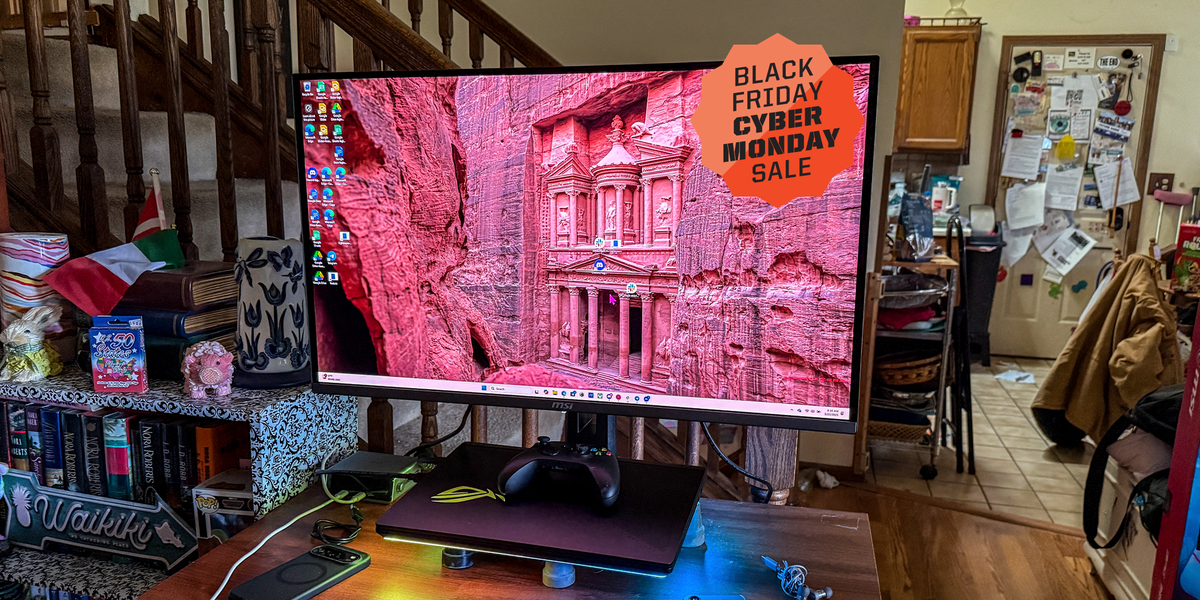

Black Friday 2025 was a very good time to be picky about a gaming monitor. Not just “grab whatever has the biggest red sale tag” good. More like “finally, the monitor market is making sense” good.
The biggest story was simple: buyers no longer had to choose between bargain-bin 1080p screens and painfully expensive halo products. The gap in the middle got crowded in the best way possible. Suddenly, 1440p monitors with 180Hz to 240Hz refresh rates looked like the smart buy, 4K dual-mode panels started flirting with sanity, and OLED displays dipped low enough to make thousands of gamers stare at their carts and whisper, “Well… maybe just this once.”
If you looked across the best Black Friday gaming monitor deals 2025 coverage, a few themes kept repeating. Budget monitors got cheaper, premium panels got more tempting, and retailers stretched the sale beyond a single frantic day. That meant shoppers had more time to compare specs, watch real price drops, and avoid getting fooled by a “holiday deal” that was about as exciting as cold gravy.
So what were the best Black Friday gaming monitor deals 2025? The short answer: the best gaming monitor sales were not always the flashiest products with the loudest marketing. The real winners were monitors that matched a specific kind of gamer at a genuinely attractive price.
Why Black Friday 2025 Was So Strong for Gaming Monitor Sales
A few forces came together at once. First, OLED kept moving from “luxury eye candy” to “expensive, yes, but now within striking distance.” Second, brands leaned hard into gamer-friendly features like 240Hz refresh rates, sub-1ms response times, HDMI 2.1, USB-C, adaptive sync, and dual-mode operation. Third, retailers got more aggressive about early promotions, longer sale windows, and highly visible price competition.
That last point mattered a lot. By 2025, Black Friday was not really just Black Friday anymore. It was more like a shopping season wearing a Black Friday costume. Retailers such as Newegg turned the event into a month-long push, while brands and big-box stores kept dropping monitor deals before, during, and after Thanksgiving weekend. For buyers, that was excellent news. Instead of panic-buying the first panel with the word gaming slapped across the box, you could actually compare a 1440p IPS monitor, a 4K OLED, and an ultrawide without feeling like the sale would vanish if you blinked.
Even better, brand-direct pricing started competing with retailer discounts. Amazon, Best Buy, Dell, Newegg, Samsung, ASUS, and LG all had some skin in the game. The result was a Black Friday monitor sale season that felt broader, smarter, and more competitive than usual.
Best Black Friday Gaming Monitor Deals 2025 at a Glance
- Best budget 1080p deal: affordable Asus and MSI panels under or near $100 proved that entry-level gaming no longer had to feel miserable.
- Best value category overall: 27-inch 1440p monitors with 180Hz to 240Hz refresh rates were the sweet spot for most PC gamers.
- Best “wait, that’s actually reasonable” upgrade: dual-mode 4K monitors made more sense than ever.
- Best premium trend: OLED gaming monitor deals got serious, especially in 27-inch and 32-inch models.
- Best desk-dominating flex: curved ultrawide and 49-inch super-ultrawide displays delivered dramatic discounts and even more dramatic vibes.
Budget Wins: 1080p Deals That Did Not Feel Cheap
Let’s start at the low end, because every Black Friday shopping guide needs a section for people who want more frames without selling a kidney.
One of the most widely noticed budget options was the Asus VY249HGR, which fell from around $119.99 to about $79.99. PC Gamer also highlighted the MSI Pro MP243XW at roughly $69.99. Those are the kinds of numbers that make casual gamers, students, and “I just want something smoother than my current fossil” shoppers perk up immediately.
No, these were not dream displays for a bleeding-edge gaming rig. But they absolutely mattered. A cheap gaming monitor used to mean a depressing pile of compromises. Black Friday 2025 changed that conversation a little. A fast, usable 1080p monitor from a recognizable brand suddenly became very achievable, especially for esports titles, MOBAs, older games, and general mixed use.
Popular Mechanics also shined a light on accessible options like an Asus TUF 25-inch Full HD model and the MSI MAG E20. That tells you something important about the 2025 gaming monitor sales landscape: the low-price tier was not just random mystery-brand filler. Big names were actually fighting in the entry-level bracket.
Still, this is where shoppers needed self-control. If you mainly play Valorant, Counter-Strike, Rocket League, or similar fast games, a budget 1080p panel makes perfect sense. But if your PC is strong enough for 1440p, going too cheap can save money and cost satisfaction. Black Friday deals are supposed to deliver joy, not buyer’s remorse in 27 inches.
1440p Was the Real Sweet Spot
If Black Friday 2025 had a most sensible category, it was 1440p. This is the zone where gaming monitors stop feeling basic and start feeling genuinely exciting without wandering into “premium regret” territory.
PC Gamer’s roundup captured that beautifully. The MSI Pro MP275Q dropped to around $129.99, while other 1440p panels from Acer and similar brands landed in the high-$100s to low-$200s. GamesRadar also highlighted 1440p deals like the Acer Nitro XV271U at about $179.99. These were not throwaway discounts. They were real value plays.
And that matters because a 1440p gaming monitor is arguably the best fit for a huge portion of the PC gaming audience. You get a clear step up in sharpness over 1080p, but you do not need an absurd GPU budget just to enjoy the experience. Pair that resolution with 180Hz or 240Hz, and you get a display that can handle competitive multiplayer on Friday night and a cinematic open-world game on Sunday afternoon without breaking a sweat.
This was also the price band where shoppers had the most room to choose their priorities. Some buyers wanted IPS clarity and value. Others wanted a curve. Others cared about stand ergonomics, adaptive sync support, or cleaner color performance. In the 2025 Black Friday gaming monitor deals, 1440p gave buyers options instead of forcing them into one obvious pick.
That is why this category felt so strong. It was not merely cheap. It was balanced. And balanced usually wins in the real world, even if it is less glamorous than a glowing OLED monster from your favorite YouTuber’s setup tour.
4K and Dual-Mode Monitors Finally Got Interesting
For a long time, 4K gaming monitors had a reputation problem. They looked incredible on spec sheets and in review photos, but their prices often made normal humans quietly close the tab and go make a sandwich instead.
Black Friday 2025 improved that.
One standout was the MSI MAG 275UPD, a dual-mode 27-inch monitor that could run at 4K and 144Hz or switch to 1080p and 288Hz. That was one of the most interesting examples of a gaming monitor sale doing more than just shaving a few dollars off a premium toy. It actually brought a clever feature set into range for mainstream enthusiasts.
The beauty of dual-mode is that it serves two gamer personalities at once. Want maximum image detail for RPGs, open-world adventures, strategy games, or general desktop use? Run 4K. Want faster, lighter competitive play? Switch to the lower-resolution, higher-refresh mode and chase every frame you can get. ASUS pushed dual-mode as a major feature on its ROG OLED lineup, and Best Buy’s Black Friday listings showed major markdowns on an ASUS ROG Swift 32-inch dual-mode OLED that fell to $949.99 from $1,299.99.
That was still expensive, obviously. This is not a fairy tale. But it crossed an important line from “pure fantasy hardware” into “painful, but defensible for the right buyer.”
Meanwhile, 4K OLED also looked less untouchable than before. Tom’s Guide highlighted an Alienware 27-inch 4K QD-OLED at about $699, down from $899. PCWorld pointed to a more affordable MSI 27-inch 4K IPS monitor around $230 as one of the strongest gaming monitor values in the sale window. Together, those deals showed that 4K gaming monitors were no longer living in a single premium-only bubble. There were now multiple entry points depending on how fancy you wanted to get.
OLED Stole the Show
If there was one category that defined the best Black Friday gaming monitor deals 2025, it was OLED. Not close. Not even a little.
Tom’s Hardware, PCWorld, Tom’s Guide, Popular Mechanics, The Verge, and retailer listings all kept circling back to the same conclusion: OLED gaming monitor deals finally became compelling enough to change buyer behavior.
The Alienware AW2725DF was a headline-grabber at roughly $535.99, down from $899.99. That is a 27-inch QHD OLED with a sizzling 360Hz refresh rate. Tom’s Hardware also highlighted the LG 27GX700A-B at around $549.99, down from $849.99, bringing together QHD resolution, 280Hz speed, G-Sync, FreeSync, and the kind of picture quality that makes older LCDs look personally offended.
Then there was the Acer 27-inch OLED 1440p 280Hz option around $399, which helped push the category into “seriously, maybe now is the time” territory. The Verge also called attention to MSI’s MAG271QPX E2 at $380, a QD-OLED gaming monitor that combined 1440p resolution, 240Hz refresh rate, useful ports, and a three-year burn-in warranty. That last detail matters more than a lot of people admit.
OLED still makes cautious shoppers nervous because of burn-in concerns, especially if the monitor will do double duty for work, streaming, gaming, and leaving static windows open for hours. Brands know this. ASUS leaned heavily into OLED care features and burn-in protection on its Black Friday monitor page, and warranty coverage became part of the sales pitch rather than fine print nobody reads until it is too late.
That is the real reason OLED dominated 2025 gaming monitor sales. It was not just prettier. It was more practical than it used to be. Buyers could finally pair jaw-dropping contrast and near-instant response times with warranties, protective features, and prices that felt aggressive instead of absurd.
Ultrawide and Super-Ultrawide Deals Were the Most Fun
Not everyone needs a giant curved gaming monitor. Some people just want one because it makes their desk look like a command center in a sci-fi movie. Black Friday 2025 was kind to those people.
Samsung’s Odyssey OLED G9 was one of the biggest stars of the season. Depending on the retailer and the exact point in the sale cycle, it showed up around $898, around $999, and around $1,100 in different deal coverage. No matter which number you focus on, the important point is the same: a 49-inch dual-QHD 240Hz OLED super-ultrawide dropped far enough to feel like a real Black Friday event, not just a courtesy discount.
Tom’s Guide also highlighted the LG UltraGear 45GX950A-B at $1,499, down from $1,999. Best Buy’s broader Black Friday monitor pages showed an LG UltraGear 45-inch OLED model with $600 off. For buyers who wanted immersive racing, flight sims, open-world spectacle, or just enough horizontal screen space to lose small pets, this category was a playground.
And the fun was not limited to premium buyers. Popular Mechanics and GamesRadar also called out more affordable curved ultrawide options that dipped close to $200. These were ideal for shoppers who wanted that wraparound feeling without putting a crater in their bank account.
These monitors are not for everyone. They are large, dramatic, sometimes ridiculous, and often a little demanding in terms of desk space. But Black Friday has never been entirely about necessity. Sometimes it is about making your setup feel bigger, more immersive, and slightly more unhinged in a good way.
How to Shop Black Friday Gaming Monitor Sales Without Doing Something Dumb
Match the monitor to your GPU
A 4K 240Hz OLED sounds amazing until your graphics card starts breathing like it ran up a hill. Buy for the hardware you actually own, not the fantasy rig you may or may not build six months from now.
Know your style of gaming
Competitive players should care about refresh rate, motion clarity, and response time first. Mixed-use gamers may get more value from sharper resolution, better HDR, better color, or a more flexible port layout.
Do not ignore ports
HDMI 2.1 matters for modern consoles and some premium PC setups. DisplayPort still matters for desktop gaming. USB-C is a real quality-of-life upgrade if you also connect a laptop or handheld. Port selection is not glamorous, but it is the difference between a convenient monitor and one that annoys you every day.
Take OLED protection seriously
If you are buying OLED, read the warranty details and panel care features. Burn-in coverage, pixel cleaning tools, screen-shift protections, and return policies matter a lot more when you are spending serious money during a holiday sale.
Do not obsess over the exact day
One of the biggest lessons from 2025 was that great gaming monitor deals often appeared before the official Black Friday date and sometimes lingered into Cyber Monday. If a monitor you want hits a record-low or near-record-low price, waiting just because the calendar has not reached the exact holiday can be a clever way to miss out.
Which Shoppers Won the Most in 2025?
Value-focused PC gamers won big with 27-inch 1440p IPS monitors in the 180Hz to 240Hz range.
Budget gamers won with 1080p panels that were finally fast, affordable, and recognizable enough not to feel like a gamble.
OLED-curious buyers had their best Black Friday yet, especially in the roughly $380 to $650 range.
Premium enthusiasts got meaningful discounts on 4K OLED, 32-inch flagship panels, and dual-mode monitors that once looked completely out of reach.
Ultrawide dreamers absolutely had a moment, with both premium and budget curved monitors showing stronger price cuts than many shoppers expected.
Conclusion
The best Black Friday gaming monitor deals 2025 were not just about giant markdowns. They were about better choices. This was the year when gaming monitor sales became broad enough, competitive enough, and aggressive enough to give almost every kind of buyer a real upgrade path.
Budget shoppers found actual value. Midrange gamers found the 1440p sweet spot. OLED fans finally saw prices that felt less like punishment and more like temptation. And premium shoppers got meaningful discounts on some genuinely outrageous hardware.
If there is one big lesson from the 2025 sale season, it is this: the smartest gaming monitor deal is the one that fits your setup, your games, and your eyes, not the one with the biggest percentage-off badge. Because when the Black Friday chaos ends, you are not staring at the discount. You are staring at the screen.
Black Friday Gaming Monitor Shopping Experiences: What It Actually Feels Like
Anyone who has shopped for a gaming monitor during Black Friday knows the experience is part strategy, part chaos, and part weird emotional attachment to a rectangular object.
At first, it starts innocently. You tell yourself you are “just browsing.” Then three hours later, you have twelve tabs open, two retailer accounts signed in, a spreadsheet you absolutely did not plan to make, and a sudden urge to learn the difference between matte coating, semi-gloss finish, QD-OLED, WOLED, mini-LED, IPS glow, and every other term the monitor industry has ever invented to make normal people feel underqualified.
Then comes the internal debate. One side of your brain says a good 27-inch 1440p IPS monitor is more than enough. The other side is whispering that maybe you deserve a 240Hz OLED because life is short and your desk has suffered enough. That is the true Black Friday gaming monitor sales experience: not shopping, but negotiating with yourself like a tired diplomat at 1:14 a.m.
The funniest part is how quickly your standards change. A week earlier, a 27-inch 1440p monitor seemed ideal. Then you see a 34-inch ultrawide on sale. Suddenly your current monitor feels like a cereal box with backlighting. By the time you click on a 49-inch OLED G9 listing, you are mentally rearranging your room, measuring your desk, and wondering whether your neck is emotionally prepared for this level of commitment.
There is also a very real thrill to catching a deal at the right moment. A price drops. You refresh. It is still there. You refresh again because you do not trust happiness. You compare it to two review roundups, one retailer page, and a Reddit thread you know you should not take too seriously. Then you buy it and immediately begin researching whether you should have waited for Cyber Monday instead. This, too, is part of the ritual.
And then comes setup day, which is where the emotional payoff happens. You unbox the monitor, wrestle with foam, attach the stand, pretend your cable management is under control, and finally power it on. If it is a real upgrade, you know almost immediately. Motion looks cleaner. Colors hit harder. Blacks finally look black instead of “dark gray doing its best.” Even your desktop wallpaper starts acting like it has a personality.
That is why Black Friday gaming monitor deals matter more than a lot of other holiday discounts. A monitor is not just another gadget. It is the thing you stare at every day. It shapes your games, your work, your movies, your late-night browsing, your streaming setup, and probably your posture too, for better or worse.
So yes, the shopping experience can be messy. The spec comparisons can get ridiculous. The decision fatigue is real. But when you land the right deal on a monitor that genuinely improves your setup, it feels less like buying another piece of tech and more like upgrading your everyday life. And honestly, that is the kind of Black Friday win worth chasing.


