
Note: This article is based on real reported information from recognized record listings, science publications, educational organizations, nuclear agencies, and reputable technology coverage. It avoids build instructions and focuses on the story, science, safety context, and educational meaning.
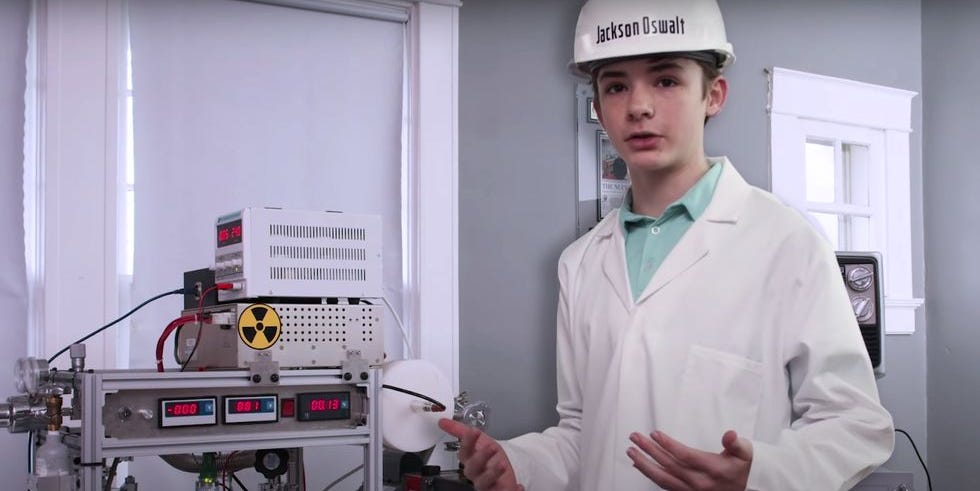
A teenager building a working fusion reactor sounds like the opening scene of a superhero origin story, except the cape is probably a lab coat, the villain is boredom, and the secret lair is a family playroom or garage. Yet the headline is not science fiction. Teenagers have built small nuclear fusion machines, known as fusors, and one American student, Jackson Oswalt, is officially recognized by Guinness World Records as the youngest person to achieve nuclear fusion.
The phrase “teen builds working fusion reactor” grabs attention because it seems to break every rule of ordinary adolescence. Most people at 12 or 14 are negotiating homework, sports practice, and whether cereal counts as dinner. Meanwhile, young experimenters like Oswalt, Taylor Wilson, Thiago Olson, Jamie Edwards, and other amateur fusor builders were studying plasma, vacuum systems, radiation detection, and nuclear reactions. Casual stuff. Totally normal. Please pass the Pop-Tarts and the neutron detector.
But the real story is more interesting than the viral version. These homemade fusion devices are not power plants. They do not produce useful electricity, and they are not tiny versions of the Sun ready to plug into a toaster. They are experimental machines that can create measurable fusion reactions under controlled conditions, usually by accelerating deuterium ions inside a vacuum chamber. That is still impressive. It is also a reminder that curiosity, mentorship, safety, and disciplined learning can turn a wild idea into a legitimate scientific milestone.
The Real “Youngest to Achieve Fusion” Story
The current Guinness-recognized record holder for the youngest person to achieve nuclear fusion is Jackson Oswalt from Memphis, Tennessee. He completed his fusion experiment on January 19, 2018, just hours before his 13th birthday. His device was a fusor operated in the playroom of his family home. According to the official record, his achievement was verified by Fusor.net, the Open Source Fusor Research Consortium, and fusion researcher Richard Hull.
That matters because many older headlines still point to Taylor Wilson, who achieved fusion at age 14 in 2008 and became one of the most famous young nuclear science prodigies in the United States. Wilson’s story was widely covered by Popular Science and TED, where he later spoke about building a fusion reactor and using nuclear science to solve real-world problems. For years, Wilson was commonly described as the youngest person to produce fusion. Oswalt later lowered the age record.
So, the clean answer is this: Taylor Wilson was a landmark teen fusioneer at 14, but Jackson Oswalt is the Guinness-recognized youngest person to achieve nuclear fusion, completing the feat at 12 years old. The internet, being the internet, often compresses that into one shiny sentence and leaves the timeline in a pile of smoking wires. Good SEO deserves better.
What Is a Fusor, and Why Is It Not a Power Plant?
A fusor is a type of inertial electrostatic confinement device. That phrase sounds like it was invented to scare people away from physics, but the basic idea is understandable. A fusor uses an electric field to accelerate charged particles, often deuterium ions, toward one another inside a vacuum chamber. If some of those ions collide with enough energy, they can fuse, producing detectable nuclear products such as neutrons.
The important word is “detectable,” not “profitable.” A fusor can demonstrate nuclear fusion, but it consumes far more energy than it produces. In other words, it can prove that fusion happened, but it will not run your refrigerator. This distinction is crucial because a “working fusion reactor” in the amateur fusor world means the device has achieved measurable fusion reactions. It does not mean the machine has achieved energy gain or commercial power generation.
Large fusion programs use much more advanced approaches, including magnetic confinement machines such as tokamaks and stellarators, or laser-driven inertial confinement systems. These programs involve national laboratories, huge budgets, specialized teams, and years of engineering. A home-built fusor is more like a brilliant science demonstration with real nuclear physics inside it. It is not a shortcut to unlimited clean energy, although it can inspire the people who may one day work on that future.
Jackson Oswalt: From Video Games to Vacuum Chambers
Jackson Oswalt’s story became especially compelling because of his age and the location: a family home in Memphis. According to his own project description, he designed and built an inertial electrostatic confinement fusion reactor at 12 years old and used neutron detection to verify that fusion had occurred. He was inspired partly by earlier young fusor builders, including Taylor Wilson.
Oswalt’s achievement also became famous because authorities reportedly checked the home for safety concerns. The popular version of the story makes it sound like a movie scene: agents, instruments, and a young scientist hoping his science project does not accidentally become a neighborhood legend for the wrong reason. The serious takeaway is that nuclear experiments, even small ones, are not casual weekend crafts. They involve electrical hazards, vacuum hardware, X-ray concerns, neutron detection, and strict safety planning.
That is why Oswalt’s record is not just about raw intelligence. It is about persistence, research, documentation, verification, and family support. The machine did not appear overnight like a science-fair pumpkin carriage. It took learning, mistakes, troubleshooting, and the kind of patience that makes ordinary homework look mercifully short.
Taylor Wilson: The Teen Who Made Fusion Famous
Before Jackson Oswalt became the Guinness-recognized youngest fusioneer, Taylor Wilson was the name most people associated with teen-built fusion. Wilson achieved fusion at 14 and later became a well-known speaker, inventor, and nuclear science advocate. TED describes him as a nuclear scientist who built a fusion reactor as a teenager and went on to explore ideas related to radiation detection, medical isotopes, security, and advanced nuclear energy.
Wilson’s story helped make the phrase “star in a jar” popular among science fans. It is a catchy image, even if technically simplified. The glow of plasma inside a fusor looks futuristic enough to make any garage feel like a spacecraft engine room. More importantly, Wilson showed that young people can do serious scientific work when they combine curiosity with access to resources, expert guidance, and a willingness to learn beyond the classroom.
His path also reminds readers that the best science stories do not end at the headline. Building the device was only one chapter. Wilson’s later work and public speaking helped shift the conversation from “Wow, a kid built a reactor” to “How can young scientists use nuclear technology responsibly?” That second question is less viral, but much more useful.
Other Young Fusor Builders Who Pushed the Story Forward
The world of amateur fusion includes more than one headline-making teenager. Thiago Olson, a high school student, was reported by Wired in 2007 to have built a working fusion reactor using sourced parts and careful experimentation. British student Jamie Edwards also drew attention in 2014 when he became known as a very young “fusioneer.” More recently, Aiden McMillan, a Dallas seventh-grader, has been reported as pursuing Guinness recognition after building a fusion machine with support from a makerspace.
These stories vary in age, verification status, and technical detail, but they point to the same broader trend: motivated students can now access information, communities, and tools that were once locked behind university doors. Online forums, makerspaces, surplus scientific equipment, and educational videos have changed the landscape. A determined teenager can learn astonishing amounts of physics without waiting for college.
That does not mean every ambitious project belongs in a bedroom. The better lesson is that access should be paired with supervision, safety, ethics, and mentorship. A teenager building a working fusion reactor is not a reason for every parent to clear out the guest room and order vacuum equipment. It is a reason to support science education, build safer learning environments, and help gifted students find responsible pathways for advanced projects.
How Fusion Works in Simple Terms
Nuclear fusion happens when two light atomic nuclei combine to form a heavier nucleus, releasing energy. It is the process that powers the Sun and other stars. On Earth, scientists often study hydrogen isotopes such as deuterium and tritium because their nuclear properties make them useful for fusion research. Deuterium is a heavier form of hydrogen found naturally in water, while tritium is radioactive and much rarer.
In a small fusor, the typical goal is not to recreate the Sun in full glory. The goal is to create conditions where a small number of deuterium atoms can collide with enough energy to fuse. When deuterium-deuterium fusion occurs, one possible result includes helium-3 and a neutron. Detecting those neutrons is one way experimenters can show that actual fusion occurred.
This is why verification matters. A glowing plasma by itself is not proof of fusion. Plasma can look spectacular and still be only a bright electric discharge. Real fusion claims require evidence, usually through neutron detection, calibration, and review by people who understand the field. In science, “trust me, it glowed purple” is not a peer-reviewed measurement, though it might still look fantastic on a poster.
Why the Achievement Matters
The phrase “youngest person to achieve nuclear fusion” matters because it captures imagination. It tells students that physics is not just a textbook filled with equations waiting to ambush them before lunch. Physics is a living field where real people ask bold questions, build devices, test ideas, and learn from failure.
For educators, these stories are powerful examples of project-based learning. A student who builds a fusor must understand pieces of electrical engineering, mechanical design, vacuum technology, nuclear physics, radiation detection, research documentation, and risk management. That is an entire STEM curriculum wearing one very intimidating lab badge.
For parents, the story is both inspiring and mildly terrifying. It shows what can happen when a young person’s curiosity is taken seriously. It also shows why boundaries matter. Encouragement does not mean saying yes to every risky idea. It means helping students find mentors, safe facilities, expert review, and structured ways to pursue difficult goals.
For the public, the achievement helps demystify fusion. Commercial fusion remains one of the biggest engineering challenges in energy. Scientists are still working toward systems that can reliably produce more useful energy than they consume, operate safely, handle materials under extreme conditions, and become economically practical. Teen fusors do not solve those problems, but they make the field feel less abstract. They show that the underlying physics can be demonstrated, measured, and learned.
The Safety Conversation Nobody Should Skip
Any article about a teen building a working fusion reactor needs a safety section, because otherwise the internet may do what it does best: turn inspiration into questionable weekend plans. Fusors can involve dangerous high voltage, vacuum chamber risks, X-ray generation, neutron radiation, pressurized gases, and complex electrical systems. These are not ordinary science toys.
The responsible takeaway is not “go build one.” The responsible takeaway is “go learn deeply, find qualified mentors, follow safety rules, and respect the hazards.” Many successful young builders had support from parents, science communities, makerspaces, or experts who could help evaluate risks. Serious projects require serious oversight.
Even professional fusion research is surrounded by safety analysis, regulation, monitoring, and engineering controls. The Nuclear Regulatory Commission notes that fusion differs from traditional fission reactors because it does not rely on a self-sustaining chain reaction, but that does not make every fusion experiment automatically safe. “Not a fission reactor” is not the same as “perfectly harmless.” Science is fun. Electrocution is not. Radiation safety is not optional. Common sense should always be invited to the lab, preferably before the power supply is.
Fusion, Clean Energy, and the Bigger Dream
Fusion attracts attention because it promises an energy source with enormous potential. In principle, fusion could provide abundant energy with no long-lived radioactive waste like that associated with conventional fission power. Deuterium is widely available, and fusion fuel cycles are the focus of major research programs. The dream is clean, reliable energy inspired by the process that powers the stars.
But the road from “fusion occurred” to “fusion powers cities” is long. A small fusor proves that nuclei fused. A commercial fusion plant must do much more: sustain reactions, manage heat, protect materials from neutron damage, produce or handle fuel, convert energy into electricity, operate reliably, meet regulations, and compete economically. That is a skyscraper of engineering challenges stacked on a foundation of plasma physics.
Still, teen fusor builders play a meaningful cultural role. They make fusion visible. They inspire younger students to ask better questions. They remind adults that talent can appear early and in unexpected places. They also show that advanced science is not magic. It is a chain of learning, testing, failing, improving, and proving.
What Students Can Learn From the Youngest Fusioneers
1. Curiosity Is a Skill, Not Just a Mood
Jackson Oswalt did not achieve fusion because he was casually interested for one afternoon. Taylor Wilson did not become a notable young scientist by watching one documentary and calling it a career. Their stories show that curiosity becomes powerful when it turns into disciplined study. The best young scientists ask questions, then chase those questions with books, experiments, mentors, and persistence.
2. Documentation Matters
In science, a claim is only as strong as the evidence behind it. A fusor must be verified through measurements, especially neutron detection. Students can learn from this: take notes, record results, compare data, and be honest about what worked and what did not. A messy notebook may not look glamorous, but it is often where real discovery lives.
3. Failure Is Part of the Machine
Advanced projects rarely work the first time. Vacuum leaks happen. Measurements confuse people. Components fail. Calculations need revision. The difference between a dreamer and a builder is not that the builder avoids failure. It is that the builder learns from it without turning the entire project into a dramatic farewell speech.
4. Mentorship Makes Ambition Safer
Young talent needs guidance. That does not weaken the achievement; it strengthens it. Mentors help students avoid dangerous mistakes, understand standards, and connect ambition with responsibility. A brilliant student with good mentors is much more likely to become an innovator than a cautionary tale.
Experience Section: Lessons From the Story of a Teen Fusion Builder
Stories like “Teen Builds Working Fusion Reactor: Youngest to Achieve Fusion” feel exciting because they compress years of effort into one dazzling headline. But the lived experience behind the headline is probably less like a movie montage and more like a long series of tiny battles: reading material that makes your brain feel like soup, fixing problems no one else in your grade can pronounce, and explaining to relatives that no, you are not trying to build a bomb in the playroom.
The first experience worth noticing is the emotional roller coaster of ambitious learning. A young student who takes on nuclear fusion is not just learning facts. They are learning how to stay calm when the project refuses to cooperate. They must become comfortable with confusion. That is one of the most valuable skills in any scientific field. Confusion is not a stop sign. It is a sign that the brain has arrived at the edge of what it currently understands.
The second experience is problem-solving under constraints. Teen fusor builders often work without the unlimited resources of a national lab. They must think carefully about design, measurement, cost, safety, and available tools. That kind of constraint can be frustrating, but it also builds creativity. Many great engineers learn early that the perfect part, perfect budget, and perfect schedule rarely arrive together wearing matching uniforms. Real innovation often begins with, “Well, this is what we have. Now what?”
The third experience is learning how to communicate science. A young fusioneer must explain a complex project to parents, teachers, reporters, record evaluators, and sometimes skeptical experts. That is not easy. Fusion involves terms like plasma, deuterium, neutron flux, vacuum chamber, and electrostatic confinement. If a student can explain those ideas clearly without making the listener quietly search for the nearest exit, that student has gained a rare and valuable skill.
The fourth experience is responsibility. Advanced science changes a young person’s relationship with risk. When a project involves high voltage or radiation detection, the builder must think beyond personal excitement. They must consider family safety, legal rules, equipment limits, and expert guidance. That mindset is a major step toward maturity. The goal is not to be fearless. The goal is to be careful enough to keep learning.
The fifth experience is identity. A teenager who builds a working fusion reactor may suddenly be labeled a genius, prodigy, future physicist, or “that kid whose parents definitely have stronger nerves than mine.” Labels can be flattering, but they can also be heavy. The healthiest lesson is that achievement should open doors, not become a cage. A young scientist is still a young person, still learning, still allowed to change direction, and still allowed to be more than one headline.
For students reading this story, the practical inspiration is not to copy the project. It is to copy the mindset: learn deeply, ask serious questions, seek mentors, respect safety, document evidence, and keep going when the first version fails. Fusion may be an extreme example, but the pattern applies everywhere. Whether the project is robotics, coding, biology, aerospace, climate science, or a homemade compost system that does not smell like a swamp monster, the same habits matter.
The experience of these teen builders also offers a message to schools. Some students need more than standard assignments. They need room for serious independent research, access to safe labs, and adults who can say both “yes, explore” and “no, not that way.” The future of STEM depends not only on textbooks but on environments where unusual curiosity is guided instead of flattened.
Finally, the story reminds everyone that wonder is still one of the strongest engines in science. A child looks at the Sun and asks how it shines. A teenager reads about fusion and wonders whether the same process can be demonstrated on Earth. A project begins. Years pass. Measurements are taken. Experts review the evidence. Suddenly, the world has a new youngest fusioneer, and countless other students see the headline and think, “Maybe I can build something extraordinary too.” That spark may be the most powerful reaction of all.
Conclusion
The story of a teen building a working fusion reactor is not just a quirky science headline. It is a window into ambition, modern STEM learning, and the strange beauty of serious curiosity. Jackson Oswalt’s Guinness-recognized achievement at 12 years old, Taylor Wilson’s influential fusion story at 14, and the work of other young fusor builders show that advanced science can begin surprisingly early when curiosity meets discipline.
At the same time, the story needs careful framing. A fusor is not a commercial power plant. It does not solve the world’s energy problems by itself. It is a small experimental device capable of producing measurable fusion reactions, and it comes with real safety concerns. The achievement is impressive precisely because it requires research, patience, verification, and responsibility.
In the end, “Teen Builds Working Fusion Reactor: Youngest to Achieve Fusion” is a story about more than atoms colliding. It is about young minds colliding with big questions. Sometimes, when that happens, the result is not just a neutron. It is inspiration.
SEO Tags


