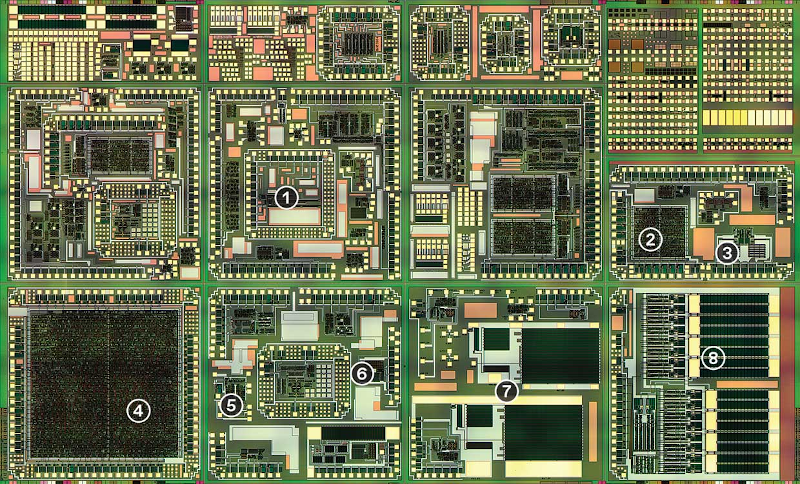

Silicon carbide chips can go to helland that is meant as a compliment. In the world of semiconductors, “hell” is not a dramatic metaphor invented by a bored engineer with too much coffee. It is a place with crushing heat, brutal voltage, radiation, vibration, unforgiving efficiency demands, and the kind of thermal stress that makes ordinary silicon start updating its résumé.
For decades, silicon has been the dependable workhorse of electronics. It powers phones, laptops, servers, cars, appliances, and the endless parade of blinking gadgets we pretend not to depend on. But when the job involves high voltage, high temperature, high frequency, or serious power conversion, silicon often needs help: bigger cooling systems, larger circuits, more protective design margins, and occasionally a gentle pat on the heat sink.
Silicon carbide, usually shortened to SiC, is built for nastier neighborhoods. It is a wide-bandgap semiconductor material used in power electronics, EV traction inverters, fast chargers, solar inverters, industrial motor drives, aerospace electronics, and extreme-environment sensors. Compared with traditional silicon, SiC can handle higher electric fields, switch faster, tolerate higher temperatures, and waste less energy as heat. In plain English: it can move serious electricity without turning the whole system into a toaster with ambition.
What Are Silicon Carbide Chips?
Silicon carbide chips are semiconductor devices made from a compound of silicon and carbon. The material is not new; silicon carbide has been known for more than a century and has long been used in abrasives, ceramics, and high-temperature applications. What is new is the modern ability to grow high-quality SiC crystals, slice them into wafers, fabricate power devices, and package them for demanding real-world systems.
In electronics, silicon carbide is mostly famous for power devices such as SiC MOSFETs, Schottky diodes, and power modules. These are not the same as the tiny logic chips that run your apps, stream your videos, or help your laptop pretend it is calm while 42 browser tabs are open. SiC is not trying to replace every silicon processor. It is focused on the rough-and-tumble world of power conversion: turning electricity from one form into another with less loss, less heat, and more control.
Think of ordinary computing chips as office workers. Think of SiC power chips as industrial electricians wearing flame-resistant boots. Both are important. Only one is volunteering to stand near hundreds or thousands of volts and say, “Sure, I can handle that.”
Why Silicon Carbide Is a Big Deal
1. It Handles Heat Like a Tiny Ceramic Viking
The headline feature of silicon carbide is toughness under heat. NASA’s work on SiC electronics has shown why the material gets engineers so excited: SiC circuits have been tested in extremely hot environments where conventional silicon electronics would need heavy protection, remote placement, or active cooling. NASA has demonstrated silicon carbide electronics operating at temperatures around 500°C and even in simulated Venus surface conditions. Venus, for the record, is not a spa. It is more like a pressure cooker with weather and commitment issues.
That heat tolerance matters because cooling is expensive. In cars, aircraft, data centers, factories, and energy systems, every extra cooling component adds cost, weight, size, maintenance, and failure points. If electronics can survive closer to the hot action, designers can simplify systems. That is the magic trick: not just making a chip that survives heat, but changing the architecture around it.
2. It Wastes Less Energy
Power conversion always involves losses. When electricity moves through an inverter, charger, converter, or power supply, some energy becomes heat. That heat is not useful; it is your money leaving through the thermal vent wearing sunglasses.
Silicon carbide devices can reduce both conduction losses and switching losses in many high-voltage applications. Because SiC can switch faster and operate efficiently at higher voltages, engineers can often design smaller, lighter, more efficient systems. In electric vehicles, that can help improve range, reduce cooling burden, or allow more compact power electronics. In fast chargers, it can help deliver more power with better efficiency. In renewable energy systems, it can help convert electricity from solar panels or batteries with fewer losses.
3. It Makes EVs More Efficient
Electric vehicles are one of the biggest reasons silicon carbide became a boardroom buzzword rather than a laboratory curiosity. An EV traction inverter converts DC power from the battery into AC power for the motor. That conversion happens constantly while the vehicle moves, accelerates, climbs hills, and recovers energy through regenerative braking.
When the inverter is more efficient, less energy is wasted as heat. That can support longer driving range, stronger performance, lighter cooling systems, or improved charging architecture. SiC is especially attractive in higher-voltage EV platforms, such as 800-volt systems, where efficiency and power density become even more important.
Of course, SiC does not magically turn every EV into a spaceship. Battery chemistry, aerodynamics, tires, motor design, software, and vehicle weight still matter. But in the powertrain, SiC is one of those behind-the-scenes upgrades that can make the whole machine feel sharper and waste less energy while doing it.
The “Hell” Silicon Carbide Can Survive
The title “Silicon Carbide Chips Can Go To Hell” works because SiC has a talent for places where electronics usually complain. These chips are useful in environments where heat, voltage, and reliability demands get intense.
Venus-Like Heat
NASA has studied SiC electronics for missions to hostile planetary environments. Venus is an especially nasty test case because its surface temperature is hot enough to melt some metals, and its atmospheric pressure is far higher than Earth’s. Traditional electronics would need serious protection to survive for long periods there. SiC opens the door to sensors and control electronics that can operate longer without bulky cooling or shielding.
Aircraft Engines and Industrial Systems
High-temperature electronics are also valuable in aerospace and industrial settings. Sensors placed closer to engines, turbines, pumps, and combustion systems can provide better real-time data. Instead of routing signals through long cables from a safe, cooler location, rugged electronics can sit nearer the source. That can improve monitoring, reduce wiring complexity, and make systems smarter.
High-Voltage Grids and Renewable Energy
Modern electricity is not polite. Solar farms, battery storage systems, wind power, electric vehicle chargers, and industrial drives all require power electronics that can handle large voltages and currents efficiently. SiC devices can support compact, high-efficiency designs in these areas, helping reduce energy losses as electricity is converted, controlled, and delivered.
AI Data Centers
AI data centers are hungry. Very hungry. They do not just consume electricity; they ask for it in bulk, then create heat like they are auditioning for a volcano documentary. Silicon carbide is increasingly discussed for data center power infrastructure because even small efficiency improvements can matter when power is converted multiple times before reaching processors and accelerators.
In data centers, wasted power becomes a double problem. First, the operator pays for electricity that never becomes useful computing. Second, the operator pays again to remove the heat created by that wasted electricity. That is why power efficiency is not a boring spreadsheet issue. It is a direct operating-cost issue, a cooling issue, and sometimes even a site-planning issue.
Silicon Carbide vs. Silicon: The Honest Comparison
Silicon carbide is not “better than silicon” in every way. That kind of claim belongs on a bumper sticker, not in a serious article. Silicon remains unbeatable for mainstream logic, memory, and low-cost electronics because the global silicon manufacturing ecosystem is mature, enormous, and ridiculously optimized.
SiC shines where silicon struggles: high voltage, high power, high temperature, and high switching frequency. The tradeoff is cost and manufacturing difficulty. SiC wafers are harder to grow, defects are harder to manage, and device fabrication has historically been more expensive. Silicon is like mass-produced bread. Silicon carbide is like artisan sourdough baked during a thunderstorm by someone with a materials science degree.
That is changing, though. Industry investments in larger wafers, improved crystal growth, better packaging, and higher-volume manufacturing are helping SiC scale. Companies are moving from 150mm to 200mm wafers, and research announcements around 300mm SiC technology suggest that the long-term manufacturing roadmap is getting more ambitious. Bigger wafers can improve throughput and potentially reduce cost over time, although getting there is not as simple as making the pizza larger.
The Reliability Problem Nobody Should Ignore
Silicon carbide is tough, but it is not magic. Reliability remains one of the most important technical topics in SiC power electronics. Researchers and standards bodies have studied issues such as gate oxide reliability, defects, threshold voltage shifts, packaging stress, thermal cycling, and long-term degradation.
One reason SiC MOSFET reliability is tricky is that the device structure often still uses silicon dioxide at the gate interface. That interface is not identical to ordinary silicon technology, and it can introduce challenges. In power systems, the chip is also exposed to high voltage, fast switching, heat, and repeated stress. A device may look great in a datasheet, but the real question is: how does it behave after years of hard work inside a car, charger, inverter, aircraft, or industrial machine?
That is why packaging matters so much. A SiC die may be impressive, but a power module is a team sport. Thermal resistance, parasitic inductance, layout, gate driving, insulation, solder fatigue, wire bonds, substrates, and cooling paths all affect performance. You cannot just drop a SiC MOSFET into an old silicon design and expect angels to sing. The system has to be designed around the device.
Where Silicon Carbide Chips Are Used Today
Electric Vehicles
SiC power modules are increasingly used in EV traction inverters, onboard chargers, and DC-DC converters. The strongest value appears in high-performance and higher-voltage platforms where efficiency, switching speed, and thermal performance justify the added cost.
Fast Charging
DC fast chargers need efficient, compact power conversion. SiC can help reduce losses and support higher switching frequencies, which may shrink passive components such as inductors and capacitors. That can lead to denser charger designs with better thermal behavior.
Solar and Energy Storage
Solar inverters and battery energy storage systems depend on efficient power conversion. SiC devices can help improve power density and reduce energy loss, especially as grid-connected systems grow more complex and more distributed.
Industrial Motor Drives
Factories use countless motors, and motors use a massive share of global electricity. More efficient drives can reduce energy waste, improve control, and lower cooling requirements. SiC can be useful in high-power motor-drive applications where switching performance and voltage capability matter.
Aerospace and Harsh Environments
SiC’s ability to tolerate heat and radiation makes it attractive for aerospace sensors, engine-adjacent electronics, and space exploration hardware. This is where the “go to hell” phrase becomes more than a joke. Sometimes the mission really does involve environments that laugh at ordinary electronics.
Recent Momentum: Bigger Wafers and Higher Voltages
The silicon carbide industry is moving quickly. Wolfspeed announced a commercially available 10 kV SiC power MOSFET in 2026, a signal that the market is pushing beyond conventional voltage classes into heavy-duty applications. The same company also announced progress in 300mm SiC technology, pointing toward a future where SiC manufacturing could become more scalable.
Meanwhile, companies such as onsemi, Microchip, and others are building SiC product portfolios for EVs, charging infrastructure, data centers, energy systems, and industrial conversion. Reuters has reported both the promise and the pressure in the sector: SiC is attractive because it improves efficiency, but the market has also faced uncertainty tied to EV demand cycles and expensive manufacturing expansion.
That tension is important. SiC is not a fairy tale where every company wins by sprinkling wide-bandgap dust on a quarterly report. It is a real industry with capital costs, yield challenges, supply-chain risk, customer qualification cycles, and brutal competition. The technology is exciting precisely because it is hard.
Why the Packaging Is Almost as Important as the Chip
A silicon carbide chip may be the star, but packaging is the stage, lighting, security team, and emergency exit plan. SiC switches fast, and fast switching can create electromagnetic noise, voltage overshoot, ringing, and layout headaches. Engineers must pay close attention to gate drivers, PCB layout, module parasitics, insulation, thermal paths, and protection circuits.
This is why SiC adoption often requires more than replacing one part number. The best results come when engineers redesign the system around SiC’s strengths. That may mean higher switching frequencies, smaller magnetics, better cooling, new module formats, or revised control strategies. Used carelessly, SiC can behave like a race car in a grocery store parking lot. Used properly, it can be elegant, efficient, and slightly intimidating.
The Cost Question: Why Isn’t Everything SiC Already?
The answer is simple: money, manufacturing, and maturity. SiC devices cost more than comparable silicon devices in many cases. For low-voltage, low-power, cost-sensitive products, silicon still makes more sense. A toaster does not need a premium wide-bandgap power stage unless that toaster is preparing for reentry from orbit.
SiC earns its place when system-level savings offset device-level cost. A more expensive SiC chip may be justified if it allows a smaller cooling system, lighter packaging, higher efficiency, longer range, faster charging, or reduced energy losses. The economics depend on the application. In a premium EV or megawatt-scale charger, the math may work beautifully. In a cheap wall adapter, maybe not.
Experiences and Practical Lessons from the World of Silicon Carbide Chips
Working with silicon carbide chips can feel like adopting a highly trained racing dog. It is fast, capable, impressive, and absolutely not interested in your lazy habits. Engineers who come from traditional silicon power designs often discover that SiC rewards precision and punishes casual assumptions.
The first experience many teams report is surprise at how much the surrounding system matters. A SiC MOSFET may promise low losses and high switching speed, but the moment it enters a real design, the layout starts speaking loudly. Stray inductance becomes a villain. Gate resistance becomes a negotiation. The thermal path becomes a courtroom drama. Suddenly, the problem is not “Which chip is best?” but “Can our entire design behave well at the speed this device wants to run?”
Another practical lesson is that heat does not disappear just because SiC is efficient. Lower losses are wonderful, but high-power systems still move serious energy. Thermal design remains essential. Heat sinks, substrates, baseplates, airflow, liquid cooling, interface materials, and sensor placement still matter. SiC gives engineers more room to work; it does not cancel physics. Physics, as usual, refuses to be unfriended.
Testing is also a different experience. Fast switching edges can create measurement problems that make ordinary oscilloscope habits look sloppy. Probe grounding, bandwidth, common-mode noise, and layout-induced artifacts can mislead even experienced teams. A waveform may look terrifying not because the circuit is failing, but because the measurement setup is acting like a tiny radio antenna with opinions.
There is also a learning curve in reliability thinking. SiC devices can survive harsh conditions, but harsh does not mean careless. Engineers must consider avalanche behavior, short-circuit withstand time, gate oxide stress, body diode operation, thermal cycling, and mission profiles. Automotive customers, aerospace teams, and industrial buyers do not simply ask whether a device is efficient on day one. They ask whether it will still behave after years of vibration, heat, moisture, overloads, and real users doing real-user things.
From a product-design perspective, one of the best experiences with SiC is discovering that efficiency gains can cascade. A more efficient inverter may need less cooling. Less cooling may reduce weight. Reduced weight may improve system performance. Smaller passive components may shrink the enclosure. A cleaner thermal design may improve reliability. One better power stage can ripple through the whole product like a well-behaved engineering domino chain.
But the opposite is also true. Poor implementation can waste SiC’s advantages. If the layout is sloppy, the gate driver mismatched, the package poorly cooled, or the control strategy unchanged from an older silicon design, the result may be expensive disappointment. SiC is not a magic sticker. It is a high-performance material that expects the rest of the design to show up dressed properly.
The most useful mindset is respect. Respect the voltage. Respect the switching speed. Respect the thermal path. Respect the qualification process. Silicon carbide chips can go to hell, yesbut they should not be sent there with bad layout, weak protection, and a shrug. Give them a proper system, and they can help build EVs that drive farther, chargers that run cooler, factories that waste less energy, data centers that sip power more intelligently, and spacecraft that survive places where ordinary electronics would immediately request vacation days.
Conclusion
Silicon carbide chips can go to hell because they were built for the jobs silicon would rather avoid. They tolerate heat, high voltage, fast switching, and harsh environments with a confidence that makes them essential for the next generation of power electronics. From electric vehicles and fast chargers to solar inverters, industrial drives, aerospace systems, and AI data center power infrastructure, SiC is becoming one of the most important materials in modern electrification.
Still, the story is not hype-only. Silicon carbide is expensive, difficult to manufacture, and demanding to design with. Reliability, packaging, testing, and system integration all matter. The winners will not be the teams that simply buy SiC parts. The winners will be the teams that understand how to use them.
In the end, silicon carbide is not replacing silicon everywhere. It is doing something more interesting: taking over the brutal power jobs where efficiency, heat tolerance, and voltage handling matter most. Silicon can keep the office. Silicon carbide is heading into the furnace with a clipboard.


