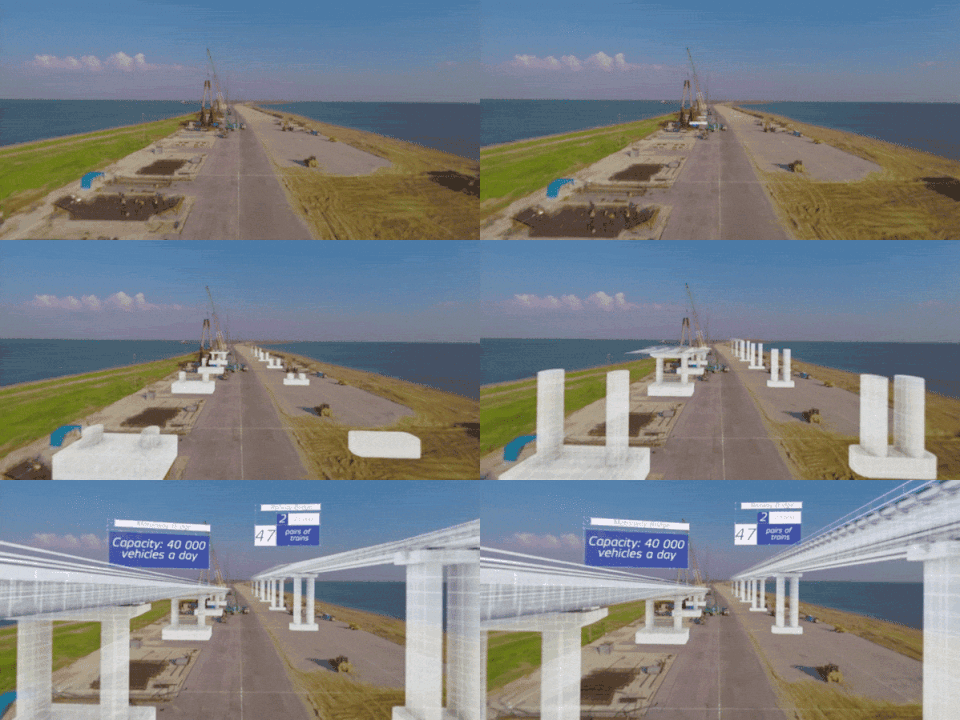

Some bridges are built to shorten a journey. Others are built to make a political statement so loudly that even the concrete seems to be clearing its throat. The Crimean Bridge, also known as the Kerch Strait Bridge, belongs firmly in the second category. Stretching roughly 19 kilometers across the Kerch Strait, it links Russia’s Taman Peninsula with Crimea, the Ukrainian peninsula Moscow seized and annexed in 2014. On paper, it is a road-and-rail infrastructure project. In reality, it is a monument, a military artery, a sanctions magnet, a propaganda stage, and one of the most famous targets in the Russia-Ukraine war.
Russia’s long, troubled bridge to Crimea was never just about traffic. It was about control. It was about showing that Moscow intended to physically bind Crimea to Russia even while most of the world continued to recognize Crimea as part of Ukraine. The bridge promised convenience for civilians, smoother freight movement, and a glossy new symbol of permanence. But like many symbols built in a hurry and defended in a war, it soon became less a trophy than a headache with guardrails.
What Is the Crimean Bridge?
The Crimean Bridge is a pair of parallel structures: a four-lane road bridge and a double-track railway bridge. It crosses the Kerch Strait, the narrow waterway connecting the Black Sea and the Sea of Azov. Russia opened the road section in May 2018, with President Vladimir Putin personally driving a truck across it for the cameras. The rail section opened later, with passenger service beginning in late 2019 and freight service following in 2020.
At about 12 miles long, the bridge became one of the largest infrastructure projects Russia had completed in the post-Soviet era. Russian officials promoted it as Europe’s longest bridge and a marvel of engineering. Critics saw something else: a giant political staple driven through contested territory. The United States and its allies condemned the project as a violation of Ukrainian sovereignty, and Washington sanctioned multiple companies and individuals connected to its construction.
Why Russia Built the Bridge
After Russia seized Crimea in 2014, Moscow faced a practical problem. Crimea was politically occupied, but geographically awkward. Before the bridge, Russia relied on ferries, air routes, and sea transport to move people and goods to the peninsula. Ukraine still controlled much of the land access, and that created a logistical vulnerability for Moscow.
The Kerch Strait Bridge was designed to solve that problem. It gave Russia a direct road and rail link to Crimea without passing through Ukrainian-controlled territory. It helped transport tourists, consumer goods, construction materials, fuel, and eventually military supplies. In Moscow’s official narrative, the bridge was proof that Crimea had been “reunited” with Russia. In Kyiv’s view, it was proof that Russia was trying to cement an illegal occupation with steel, asphalt, and a very expensive ribbon-cutting ceremony.
A Bridge Built for More Than Cars
The public-facing image of the bridge was cheerful: vacationers driving to beaches, freight moving faster, families skipping ferry queues. But the bridge also carried obvious military significance. Once Russia launched its full-scale invasion of Ukraine in February 2022, the bridge became part of a broader supply network supporting Russian forces in Crimea and southern Ukraine. It helped move equipment, ammunition, personnel, and fuel. That made it not only symbolic but operationally valuable.
For Ukraine, this turned the Crimean Bridge into a legitimate strategic target. Kyiv has repeatedly argued that infrastructure used to support Russia’s war effort is not simply civilian scenery. Moscow, unsurprisingly, calls attacks on the bridge terrorism. The disagreement is not just rhetorical; it sits at the center of how both sides explain the war to the world.
The Engineering Challenge Beneath the Politics
Even without war, building across the Kerch Strait was no weekend DIY project. The area has difficult geology, strong currents, mud volcanoes, shallow waters, and a history of harsh weather. Earlier bridge ideas go back more than a century. During World War II, German and Soviet forces both tried versions of a Kerch crossing. A Soviet railway bridge built in 1944–45 was damaged by ice and soon dismantled.
Modern Russia approached the project with enormous political urgency. The bridge reportedly cost hundreds of billions of rubles and required thousands of piles, access roads, railway connections, and marine construction work. The official message was triumph: Russia could build big, fast, and under sanctions pressure. But critics questioned whether the project was rushed for political theater and whether the long-term environmental and shipping consequences had been properly considered.
Legal Trouble: Ukraine, Sovereignty, and Sanctions
The bridge’s legal controversy begins with Crimea itself. Russia annexed Crimea in 2014 after a disputed referendum held under Russian military presence. Ukraine, the United States, the European Union, NATO, and many other governments rejected the annexation. From that perspective, Russia did not build a bridge to its own territory; it built infrastructure into occupied Ukrainian land without Ukraine’s consent.
That is why the United States imposed sanctions on companies involved in the Kerch Bridge project, including construction and design entities. U.S. officials described the bridge as part of Russia’s effort to consolidate control over Crimea. The legal issue was not a footnote. It shaped financing, insurance, contracts, and international cooperation. The bridge became a case study in how infrastructure can become geopolitics poured into concrete.
The Sea of Azov Problem
The Kerch Strait is not just a scenic gap between landmasses. It is the maritime doorway between the Black Sea and the Sea of Azov, where Ukrainian ports such as Mariupol and Berdyansk once played major commercial roles. Ukraine and Western governments have accused Russia of using its control around the bridge and the strait to restrict shipping and pressure Ukraine economically.
The bridge’s design includes a large arch span for ships, but critics have argued that its clearance limits the size of vessels able to pass into the Sea of Azov. In 2018, tensions exploded when Russian forces seized Ukrainian naval vessels near the Kerch Strait after blocking passage. That incident pushed Ukraine to declare martial law in several regions and reminded the world that the bridge was not sitting peacefully above geopolitics; it was parked right in the middle of it, hazard lights blinking.
The 2022 Explosion: A Birthday Surprise Moscow Did Not Enjoy
On October 8, 2022, a massive explosion damaged the Crimean Bridge. Russian authorities said a truck bomb caused the blast, which collapsed parts of the road bridge and set fuel tankers on the rail bridge ablaze. The explosion came one day after Putin’s 70th birthday, a timing detail that Ukraine’s online commentariat treated with the subtlety of a marching band.
The damage was both practical and symbolic. Traffic was disrupted, repairs began quickly, and Russia tightened security. But the psychological impact was harder to patch. The bridge had been sold as a protected national achievement. Seeing it burning on video punctured the aura of invulnerability that Moscow had tried to wrap around Crimea. Ukraine’s security service later claimed responsibility for the operation.
The 2023 Attack: Sea Drones Enter the Story
In July 2023, the bridge was hit again, this time in an attack widely associated with Ukrainian maritime drones. The strike damaged the road section and temporarily halted traffic. Two civilians were reported killed. Russia blamed Ukraine and launched retaliatory strikes, including attacks on Ukrainian port infrastructure after Moscow withdrew from the Black Sea grain deal.
The 2023 attack mattered because it showed how Ukraine was adapting. Instead of relying only on missiles or conventional sabotage, Ukrainian forces demonstrated the growing importance of unmanned surface vessels in the Black Sea. Cheap, innovative, and difficult to defend against perfectly, sea drones became a signature of Ukraine’s campaign against Russian naval and logistical assets.
The 2025 Underwater Strike
In June 2025, Ukraine’s Security Service said it had struck the Crimean Bridge again, this time using underwater explosives against bridge supports. The agency claimed the operation involved the equivalent of 1,100 kilograms of explosives. Russian authorities temporarily suspended traffic but publicly downplayed the damage. Reuters verified the location of video released by Ukraine but could not independently confirm the exact timing of the blast.
This episode reinforced a pattern: the bridge may still function, but it no longer functions as a simple symbol of Russian confidence. Every closure, inspection, repair, and defensive upgrade turns it into a reminder that occupation infrastructure is vulnerable. Moscow can rebuild road spans and place floating barriers, but it cannot easily rebuild the myth that Crimea is safely out of reach.
How Russia Defends the Bridge
Russia has treated the Crimean Bridge like a prized asset surrounded by increasingly nervous bodyguards. Its defenses have reportedly included air defense systems, naval patrols, smoke screens, barriers, floating booms, and barges designed to complicate sea-drone approaches. Security checks on vehicles have also caused traffic delays, especially during tourist season.
Yet defending a 19-kilometer bridge in wartime is brutally difficult. A bridge is long, fixed, visible, and impossible to hide. It has approaches, support structures, rail lines, road decks, power systems, and nearby logistics nodes. In military terms, it is not one target but a menu. And for Ukraine, whose forces have repeatedly shown creativity in long-range strikes, the bridge remains a tempting plate.
Has the Bridge Lost Military Importance?
The Crimean Bridge was once Russia’s most direct physical connection to Crimea. But after the 2022 invasion, Moscow also carved out a so-called land bridge through occupied parts of southern Ukraine, including areas of Donetsk, Zaporizhzhia, and Kherson regions. Russia has also worked on alternative rail routes through occupied territory. These routes may reduce dependence on the Kerch crossing.
That does not make the Crimean Bridge irrelevant. It still matters for civilian movement, propaganda, logistics, and political symbolism. However, its military role appears to have changed. If Russia uses it less for heavy military transport because of Ukrainian threats, that itself is a Ukrainian success. A bridge does not have to fall into the sea to become strategically weakened. Sometimes it only has to make planners nervous enough to reroute the trucks.
Why the Bridge Still Matters So Much
The Crimean Bridge matters because it sits at the intersection of five major issues: sovereignty, logistics, propaganda, maritime access, and morale. For Russia, it is a claim made physical. For Ukraine, it is an occupation symbol and a supply line. For military analysts, it is a case study in modern precision warfare. For civilians, it is a road that can suddenly become a checkpoint, a traffic jam, or a headline.
The bridge also matters because Crimea matters. Sevastopol hosts Russia’s Black Sea Fleet, though Ukraine’s strikes have forced Russia to adjust its naval posture. Crimea provides air bases, ports, radar sites, and logistical depth. Control of Crimea affects the Black Sea, southern Ukraine, and even global grain routes. The bridge is not the whole Crimea story, but it is one of the most visible chapters.
Propaganda, Prestige, and the Problem With Symbols
Authoritarian governments love giant infrastructure because it photographs well. A bridge says movement, permanence, competence, destiny. It is a national selfie stick made of steel. Putin’s truck drive across the Crimean Bridge in 2018 was designed to show confidence and control. The message was simple: Russia came, Russia built, Russia stays.
But symbols are dangerous because they invite symbolic blows. When Ukraine damages the bridge, the effect is not only measured in repair costs. It is measured in memes, morale, military uncertainty, and diplomatic attention. The more Moscow celebrates the bridge, the more humiliating every successful strike becomes. That is the awkward bargain of prestige projects: once you turn concrete into mythology, cracks become news.
Economic and Civilian Impact
For people living in or traveling to Crimea, the bridge has had real civilian significance. It made road travel easier, reduced dependence on ferries, and supported tourism and commerce. Russian families used it for summer vacations. Trucks used it to move goods. Local businesses benefited from improved access to Russia’s mainland economy.
War changed the experience. Security checks, closures, explosions, and military traffic made the bridge feel less like a normal highway and more like a tense border crossing pretending not to be one. Civilians using the bridge became unwilling participants in a geopolitical drama. The road may be smooth, but the context is anything but.
Environmental and Maritime Concerns
Ukraine and environmental observers have raised concerns about the bridge’s impact on the Kerch Strait ecosystem, fish migration, sediment movement, and local maritime conditions. Large infrastructure in shallow, sensitive waters can alter currents and disrupt habitats. Add military activity, ship restrictions, explosions, and emergency repairs, and the environmental picture becomes even murkier.
The bridge also changed maritime behavior in the region. Russia’s control over the strait, combined with the physical presence of the bridge, gave Moscow more leverage over movement between the Black Sea and the Sea of Azov. For Ukraine, that has economic and security consequences far beyond the bridge itself.
Experiences and Lessons From Russia’s Long, Troubled Bridge to Crimea
To understand Russia’s long, troubled bridge to Crimea, imagine approaching it not as a soldier or politician, but as a traveler. The road stretches ahead like a promise: clean lanes, big sky, water on both sides, and the strange confidence of modern engineering. For a moment, it might look ordinary. That is the trick of infrastructure. A bridge can make enormous political conflict feel like a commute. You see asphalt before you see annexation. You see rail tracks before you see sanctions. You see traffic signs before you see the war map.
But the Crimean Bridge teaches that infrastructure is never neutral when it is built across contested land. A truck driver may think about fuel costs and delivery times. A family may think about the beach. A military planner sees routes, chokepoints, replacement capacity, and vulnerability. A diplomat sees sovereignty. A journalist sees symbolism. A Ukrainian citizen may see occupation made concrete. A Russian television producer may see a perfect camera angle. Everyone is looking at the same bridge, but nobody is seeing the same thing.
One experience connected to this topic is the way bridges change emotion after an attack. Before 2022, Moscow presented the Kerch Bridge as a finished sentence: Crimea is connected, the matter is closed. After the explosions, the punctuation changed. Suddenly the bridge became a question mark. Could it be defended? Could it be repaired fast enough? Could Russia keep using it for war? Could Ukraine hit it again? The structure still stood, but the certainty around it had been damaged.
Another lesson is that modern war has made “rear areas” feel much closer to the front. In older thinking, a bridge far behind the line might seem safe. Ukraine’s use of drones, sabotage, missiles, and maritime innovation has challenged that assumption. The Kerch Bridge shows how distance no longer guarantees security. A fixed asset in a predictable location is always sending an invitation to enemy planners, even if the invitation is written in reinforced concrete.
There is also a human experience here: waiting. Waiting at checkpoints. Waiting during temporary closures. Waiting for official explanations that may be incomplete. Waiting for repairs. Waiting for the next warning. People who depend on contested infrastructure live with uncertainty baked into daily life. A bridge that was supposed to simplify movement can become a source of anxiety. The same span that once promised convenience can suddenly ask every traveler an uncomfortable question: what happens if the road home closes?
For analysts, the bridge offers a broader experience in humility. Big infrastructure can change strategy, but it cannot erase politics. Russia built the bridge to make Crimea feel permanently attached. Instead, the bridge became a permanent reminder that the status of Crimea remains disputed, militarized, and unresolved. It helped Russia, but it also gave Ukraine a visible target. It projected strength, but it created vulnerability. It shortened the route to Crimea, but it lengthened the list of problems Moscow must manage.
The most important experience, perhaps, is recognizing how physical objects carry political memory. The Crimean Bridge is not merely a way across water. It is a timeline: 2014 annexation, 2018 opening ceremony, 2022 explosion, 2023 sea-drone attack, 2025 underwater strike, and continuing military tension. Every event adds another layer. Every repair patch becomes part of the story. In that sense, Russia’s bridge to Crimea is long not only in kilometers, but in consequences.
Conclusion: A Bridge That Cannot Escape the War
Russia’s Long, Troubled Bridge to Crimea is more than a massive crossing over the Kerch Strait. It is a physical argument about territory, power, and permanence. Russia built it to bind Crimea closer after an annexation the United States, Ukraine, and many other governments reject. The bridge improved access, supported logistics, and became a centerpiece of Russian messaging. But it also became a target because it served the war effort and symbolized occupation.
The Crimean Bridge still stands, but standing is not the same as winning. Its history now includes sanctions, legal disputes, maritime tensions, explosions, drone attacks, defensive improvisation, and strategic uncertainty. Moscow wanted a bridge that would settle the Crimea question. Instead, it built one of the clearest reminders that the question remains open, dangerous, and deeply contested.


