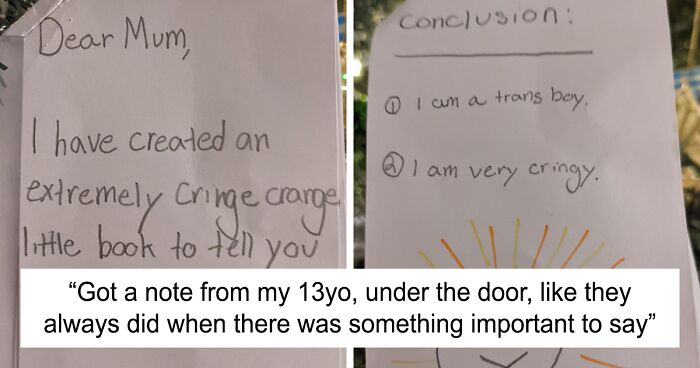

Coming out can arrive with a dramatic speech, a carefully timed family meeting, orwhen you are a clever 13-year-old with excellent comic instinctsa handmade booklet slipped under a bedroom door. In one widely shared story, writer and mother Amanda Mancino-Williams described how her teenager used drawings, wordplay, and a little science humor to tell her that he was her son.
The moment resonated because it was funny without making light of something important. More than that, the mother’s response centered pride, love, and gratitude. Her son had trusted her with a deeply personal truth, and she treated that trust as the gift it was. No interrogation lamp. No family press conference. No 27-part documentary titled Mom Processes a Pronoun. Just a child reaching out and a parent reaching back.
A Handmade Coming-Out Message With a Brilliant Punchline
The story first spread online in December 2020. According to the mother’s public account, her 13-year-old often placed notes under her door when something important felt easier to explain in writing. This time, the note came as a small illustrated booklet.
Its central joke moved from “daughter” to “son” through drawings: a dot represented the first word, while a bright sun represented the second. The teenager explained that the dot-based identity no longer fit and that being the glowing ball of gas was a much better match. It was a coming-out announcement, a visual pun, and a dad joke delivered before the kid was even old enough to drive. Frankly, that is advanced-level parenting energy coming from the child.
Why Writing May Feel Safer Than Speaking
For many teenagers, a written message creates breathing room. A face-to-face conversation can feel unpredictable, especially when the subject involves gender identity, sexual orientation, relationships, mental health, or another private part of life. Writing lets a young person choose the words, revise them, and communicate without being interrupted by nerves.
A letter or text does not make the conversation less sincere. It may actually show how carefully the teenager has thought about it. The format can also help a parent pause before responding, which is useful when the heart is racing and the brain has temporarily become a loading icon.
Why the Mother’s Reaction Matters So Much
The heart of this story is not simply that a teenager came out as transgender. It is that he apparently believed home was safe enough to do so. Trust like that is rarely built in one grand gesture. It grows through years of smaller signals: respectful conversations, listening without mockery, defending people who are treated unfairly, and making it clear that love is not conditional on a child following a script someone else wrote.
Leading pediatric and mental-health organizations consistently emphasize that family acceptance is associated with better well-being for LGBTQ+ young people. Transgender identity itself is not a mental illness. The serious risks many transgender and gender-diverse teenagers face are strongly connected to rejection, bullying, harassment, isolation, and discrimination. A supportive home cannot eliminate every challenge, but it can become a powerful protective base.
Acceptance Is Active, Not Merely Silent
A parent does not need a graduate degree in gender studies by breakfast the next morning. However, quiet tolerance is not always enough. A child should not have to decode whether “we still love you” means genuine acceptance or “we will avoid the topic until college.”
Active support can be simple. Use the child’s requested name and pronouns. Ask who else knows. Find out whether the child wants help telling siblings, relatives, teachers, or a doctor. Correct mistakes without turning each one into a five-minute apology opera.
Most importantly, keep showing affection and interest in the whole person. A transgender child is still the same kid who forgets a water glass upstairs, laughs at oddly specific memes, and suddenly needs poster board at 9:12 p.m. for a project due tomorrow.
How Parents Can Respond When a Child Comes Out
There is no single perfect sentence, but there are several good places to begin: “I love you.” “Thank you for trusting me.” “I’m glad you told me.” “What would feel supportive right now?” These responses make the child’s emotional safety the first priority.
1. Listen Before Trying to Solve Everything
Coming out is not necessarily a request for a complete action plan. Sometimes a child needs to be heard before discussing school records, clothing, hair, extended family, counseling, or health care. Ask open questions and let the teenager set the pace.
Useful questions include: “What name and pronouns would you like me to use?” “Should I use them everywhere or only with certain people?” “Is there anything you are worried about?” “Do you want advice, help, or just someone to listen?” The last question deserves a place on every refrigerator in America.
2. Protect the Child’s Privacy
A child coming out to one parent has not automatically given permission for a family-wide announcement. Before telling a spouse, grandparent, teacher, neighbor, or social-media audience, ask the child. Even a proud post can become an unwanted outing if the young person did not agree to it.
The mother in the viral story stated that she sought her children’s permission before sharing personal material. That detail matters. Pride and privacy can coexist. A parent can celebrate without turning a child’s identity into community property.
3. Follow the Child’s Lead on Names and Pronouns
Using a chosen name and correct pronouns is one of the clearest everyday ways to show respect. Parents may make mistakes at first, especially after years of habit. The best response is brief: apologize, correct the word, and continue. A small repair is more reassuring than a long speech about how difficult grammar has suddenly become.
4. Process Personal Emotions With Another Adult
A parent may feel surprised, worried, confused, protective, or uncertain about the future. Those feelings can be real without being placed on the child’s shoulders. A trusted counselor, knowledgeable pediatrician, parent-support group, or organization such as PFLAG can offer space to learn and process.
The child should not become the family’s full-time instructor, debate moderator, and emotional support specialist. Curiosity is welcome; making the teenager defend his existence at the dinner table is not.
5. Ask About School Safety
School can be a major source of belonging or stress. Talk privately about teachers, friends, bathrooms, locker rooms, sports, records, and bullying. Ask whether the student wants a parent to contact the school or prefers to begin with a counselor or trusted teacher. Never assume that being out at home means being out everywhere.
If bullying occurs, document incidents and communicate with school staff. Supportive adults, inclusive policies, student clubs, and respectful use of names and pronouns can improve a young person’s sense of safety and connection.
What This Story Teaches About Trust
The booklet was adorable, but its real message was larger than the joke. The teenager was effectively saying, “This is who I am, and I believe you can know.” That sentimentspoken or unspokenis one of the most meaningful compliments a parent can receive.
Trust does not require parents to know every answer. It requires them to remain present. A good response can include honest uncertainty: “I have things to learn, but I am with you.” That is far more reassuring than pretending to understand everything or reacting as though the family has entered an emergency.
Coming Out Is Usually a Process
Young people may try different words while understanding themselves. A teenager might identify as transgender, nonbinary, gender-fluid, questioning, gay, bisexual, or use no label at all. A label can remain stable, evolve, or become more specific. Supporting exploration does not force an outcome; it gives the young person room to communicate honestly.
Parents sometimes fear that affirmation means rushing into decisions. In ordinary family life, affirmation begins with listening, respect, and appropriate professional guidance when needed. Social, school, legal, and medical questions are separate conversations, and each should be approached thoughtfully rather than bundled into one panicked leap.
Small Supportive Actions That Carry Big Weight
Support often looks wonderfully ordinary. It can mean replacing a bedroom name sign, practicing pronouns privately, buying clothes the teenager feels comfortable wearing, or checking how a child wants to be introduced. It can mean refusing to laugh at transphobic jokes and correcting a relative who repeatedly uses the wrong name.
It also means keeping the rest of family life intact. Ask about homework, music, games, sports, friendships, and snacks. Gender identity is important, but it is not the only interesting thing about a young person. Nobody wants every trip to the grocery store to become a solemn summit on identity while the ice cream melts.
Watch for Signs That Extra Help Is Needed
Parents should pay attention to major changes in sleep, appetite, school attendance, mood, friendships, or interest in usual activities. Expressions of hopelessness, self-harm, or suicidal thinking require immediate attention from qualified professionals or crisis services.
Seeking help is not a sign that being transgender is the problem. It is a response to distress, which may be influenced by bullying, rejection, anxiety, depression, or other pressures.
A pediatrician or licensed mental-health professional experienced with LGBTQ+ youth can help families sort through concerns without shaming the child. Competence matters: supportive care should focus on the young person’s well-being, not on trying to force a predetermined identity.
Why Heartwarming Coming-Out Stories Still Matter
Positive stories do not erase the difficulties transgender youth may face. They do, however, show what is possible. They offer parents a model that is calmer than outrage-driven headlines and kinder than the assumption that every family conversation must become a battle.
This story became memorable because the teenager brought creativity and humor to a vulnerable moment, while his mother responded with pride. Their exchange reminded readers that acceptance is not an abstract political slogan inside a home. It is a series of choices: listen, believe, respect, protect, and keep loving out loud.
There is also something delightfully teenage about the entire presentation. The message was profound, but the delivery included a pun about celestial gas. That combinationsincerity wrapped in sillinessis often how adolescents survive emotionally intense moments. Humor can reduce fear, create connection, and allow a child to say something enormous without feeling swallowed by its enormity.
Related Experiences: What Families Often Learn After a Child Comes Out
The following examples are illustrative composites based on commonly reported family experiences. They are not additional claims about the family in the original viral story.
The Quiet Conversation After the Big Moment
After a child comes out, parents sometimes expect an immediate, life-changing discussion. Instead, the teenager may say, “Okay, cool,” ask whether there are any cookies, and disappear into a video game. This can feel anticlimactic, but it is often a good sign. The child may have spent weeks or months building up to the disclosure. Once the words are out, ordinary life is exactly what they want.
A useful follow-up might happen the next day: “I meant what I said. I love you, and I’m here. Is there anything you want me to know?” That keeps the door open without standing in the doorway with a clipboard.
The Parent Who Practices in Private
One common experience involves a parent who is fully supportive but keeps stumbling over a new name or pronoun. Rather than making the child absorb repeated mistakes, the parent practices while driving, cooking, or talking with a trusted adult who has permission to know. “He has soccer Tuesday. He likes that song. He needs new shoes.” Repetition builds a new habit.
When a mistake happens, the parent says, “Sorryhe,” and moves on. Over time, the correction becomes natural. The important lesson is that effort should be visible, while guilt should not become the main character.
The Extended-Family Challenge
Another frequent turning point comes when a relative responds poorly. A grandparent may insist that the change is confusing, or an uncle may treat respect as optional. The supportive parent then has to become an advocate, not merely a sympathetic observer.
A clear boundary can sound like this: “You do not have to understand everything today, but you do need to use his name and speak respectfully.” The goal is not to win a holiday debate. It is to make sure the young person does not learn that family harmony matters more than his dignity.
The School Meeting That Follows the Child’s Plan
Some teenagers want immediate changes at school; others want privacy. A supportive family asks before acting. Together, they may make a list: which teachers know, what name should appear in class, where the student feels safe, and who can help if bullying occurs.
The parent’s role is to provide backup, not seize control. A teen who chooses to speak during a school meeting can gain confidence and self-advocacy skills. A teen who asks the parent to speak is not less brave. Courage is not measured by how many uncomfortable adults a 13-year-old can educate before lunch.
The Relief Parents Sometimes Notice
Families often describe a child appearing lighter after being accepted. The teenager may talk more, participate more comfortably in family life, or show renewed interest in clothes, activities, and friendships. Not every problem disappears, and adolescence remains adolescencelaundry may still live permanently on the floorbut the child no longer has to spend as much energy hiding at home.
That relief helps explain why a loving first response matters. A parent cannot control the entire world, but they can make home a place where the child does not need armor.
Conclusion: The Best Response Begins With Love
The 13-year-old’s handmade booklet made people smile because it paired bravery with wit. Yet the most heartwarming part was the relationship behind it. He trusted his mother enough to share who he was, and she was proud enough to celebrate that trust.
Parents facing a similar moment do not need a flawless script. They need to listen, protect privacy, use respectful language, seek reliable information, and remind their child that love has not been reduced, delayed, or placed under review.
Sometimes the sentence that changes everything is also the simplest: “Thank you for telling me. I love you. We’ll figure this out together.”


