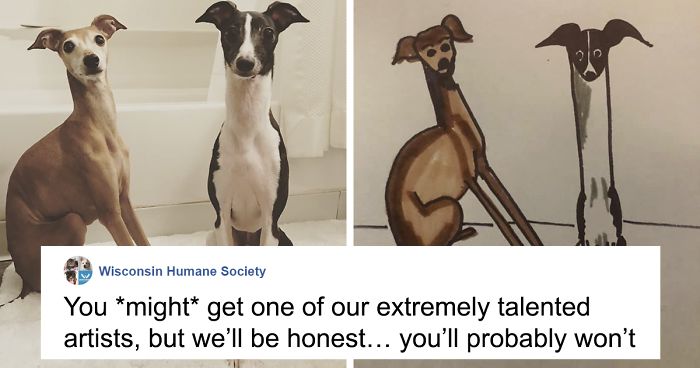
Humane Society Promises To Make A Bad Original Drawing Of Your Pet For A $15 Donation And Here’s The Results (35 Pics)

There are many reasons to donate to an animal shelter. You might want to help feed a hungry kitten, provide medical treatment for an injured dog, or give an abandoned rabbit a safe place to sleep. Receiving a hilariously inaccurate portrait of your own pet is not usually on the list.
The Wisconsin Humane Society changed that with a fundraising idea that was equal parts generosity, social-media genius, and artistic chaos. Supporters who donated $15 could submit a photograph of a beloved pet. In return, a member of the shelter’s staff or volunteer team would attempt to create an original portrait.
The word “attempt” was doing some serious work.
Some contributors received surprisingly polished illustrations. Others discovered what their dog might look like as a potato with eyebrows. Cats became fuzzy triangles. Elegant horses acquired legs that seemed to have been installed by different contractors. Yet every portrait had personality, and every donation supported animals that genuinely needed help.
A Simple $15 Idea That Became a Fundraising Sensation
The Wisconsin Humane Society launched its original poorly drawn pet portrait campaign in February 2020. The instructions were wonderfully straightforward: donate $15, post a pet photograph, and wait for an unpredictable work of art.
The shelter assembled a mixed group of employees and volunteers. A few had legitimate artistic skills. Many apparently regarded a sharpened crayon as advanced equipment. That uncertainty became the campaign’s biggest attraction. Donors were not purchasing a professional commission; they were buying a surprise and supporting a meaningful cause at the same time.
The response arrived almost immediately. Within approximately 48 hours, the organization received around 700 portrait submissions, raised about $12,000, and recruited more than 50 staff members and volunteers to tackle the growing artistic backlog.
The idea was inspired by an earlier fundraiser from Baltimore Animal Rescue and Care Shelter. That campaign reportedly brought in roughly $13,000, showing that questionable art could produce very respectable financial results. Helping Hands Humane Society later adapted the concept and raised about $1,200 during one of its early attempts.
In other words, this was not merely a collection of bad drawings. It became a repeatable model for community-centered animal shelter fundraising.
Why the 35 Pet Portrait Results Are So Entertaining
The collection of 35 pictures is funny because each portrait sits somewhere between recognizable likeness and complete zoological confusion. The artists often captured one essential characteristic while cheerfully losing control of everything else.
Some Artists Focused on One Memorable Feature
A dog’s giant ears might dominate the page. A cat’s suspicious expression could become the entire composition. A pet with a dramatic underbite might emerge as a floating mouth supported by several uncertain lines.
This selective accuracy is part of the charm. Pet owners instantly recognize the one expression, posture, or feature that defines their animal. The rest of the drawing may look like it was completed during turbulence, but the personality survives.
Ordinary Pets Became Mythical Creatures
When perspective and anatomy take the afternoon off, even a familiar pet can become a mysterious new species. A sitting dog may end up with the body of a beanbag chair. A long-haired cat can resemble an exploding dust mop. A rabbit may acquire the proportions of a kangaroo designed from memory.
These transformations are not failures in the traditional sense. They are visual punchlines. The original photograph sets up an expectation, and the handmade portrait delivers an affectionate surprise.
A Few Portraits Were Suspiciously Good
Not every participant received a drawing destined for the refrigerator’s least visible corner. Several volunteers clearly knew how to handle pencils, paint, or digital illustration tools. Their work included recognizable proportions, thoughtful shading, and carefully observed details.
That artistic lottery made the campaign even more exciting. A donor might receive a polished portrait suitable for framingor a circle with legs. Both outcomes were considered victories.
The Imperfections Made Every Picture Original
A professionally produced pet portrait may be beautiful, but it is expected to be beautiful. These drawings offered something different: evidence that a real person spent time studying a stranger’s pet and trying to capture it.
Crooked lines, improvised colors, oversized noses, and unexplained background objects gave each picture an identity that could not be duplicated by a template. The humor came from human interpretation rather than deliberate cruelty or mockery.
The Real Art Was the Fundraising Strategy
The Wisconsin Humane Society’s campaign worked because it removed several common obstacles to charitable giving.
The Donation Amount Felt Accessible
A $15 contribution was large enough to matter but small enough to feel approachable for many supporters. It also came with an immediate emotional reward: a personalized portrait and a story worth sharing.
Animal welfare fundraising guidance often recommends making a specific request, suggesting a clear amount, and simplifying the donation process. The poorly drawn pet fundraiser followed all three principles without sounding like a formal fundraising presentation.
The Campaign Was Easy to Understand
There were no complicated contest rules, elaborate ticket packages, or seven-page registration forms. People donated, submitted a pet photograph, and received artwork. The value proposition could fit into a single social-media post.
That clarity mattered. Supporters did not have to calculate what they were getting or wonder how to participate. They could make a quick decision, share a picture already stored on their phone, and join the fun.
Every Participant Helped Create Content
Traditional fundraisers often depend on an organization repeatedly producing new promotional material. This campaign encouraged the audience to supply much of the content.
Donors posted photographs. Artists replied with portraits. Friends commented, tagged other pet owners, and shared the funniest comparisons. Every new submission became a miniature advertisement for the fundraiser.
Best Friends Animal Society notes that compelling social content can help animal organizations reach beyond their existing audiences, attract financial support, recruit volunteers, and strengthen community trust. This campaign accomplished all of those goals with an endless supply of expressive animal faces.
It Made Donating Feel Like Participation
People were not simply transferring money and closing a browser tab. They were joining a collaborative event. The shelter, volunteers, donors, and pets all had a role.
Even people who did not donate could follow the results, laugh at the artwork, learn about the shelter, and potentially participate in future campaigns. That broader engagement gave the fundraiser value beyond its immediate financial total.
Why Animal Shelters Need Creative Fundraisers
The silly drawings were attached to a serious mission. Animal shelters must pay for food, cleaning supplies, safe housing, transportation, vaccinations, medical procedures, behavioral support, and trained staff. They also help reunite lost animals with families, support foster homes, promote adoptions, and provide community services intended to keep pets from being surrendered.
Shelter Animals Count estimated that 5.8 million cats and dogs entered shelters and rescue organizations across the United States during 2025. Approximately 4.2 million were adopted, illustrating both the scale of the work and the continued need for public support.
The ASPCA has also emphasized that many shelters are caring for growing proportions of animals with medical or behavioral challenges. These cases often require more time, specialized expertise, and financial resources than routine care.
A $15 donation will not independently operate an animal shelter. Hundreds of small donations, however, can fund substantial amounts of care. More importantly, a successful campaign can introduce the organization to people who may later adopt, foster, volunteer, donate supplies, or become recurring supporters.
From One Viral Event to a Lasting Animal Fundraising Trend
The success of poorly drawn pet portraits did not disappear after the first round. Shelters and rescue organizations around the country have continued adapting the concept with different prices, themes, delivery methods, and groups of volunteer artists.
The Wisconsin Humane Society eventually turned Poorly Drawn Pets into an annual event. By its sixth edition, the requested contribution had increased to $25, and outside groups such as Milwaukee Brewers employees had joined the drawing effort.
Pasadena Humane has also hosted versions of the fundraiser. A 2025 campaign attracted more than 450 submissions and reportedly raised approximately $11,000. Participants submitted everything from dogs and cats to birds, turtles, hamsters, and horses.
The Animal Foundation held its third annual version in 2026, charging $25 per pet and publishing hundreds of finished pieces online. Its rules explicitly required human-created artwork and prohibited AI-generated portraits, preserving the unpredictable handmade quality that made the concept popular in the first place.
That evolution demonstrates the strength of the original idea. It is inexpensive to organize, flexible enough for small or large shelters, suitable for online participation, and naturally designed for social sharing.
What Other Nonprofits Can Learn From Bad Pet Drawings
Offer an Experience, Not Just an Object
The finished portrait mattered, but anticipation was equally important. Donors wondered who would draw their pet, whether the result would be beautiful or baffling, and how their friends would react.
Nonprofits can apply the same principle without copying the exact idea. A fundraiser might offer personalized poems, handmade thank-you cards, humorous awards, custom voice messages, or volunteer-created crafts. The reward does not need to be expensive. It needs to be personal and memorable.
Use Honest Humor
The Humane Society did not pretend every volunteer was a professional illustrator. It turned the lack of guaranteed quality into the central joke.
That honesty lowered expectations while increasing curiosity. It also made the organization feel approachable. Supporters were invited to laugh with the shelter rather than being pressured through guilt.
Keep the Mission Visible
The comedy attracted attention, but the animals remained the reason for the campaign. Strong nonprofit content should connect the fun activity to its real impact.
A cheerful drawing fundraiser becomes more meaningful when supporters understand that proceeds help provide meals, medicine, shelter, and second chances. The humor opens the door; the mission gives people a reason to stay.
Prepare for Success Before Going Viral
The Wisconsin campaign received hundreds of requests in a short period. That sounds wonderful until someone remembers that every portrait requires a human being, a drawing tool, and at least a few uninterrupted minutes.
Shelters considering a similar event should recruit artists in advance, set a submission limit, establish a delivery schedule, create simple rules, and decide how completed portraits will be distributed. A campaign that raises money should not leave already busy shelter workers buried under 900 unfinished sketches of golden retrievers.
What the 35 Pictures Say About the Bond Between People and Pets
The collection is amusing, but its popularity also reveals how deeply people care about their animals.
Pet owners notice tiny details: the way a dog tilts its head, the expression a cat makes before knocking something off a shelf, or the precise shape of a rabbit’s ears when snacks appear. When those details show up in a drawingeven a clumsy onethe owner feels recognized.
Posting a pet photograph also gives people an opportunity to tell a story. A donor may explain that the animal was adopted from a shelter, survived an illness, helped the family through a difficult period, or has a bizarre habit involving laundry baskets.
Helping Hands Humane Society reported that its campaign comments developed into a lively community where supporters shared adoption stories and described the quirks of their pets. The fundraiser therefore produced more than donations; it encouraged conversations among people connected by a shared affection for animals.
Each awkward portrait became a small celebration of a specific animal. The dog did not need perfect proportions. The cat did not care whether the artist understood perspective. The picture mattered because the pet mattered.
A Participant’s Experience: From Pet Photo to Questionable Masterpiece
The following is a realistic composite of the experience commonly created by poorly drawn pet fundraisers rather than a claim of personal participation.
First comes the search for the perfect photograph. This sounds easy until you realize that most of your pet pictures fall into three categories: blurry movement, accidental close-ups of a nose, and sleeping poses that make the animal resemble a dropped winter coat.
You eventually choose a photograph that captures your pet’s personality. Perhaps your dog is sitting proudly with one ear pointing north and the other considering a different career. Maybe your cat is staring into the camera with the quiet disappointment of a manager reviewing your quarterly performance.
You make the donation, upload the photograph, and immediately begin imagining the possibilities. Will a talented volunteer create a sensitive watercolor? Will a child with a purple marker draw your Labrador as a six-legged submarine? There is no way to know.
Then comes the waiting. You check the fundraiser page more often than necessary. Other portraits appear. One pet receives a remarkably detailed illustration. Another becomes four rectangles connected by optimism. Your confidence rises and falls with every update.
Finally, your portrait arrives.
At first, you may need a moment. The head is too large. The eyes are looking in separate time zones. Your pet’s elegant tail has become something resembling a question mark attached during an emergency repair.
And yet the artist noticed the crooked ear.
That one detail changes everything. Suddenly, the drawing is not simply bad. It is your petfiltered through the hands, humor, and limited anatomical confidence of a stranger who volunteered time to help shelter animals.
You send the image to family members. Someone laughs. Someone suggests framing it. You place the photograph and portrait side by side on social media, where friends begin asking how they can get their own.
The shelter receives more attention. Another supporter donates. A volunteer feels proud that a ten-minute sketch produced a dozen smiles. People who came for the comedy discover adoptable animals, fostering information, community programs, and other ways to help.
Months later, the portrait may still be hanging near your desk. It is unlikely to impress an art historian, but it has a better story than most professionally printed decorations. It represents a pet you love, a volunteer willing to participate, and a small contribution transformed into real assistance.
That is the experience these campaigns sellnot artistic perfection, but connection. The donor feels involved, the volunteer contributes a personal skill or enthusiastic lack of skill, and the shelter turns attention into care for animals.
Conclusion: Delightfully Bad Art for a Genuinely Good Cause
The Wisconsin Humane Society’s $15 pet portrait fundraiser succeeded because it understood something important: charitable giving does not always need to feel formal or somber.
By promising unpredictable original artwork, the organization created a low-cost experience that people wanted to join and share. The campaign raised approximately $12,000 in about two days, generated hundreds of pet portraits, mobilized staff and volunteers, and inspired similar events at shelters across the country.
The 35 featured results range from charming to confusing, but that is exactly why they work. Each portrait contains humor, effort, and affection. More importantly, every oversized ear and mysteriously shaped paw helped direct attention toward animals in need.
Great fundraising does not always require a gala, a celebrity host, or a silent auction featuring a vacation package nobody understands. Sometimes it requires a pet photograph, a $15 donation, and one brave volunteer who has not drawn anything since elementary school.


