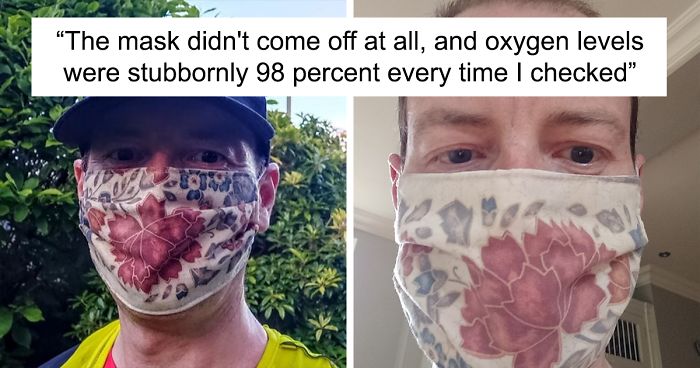

At some point during the mask debates, the internet became a strange place where a grocery-store face covering was treated like a portable oxygen dungeon. One person’s aunt shared a scary post. Someone’s neighbor claimed masks “trap carbon dioxide.” A guy in a parking lot became, somehow, an amateur respiratory physiologist. Then Dr. Tom Lawton, an intensive care doctor, decided to answer the rumor in the most doctor-meets-endurance-runner way possible: he ran about 22 miles while wearing a face mask and checked his oxygen levels along the way.
The result? His oxygen saturation stayed normal, reportedly hovering around 98 to 99 percent. In plain American English: his body was getting oxygen just fine. No dramatic collapse. No sci-fi suffocation scene. Just a sweaty doctor, a pulse oximeter, a cloth mask, and a very tired pair of legs.
The story went viral because it was simple, visual, and refreshingly practical. It did not require a 90-slide medical lecture or a whiteboard full of chemistry. It showed what health experts had been explaining all along: for most healthy people, wearing a properly fitted face mask does not lower oxygen levels. A mask may feel warm, annoying, humid, or socially awkward when you run into your ex at the pharmacy, but discomfort is not the same thing as oxygen deprivation.
Who Was the Doctor Behind the 22-Mile Mask Run?
The doctor at the center of the story was Dr. Tom Lawton, an ICU physician in the United Kingdom. During the COVID-19 pandemic, he saw misinformation spreading online about face masks. Some posts claimed that masks reduced oxygen intake or caused dangerous carbon dioxide buildup. Rather than simply telling people the claim was wrong, he created a real-world demonstration.
Lawton ran from home to work and back while wearing a cloth face mask. The route totaled roughly 22 to 22.5 miles, close to a marathon distance. He carried a pulse oximeter, a small device that clips onto a finger and estimates blood oxygen saturation. Throughout the run, he checked his oxygen level every 20 to 30 minutes. According to media reports, his readings stayed around 98 percent or higher, comfortably within the normal range for healthy adults.
His point was not that everyone should sprint across town in a mask before breakfast. Please do not make your local sidewalk your personal medical experiment. His message was more practical: if a healthy, trained runner can cover more than 20 miles in a mask without oxygen saturation dropping, then most healthy people can wear a mask for ordinary tasks like shopping, riding public transportation, visiting a clinic, or standing in line while silently judging someone’s 47-item “express lane” cart.
Do Face Masks Lower Oxygen Levels?
For most healthy people, the answer is no. Face masks and respirators are designed to let air pass through while blocking or reducing respiratory droplets and particles. Oxygen and carbon dioxide molecules are tiny. They are much smaller than the droplets that masks are meant to reduce. That is why doctors, nurses, dentists, lab workers, construction workers, and many other professionals can wear masks or respirators for long periods while still breathing safely.
What masks can do is make breathing feel different. A mask adds a layer between your mouth, nose, and the open air. That can create warmth, moisture, and a mild sense of resistance. During exercise, especially intense exercise, that sensation may be more noticeable. You may feel hotter. Your face may sweat. Your workout may feel harder. Your breathing may sound like you are auditioning for a dragon role in a low-budget fantasy movie.
But feeling more effort is not the same as having low oxygen. Studies have generally found that masks do not meaningfully reduce oxygen saturation in healthy people during normal use, and many studies on exercise show that while masks may increase perceived exertion, oxygen levels usually remain within a safe range. That distinction matters because misinformation often confuses “this feels uncomfortable” with “this is medically dangerous.” Those are very different claims.
Understanding Oxygen Saturation Without Needing a Medical Degree
Oxygen saturation, often written as SpO2, tells you roughly how much oxygen your red blood cells are carrying. A pulse oximeter estimates this number using light. In many healthy adults, normal oxygen saturation is typically in the mid-to-high 90s. A reading of 98 percent, like the one reported during Lawton’s run, is very normal.
Pulse oximeters are useful, but they are not magical truth machines. Cold fingers, dark nail polish, movement, poor circulation, device quality, and user error can affect readings. Still, for a public demonstration, Lawton’s repeated normal readings gave people an easy way to understand the main point: the mask was not blocking his body from oxygenating his blood.
Think of it like wearing a light rain jacket. You may feel warmer. You may notice the fabric. You may complain about it, because complaining is a proud human tradition. But wearing the jacket does not mean the outside world has vanished. Similarly, a standard face mask changes the sensation of breathing, but it does not seal you inside an airless chamber.
Why the Mask Myth Became So Popular
The idea that masks lower oxygen levels spread widely because it sounds believable at first glance. When something covers your nose and mouth, your brain may interpret the sensation as restriction. Add anxiety, heat, exercise, poor mask fit, or a long grocery line, and the feeling can become unpleasant fast.
There is also a psychological factor. Breathing is one of those body functions we usually ignore until something calls attention to it. The moment you think too hard about breathing, you may suddenly feel as if you are doing it wrong. A mask can trigger that awareness. People may then assume the mask is depriving them of oxygen when the real issue is discomfort, anxiety, humidity, or simply not being used to the sensation.
Social media made the problem worse. A scary claim with a dramatic image travels faster than a careful explanation from a pulmonologist. “Masks are suffocating you!” is emotionally punchy. “For most people, masks do not significantly affect oxygen saturation, though comfort and medical exceptions should be considered” is accurate, but it does not exactly scream viral content.
What the Science Says About Masks, Oxygen, and Exercise
Research on masks and exercise has produced a consistent general message: masks may make physical activity feel more difficult, but they usually do not cause dangerous oxygen drops in healthy people. Some studies have found small changes in breathing patterns, heart rate, comfort, or carbon dioxide levels under certain conditions, especially during high-intensity exertion or with tight respirators. However, these changes are not the same as saying masks are broadly unsafe.
For everyday use, such as walking into a store, sitting in a waiting room, or riding a bus, the oxygen concern is even weaker. These activities demand far less from the body than a 22-mile run. If oxygen saturation remains stable during strenuous exercise in many healthy subjects, it is highly unlikely that a quick errand in a mask will suddenly starve a healthy person of oxygen.
That said, responsible health writing should avoid turning one dramatic example into a universal rule. Lawton’s run was a demonstration, not a randomized clinical trial. It involved one fit doctor who was comfortable running long distances. The broader scientific evidence matters more than one viral story. Fortunately, the broader evidence points in the same general direction: masks are safe for most people, and oxygen-level myths are exaggerated.
What About Carbon Dioxide?
Carbon dioxide, or CO2, is another common mask-related fear. The claim usually goes something like this: “You breathe out CO2, the mask traps it, then you breathe it back in.” It sounds neat, tidy, and alarming. It is also oversimplified.
Standard face masks are not airtight. Air moves through and around them. Carbon dioxide molecules are extremely small and pass through mask materials. Some CO2 may temporarily collect in the small space between the face and the mask, especially with tighter masks, but in most healthy people this does not translate into dangerous carbon dioxide poisoning. Medical professionals have worn masks for long shifts for decades without turning into woozy hospital zombies.
There are exceptions worth taking seriously. People with certain severe respiratory conditions, advanced heart disease, panic disorders, sensory issues, or other medical concerns may struggle with masks or need individualized advice. That does not make the general oxygen myth true; it simply means health advice should leave room for real human variation. Good public health guidance is not a sledgehammer. It is more like a seat belt: broadly useful, occasionally needing adjustment, and much better when people understand why it exists.
Why Masks Can Feel Harder During Workouts
Running in a mask is not the same as sitting in a mask. Exercise increases oxygen demand and carbon dioxide production. Your breathing becomes faster and deeper. A mask can increase the feeling of breathing resistance, trap heat and moisture, and make sweat collect around the face. This can make a workout feel harder even when oxygen saturation stays normal.
For runners, cyclists, gym-goers, and weekend warriors, the key is to separate safety from performance. You may not hit your best pace while masked. Your heart rate may climb slightly faster. You may need more breaks. Your face may feel like it is hosting a tiny tropical weather system. That does not automatically mean the mask is harming you.
People exercising in masks should use common sense. Start slower than usual. Avoid intense workouts in extreme heat. Choose a breathable, well-fitting mask when masking is needed. Replace a wet mask because moisture can make it less comfortable and less effective. Stop if you feel chest pain, severe shortness of breath, faintness, confusion, or symptoms that feel unusual for you. Listening to your body is not weakness; it is the body’s customer service department trying to get through.
What Lawton’s Run Provedand What It Did Not Prove
Dr. Lawton’s 22-mile mask run was powerful because it turned an abstract debate into a clear image. It showed that a healthy person could perform a demanding endurance effort in a mask while maintaining normal oxygen saturation. It challenged the claim that masks automatically cause oxygen levels to drop.
However, it did not prove that every person should run long distances in a mask. It did not prove that masks feel pleasant. It did not prove that people with serious medical conditions never need accommodations. It also did not prove that every type of face covering performs the same way. A thin cloth mask, surgical mask, KN95, and N95 respirator can differ in fit, filtration, comfort, and breathing resistance.
The best takeaway is balanced: masks do not generally lower oxygen levels in healthy people, but comfort, fit, activity level, heat, and personal health conditions matter. That is a far better message than either extreme: “Masks are deadly” or “Masks are always effortless.” Reality, as usual, is less dramatic and more useful.
How Masks Actually Help Reduce Respiratory Spread
Masks became a major public-health tool because respiratory viruses can spread through droplets and smaller particles released when people breathe, talk, cough, sneeze, sing, or passionately explain why their fantasy football team was robbed. A mask helps reduce the amount of respiratory material released into shared air. Better-fitting masks and respirators can also help reduce what the wearer inhales.
Masking works best as one layer of protection. Ventilation, staying home when sick, vaccination when appropriate, hand hygiene, testing, and avoiding crowded indoor spaces during outbreaks can all help reduce risk. A mask is not a force field. It is not an invisibility cloak. It is a filter and barrier that can reduce exposure when used correctly.
Fit matters. A mask should cover both the nose and mouth. Wearing it under the nose is like installing a screen door and leaving the window open. The mask should sit snugly without painful gaps. It should be clean and dry. If it is disposable, it should be replaced when dirty, damaged, or difficult to breathe through. If reusable, it should be washed according to instructions.
Common Mask Myths, Answered Simply
Myth 1: Masks cause low oxygen in healthy people.
For most healthy people, masks do not cause oxygen saturation to fall below normal levels. They may feel uncomfortable, especially during exertion, but discomfort is not the same as hypoxia.
Myth 2: If breathing feels harder, the mask is dangerous.
Not necessarily. A mask can increase perceived effort. Heat, moisture, anxiety, and activity intensity can all make breathing feel different. If symptoms are severe or unusual, stop and seek medical guidance.
Myth 3: Carbon dioxide gets trapped at dangerous levels.
For most healthy people using standard masks properly, dangerous CO2 buildup is not expected. People with certain health conditions should talk with a clinician about safe options.
Myth 4: One viral story proves everything.
Lawton’s run was a memorable demonstration, but the strongest conclusion comes from combining the story with physiology, clinical experience, and research studies.
Practical Tips for Wearing a Mask More Comfortably
If you need or choose to wear a mask, comfort makes consistency easier. Choose a mask that fits your face without sliding. Try different shapes if ear loops hurt or gaps form near the cheeks. For long wear, a mask with a nose wire can improve fit and reduce glasses fog, also known as the official sport of frustrated eyeglass owners.
Keep spare masks available. A damp mask can feel awful and may not perform as well. If you are exercising, commuting, or working a long shift, having a backup can save your face from swamp mode. For sensitive skin, wash reusable masks with fragrance-free detergent and avoid heavy makeup under the mask when possible.
If masks make you anxious, practice wearing one for short periods in a calm setting. Breathe slowly through your nose if comfortable. Remind yourself that the sensation is not the same as oxygen loss. Gradual exposure can help the brain stop treating the mask like an emergency alert.
When to Ask a Doctor About Mask Use
Most people can wear masks safely, but some should check with a healthcare professional. This includes people with severe chronic lung disease, certain heart conditions, significant breathing disorders, panic attacks triggered by face coverings, developmental or sensory challenges, or conditions that make it difficult to remove a mask without help.
Children under age 2 should not wear masks because of safety concerns. Anyone who is unconscious, unable to remove a mask, or having severe breathing trouble should not be masked in a way that delays medical care. Public-health advice should never override urgent common sense.
For everyone else, the practical question is not “Will a mask steal my oxygen?” It is “Which type of mask fits well, feels tolerable, and makes sense for the risk level of this situation?” That is a more useful conversationand one with fewer Facebook comment wars.
Experiences and Real-Life Lessons From the 22-Mile Mask Run
The most interesting part of Dr. Lawton’s run is not just the number 22. It is the way the story turned public health into something people could picture. Many health messages fail because they sound abstract. “Respiratory droplets,” “oxygen saturation,” and “aerosol transmission” are accurate terms, but they do not exactly make people put down their coffee and say, “Tell me more, science wizard.” A doctor running nearly a marathon in a mask, however, is instantly understandable.
One lesson from the experience is that demonstrations can cut through noise when explanations alone do not. People who distrust official guidance may ignore charts, but they may pause when they see a physician test a claim on his own body while measuring the result. That does not mean every health question should be settled by stunts. Science still matters more than spectacle. But a smart demonstration can open the door for better understanding.
Another lesson is that fear often hides inside physical discomfort. Many people genuinely felt uneasy in masks. Some felt hot. Some felt claustrophobic. Some noticed their breathing more than usual. Those experiences were real. The mistake was turning those feelings into a false medical conclusion: “I feel uncomfortable, therefore my oxygen must be dropping.” Lawton’s run helped separate sensation from physiology. A mask can be annoying without being dangerous.
The story also shows why health communication needs empathy. It is easy to mock people for believing myths, but fear spreads when people feel dismissed. A better approach is to say, “Yes, masks can feel strange. Here is what is happening. Here is what is not happening. Here is when to seek medical advice.” That tone respects people’s experiences while still correcting misinformation. In other words, you can fight bad science without acting like a smug human clipboard.
For athletes, the run offered a useful reminder: performance and safety are not identical. A runner may feel slower or more uncomfortable in a mask, especially in warm weather. That does not mean oxygen levels are falling. It may mean the body is dealing with heat, moisture, breathing resistance, or simply the mental irritation of having fabric on the face. Training adjustments can help. Slow down, shorten the workout, carry spare masks, and avoid treating every run like an Olympic trial sponsored by stubbornness.
For parents, teachers, workers, and everyday shoppers, the story made mask use feel less mysterious. If an ICU doctor could run to work and back with stable oxygen readings, then a short masked errand was unlikely to be a respiratory crisis for a healthy adult. That kind of perspective mattered during a time when many people were scared, overloaded with information, and trying to make daily decisions in a fast-changing pandemic.
The experience also highlights the limits of “proof” in public life. Some people changed their minds. Others did not. Misinformation is sticky because it often serves an emotional purpose. It gives people a reason to reject something they dislike. A single run cannot fix distrust, political division, or social-media chaos. But it can give reasonable people a memorable example to lean on when rumors get loud.
Finally, Lawton’s run is a small case study in practical courage. He did not just argue online. He used his medical knowledge, his fitness, and a simple device to make a point. He communicated in a way people could understand. He also raised attention for a charitable cause, which is a nice bonus in a story that already had enough sweat to qualify as weather.
The lasting message is not that masks are perfect or that everyone loves wearing them. The message is that evidence matters. Oxygen saturation can be measured. Claims can be tested. Feelings can be acknowledged without being mistaken for facts. And sometimes, when misinformation runs wild, the best response is a doctor running 22 miles with a mask onquietly, stubbornly, and with perfectly normal oxygen levels.
Conclusion
Dr. Tom Lawton’s 22-mile masked run became famous because it answered a loud myth with a simple measurement. His oxygen levels stayed normal, reinforcing what medical experts and research have repeatedly explained: for most healthy people, wearing a face mask does not lower oxygen levels. Masks can feel warm, awkward, humid, or harder to breathe through during exercise, but those sensations do not automatically mean oxygen deprivation.
The smarter takeaway is balanced and practical. Wear a well-fitting mask when it makes sense for respiratory protection. Do not confuse discomfort with danger. Adjust workouts and daily routines when needed. Ask a healthcare professional if you have a condition that makes mask use difficult. And when social media starts shouting that a face covering turns humans into houseplants, remember the doctor, the 22 miles, the pulse oximeter, and the stubbornly normal oxygen readings.
Note: This article is for general informational purposes only and should not replace professional medical advice. People with serious breathing, heart, sensory, or anxiety-related concerns should ask a qualified healthcare professional about safe mask use.


