
Editorial note: This feature is based on real design reporting, profile interviews, and interiors references about Twig Hutchinson, modern rustic decorating, antiques, natural materials, and collected English-style homes. Key references include Remodelista’s coverage of Hutchinson’s London home and summerhouse, Hutchinson’s own professional profile, Light Locations, SheerLuxe, Collagerie, Up With The Lark, Architectural Digest, The Spruce, ELLE Decor, Veranda, and Martha Stewart.
Some interiors arrive wearing a tuxedo. Others show up in muddy boots, carrying an antique stool, a bunch of dried flowers, and a candle that smells faintly of old stone, rain, and excellent judgment. Twig Hutchinson’s world belongs to the second groupbut somehow, it still knows exactly which fork to use at dinner.
The phrase “rough, rustic, and refined” sounds like a contradiction until you see how Hutchinson works. Her spaces are not polished in the glossy, please-don’t-touch-the-sofa way. They are polished in the deeper sense: carefully edited, emotionally warm, full of texture, and rich with objects that look as if they have led interesting lives. The result is rustic design without clichés, refinement without stiffness, and comfort without the tragic overpopulation of throw pillows.
Hutchinson is known as a creative director, brand consultant, art director, and interior stylist working across interiors, fashion, and lifestyle. Her visual language is deeply layered but never cluttered. A neutral wall might meet an antique shutter. A rough wooden crate might become storage. A modern black pendant might hover above a country-style kitchen. In less skilled hands, this could look like a flea market had a nervous breakdown. In Hutchinson’s hands, it looks inevitable.
Who Is Twig Hutchinson?
Twig Hutchinson has built a career around atmosphere. She works with brands to shape visual worlds across product, space, and image, which helps explain why her interiors feel so complete. They are not just rooms; they are scenes with tone, character, and a very good camera angle.
Her background as an interior and prop stylist gives her rooms a rare precision. A prop stylist learns quickly that every object has a job. A jug is not just a jug. It can add height, texture, age, color, or a little wink of domestic poetry. A stool can soften a corner. A ceramic bowl can rescue a shelf from looking like it was arranged by someone afraid of joy.
Hutchinson’s own London home has been widely admired for its mix of early Victorian bones, rustic French-inspired details, humble materials, and clever reuse. Remodelista noted that she combined a small dining room and separate kitchen into one more functional space, refreshed a bathroom, and adjusted her summerhouse to make it more usable for photo shoots. That combination of practicality and beauty is central to her appeal. She does not decorate as if life is an interruption. She decorates as if life is the whole point.
The Beauty of the Mix
One of Hutchinson’s most memorable design ideas is simple: it is all in the mix. That does not mean tossing random objects into a room and hoping “eclectic” will cover the evidence. It means balancing opposites until they start talking to each other.
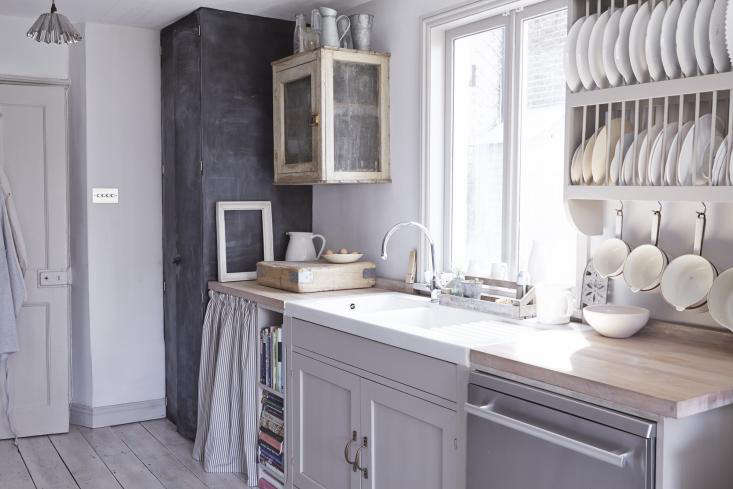
In her kitchen, rustic storage, painted cabinetry, antique shutters, and reclaimed details work alongside sharper modern lighting. The space has the soul of a country kitchen but the discipline of a stylist’s eye. Apple crates become wall storage. Old shutters are repurposed into furniture. Curtains appear where cabinet doors might be expected. The whole room feels relaxed, but nothing feels accidental.
This is the secret to modern rustic interiors: tension. Rough wood looks better beside smooth plaster. Handmade ceramics feel stronger next to marble. Linen becomes more elegant when paired with metal. A room full of only rustic pieces can become heavy; a room full of only sleek new pieces can feel cold. Hutchinson’s genius is knowing when to let the old chair speak and when to bring in a modern lamp to stop the conversation from turning into a historical reenactment.
Rough: Why Imperfection Works
Rustic interiors are often misunderstood. They do not require antlers, barn doors, or a sign that says “Gather,” especially if nobody is gathering because they are busy avoiding the sign. True rustic design is about material honesty: wood that looks like wood, stone that feels like stone, linen that wrinkles like it has a social life.
Hutchinson’s spaces celebrate surfaces that show use. A foxed mirror, a worn tabletop, a faded textile, or an old shutter carries a kind of visual memory. These pieces bring depth that cannot be bought in a hurry. New furniture may be beautiful, but older pieces often have the advantage of looking as if they have survived several dinner parties and at least one dramatic family announcement.
Design references from American interiors publications repeatedly point to natural materials, neutral palettes, reclaimed wood, stone, linen, wool, clay, and handmade objects as the backbone of rustic and farmhouse-inspired rooms. Hutchinson’s work aligns with that language but avoids the predictable. Her rustic is not theme-park rustic. It is quieter, more European, and more personal.
Rustic: The Warmth of Natural Materials
Natural materials are the emotional engine of Hutchinson-style decorating. Wood, linen, brass, ceramic, stone, cotton, and iron each bring a different temperature to a room. Wood warms. Stone grounds. Linen softens. Brass glows. Ceramics add handmade irregularity. Iron gives the room a backbone.
The key is not simply using natural materials; it is allowing them to remain themselves. A table does not need to be sanded into submission. A ceramic lamp does not need to match the vase. A linen curtain does not need to hang like a military uniform. The beauty is in the slight looseness, the lived-in ease, the feeling that the room has better things to do than impress a clipboard.
This is where Hutchinson’s design sensibility feels especially current. In a world of fast furniture and algorithm-perfect rooms, her approach values patina, craft, and individuality. A room should not look as if it was assembled in one weekend from a single cart. It should look collected, edited, and allowed to breathe.
Refined: The Discipline Behind the Charm
Refinement is often confused with luxury, but Hutchinson shows that refinement is really about restraint. Her rooms may include humble objects, but they are arranged with care. There is space around things. There are strong silhouettes. There is usually a calm palette holding the whole composition together.
A neutral foundation is crucial. Soft whites, chalky grays, warm creams, muted greens, and earthy browns create a background that allows texture to become the main event. Instead of shouting with color, the room whispers with surface: rough wood grain, ribbed glass, woven baskets, wrinkled linen, old metal, matte paint.
Then comes contrast. Hutchinson has spoken about liking opposing textures and introducing subtle pops of bright color through art or lighting. That little disruption matters. Without it, a rustic neutral room can become too polite. A mid-century lamp, abstract artwork, glossy ceramic, or black metal fixture adds the necessary spark. It is the design equivalent of wearing muddy gardening clothes with excellent earrings.
Lessons from the London Kitchen
The kitchen is often the best place to understand a designer’s philosophy because kitchens are brutally honest. They must work. You can make a living room look pretty with flowers and lighting, but a kitchen has to survive breakfast, spills, storage problems, and someone opening every drawer while asking where the scissors are.
Hutchinson’s kitchen demonstrates how rustic refinement can be practical. Combining the dining room and kitchen made the space more sociable and useful. Painted cabinetry gave a simple foundation character. Reclaimed handles added age. Fabric under-counter curtains introduced softness and a French country note. Wall-hung crates created storage without pretending to be sleek.
The lesson is not to copy every detail. The lesson is to ask better questions. Where can a humble material replace something generic? What existing object could be reused? Can storage be beautiful? Can one modern element sharpen the room? Can a color feel earthy instead of trendy?
The Summerhouse Effect
Hutchinson’s South London summerhouse is another excellent study in rustic restraint. It has been described as a white-washed garden structure used as a guest bedroom, with minimal furnishings, parquet flooring, underfloor heating, Shaker-style pegs, and a rustic ladder for storage. That combination is wonderfully telling: simple, useful, charming, and quietly clever.
The summerhouse proves that small spaces benefit from discipline. A compact room cannot carry too many design ideas without looking like a storage unit with ambition. Whitewashed walls maximize light. Peg rails make vertical storage attractive. A ladder offers function and sculptural shape. Wood flooring adds warmth. The room becomes spare but not sterile.
For homeowners, the takeaway is powerful: rustic refinement is not about square footage. It is about clarity. A small entry, guest room, garden office, or breakfast nook can carry the same mood if the materials are honest, the palette is calm, and the objects earn their keep.
How to Bring Twig Hutchinson’s Style Home
Start with a Quiet Palette
Begin with walls, floors, and large furniture in muted, natural tones. Think warm white, oatmeal, clay, mushroom, stone, faded green, or soft charcoal. This gives the room a flexible foundation and prevents rustic elements from feeling too busy.
Add One Rough Element
Choose something with texture and age: a reclaimed wood bench, antique stool, vintage mirror, weathered table, old basket, or hand-thrown vessel. One strong rustic piece is better than twelve items shouting, “I have character!” Character, like perfume, is best applied with restraint.
Balance It with Something Sharp
Introduce a modern lamp, black metal pendant, clean-lined chair, simple artwork, or crisp Roman shade. This keeps the room from becoming overly nostalgic. Rustic design needs contrast the way soup needs salt.
Use Storage as Decoration
Open shelves, peg rails, crates, hooks, and freestanding dressers can be both useful and beautiful. Display everyday objects that deserve to be seen: cutting boards, ceramics, folded linens, copper pans, brushes, baskets, and glassware.
Let Fabric Soften the Edges
Linen curtains, ticking stripes, loose slipcovers, wool throws, and simple cushions bring ease. Fabric is especially helpful in kitchens, bathrooms, and utility spaces where hard surfaces dominate.
Do Not Over-Perfect the Room
The most Hutchinson-like rooms have a little friction. Something handmade. Something old. Something slightly odd. Something that keeps the space human. Perfect rooms are impressive for five minutes. Lived-in rooms are lovable for years.
Why This Look Works Now
Modern rustic design continues to resonate because it answers a very modern problem: too much smoothness. We spend our days touching glass screens, scrolling through polished images, and living around objects designed to hide their construction. Rustic refinement brings back tactility. It gives the eye grain, weave, shadow, age, and evidence of the hand.
At the same time, the refined part keeps the look from feeling heavy or old-fashioned. Hutchinson’s style is not about retreating into the past. It is about borrowing the best parts of older interiorscraft, durability, patina, atmosphereand editing them for modern life.
That is why her work feels so appealing. It is aspirational but not icy. Beautiful but not bossy. It makes room for family, work, shoots, guests, flowers, books, ceramics, and probably a cup of tea that has gone cold because someone got distracted rearranging a shelf.
Experience: Living with Rough, Rustic, and Refined Style
The first thing you notice when you try to live with this kind of design is that it changes how you shop. Suddenly, the shiny new thing is not always the most tempting. You start looking at the old wooden chair in the corner of an antiques market and wondering if it has one more chapter left. You pick up a small ceramic bowl because the glaze is uneven in exactly the right way. You become the sort of person who says, “This has a nice patina,” which is dangerously close to becoming the sort of person who owns three nearly identical baskets.
But the real experience is not about shopping. It is about slowing down. A rough, rustic, and refined room asks you to notice. Morning light on limewashed walls. The scratch on a table that makes it less precious. The way a linen curtain moves when a window is cracked open. The shadow under a shelf of old plates. These are small pleasures, but interiors are built from small pleasures. Grand gestures are wonderful, but a home is mostly lived at the scale of a cup, a chair, a drawer pull, a lamp switch.
In practical terms, this style is forgiving. That may be its greatest luxury. A rustic table does not panic when someone sets down keys. A linen slipcover can wrinkle with dignity. A vintage stool can move from bathroom to bedroom to kitchen without requesting a formal transfer. Materials that age well are generous. They do not demand that life tiptoe around them.
There is also a sustainability lesson tucked inside the charm. Reusing old furniture, adapting crates into storage, recovering a quality sofa, or choosing antiques over disposable pieces can reduce waste while making a home more individual. The room gains depth, and the planet gets a tiny break. Not a bad deal, especially if the antique stool also looks fabulous next to the bathtub.
The challenge is editing. Rustic pieces are seductive because each one seems to tell a story. Unfortunately, if every object tells a story at once, the room becomes a very loud book club. The best approach is to choose a few pieces with presence and give them air. Let one old mirror command a wall. Let one heavy table anchor the kitchen. Let one odd lamp be the joke in an otherwise serious room.
Lighting matters more than people think. In a rustic refined interior, harsh overhead light can flatten all that beautiful texture. Lamps, sconces, candles, and pendants create layers. A black modern light over an old table can be transformative. It adds punctuation. It says the room is not trapped in the past; it simply has good ancestors.
Color should arrive gently. A mostly neutral room can handle a bright artwork, a green lamp, a pink ceramic, or a stripe of ticking fabric. The trick is to let color feel discovered rather than applied. It should look like something that wandered in naturally and was too charming to send away.
Ultimately, living with the Twig Hutchinson spirit is about confidence without fuss. You do not need a perfect country house, a London summerhouse, or a stylist’s prop cupboard to begin. You need curiosity, restraint, and a willingness to let materials be honest. Mix old and new. Choose texture over gloss. Keep the palette calm. Add one thing that misbehaves slightly. Then make tea, sit down, and enjoy the fact that your home no longer looks as if it was assembled by a catalog with separation anxiety.
Conclusion
“Designer Visit: Rough, Rustic, and Refined with Twig Hutchinson” is more than a tour of a beautiful design sensibility. It is a lesson in how interiors become meaningful. Hutchinson’s work shows that a home does not need to be grand to be memorable. It needs texture, balance, usefulness, craft, and a few objects with soul.
Her rooms remind us that rustic design can be elegant, refinement can be relaxed, and imperfection can be the most sophisticated thing in the room. The magic is in the mix: old shutters with modern lighting, rough wood with soft linen, neutral palettes with flashes of color, practical storage with poetic charm. It is design that feels lived in from day one and better with every passing year.


