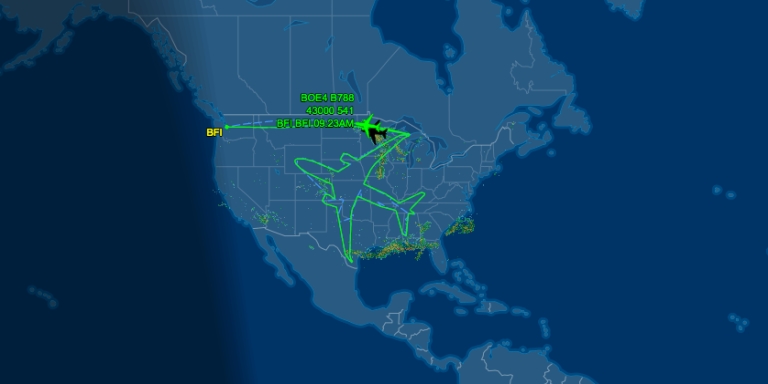

Every once in a while, aviation history produces an idea so gloriously over-the-top that it sounds like it was invented during a late-night brainstorming session fueled by coffee, jet fuel, and one extremely confident engineer saying, “What if the airport came with us?”
That was roughly the spirit behind Boeing’s airborne aircraft carrier concept: a giant Boeing 747 modified to carry, launch, recover, refuel, rearm, and manage a collection of tiny fighter aircraft while flying thousands of feet above the Earth. In other words, Boeing explored a plane with planes inside it so the big plane could keep doing plane things while the smaller planes also did plane things. Aviation grammar may never recover.
The proposed aircraft is often called the Boeing 747 Airborne Aircraft Carrier, or 747-AAC. It was a Cold War-era concept that imagined turning the famous “Queen of the Skies” into something much stranger: a flying naval carrier without the ocean, the deck crew, or the sea-sickness tablets.
What Was the Boeing 747 Airborne Aircraft Carrier?
The Boeing 747-AAC was a military concept explored during the early 1970s. Rather than hauling passengers, cargo pallets, or a suspiciously fragrant tray of airline chicken, the modified jumbo jet would carry a group of compact “microfighters.”
These small aircraft were envisioned as Boeing Model 985-121 microfighters. The broader idea was that a large carrier aircraft could travel long distances, operate near an area of conflict, and then release smaller combat aircraft to perform missions such as reconnaissance, air defense, interception, or strike operations.
The important word here is concept. Boeing did not build a completed 747-AAC. No giant airborne hangar ever rolled out of the factory with miniature fighters parked where economy-class passengers would normally argue over armrests. The project stayed in the world of studies, diagrams, engineering analysis, and dreams large enough to require four engines.
The Basic Plan
At its most ambitious, the airborne carrier concept would have allowed a modified Boeing 747 to carry as many as 10 small fighters. The carrier aircraft would have needed internal storage space, launch equipment, recovery mechanisms, maintenance areas, fuel systems, weapons storage, communications equipment, and enough crew support to make a normal airline cabin crew look like a very relaxed book club.
The proposal also considered the possibility of an airborne command-and-control role. A 747 operating as an airborne radar and coordination platform could potentially guide smaller aircraft, gather information, and direct missions over long distances.
That is where the idea becomes less like a strange aviation meme and more like a strategic thought experiment. Instead of relying entirely on nearby airfields, the military could bring a movable base into the sky.
Why Would Anyone Put Planes Inside Another Plane?
At first glance, the Boeing 747-AAC sounds like the aerospace equivalent of putting a toaster inside a refrigerator and calling it a kitchen. But the proposal came from a real strategic problem: fighter aircraft need range, fuel, maintenance, protection, and access to useful locations.
During the Cold War, military planners worried about operating over huge distances. A fighter might be fast and maneuverable, but it could not necessarily fly far enough, remain on station long enough, or operate from an airfield close enough to the target area. A large mothership aircraft could, in theory, solve part of that problem.
The carrier aircraft would handle the long trip. The smaller fighters would handle the tactical mission. It was a division of labor: the jumbo jet would be the long-haul logistics department, while the microfighters would be the fast, angry coworkers sent to handle the difficult meeting.
The Strategic Appeal of a Flying Base
A land base can be attacked, blocked, politically restricted, or simply too far away. An airborne aircraft carrier might offer a mobile alternative. It could move quickly, avoid dependence on runways close to the battlefield, and position smaller aircraft where they were most useful.
In theory, this offered several advantages:
- Long-range deployment without requiring nearby conventional bases.
- Rapid launch of small fighters near an operational area.
- Potential for reconnaissance and surveillance coverage.
- A mobile command platform with airborne communications.
- The ability to recover and service the smaller aircraft after their missions.
That final point was the real moonshot. Air-launching a smaller aircraft is hard enough. Recovering it back into a flying mothership is where the idea stops being “clever” and starts becoming “please bring several wind tunnels, a large budget, and a team of people who enjoy terrifying aerial geometry.”
The Plane Inside the Plane: Boeing’s Microfighter Idea
The Boeing Model 985-121 microfighter was designed around the needs of the carrier concept. A standard fighter aircraft would have been too large, too heavy, and too awkward to pack efficiently inside a 747-based airborne carrier.
The smaller aircraft needed to be compact enough for storage yet capable enough to perform useful missions after launch. That is an extremely demanding recipe. The fighter had to be small, light, and easy to handle, but it also needed fuel, weapons, sensors, performance, pilot protection, and enough flight capability to avoid becoming an expensive lawn dart.
Designing a tiny fighter is not the same as shrinking a normal jet in the dryer. Smaller aircraft have less room for fuel, less space for equipment, and fewer easy compromises. Every pound matters. Every inch matters. Every maintenance task becomes a wrestling match with physics.
Launch: The Easier Half of the Problem
Launching a smaller aircraft from a large host aircraft has been done in aviation history. The aircraft is carried aloft, released at altitude, and then flies its own mission. The mothership gives the smaller vehicle a head start by saving it the fuel and runway distance needed to reach launch altitude.
That is why air-launch systems have appeared in research, spaceflight, and experimental aviation. A carrier aircraft can lift another vehicle into a useful part of the atmosphere before releasing it.
For the 747-AAC, the microfighters would have needed controlled release systems. The carrier could not simply open a hatch and hope everyone had read the instructions. The smaller aircraft would need to leave cleanly, avoid the 747’s structure, escape turbulent airflow, and begin stable flight immediately.
Recovery: The Part That Makes Engineers Sweat
Recovering the fighter was far more difficult than launching it. The microfighter would need to approach the huge carrier aircraft, match speed, hold a stable position in disturbed air, connect with a recovery mechanism, and then be brought safely inside.
Imagine trying to park a motorcycle in a moving garage during a windstorm, except the garage is flying at high altitude, the motorcycle is flying too, and both vehicles are carrying enough fuel and equipment to make mistakes extremely unpopular.
The wake turbulence behind a large aircraft is not a minor inconvenience. Large aircraft create powerful vortices and disturbed airflow. A small aircraft operating close behind or below a jumbo jet would face a difficult and potentially dangerous environment. Even modern pilots are trained to respect the wake of larger aircraft, which helps explain why repeated airborne recovery operations would have been such a major challenge.
Maintenance in Midair Was Another Big Ask
A useful military aircraft needs more than a launch button. It needs fuel, inspections, repairs, communications equipment, ammunition handling, spare parts, and trained people who know which panel not to remove while the aircraft is traveling at hundreds of miles per hour.
The 747-AAC concept therefore required something closer to a flying hangar than a simple transport aircraft. It would need internal systems capable of keeping small fighters mission-ready. That sounds impressive because it is impressive. It also sounds expensive because it would have been spectacularly expensive.
The Idea Was Strange, but It Was Not New
The Boeing 747-AAC was not humanity’s first attempt to make one aircraft carry another aircraft. Aviation has been experimenting with “parasite fighters” and mothership concepts since long before the 747 entered airline service.
Flying Aircraft Carriers Before the 747
In the early twentieth century, U.S. Navy airships such as the USS Akron and USS Macon operated small Curtiss Sparrowhawk fighters. These aircraft could be launched from and recovered by the giant airships using trapeze systems. The concept was part scouting platform, part defensive system, and part proof that aviation history has always contained at least one engineer willing to ask, “Can we hang a fighter from a blimp?”
Later experiments explored aircraft carried by bombers. The McDonnell XF-85 Goblin was designed as a parasite fighter intended to fit inside a bomber’s bomb bay. The goal was to give long-range bombers defensive fighter protection without requiring conventional fighters to fly the entire distance.
The U.S. Air Force also tested the FICON program, in which a Convair B-36 carried and recovered modified Republic fighters. The program proved that the concept could work under controlled conditions, but it also highlighted the central problem: recovery was difficult, the system imposed performance penalties, and operational usefulness did not always justify the complexity.
The Boeing 747-AAC inherited all of that history. It was not a random fantasy. It was a much bigger, more ambitious version of an old dream: let one aircraft transport another aircraft to where it is needed most.
Why the Boeing 747-AAC Never Became Reality
The simplest answer is that “technically possible” and “smart to build” are very different phrases.
Aviation history is full of ideas that could be made to work with enough money, enough engineers, enough test flights, and enough tolerance for paperwork. The 747-AAC faced several huge problems at once.
1. Recovery Was Dangerously Complex
Launching a microfighter would have been challenging. Recovering one repeatedly in turbulence, near a massive aircraft, with military equipment onboard, would have been much harder. The system would need extraordinary precision and reliability.
One failed recovery could damage the fighter, the carrier aircraft, or both. A normal runway landing gives pilots room to adjust. A midair docking maneuver gives them far less mercy.
2. The Carrier Would Become a Very Expensive Target
A 747-based airborne carrier would have been enormous, valuable, and difficult to replace. It would carry fighters, fuel, people, equipment, weapons, and command systems in one package. That creates efficiency, but it also creates a tempting target.
Military planners generally prefer not to put every important thing into one flying basket unless the basket has extremely good defenses. The 747-AAC would have needed protection, escorts, planning support, and a safe operating area. Suddenly, the flying airport starts needing its own airport security department.
3. Aerial Refueling Solved Part of the Same Problem
By the time the 747-AAC was being studied, aerial refueling had already become a powerful way to extend the range of fighter aircraft. Tankers allowed conventional fighters to travel farther and remain airborne longer without needing to be stored inside a larger aircraft.
Refueling is not simple, but it is far more mature than repeatedly catching and storing combat aircraft inside a jumbo jet. A tanker gives fighters fuel. The airborne carrier concept would need to provide fuel, storage, launch, recovery, maintenance, command support, and a very brave maintenance checklist.
4. The Microfighters Would Have Limits
Small fighters can be agile and compact, but they have less room for fuel, sensors, weapons, and pilot support systems. A tiny aircraft might be easier to carry, but it might not match the endurance or capability of a conventional fighter.
That means the 747-AAC would be solving one problem while creating several others. The smaller the fighter became, the more carefully planners would need to ask whether it could actually perform the mission once released.
The Boeing 747 Did Carry Something Huge for Real
Although the 747-AAC remained a concept, Boeing 747s did become famous for carrying unusual things.
NASA modified two Boeing 747s into Shuttle Carrier Aircraft. These aircraft transported Space Shuttle orbiters on top of their fuselages. The sight of a 747 carrying a Space Shuttle looked like someone had placed a spaceship on an airplane and then calmly asked it to fly across the country.
Those Shuttle Carrier Aircraft were real, successful, and historically important. But they were not airborne carriers in the 747-AAC sense. They did not launch the shuttle into combat, recover it through a hatch, or send it downstairs for a midair refueling break. They transported a large external payload from one location to another.
NASA also used B-52 aircraft as motherships to launch X-15 rocket planes and other research vehicles. That proved that one aircraft can carry another into the sky and release it for a specialized mission. What the 747-AAC tried to add was the missing boss-level challenge: recover the smaller aircraft, service it, and send it back out again.
What the 747-AAC Still Teaches Us
The Boeing 747 Airborne Aircraft Carrier is fascinating because it sits at the border between practical engineering and magnificent ambition. It was not silly. It was simply an answer to a difficult strategic question using a solution so complex that the answer eventually outweighed the question.
That is not a failure of imagination. In fact, it is proof of imagination. Serious engineering includes studying ideas that may never become products. Sometimes the most valuable outcome is discovering exactly why a tempting solution should remain on paper.
The 747-AAC also reminds us that aircraft are not just vehicles. They are systems. A fighter needs fuel, pilots, maintenance, communications, weapons, protection, logistics, mission planning, recovery options, and lots of people who would very much prefer not to improvise at 30,000 feet.
The Boeing concept tried to put that entire system into one airborne platform. It was bold, dramatic, technically intriguing, and perhaps a little too eager to make the sky do the job of both an airport and an aircraft carrier.
The Experience of Meeting a Flying Carrier That Never Flew
No one can honestly say they rode inside a Boeing 747-AAC, because no completed version ever entered service. There were no passengers squeezing past tiny fighter jets to find seat 32B. There was no in-flight announcement reminding travelers to keep their luggage clear of the microfighter launch bay. There was no frequent-flyer program offering bonus miles for surviving aerial docking operations.
Still, the concept offers a surprisingly vivid experience when you think about it in physical terms.
Start with an ordinary Boeing 747. Even when it is parked on the ground, the aircraft feels enormous. Its fuselage is tall, its wings stretch dramatically across the ramp, and its engines make most nearby vehicles look like toys. Now imagine standing beside it and realizing that, instead of carrying hundreds of people or tons of cargo, the aircraft could have been designed to carry a fleet of smaller jets inside its body.
That is when the idea shifts from “fun aviation trivia” to “wait, somebody actually had to draw all of this.” Engineers would have needed to think about how the fighters were stored, how they moved inside the carrier, where fuel lines ran, how maintenance crews worked, how weapons were handled, and how a pilot could safely guide a small aircraft back toward a giant jet producing turbulent wake behind it.
The imagined recovery sequence is especially intense. Picture a small fighter approaching from behind a massive 747. The fighter pilot is matching speed and position while working in unstable air. The pilot must avoid getting too close too quickly, avoid drifting into the carrier’s structure, and somehow connect with a recovery system designed to pull the aircraft into a protected bay.
From the outside, it would probably look graceful for a few seconds: a small aircraft moving carefully toward a giant mothership against a bright blue sky. From the cockpit, it would likely feel less like graceful aviation and more like parallel parking on a roller coaster.
Then consider the people inside the carrier. A flying hangar would need technicians, planners, communications specialists, weapons crews, fuel-management systems, and flight crew members who understood that one mechanical issue could affect not just one airplane, but an entire airborne operation. The carrier would not merely transport fighters. It would become their home base, maintenance facility, launch platform, and emergency problem-solving center.
That is why the 747-AAC remains so compelling. It was not just a plane carrying planes. It was an attempt to make an entire military aviation ecosystem fly together in one giant airborne package.
The closest real-world feeling may come from seeing a NASA Shuttle Carrier Aircraft, a B-52 carrying an experimental rocket plane, or an old image of a Navy airship launching a Sparrowhawk fighter. Those machines show that aviation has repeatedly made “impossible” combinations work. The Boeing 747-AAC simply tried to combine every one of those ideas at once and then add a full-service garage.
In the end, the project never became a flying aircraft carrier. But it remains a fantastic reminder that the history of aerospace is built not only by the machines that fly, but also by the wild designs that force engineers to ask better questions before anyone turns on the engines.


