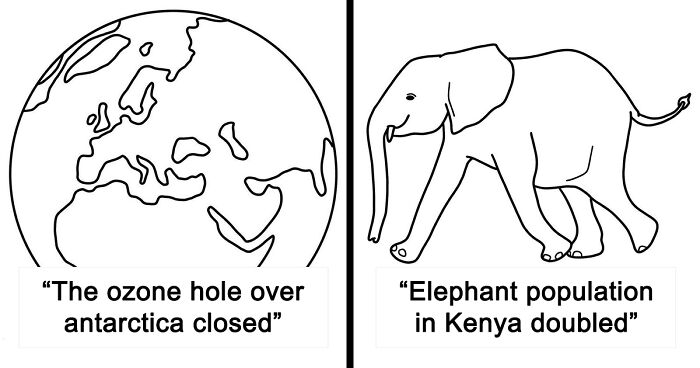

The internet has a funny little talent: it can show you a rescue puppy, a climate breakthrough, a stranger paying for someone’s groceries, and thenwithout warningserve you seven disasters, three arguments, and a comment section that needs adult supervision. That is exactly why illustrated good news has become such a refreshing corner of the web. It reminds us that the world is not only made of breaking-news sirens and doomscrolling marathons. Sometimes, it is also made of tiny acts of courage, smart solutions, community kindness, and people quietly making things better while the rest of us are trying to remember where we left our coffee.
One of the best-known examples of this uplifting visual movement is The Happy Broadcast, created by Italian-born, Los Angeles-based illustrator and creative director Mauro Gatti. His project turns positive news stories into bright, simple, charming illustrations that are easy to understand and even easier to share. The concept is wonderfully direct: take real good news from around the world, translate it into friendly visual storytelling, and give people a healthier reason to pause their scroll.
This article explores why illustrated positive news works, what makes these posts so shareable, and why audiences are hungry for optimism that still respects reality. Then, we will look at 20 uplifting post ideas inspired by real-world good news themesfrom animal rescues and medical progress to environmental wins and everyday kindness.
Why Illustrated Good News Feels So Powerful
Good news is not new. People have always loved stories about neighbors helping neighbors, scientists solving stubborn problems, or animals getting second chances. What feels different now is the format. A short illustrated post can do something a long article sometimes cannot: it can lower your emotional defenses in two seconds flat.
An illustration makes information feel approachable. Instead of dumping a complicated report into your lap like a stack of tax forms, it says, “Hey, here is a tiny window into something hopeful.” A smiling character, a bright color palette, and a short caption can transform a serious topic into a story people actually want to absorb. That does not make the news less meaningful. It makes it more human.
Positive News Is Not the Same as Pretending Problems Do Not Exist
The best uplifting posts are not fluffy distractions. They do not say, “Everything is perfect, please ignore the flaming toaster.” Instead, they highlight progress. They show that while the world has problems, people are also building solutions. This is close to the spirit of solutions journalism, which focuses not just on what is broken, but on how people are responding and what can be learned from those responses.
That distinction matters. Toxic positivity tells people to smile through everything. Constructive positivity says, “This is difficult, but here is proof that action is possible.” Mauro Gatti’s style fits neatly into that second category. His work is playful, but it is not empty. It points toward evidence, effort, and hope with sleeves rolled up.
Meet the Artist Behind the Happy Illustrations
Mauro Gatti is an illustrator, designer, and creative director whose work is known for bold simplicity, friendly characters, and a sense of humor that feels like a tiny confetti cannon. Through The Happy Broadcast, he has turned good-news storytelling into a recognizable visual language. The posts often cover categories such as animals, health, technology, the environment, community kindness, and mental health.
What makes the project especially appealing is its emotional clarity. Each post usually centers on one idea: a positive development happened, and it is worth knowing about. No dramatic headline. No panic. No shouting. Just a clear, cheerful summary paired with an illustration that looks like it came from the friendliest newspaper in the universe.
Why the Format Works on Social Media
Social platforms reward speed. Users decide in a blink whether to keep scrolling or stop. Illustrated good-news posts have three major advantages: they are visual, brief, and emotionally rewarding. The art catches the eye, the caption provides the takeaway, and the message gives readers a small mood lift.
That combination is powerful because many people are exhausted by traditional news cycles. Surveys and media research have repeatedly shown that news fatigue is real, especially when coverage feels overwhelming, repetitive, or disconnected from daily life. A positive-news illustration does not replace investigative reporting or serious journalism. But it does offer balance. It is the internet equivalent of opening a window after spending too long in a crowded room.
20 Uplifting Posts That Show Why Good News Matters
The following examples are written as original, web-ready summaries inspired by the kind of real-world positive developments often featured in illustrated good-news projects. They are not copied captions. Think of them as the kinds of uplifting posts that would make perfect illustrated panels: clear, hopeful, and just the right size for a smile.
1. A Community Pays for a Neighbor’s Hearing Aids
Few stories hit the heart faster than a community noticing a need and quietly stepping up. A neighbor who struggles to afford hearing aids is not just receiving a device; they are getting conversations, laughter, music, and connection back. That is good news with volume turned up.
2. An Eight-Year-Old’s Kindness Prevents a Bigger Problem
Children have a way of reminding adults that kindness does not need a committee meeting. A simple thoughtful action from a child can calm a tense situation, help a stranger, or prevent a problem from growing. Tiny human, huge emotional horsepower.
3. Scientists Turn Bacteria Into Cancer-Fighting Tools
Medical science is full of jaw-dropping ideas, and one of the most fascinating is using bacteria inside tumors to help fight cancer. It sounds like science fiction wearing a lab coat, but it reflects a real trend in modern medicine: turning biological systems into targeted treatment tools.
4. Free Diapers Help New Parents Breathe Easier
Newborns are adorable, but they also arrive with a surprisingly ambitious supply-chain problem. Programs that provide free diapers to families can reduce stress, improve infant care, and help parents stretch tight budgets. Sometimes good news smells faintly like baby powder.
5. Tree Planting Reaches Record Levels
Tree-planting efforts are more than pretty photo opportunities. They can support cleaner air, cooler cities, wildlife habitats, and healthier neighborhoods. A record year for planting trees is a reminder that environmental repair can start with something as humble as a seedling and a shovel.
6. Animal Shelters Celebrate Empty Kennels
When an animal shelter announces that every adoptable pet has found a home, the internet collectively melts into a puddle. These stories show the power of adoption campaigns, foster networks, volunteers, and families willing to make room for one more wagging tail.
7. A Lost Dog Travels Miles and Still Finds Its Family
Few plots are more emotionally efficient than “dog gets lost, dog comes home.” These stories remind readers of loyalty, microchipping, community search groups, and the fact that dogs apparently have built-in GPS powered by snacks and devotion.
8. Students Build a Device That Helps People With Disabilities
Some of the best innovation stories come from students solving practical problems. Whether they design affordable mobility tools, communication aids, or adaptive technology, these young inventors prove that engineering can be compassionate, not just complicated.
9. Volunteers Clean Thousands of Pounds of Trash From Beaches
Beach cleanups are satisfying because the results are visible. Before: plastic bottles, tangled fishing line, and enough wrappers to make a snack aisle nervous. After: safer sand, cleaner water, and a coastline that looks like it can finally exhale.
10. A Rare Species Makes a Comeback
Wildlife recovery stories are hopeful because they prove conservation can work. When endangered animals begin returning to historic habitats or increasing in number, it means years of habitat protection, policy work, scientific monitoring, and public support are paying off.
11. A Town Turns an Empty Lot Into a Community Garden
Community gardens are small miracles with tomatoes. They transform unused land into food, social connection, outdoor learning, and neighborhood pride. Also, they give people a socially acceptable reason to brag about zucchini.
12. A Teacher Starts a Closet for Students Who Need Supplies
Classroom kindness often happens quietly. A teacher who creates a supply closet with clothes, hygiene products, snacks, or school materials is doing more than filling shelves. They are removing barriers so students can focus on learning instead of worrying.
13. A Library Expands Free Mental Health Resources
Libraries have always been more than buildings full of books. Many now offer social services, digital access, workshops, and mental health resources. A library helping people find support is exactly the kind of civic good news that deserves a standing ovation in whisper volume.
14. Doctors Report Progress in Immunotherapy Trials
Breakthroughs in immunotherapy are among the most encouraging stories in health science. While every treatment has limits and must be evaluated carefully, progress in helping the immune system recognize and fight disease offers hope to patients and families.
15. Strangers Form a Search Party for a Missing Wedding Ring
Some good-news stories are small but emotionally enormous. A lost wedding ring recovered by strangers with metal detectors, flashlights, and heroic patience can restore more than jewelry. It restores faith in people who could have kept walking but chose to help.
16. A City Adds More Green Space for Residents
Parks, trees, and pocket gardens can improve daily life in practical ways. They offer shade, cleaner air, places to exercise, and spaces where people can meet without buying a latte the size of a soup bowl. Urban green space is public happiness infrastructure.
17. A Food Rescue Program Saves Meals From Waste
Food rescue programs connect surplus food with people who need it. That means fewer meals wasted, fewer families going hungry, and fewer perfectly good sandwiches experiencing an identity crisis in a dumpster. Efficient, compassionate, and sensible? Delicious.
18. A Senior Learns Technology and Reconnects With Family
Digital inclusion can be deeply moving. When older adults learn video calls, messaging apps, or online tools, the result is not just technical confidence. It can mean seeing grandchildren more often, accessing services, and feeling less isolated.
19. Researchers Discover a New Way to Protect Coral
Coral reefs face serious threats, but scientists continue developing creative ways to protect and restore them. Stories about coral nurseries, heat-resistant coral research, and reef restoration show that environmental challenges are not the end of the story.
20. A Small Act of Gratitude Starts a Chain Reaction
One thank-you note, one paid-forward coffee, one compliment at the right momentsmall acts can ripple. They may not solve every problem, but they can change the emotional weather of a day. And honestly, some days need a better forecast.
What These Uplifting Posts Have in Common
The strongest good-news illustrations share a few ingredients. First, they are specific. “People are nice” is pleasant, but “a neighbor paid for hearing aids after ten years of friendship” is memorable. Second, they show action. Someone planted, rescued, invented, donated, protected, healed, taught, or listened. Third, they invite readers to feel hope without demanding that they ignore reality.
That is why illustrated good news feels different from empty cheerleading. It gives optimism a job. It shows where progress is happening and suggests that more progress may be possible. In an online culture where outrage often travels faster than nuance, these posts slow people down just long enough to say, “Wait, that is actually wonderful.”
Why Readers Share Positive News
People share content for many reasons: to inform, entertain, inspire, signal values, or connect with friends. Positive-news illustrations check several of those boxes at once. They are easy to understand, emotionally warm, visually appealing, and socially safe to share. A person may hesitate to share a dense policy report, but they will gladly share a cute illustration about rescued sea turtles or a student invention that helps wheelchair users.
Sharing uplifting posts also gives people a small sense of agency. It says, “Here is something good I found. Maybe it will help your day too.” That tiny exchange can matter. Social media often makes users feel like passive spectators to chaos. Positive posts turn them into small distributors of encouragement.
The SEO Value of Uplifting Visual Storytelling
From an SEO perspective, topics like good news illustrations, uplifting posts, positive news stories, and feel-good art have strong evergreen appeal. Readers search for hopeful content during stressful news cycles, at the end of the year, around holidays, and whenever they need a mental reset. Articles about illustrated positive news can attract audiences interested in art, mental wellness, social media trends, human-interest stories, and creative communication.
The key is to avoid thin content. A strong article should not merely list “cute things.” It should explain why the format matters, analyze the emotional appeal, and give concrete examples. Search engines increasingly reward helpful content that answers intent fully. In this case, the reader wants both entertainment and insight: Who is the artist? What is the project? Why do people love it? What kinds of uplifting posts are included? This article structure answers all of those questions while keeping the tone light enough to avoid sounding like a textbook wearing uncomfortable shoes.
How Artists Can Create Meaningful Good-News Posts
Artists who want to create positive-news content can learn a lot from this format. Start with a real story. Verify the basic facts. Identify the emotional center. Then simplify the message until it can be understood quickly without becoming misleading. The illustration should support the story, not bury it under decorative fireworks.
A good visual post often has one main character, one clear action, and one emotional payoff. For example, if the story is about volunteers cleaning a beach, the image might show smiling people holding bags beside a sparkling shoreline. If the story is about medical progress, the illustration might use gentle symbols of care, science, and hope rather than intimidating lab imagery.
Humor also helps. A tiny joke can make serious progress feel less distant. The trick is to laugh with the story, not at the people involved. Good-news illustration works best when it feels kind, clever, and respectful.
Why We Need More Balanced News Diets
Nobody should replace serious news with only cheerful illustrations. That would be like eating frosting for dinner and calling it wellness. People need to know about crises, injustice, health risks, political decisions, and environmental threats. But a healthy news diet also includes stories of repair, resilience, and solutions.
When audiences only see problems, they may become overwhelmed or disengaged. When they also see responses, they may feel informed and capable. Positive-news projects help fill that gap. They do not erase bad news; they widen the frame.
of Experience: What It Feels Like to Follow Illustrated Good News
Spending time with illustrated good-news posts feels different from reading a typical news feed. A normal feed often behaves like a raccoon in a kitchen at midnight: loud, messy, and somehow holding something alarming. You open your phone to check one thing, and suddenly you are knee-deep in arguments, disasters, celebrity drama, and a headline written like it just drank six espressos. After a while, even important information can feel exhausting.
Good-news illustration changes the rhythm. The first thing you notice is visual calm. The colors are usually warm. The characters look friendly. The caption is short enough to understand before your tea gets cold. Instead of demanding emotional panic, the post invites curiosity. You think, “Oh, I did not know people were working on that,” or “That is a clever solution,” or “Maybe humanity has not completely misplaced the instruction manual.”
The most memorable experience is the sense of surprise. Many readers are used to bad news being presented as the default setting of reality. So when they see a post about a species recovering, a medical trial succeeding, a community helping a stranger, or students inventing something useful, the brain does a little double take. The good news is not naive; it is simply underrepresented. Finding it can feel like discovering a bright side door in a building you thought only had emergency exits.
Another powerful part of the experience is shareability. You do not need to write a long explanation when sending an illustrated good-news post to a friend. The image does the greeting, the caption does the work, and your message can simply say, “This made me smile.” That ease matters. In a world where many conversations online become debates before anyone has finished blinking, a wholesome post can create a rare moment of agreement. People may have different opinions on almost everything, but most can appreciate a rescued animal, a kind neighbor, or a child doing something unexpectedly wise.
Following this kind of content can also nudge people toward action. A beach cleanup post might make someone join a local volunteer day. A community garden illustration might inspire a neighborhood project. A mental health resource post might encourage someone to ask for help. The art is small, but the ripple can be real. It turns passive scrolling into a doorway, and sometimes that doorway leads to better habits, kinder conversations, or practical involvement.
Most importantly, illustrated good news gives hope a shape. Hope can feel vague when it is only a word. But when it appears as a drawing of people planting trees, doctors helping patients, neighbors supporting one another, or animals returning to safe habitats, it becomes easier to hold. That is the quiet magic of this format. It does not shout. It does not deny pain. It simply points to the helpers, the builders, the fixers, and the stubbornly kind people who keep proving that better stories are still being written.
Conclusion: Good News Deserves Good Design
Artist Illustrates “Good News” And Here Are 20 Uplifting Posts is more than a catchy headline. It captures a genuine cultural need. People are not tired of being informed; they are tired of being emotionally flattened. Illustrated positive news offers a better balance. It makes progress visible, kindness memorable, and solutions easier to share.
Mauro Gatti’s work with The Happy Broadcast shows how art can become a delivery system for hope. By turning real positive developments into simple, cheerful illustrations, projects like this remind readers that the world is not only a place of problems. It is also a place of problem-solvers.
And that may be the most uplifting post of all: while bad news is loud, good news is still happeningquietly, creatively, and sometimes with a very cute drawing attached.
Note: This article is written for web publishing and synthesized from reputable public information about positive-news illustration, constructive journalism, news fatigue, mental wellness, and real-world uplifting story themes. No source links, citation placeholders, or unnecessary publishing artifacts are included in the article body.


