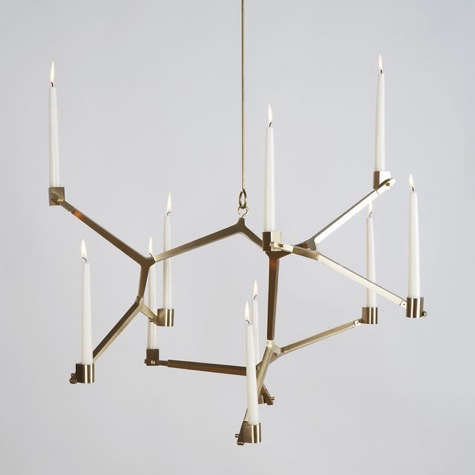

If chandeliers had personalities, the Agnes Candelabra Chandelier would be that impossibly stylish guest who shows up late, says something clever, and somehow makes the whole room look better just by existing. Designed by Lindsey Adelman for Roll & Hill, Agnes has become one of those rare lighting pieces that manages to be both highly recognizable and surprisingly adaptable. It is sculptural without becoming fussy, dramatic without throwing a tantrum, and modern without feeling like it was designed by a robot that hates joy.
Part of the reason this fixture keeps popping up in design conversations is simple: it does not behave like a conventional chandelier. Agnes began as a candelabra idea, and that origin story still lives in its long, luminous arms and candle-like glow. But instead of leaning into old-world ornament, it translates that candelabra spirit into something angular, airy, and architectural. Think candlelight after a really good design-school education.
For homeowners, designers, and anyone currently staring at a boring dining room ceiling and whispering, “You could be more,” the Agnes Candelabra Chandelier offers a compelling answer. It is not just a light source. It is a composition, a conversation starter, and in the right room, a full-blown main character.
What Makes the Agnes Candelabra Chandelier So Distinctive?
The magic of Agnes starts with contrast. It references the candelabra tradition, yet it looks unmistakably contemporary. It feels industrial, but it also gives off a soft, almost poetic glow. Its geometry is sharp, but the atmosphere it creates is warm. That balancing act is what separates Agnes from the sea of chandeliers that are either too plain to remember or too dramatic to live with.
The fixture is known for its articulated structure, which allows the glass light elements to be adjusted into different arrangements. That flexibility is a huge part of its appeal. Rather than presenting one frozen silhouette, Agnes offers controlled variation. It can look orderly and church-like, or slightly irregular and more playful. In other words, it gives you the rare luxury of customizing the mood without redesigning the entire room.
Visually, the chandelier often reads like a cross between a molecular diagram, a futuristic candle cluster, and a piece of functional sculpture. That sounds like a very artsy sandwich, but it works. The lines are lean, the voids matter as much as the solid parts, and the negative space gives the fixture breathing room. Even in larger versions, Agnes does not usually feel bulky. It feels lifted, as if it is hovering rather than hanging.
The Design Story Behind Agnes
The Agnes chandelier is closely tied to Lindsey Adelman’s broader design language: expressive forms, thoughtful geometry, and lighting that feels handcrafted in spirit even when it has precise machined elements. Adelman has worked in lighting design since the 1990s, and that long relationship with the medium shows. Agnes is not flashy in a random way. Every angle feels considered.
The original concept was rooted in a fictional heroine named Agnes from the California Gold Rush era, which helps explain the candelabra DNA and the notion of portability and modularity. That backstory gives the piece a subtle narrative layer. It is not just “modern chandelier number forty-seven.” It has a premise. And good design with a premise tends to linger in people’s minds longer than good design that merely looks expensive.
Agnes first appeared in the early 2010s and quickly established itself as one of the standout modern chandeliers of its era. Design media noticed. Retailers embraced it. Interior projects began featuring it in dining rooms, living areas, and statement entryways. Years later, it still feels current, which is not a small achievement in a category where trends can age faster than bananas on a sunny countertop.
Materials, Finishes, and Configurations
One of the reasons the Agnes Candelabra Chandelier holds up so well visually is its material palette. Common listings describe it as using machined aluminum paired with glass diffusers or glass tubes. That combination matters. Aluminum keeps the structure crisp and relatively light-looking, while glass softens the output and preserves the candle-inspired character. The result is a fixture that has both edge and glow, which is exactly what many modern interiors are trying to achieve.
Depending on the version, shoppers will typically see multiple configurations, often ranging from smaller formats such as 6-light models to larger 10-light, 14-light, and even 20-light versions. There are also related Agnes variations and custom possibilities in the broader collection. That scalability is a big part of the chandelier’s enduring usefulness. A compact Agnes can feel elegant over a smaller dining table, while a larger version can absolutely take over a generous room in the best possible way.
Common finish and glass options
Retail listings frequently show finishes such as black, bronze, brushed brass, and polished nickel, along with glass options that can subtly shift the personality of the fixture. Some versions offer straight-cut or angled-cut glass, which may sound like a tiny detail until you realize lighting people treat tiny details the way chefs treat salt: a little change can completely alter the outcome.
Made-to-order appeal
Agnes is often sold as a made-to-order luxury lighting piece, and that matters for buyers. This is not a grab-it-off-the-shelf chandelier for people who panic-buy décor at midnight. It sits in the premium end of the market, where craftsmanship, finish selection, lead times, and installation planning all deserve attention. The upside is that it feels special. The downside is that spontaneous shoppers may need to practice patience, a skill not always favored by the internet.
How the Agnes Chandelier Changes a Room
A lot of chandeliers illuminate a room. Agnes also edits it. Because the structure is so graphic, it creates rhythm overhead and helps define the center of a space. Over a dining table, it can organize the room even before the chairs arrive. In a living room, it acts almost like a suspended artwork. In an entry, it announces that this home probably has strong opinions about bookshelves, coffee, and throw blankets.
The glow is another major reason people love it. Agnes tends to create a soft, ambient, diffused light rather than a harsh blast from above. That makes it especially effective in rooms where atmosphere matters. Dining rooms, entertaining spaces, creative studios, and lounge-like living areas all benefit from lighting that flatters both the room and the humans attempting to look effortlessly put together inside it.
It also works unusually well in interiors that mix styles. Agnes can bridge industrial and refined, minimalist and expressive, vintage and contemporary. Pair it with a rustic wood table and it adds polish. Pair it with sleek cabinetry and it adds soul. Pair it with a plain white ceiling and it turns that blank overhead space into something worth looking up at, which is more than most ceilings can say.
Best Rooms for an Agnes Candelabra Chandelier
Dining rooms
This is probably the most natural habitat for Agnes. The fixture’s linear reach and warm glow suit dining spaces beautifully, especially rectangular or oval tables. A 10-light or 14-light version can feel balanced and substantial without becoming visually heavy. If you want a dining room that says “thoughtful design” instead of “we bought whatever the builder-grade aisle had left,” Agnes is a strong contender.
Living rooms
In a living area, Agnes works best when the room has enough visual breathing room around it. It is sculptural, so it appreciates some space to show off. Open-plan homes, loft-like interiors, and rooms with higher ceilings often make the most of its form. It can also soften a room full of hard-edged furniture by adding glow and movement overhead.
Entryways and foyers
If your entryway has decent ceiling height, Agnes can create an unforgettable first impression. It is the kind of chandelier that makes guests pause mid-sentence and look up, which is generally a good sign unless they were about to compliment your pie and then forgot.
Creative commercial spaces
Because some current listings describe Agnes as contract grade and note features like dimming compatibility and made-in-USA production, it also makes sense in boutique hospitality, gallery-like retail settings, and upscale office interiors that want warmth without cliché.
What to Know Before Buying
First, size matters. Agnes is airy, but it is not invisible. Measure the room, the table, and the hanging height carefully. A chandelier this distinctive should feel intentional, not like it wandered into the wrong zip code.
Second, installation details deserve real attention. Current retailer specs commonly mention sloped-ceiling compatibility, adjustable stems, dimming options, and articulated elements. All of that is excellent news, but it also means this is a fixture worth installing thoughtfully, ideally with an electrician who understands that “close enough” is not a design philosophy.
Third, think about finish coordination. Black and bronze versions can feel moodier and more grounded. Brushed brass adds warmth and a slightly richer decorative presence. Polished nickel leans cooler and more reflective. None of these choices are wrong, but each one changes how the chandelier speaks to the rest of the room.
Finally, remember that Agnes lives firmly in the luxury category. It is an investment piece, not a temporary fling. Buy it because you love the design, the atmosphere, and the way it shapes a room, not because you want to impress the neighbors for seven minutes during a holiday party.
Styling Tips for a Cohesive Look
If you are decorating around an Agnes Candelabra Chandelier, let it lead without letting it dominate everything. The best interiors around this fixture usually understand proportion and restraint. You do not need fifteen other dramatic objects competing for attention like contestants in a reality show finale.
Start with furniture that has presence but clean lines. A sculptural wood dining table, upholstered chairs with subtle curves, or a streamlined sectional all pair well. Then add texture through rugs, curtains, and natural materials so the room feels layered rather than sterile.
Agnes also benefits from thoughtful contrast. If the chandelier is angular, balance it with softer forms below. If the finish is warm, echo that warmth in wood tones or metal accents. If the room is very neutral, the chandelier can become the visual spark. If the room already has strong color, Agnes can provide the structure that keeps everything from drifting into chaos.
Why Agnes Still Feels Relevant
Some statement lighting burns bright for a moment and then starts to feel like a time capsule. Agnes has avoided that fate because it was never built around a gimmick. It rests on strong fundamentals: proportion, flexibility, material contrast, and a memorable silhouette. Those qualities age better than trends do.
It also occupies a sweet spot in modern lighting history. Agnes feels contemporary, but it still respects the emotional appeal of candlelight and the decorative history of chandeliers. That blend gives it longevity. It does not reject the past; it rewires it.
And maybe that is the simplest way to explain the chandelier’s staying power. Agnes makes modern design feel warm. It proves that geometry does not have to be cold, luxury does not have to be loud, and a chandelier can be both smart and seductive without looking like it is trying too hard. Frankly, many people would love that same review on their dating profile.
Extended Experience: What It Is Like to Live With an Agnes Candelabra Chandelier
Living with an Agnes Candelabra Chandelier is a little different from living with ordinary overhead lighting, because ordinary overhead lighting generally minds its business. Agnes does not. It participates. In the morning, when the room is full of natural light, the fixture reads almost like a line drawing in space. You notice the structure, the geometry, the way the arms map themselves against the ceiling and walls. It becomes part of the room’s architecture even before you switch it on. Then evening arrives, the glass begins to glow, and the chandelier shifts from graphic object to atmosphere machine. It is a two-act performance, and both acts are excellent.
In dining rooms especially, the experience tends to be transformational. Meals feel more composed under Agnes. A simple weeknight dinner can suddenly look like it belongs in a design magazine, even if the menu is just pasta and a salad you assembled while bargaining with yourself not to order takeout. The light is flattering, soft, and social. It helps define the table as an event zone, which is a fancy way of saying people tend to linger longer when the lighting is good. Harsh overhead light makes everyone want to leave. Agnes makes people ask whether there is dessert.
There is also a practical pleasure in the chandelier’s adjustable, articulated character. Homeowners and designers who appreciate details often enjoy the fact that Agnes does not feel locked into one static pose. That flexibility creates a sense of authorship. Even small changes in orientation can alter how the fixture reads in the room, which means the chandelier keeps offering visual interest over time. It is not chaotic or gimmicky; it just has a little bit of built-in life. That quality matters more than people expect. The best luxury objects do not merely look expensive. They keep revealing themselves.
Another experience people often mention, directly or indirectly in interiors where Agnes appears, is how surprisingly compatible it is with daily life. For such a dramatic fixture, it rarely feels fussy. It can coexist with family dinners, quiet mornings, work-from-home hours, and evenings when the room needs to serve as equal parts sanctuary and backdrop. Agnes has a rare talent for elevating a room without making the room feel too precious to use. That is a big compliment. Plenty of beautiful objects are a little intimidating. Agnes is beautiful, but it still understands that humans need to sit down, eat soup, read emails, and occasionally wear socks that do not match.
Perhaps the most lasting experience, though, is psychological. A strong chandelier changes how you perceive a room’s purpose and quality. Agnes tends to make spaces feel intentional. It tells you that someone thought carefully about mood, shape, and how design can influence everyday life. That may sound lofty for a ceiling fixture, but good lighting is sneaky that way. You do not always notice it immediately; you notice how much better everything else feels around it. And that is probably the Agnes chandelier’s greatest trick. It does not just light the room. It improves the room’s confidence.
Conclusion
The Agnes Candelabra Chandelier has earned its reputation because it does more than look dramatic in product photos. It combines a memorable concept, refined materials, modular flexibility, and atmospheric light in a way that still feels fresh years after its debut. Whether you are designing a sophisticated dining room, refining a high-ceiling living space, or investing in a true statement light, Agnes remains one of the most compelling modern chandelier options on the market.
It is sculptural without being stiff, luxurious without being gaudy, and rooted in candelabra history without getting trapped in nostalgia. In a world full of forgettable lighting, that is no small feat. Agnes does not just hang from the ceiling. It changes the conversation below it.


