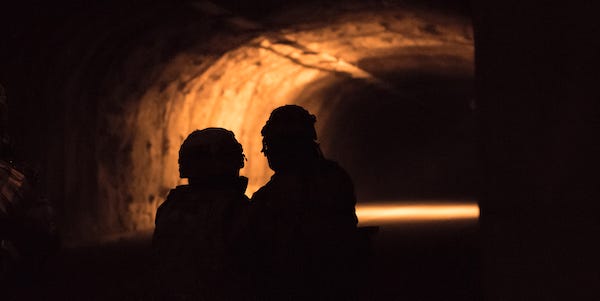

Modern armies have spent decades learning how to dominate the sky, track movement from space, fly drones over rooftops, and turn the battlefield into a giant blinking spreadsheet. Then the enemy did something both ancient and annoyingly effective: they went underground.
Across the world, militaries are now paying serious attention to subterranean warfare, a term that sounds like it belongs in a fantasy novel but is very much part of modern combat. Tunnels, sewers, caves, basements, bunkers, subway lines, drainage systems, mines, and underground command posts are no longer side notes in war planning. They are becoming central terrain.
From Gaza’s tunnel networks to Ukraine’s industrial basements and trenches, from North Korean underground facilities to Hezbollah’s bunkers in southern Lebanon, armed forces are seeing the same uncomfortable lesson repeated: the underground battlefield can cancel out many expensive advantages. Sensors struggle. GPS disappears. Radios get moody. Drones become far less useful. And soldiers suddenly find themselves fighting in places where every corner, ladder, shaft, and dark hallway feels like it was designed by a villain with a civil engineering degree.
This is why armies around the world are training to fight underground. Not because tunnels are new, but because modern warfare has made them more valuable than ever.
The Underground Battlefield Is Not New, But It Is Back in Fashion
Underground warfare has existed for thousands of years. Ancient armies dug beneath walls to collapse fortifications. Medieval attackers tunneled under castles. In World War I, both sides used mines and dugouts. In Vietnam, the Viet Cong built tunnel systems that helped them hide, move, store supplies, and launch surprise attacks.
So no, tunnels did not suddenly show up like a surprise guest at a dinner party. What has changed is the modern battlefield above ground. Today, drones, satellites, thermal sensors, precision artillery, loitering munitions, and electronic surveillance make it extremely dangerous to move in the open. If a vehicle, antenna, command post, or troop formation can be detected, it can often be targeted quickly.
Going underground offers a rough but powerful answer. It hides movement. It protects forces from aerial observation. It shelters weapons and supplies. It allows defenders to survive bombardment. And in urban areas, underground spaces can turn a city into a three-dimensional maze where the fight happens above, inside, and beneath buildings at the same time.
Why Modern Armies Care About Subterranean Warfare
1. Underground Spaces Hide Troops From Drones and Sensors
Drones have changed the way armies move. In Ukraine, small commercial drones and military unmanned aircraft have made open movement far more dangerous. A trench, basement, culvert, or tunnel may be ugly, cramped, and damp, but it can be safer than standing in the open under a sky full of cameras.
Armies are training underground because soldiers need to understand how enemies use hidden spaces to avoid detection. They also need to know how to operate when their own units must take cover beneath the surface. In other words, underground warfare is no longer just a specialist problem. It is becoming a basic survival problem.
2. Tunnels Can Turn Weak Forces Into Dangerous Defenders
One of the biggest reasons underground warfare matters is that it helps weaker forces offset stronger ones. A military with fewer aircraft, fewer tanks, and less advanced technology can use tunnels to reduce the impact of its opponent’s firepower.
That is exactly why tunnel networks have become so significant in places like Gaza. Hamas has used underground infrastructure for command and control, movement, weapons storage, ambushes, and protection. The result is a battlefield where clearing a neighborhood above ground does not automatically mean controlling what lies beneath it.
For a modern army, that is a nasty surprise. It is like winning a chess match and then discovering there is a second chessboard under the table.
3. Cities Have a Built-In Underground Layer
Modern cities are full of underground infrastructure: subways, utility tunnels, sewage systems, service corridors, parking garages, basements, storm drains, and maintenance shafts. These spaces were not built for war, but war has a talent for repurposing everything from apartment blocks to school gyms to subway platforms.
As the world becomes more urban, armies expect future conflicts to take place in dense cities. That means soldiers may have to fight through buildings while also worrying about what is beneath them. An enemy can disappear into a basement, move through a tunnel, emerge behind a unit, or hide weapons in spaces that are difficult to detect from above.
This is why subterranean operations are now tied closely to urban warfare training. Controlling the street is not enough if the enemy controls the underground route beneath it.
What Makes Fighting Underground So Difficult?
Darkness Is Only the Beginning
The obvious problem underground is darkness. But darkness is almost the friendly part. At least darkness is honest. The bigger problems include bad air, tight passages, unstable structures, confusing layouts, poor communications, hidden explosives, flooding, smoke, dust, heat, and the psychological stress of operating in confined spaces.
Soldiers trained for open terrain may find underground spaces deeply disorienting. There are fewer landmarks. Sound behaves strangely. A short distance can feel much longer. A single blocked passage can trap a team. A broken light can change everything. And a radio that works perfectly above ground may become a decorative brick underground.
Communications Can Collapse Fast
Modern armies depend on communication. Units need to share locations, call for support, update maps, request medical evacuation, and coordinate with forces nearby. Underground, that becomes harder. Soil, concrete, rock, metal, and depth interfere with signals.
This creates a command problem. Leaders above ground may not know exactly where their soldiers are. Soldiers below ground may not know what is happening outside. If the fight above and below ground is happening at the same time, poor communication can become dangerous quickly.
Mapping the Underground Is a Nightmare
Armies love maps. Underground spaces love making maps useless. Tunnel networks may be incomplete, modified, hidden, booby-trapped, or deliberately confusing. Civilian infrastructure maps may be outdated. Combat damage can alter routes. A tunnel discovered on Monday may not look the same by Friday.
This is why military researchers are investing in robots, sensors, artificial intelligence, and mapping tools for subterranean environments. Before soldiers can control an underground system, they need to understand its layout. That sounds simple until the layout is dark, dusty, branching in five directions, and possibly trying to kill them.
Real-World Examples Driving Underground Warfare Training
Gaza and the “Underground City” Problem
The Gaza war has pushed tunnel warfare back into global military discussion. Public reporting and defense analysis have described an extensive Hamas tunnel network used for movement, storage, command functions, ambushes, and hostage concealment. Israeli forces have had to confront a battlefield where the underground network is deeply connected to the above-ground urban fight.
This matters to other armies because Gaza shows how a determined force can build a defensive system that slows operations, complicates intelligence, and makes every advance more dangerous. It also shows that the underground and surface battles cannot be treated as separate problems. A soldier clearing a building may be dealing with the same fight as another soldier below the floor.
Ukraine and the Return of Industrial Underground Warfare
Ukraine has shown a different version of the same lesson. In cities such as Bakhmut and in industrial areas such as the Azovstal steel plant in Mariupol, underground and semi-underground spaces became part of the battlefield. Basements, tunnels, mines, trenches, culverts, and industrial facilities offered protection, concealment, and movement options.
The war has also shown how drones and artillery push soldiers into cover. When the sky is full of surveillance, even a drainage tunnel can become valuable terrain. That does not make it comfortable terrain. Nobody is adding “luxury culvert living” to a travel brochure. But in combat, survivability often beats comfort by a wide margin.
Lebanon, North Korea, Iran, and the Strategic Underground
Hezbollah has long been associated with tunnels and bunkers in southern Lebanon, using underground infrastructure to protect personnel, store equipment, disperse fighters, and complicate targeting. North Korea is also widely known for extensive underground military facilities, hardened artillery positions, tunnels, and shelters. Iran has invested in hardened and deeply buried facilities to protect sensitive military assets.
These examples matter because they show that subterranean warfare is not limited to insurgents. States and non-state actors both use underground spaces. Some tunnels are tactical, supporting ambushes and local movement. Others are strategic, protecting command centers, missile systems, weapons production, or national leadership.
How Armies Are Training for Underground Combat
Building Realistic Subterranean Training Facilities
The U.S. Army and other militaries have developed training sites that include tunnels, hatches, tight corridors, hidden rooms, obstacles, and low-light conditions. These facilities help soldiers practice movement, communication, casualty evacuation, mapping, and coordination in confined spaces.
Training matters because underground combat cannot be mastered by reading a manual while sitting comfortably under fluorescent lights. Soldiers need to experience the stress of tight spaces, the confusion of limited visibility, and the challenge of working as a team when normal communication methods fail.
Combining Infantry, Engineers, EOD, Dogs, and Robots
Underground operations often require mixed teams. Infantry may provide security. Combat engineers may assess structures and obstacles. Explosive ordnance disposal specialists may deal with hazards. Military working dogs may help detect threats. Robots may enter spaces before people do.
The key point is that underground warfare is not just “regular infantry, but lower.” It is a specialized environment that demands additional tools, training, and coordination. A tunnel is not simply a hallway with commitment issues.
Training the Mind, Not Just the Body
Subterranean warfare is physically exhausting, but the psychological burden can be just as serious. Claustrophobia, darkness, isolation, disorientation, fear of traps, and the inability to see far ahead can place heavy stress on soldiers.
That is why armies must train not only tactics and equipment use, but also confidence, calm decision-making, and teamwork. Panic underground can spread quickly. A disciplined team that can move slowly, communicate clearly, and control fear has a major advantage.
The Technology Race Beneath the Surface
Robots Are Becoming the First Ones In
One of the biggest shifts in subterranean warfare is the use of robots and unmanned systems. Sending a robot into a dark tunnel before sending a human is an easy decision, assuming the robot can move, map, transmit, and avoid getting stuck in the world’s least convenient pothole.
DARPA’s Subterranean Challenge highlighted this problem. The competition pushed teams to develop autonomous systems that could map, navigate, and search underground tunnel, urban, and cave environments. The challenge was not just movement. It was movement without GPS, with poor communications, rough terrain, darkness, smoke, and unpredictable obstacles.
The military value is obvious. Robots can scout ahead, identify hazards, build maps, detect gas, search for survivors or hostages, and reduce risk to soldiers. But robots are not magic. Underground environments punish machines too. Wheels slip. drones hit walls. sensors get confused. batteries die. The tunnel, apparently, does not care about your software update.
Artificial Intelligence and Mapping Tools
Future underground warfare will likely rely heavily on AI-assisted mapping, sensor fusion, and pattern recognition. As soldiers, drones, robots, and sensors collect data, software can help build a clearer picture of the underground network.
This is especially important because tunnel systems can change. Entrances may be hidden or sealed. Routes may connect unexpectedly. A map created by one team needs to be shared quickly with units above and below ground. The faster an army understands the underground terrain, the less it is fighting blind.
Why Training Underground Matters for Future Wars
Armies are training underground because future wars are likely to be more urban, more transparent above ground, and more technologically intense. The more dangerous the surface becomes, the more valuable underground spaces become. This creates a strange paradox: the more advanced warfare gets, the more important caves, tunnels, basements, and sewers may become.
Subterranean warfare also forces militaries to think in three dimensions. The battlefield is not just left, right, forward, and back. It is up, down, inside, beneath, and around. A unit may control a street but not the basement. It may control a building but not the tunnel underneath. It may destroy a command post only to discover that the real command node was deeper below.
Lessons Learned From Underground Warfare
Lesson One: The Surface Fight and Underground Fight Are Connected
One major lesson from recent conflicts is that underground operations cannot be isolated from the rest of the battle. A tunnel entrance inside a building affects the building fight. A basement command post affects artillery and drone targeting. A sewer route can affect rear-area security.
Commanders must plan for the surface and subterranean fight together. Otherwise, they risk clearing the same area twice: once above ground and again below it, with the second round being darker, dirtier, and much less fun.
Lesson Two: Technology Helps, But Training Wins
Robots, sensors, drones, and AI tools are valuable. But technology cannot replace trained soldiers who understand the environment. Underground operations require patience, discipline, teamwork, and judgment. The best equipment in the world will not help much if a unit has never practiced moving, communicating, and making decisions in a confined underground space.
Lesson Three: Underground Defense Can Slow Powerful Armies
Tunnels and underground facilities do not make a force invincible. They can be found, isolated, sealed, flooded, destroyed, or bypassed depending on the mission and legal constraints. But they can slow an attacker, absorb resources, create uncertainty, and impose psychological pressure.
That delay can matter. In war, time is not just time. Time is logistics, politics, morale, media attention, international pressure, and battlefield momentum. A tunnel network that slows an offensive can become strategically important even if it never wins a battle by itself.
Experiences and Reflections: What Underground Training Teaches Armies
Anyone who has watched soldiers train for underground operations can understand quickly why the environment earns respect. Above ground, even in a difficult urban exercise, there is usually some sense of space. There is a skyline, a street, a doorway, a vehicle, a horizon. Underground, that comfort disappears. The world shrinks to the reach of a light, the sound of breathing, the person ahead, and the uncomfortable awareness that the exit is behind you somewhere.
One experience commonly described in subterranean training is how quickly confidence changes. A soldier who is calm in an open field may feel uneasy in a narrow passage. A leader who can read terrain easily above ground may struggle when every corridor looks similar. A team that communicates smoothly outdoors may suddenly find that radios fail, echoes confuse voices, and hand signals are hard to see. The underground environment exposes weak habits fast. It is a brutally honest teacher, and it does not grade on a curve.
Another practical lesson is that speed underground is different. On the surface, speed often means moving quickly across distance. Underground, speed may mean moving carefully enough to avoid mistakes. A rushed team can miss a side passage, lose track of its route, exhaust itself, or create confusion with units above ground. In this environment, slow can be smooth, and smooth can be fast. That phrase may sound like it belongs on a motivational gym poster, but underground it becomes real.
Training also shows the importance of small details. Marking routes, tracking who entered and exited, managing batteries, checking air quality, maintaining light discipline, and rehearsing emergency extraction can matter as much as marksmanship. The glamorous parts of warfare tend to get more attention, but underground operations are built on boring habits done correctly. Boring, in this case, is beautiful. Boring keeps people alive.
There is also a human lesson. Underground spaces can make even experienced soldiers feel isolated. The darkness, heat, smell, tight walls, and limited communication create stress that is hard to explain until someone experiences it. Good units learn to manage that stress together. They keep instructions simple. They check on each other. They avoid unnecessary noise and confusion. They train until the environment feels less alien. Nobody turns a tunnel into a cozy living room, but training can make it less psychologically overwhelming.
Finally, underground training teaches humility. Modern militaries can spend billions on aircraft, satellites, networks, and precision weapons, yet a determined enemy with shovels, concrete, patience, and local knowledge can create a serious operational problem. That does not mean technology is useless. It means technology must be paired with preparation. The army that assumes underground spaces are rare surprises will be shocked. The army that trains for them will still face danger, but at least it will not be meeting the tunnel for the first time on the worst day possible.
Conclusion
Armies around the world are training to fight underground because the battlefield is changing above ground. Drones, sensors, precision weapons, and urban warfare have made the surface more visible and more dangerous. In response, enemies are using tunnels, basements, bunkers, caves, sewers, and underground facilities to hide, move, survive, and attack.
Subterranean warfare is difficult, frightening, and technically complex. It challenges communication, navigation, mapping, leadership, logistics, and morale. It requires specialized training, mixed teams, robots, sensors, and disciplined soldiers who can operate in darkness without losing control of the mission.
The future of war may still include tanks, aircraft, missiles, drones, and satellites. But it will also include the places beneath our feet. And as recent conflicts have shown, the army that ignores the underground battlefield may find itself fighting an enemy it cannot see, in terrain it does not understand, on terms it did not choose.
Note: This article is written for public educational and SEO purposes. It discusses subterranean warfare at a high level and does not provide tactical instructions for conducting combat operations.