
Black holes in space sound like something invented by a science-fiction writer who had too much coffee and a very dramatic imagination. A place where gravity is so strong that even light cannot escape? A cosmic object that can bend space, swallow stars, and still remain invisible? It almost feels rude. Yet black holes are real, fascinating, and central to how scientists understand the universe.
Despite their spooky reputation, black holes are not magical space vacuums roaming the galaxy like hungry monsters with bad manners. They are extremely dense objects formed when a huge amount of matter is squeezed into a very small region. Their gravity becomes so intense that once anything crosses a boundary called the event horizon, it cannot return. Not light. Not gas. Not your favorite satellite. Nothing.
This guide breaks down the major types of black holes, how they form, how scientists study them, and why they matter. Along the way, we will meet stellar black holes, supermassive black holes, intermediate-mass black holes, and the still-hypothetical primordial black holes. Think of it as a cosmic field trip, minus the need for a spacesuit and the awkward zero-gravity lunch break.
What Is a Black Hole?
A black hole is an astronomical object with gravity so powerful that nothing can escape after crossing its event horizon. The event horizon is not a physical surface like the ground under your feet. It is more like a point of no return. Once matter or radiation passes it, escape would require moving faster than light, which the universe simply does not allow.
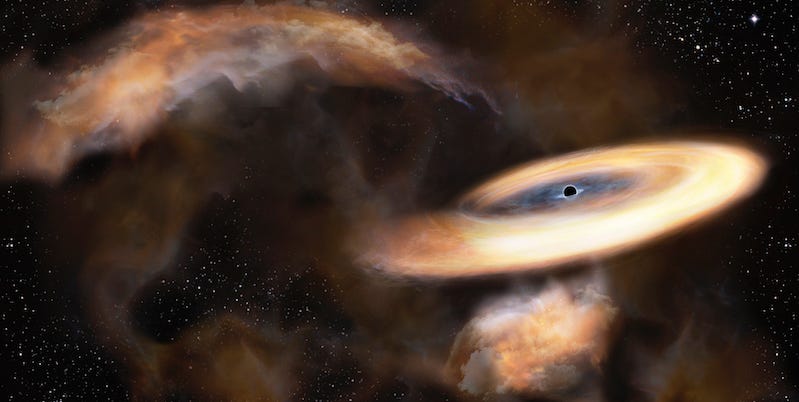
The “black” part of a black hole comes from the fact that it emits no visible light from inside the event horizon. However, the area around a black hole can glow intensely. Gas, dust, and stars pulled toward it may form an accretion disk, a swirling ring of superheated material. This disk can shine in X-rays, radio waves, and other forms of radiation, giving astronomers clues about the invisible object at the center.
How Do Black Holes Form?
Many black holes form when massive stars reach the end of their lives. A star spends most of its existence balancing gravity, which pulls inward, against pressure from nuclear fusion, which pushes outward. When a massive star runs out of usable fuel, that balance collapses. The core falls inward, and the outer layers may explode as a supernova. If the remaining core is massive enough, it can collapse into a black hole.
Other black holes may form through mergers. When two black holes orbit each other, they can spiral inward and collide, creating a larger black hole. These collisions send ripples through space-time called gravitational waves, which observatories on Earth can detect. Supermassive black holes may grow by feeding on gas, merging with other black holes, and evolving alongside their host galaxies over billions of years.
Main Types of Black Holes in Space
Astronomers usually classify black holes by mass. The main categories are stellar-mass black holes, intermediate-mass black holes, and supermassive black holes. Scientists also study the possibility of primordial black holes, which may have formed in the earliest moments after the Big Bang.
1. Stellar-Mass Black Holes
Stellar-mass black holes are the smallest confirmed black holes. They typically form from the collapsed cores of massive stars. Many are several times to dozens of times the mass of the Sun, although gravitational-wave discoveries have revealed some that are even heavier.
These black holes are often found in binary systems, where they orbit a companion star. If the black hole pulls gas from that star, the gas heats up and emits X-rays. That X-ray glow gives astronomers a way to detect a black hole that would otherwise be invisible. In other words, the black hole does not announce itself with a neon sign; it lets the stolen star gas do the talking.
2. Supermassive Black Holes
Supermassive black holes are the giants of the black hole family. They contain hundreds of thousands to billions of times the mass of the Sun. Most large galaxies appear to have one at their center, including our own Milky Way. The Milky Way’s central black hole is called Sagittarius A*, and it has a mass of about four million Suns.
The first black hole ever directly imaged was the supermassive black hole in the galaxy M87. The Event Horizon Telescope captured the now-famous glowing ring around its shadow. Later, the same global telescope network produced an image of Sagittarius A*. These images did not show the black hole itself, because black holes do not emit light. Instead, they revealed the bright material around the black hole and the dark central shadow caused by its gravity.
3. Intermediate-Mass Black Holes
Intermediate-mass black holes are the mysterious middle children of the black hole world. They are heavier than stellar-mass black holes but lighter than supermassive black holes. Their existence is supported by several strong candidates, but they are harder to find than the smaller and larger types.
Why are they important? Because they may help explain how supermassive black holes grew. If intermediate-mass black holes formed early in cosmic history and merged repeatedly, they could have become the seeds of the giants now found at galactic centers. Scientists continue searching for them in star clusters, dwarf galaxies, and unusual X-ray sources.
4. Primordial Black Holes
Primordial black holes are hypothetical black holes that may have formed shortly after the Big Bang. Unlike stellar black holes, they would not need a dying star as their birthplace. Instead, they could have formed from extremely dense regions in the young universe.
No primordial black hole has been confirmed, but the idea remains interesting because it could help answer big questions about dark matter, early cosmic structure, and the conditions of the infant universe. They are the ultimate “maybe” in black hole science: not proven, not dismissed, and definitely not boring.
Important Parts of a Black Hole
The Event Horizon
The event horizon is the boundary beyond which escape is impossible. Outside the event horizon, objects can still orbit, shine, collide, and sometimes escape. Inside it, all paths lead inward. This boundary is what makes a black hole a black hole.
The Singularity
At the center of a black hole, current physics predicts a singularity, a region where density becomes extremely high and our usual equations break down. Scientists do not yet have a complete theory that combines gravity with quantum mechanics, so the true nature of the singularity remains one of the biggest mysteries in physics.
The Accretion Disk
An accretion disk forms when gas and dust spiral around a black hole before falling in. Friction and gravity heat this material to extreme temperatures, causing it to glow. Some accretion disks are among the brightest objects in the universe, especially when they power active galactic nuclei and quasars.
Relativistic Jets
Some black holes launch powerful jets of particles moving at nearly the speed of light. These jets can stretch thousands or even hundreds of thousands of light-years into space. Scientists think they are connected to magnetic fields, spinning black holes, and matter swirling in accretion disks, though the details are still being studied.
How Do Scientists Study Something Invisible?
Black holes do not shine by themselves, so astronomers study their effects on nearby matter, light, and space-time. If stars orbit an invisible object with enormous mass, that object may be a black hole. If gas heats up and blasts X-rays while spiraling around something unseen, a black hole may be nearby. If two black holes merge, gravitational-wave detectors can pick up the signal from the collision.
Modern black hole research uses many tools. X-ray telescopes study hot gas near black holes. Radio telescopes can image material close to the event horizon. Optical and infrared telescopes track the motion of stars near galactic centers. Gravitational-wave observatories detect the tremors caused by black hole mergers. Together, these tools let scientists study black holes from multiple angles, like cosmic detectives with very expensive magnifying glasses.
Famous Black Holes You Should Know
Sagittarius A*
Sagittarius A* sits at the center of the Milky Way galaxy. It is about four million times the mass of the Sun. Scientists confirmed its presence by tracking stars orbiting at incredible speeds around an unseen central mass. The Event Horizon Telescope later produced an image of the glowing material around it.
M87*
M87* is the supermassive black hole at the center of the galaxy Messier 87. It became famous in 2019 when the Event Horizon Telescope released the first direct image of a black hole’s shadow. M87* is billions of times more massive than the Sun and powers an enormous jet extending far beyond its host galaxy’s center.
Cygnus X-1
Cygnus X-1 is one of the earliest and best-known black hole candidates. It is part of an X-ray binary system, where a compact object pulls material from a companion star. The X-ray emissions and mass measurements strongly support the conclusion that the compact object is a black hole.
Black Hole Facts That Sound Fake but Are Real
Black Holes Do Not Suck Up Everything in the Universe
A black hole’s gravity depends on its mass, just like any other object. If the Sun were magically replaced by a black hole with the same mass, Earth would not get sucked in. It would continue orbiting in roughly the same path. The problem, of course, would be the lack of sunlight, which is a rather large customer-service issue for life on Earth.
Time Behaves Strangely Near a Black Hole
Einstein’s theory of general relativity predicts that strong gravity affects time. Near a black hole, time passes differently compared with time far away from it. This is not just movie drama. It is a real consequence of how gravity and space-time work.
Black Holes Can Grow
Black holes grow by absorbing matter and merging with other black holes. However, they do not eat endlessly at random. Matter must come close enough and lose enough energy to fall in. Space is mostly empty, so even a supermassive black hole spends much of its life not actively feeding.
Black Hole Mergers Shake Space-Time
When two black holes collide, they release energy as gravitational waves. These waves stretch and squeeze space-time by tiny amounts as they pass through Earth. LIGO and other observatories detect these signals, allowing scientists to study black holes without needing light at all.
Some Black Holes Help Shape Galaxies
Supermassive black holes can influence their host galaxies. When they feed actively, they may release energy through radiation and jets. This energy can heat gas, affect star formation, and change how galaxies evolve. A black hole may be invisible, but its impact can be galactic.
Are Black Holes Dangerous to Earth?
Black holes make excellent movie villains, but Earth is not currently threatened by one. The nearest known black holes are far away, and a black hole would need to pass extremely close to disturb the solar system. Space is enormous, and close encounters between black holes and planets are very unlikely.
The supermassive black hole at the center of the Milky Way is also not a danger to us. Sagittarius A* is about 26,000 light-years away. It helps define the structure of our galaxy’s center, but it is not going to suddenly lean across the Milky Way and steal your sandwich.
Why Black Holes Matter
Black holes are more than cosmic curiosities. They test the limits of physics. They help scientists study gravity, space-time, galaxy formation, high-energy particles, and the early universe. They also reveal where our theories are incomplete. General relativity works incredibly well for large-scale gravity, while quantum mechanics works beautifully for the tiny world of particles. Inside black holes, those two realms collide conceptually, and scientists are still working to understand what happens there.
Studying black holes is a way of asking the universe difficult questions. What happens when matter is compressed beyond ordinary limits? How did the first supermassive black holes grow so quickly? Can gravity and quantum physics be unified? Are primordial black holes real? Every answer opens another door, and sometimes that door leads to a room full of equations wearing sunglasses.
Experiences Related to Black Holes in Space
Learning about black holes is not only about memorizing facts. It can become a surprisingly personal experience because black holes change how people imagine the universe. The first time many students or casual readers hear that light cannot escape a black hole, the idea feels impossible. Light is the fastest thing we know. It crosses space at breathtaking speed. Yet near a black hole, gravity bends the rules so dramatically that even light loses the escape game.
One of the best experiences related to black holes is simply looking up at the night sky after learning what they are. You will not see a black hole with your eyes, but that is part of the wonder. Somewhere beyond the visible stars, stellar remnants may be orbiting companion stars. At the center of the Milky Way, Sagittarius A* quietly anchors the galaxy’s core. The sky suddenly feels less like a flat ceiling and more like a deep, active, mysterious place.
Another powerful experience is seeing the famous Event Horizon Telescope image of M87*. At first glance, it may look like a blurry orange ring. It is not a glossy space poster or a perfectly polished Hollywood visual. But that fuzzy ring represents one of the greatest achievements in modern astronomy. Scientists combined radio telescopes around the world to create an Earth-sized virtual telescope. The result was visual evidence of a region shaped by gravity so extreme that it turns ordinary intuition into spaghetti.
Black holes also make great classroom and family discussion topics because they invite big questions. What would happen if you fell toward one? Why does time slow down near strong gravity? Could black holes connect to other parts of the universe? Some questions have solid scientific answers, some are speculative, and some remain unknown. That mix is exactly what makes the topic exciting. It teaches curiosity without pretending every mystery is solved.
For people who enjoy documentaries, planetarium shows, science museums, or astronomy apps, black holes provide a perfect gateway into deeper space science. A black hole lesson can lead to learning about massive stars, supernovas, galaxies, Einstein’s relativity, gravitational waves, radio astronomy, and the Big Bang. It is like opening one cosmic drawer and discovering that it contains the entire universe’s junk drawer, except the junk is beautiful and occasionally emits X-rays.
Writers, artists, and science communicators also find black holes inspiring because they are both real and symbolic. They represent mystery, transformation, danger, hidden power, and the limits of knowledge. That is why black holes appear in movies, novels, games, and artwork. The challenge is to enjoy the drama while respecting the science. Real black holes are already strange enough. They do not need extra superpowers.
The most meaningful experience may be the feeling of humility. Black holes remind us that the universe is bigger, older, and more surprising than daily life suggests. We worry about traffic, deadlines, and whether the Wi-Fi is having an emotional crisis. Meanwhile, far away, black holes are merging, galaxies are evolving, and space-time is ringing like a cosmic bell. Learning about black holes does not make everyday problems vanish, but it can put them into perspective. Sometimes, that perspective is worth more than any single fact.
Conclusion
Black holes in space are among the most fascinating objects in the universe. They form from collapsed stars, grow through mergers and accretion, shape galaxies, and challenge our deepest theories of physics. Stellar-mass black holes reveal the dramatic endings of massive stars. Supermassive black holes dominate galactic centers. Intermediate-mass black holes may explain how cosmic giants grow. Primordial black holes, if they exist, could offer clues about the earliest moments of the universe.
The more scientists study black holes, the less they seem like simple cosmic traps and the more they become laboratories for extreme physics. They are dark, powerful, mysterious, and scientifically priceless. Also, let’s be honest: any object that can bend light, warp time, and make Einstein look even smarter deserves a little attention.


