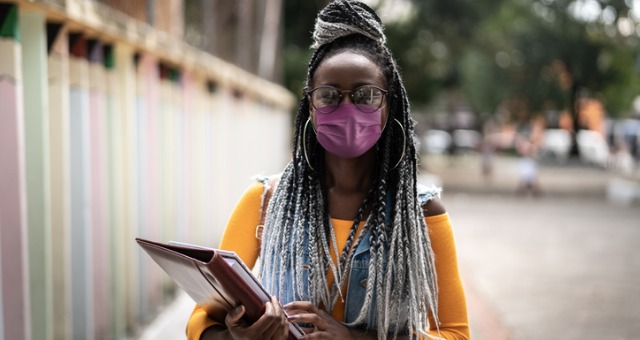

Teaching has always been part performance, part public service, and part controlled chaos. Add a face mask, a classroom full of students, a few competing accents, a humming air purifier, and one student sharpening a pencil like they are preparing for battle, and suddenly the simple act of saying, “Please open your books,” becomes an acoustic obstacle course.
“Teaching behind the mask” is more than a pandemic memory. Masks are still used in schools during respiratory illness outbreaks, flu season, individual health needs, and high-risk classroom situations. For many teachers, especially those working with English language learners, deaf or hard-of-hearing students, young children, and multilingual classrooms, face coverings changed how speech, emotion, authority, humor, and identity traveled across the room.
The problem was not only that masks made voices quieter. They also removed lips, smiles, tiny facial clues, and the comforting half-grin teachers use when a lesson is going off the rails but everyone is pretending it is fine. They made accents feel sharper to some listeners and less clear to others. They turned ordinary consonants into shy little noises hiding behind fabric. Yet they also forced educators to become more intentional, more visual, more patient, and, in many cases, more inclusive.
Why Masks Change Classroom Communication
A face mask does not erase speech, but it does reshape it. High-frequency sounds such as “s,” “f,” “th,” and “sh” can become harder to hear, especially in rooms with background noise. Those sounds may seem small, but they carry big meaning. The difference between “thin” and “fin,” “ship” and “sip,” or “class” and “glass” can matter a lot when students are learning new vocabulary, following safety instructions, or trying to understand a teacher’s joke before it expires in midair.
Classrooms are rarely acoustically perfect. Desks scrape. HVAC systems rumble. Students whisper, cough, laugh, unzip backpacks, and somehow drop the loudest water bottle on Earth. When a teacher speaks through a mask, the voice has to compete with all of that while losing some crispness. The farther a student sits from the teacher, the more the message can blur. In large rooms, gyms, labs, music rooms, and cafeterias, the challenge grows even bigger.
Facial visibility is equally important. Students do not only hear a lesson; they read it. They watch a teacher’s mouth form sounds, notice eyebrows rising before a question, and recognize a smile that says, “You are safe to try.” A mask covers much of that information. For students who rely on lipreading, facial expressions, or visual speech cues, the classroom can suddenly feel like a video with half the screen cropped out.
Accents, Identity, and the Masked Classroom
Accents are not errors. They are histories you can hear. A teacher’s accent may reflect region, family, language background, migration, culture, or community. In a healthy classroom, accent diversity is not a flaw to be corrected but a resource that teaches students how wide and flexible English can be.
Still, masks complicated accent perception. When speech is muffled, listeners may blame the speaker’s accent rather than the listening conditions. A student might think, “I cannot understand my teacher because of their accent,” when the real problem is the combination of fabric, distance, noise, and missing facial cues. That distinction matters. If schools ignore it, teachers with regional, multilingual, or non-native accents can face unfair pressure to “sound clearer” in ways that quietly become pressure to sound less like themselves.
Good teaching behind the mask requires separating clarity from accent bias. Clarity means organizing speech, pacing instruction, using visual support, checking understanding, and reducing noise. Accent bias means assuming one way of speaking is automatically smarter, cleaner, or more professional than another. The first helps students learn. The second teaches them the wrong lesson.
Accent Diversity Can Strengthen Listening Skills
Students benefit from hearing different Englishes. In the real world, English does not arrive in one polished broadcast voice. It comes from nurses, engineers, grandparents, cashiers, scientists, neighbors, classmates, and YouTube tutorials recorded in kitchens with suspicious lighting. When teachers normalize accent diversity, students become better listeners and more respectful communicators.
A masked classroom can make this work more deliberate. Teachers can say, “Different people pronounce words differently. Our job is not to make fun of that. Our job is to listen carefully, ask respectfully, and use context.” That one sentence can turn a frustrating listening moment into a lesson in cultural intelligence.
Who Is Most Affected by Muffled Teaching?
Every student can miss information in a masked classroom, but some groups face higher barriers. Deaf and hard-of-hearing students may lose access to lip movements and facial expressions. Students with auditory processing challenges may struggle when speech is less distinct. Young children, who are still building phonological awareness, may need extra repetition and visual modeling. English language learners may have to decode new sounds, new vocabulary, and a covered face all at once. That is not a language lesson; that is a boss level.
Students with attention differences may also be affected. When speech becomes harder to follow, the brain has to work harder. That extra effort can lead to fatigue, distraction, or frustration. A student who appears “checked out” may actually be doing intense mental gymnastics just to figure out whether the teacher said “write the answer” or “right answer.”
Teachers are affected, too. Speaking louder for long periods can strain the voice. Many educators learned this the hard way after a day of projecting through masks and going home sounding like a haunted kazoo. Voice fatigue is not a small issue. A tired teacher voice can reduce lesson quality, classroom energy, and teacher well-being.
Practical Strategies for Teaching Behind the Mask
The best solutions are not dramatic. They are small, consistent habits that make speech visible, predictable, and easier to process. Teachers do not need to become professional stage actors, although a little theater never hurts. They need a communication system.
1. Slow Down Without Sounding Like a Robot
Speaking slowly helps, but overdoing it can sound unnatural and even patronizing. The goal is not to talk like a GPS that has lost hope. The goal is to speak clearly, pause between important ideas, and give students time to process. Shorter sentences often work better than simply louder sentences.
Instead of saying, “After you finish the paragraph, compare your response with your partner and then revise your answer using evidence from the text,” a teacher might say: “First, finish the paragraph. Then talk with your partner. After that, revise your answer. Use evidence from the text.” Same meaning, less fog.
2. Pair Spoken Words With Written Words
When speech is muffled, written support becomes a lifeline. Directions should appear on the board, in slides, or on handouts. Key vocabulary should be visible. Important names, dates, formulas, and page numbers should not depend on perfect hearing.
This helps everyone, not only students with identified needs. A visual agenda can reduce repeated questions, save teacher energy, and prevent the classic classroom mystery: “Wait, what are we doing?” Written support also helps students who process language better when they can see it.
3. Use Gestures and Body Language on Purpose
Masks hide smiles, but they do not hide the whole teacher. Eye contact, posture, hand signals, pointing, thumbs-up signs, and movement can carry meaning. A teacher can create simple classroom gestures for “repeat,” “write this down,” “turn and talk,” “pause,” and “great idea.”
These signals are especially useful in noisy rooms or when students are working in groups. They also reduce the need for constant voice projection. The less a teacher has to shout, the more voice remains available for actual teaching instead of emergency announcements like, “Please stop trying to balance three rulers on your head.”
4. Check Understanding Without Embarrassing Students
Asking “Does everyone understand?” is tempting, but it often produces a room full of silent nods from students who absolutely do not understand. Better checks are specific and low-pressure. A teacher can ask students to show one to five fingers for confidence, write one question on a sticky note, complete a quick exit ticket, or repeat instructions to a partner.
For English language learners, comprehension checks should focus on meaning rather than speed. Give students time. Let them use sentence frames. Encourage them to ask, “Can you repeat that more slowly?” or “Can you write that word?” These are not signs of weakness. They are academic survival tools.
5. Improve the Listening Environment
Teachers cannot always redesign classrooms, but small changes help. Close doors when hallway noise is high. Arrange seats so students can see the teacher and each other. Use carpets, soft materials, or bulletin boards when possible to reduce echo. Stand where students can see you before giving instructions. Avoid talking while facing the board.
Technology can help as well. A microphone, classroom speaker, captioned video, or assistive listening device can make a major difference. Amplification is not about making a teacher sound like a game-show host. It is about making speech evenly accessible across the room.
Clear Masks, Microphones, and Captions: Helpful Tools With Limits
Clear masks can restore access to lip movements and facial expressions, which is valuable for many students. However, not every clear mask performs the same way. Some fog. Some distort sound. Some fit poorly. Schools should choose options carefully and consider both safety and communication access.
Microphones are often underrated. A small teacher microphone can reduce vocal strain and help students hear more evenly. This is especially useful in large classrooms, music rooms, language classes, and spaces where distancing or ventilation noise makes speech harder to follow.
Captions and transcripts are also powerful tools. Videos should be captioned. Recorded mini-lessons can include written summaries. Digital platforms can support students who need to review instructions later. The goal is not to replace live teaching but to give students multiple paths to the same content.
Teaching English Language Learners Behind the Mask
For English language learners, masks create a double challenge: the language is new, and the speaker is partly hidden. This makes intentional instruction essential. Teachers should pre-teach vocabulary, use visuals, model sentence patterns, and give students structured chances to practice speaking.
Pronunciation work may need extra care. Students often watch the mouth to learn how sounds are formed. If a mask hides that, teachers can use diagrams, videos, mirrors, or transparent masks when appropriate. They can also describe what the mouth is doing: “Your tongue goes between your teeth for the ‘th’ sound,” or “Your lips touch lightly for ‘m’.” Yes, it feels a little strange the first time. Teaching is already strange. We sing cleanup songs to teenagers if the day gets weird enough.
Teachers should also be honest about listening. Saying, “Masks can make speech harder to understand, so we will help each other,” gives students permission to ask for repetition. It lowers shame. It also models real communication: people misunderstand each other, repair the message, and keep going.
Classroom Culture: The Hidden Curriculum of Masked Teaching
Behind every mask lesson is a culture lesson. Students learn how people respond when communication is difficult. Do they laugh at accents? Do they roll their eyes when someone asks for repetition? Do they assume louder means clearer? Or do they become patient, flexible, and respectful?
A teacher can set the tone early. Try language such as: “In this room, we do not make fun of how people speak. We ask clarifying questions. We listen for ideas. We help each other understand.” That message supports multilingual students, students with speech differences, and anyone who has ever had a sentence come out sideways in publicwhich is all of us.
Humor helps, too. A teacher might say, “My mask sometimes eats consonants for breakfast, so raise your hand if it steals one.” Light humor makes the issue visible without blaming students or teachers. It turns frustration into teamwork.
What Masked Teaching Revealed About Good Teaching
Masked teaching exposed something educators already knew: communication is not just talking. It is design. It is pacing, visuals, relationship, repetition, environment, and trust. A teacher can speak beautifully and still be misunderstood if the room, lesson, or culture makes listening difficult.
It also revealed that accessibility strategies help everyone. Written directions support students with hearing needs, English learners, absent students, anxious students, and students who were thinking about lunch when directions were first given. Captions help multilingual learners and native speakers. Microphones help students in the back row and save teachers’ voices. Clear routines help students who missed a word and students who missed the entire morning because their brain was still buffering.
The lesson is not that masks are good or bad for education in every situation. The lesson is that communication barriers are real, and schools can plan for them. When masks are needed for health reasons, instruction should not depend on heroic teacher lungs or student guesswork. It should be supported by smart design.
Experience-Based Reflections: What Teaching Behind the Mask Feels Like
Teaching behind a mask can feel like trying to conduct an orchestra from inside a pillowcase. You know what you mean. Your lesson plan knows what you mean. The student in the front row probably knows what you mean. But somewhere near the pencil sharpener, your carefully prepared explanation has become a soft cloud of vowels.
One of the first experiences many teachers noticed was the strange disappearance of facial warmth. A smile, normally the easiest classroom tool, suddenly became invisible. Teachers had to learn how to “smile with their eyes,” which sounds poetic until you try doing it during third period while also taking attendance, opening a slide deck, and reminding someone that a hoodie string is not a laboratory instrument. Eye expression, hand gestures, and tone became more important because the lower half of the face was off duty.
Another common experience was voice fatigue. Teachers who were used to projecting naturally began pushing harder. By the afternoon, their throats felt dry, their voices sounded rough, and every instruction required extra effort. The solution was not simply to get louder. In fact, louder speech often became less clear. The better approach was to reduce teacher talk, chunk directions, use the board more, and create repeatable routines. A teacher who writes “1. Read. 2. Highlight. 3. Discuss. 4. Submit.” saves both voice and sanity.
Masked teaching also made teachers more aware of student silence. Before masks, a confused face was easier to spot. A wrinkled nose, a half-open mouth, or a nervous smile could signal, “I am lost, but please do not call on me because I enjoy having a soul.” With masks, those cues were harder to read. Teachers had to build new systems: thumbs sideways, private chat messages, quick polls, colored cards, mini-whiteboards, or simple check-in questions. The best classrooms did not wait for confusion to become obvious. They invited students to reveal it safely.
For teachers with accents, masked teaching could be emotionally complicated. Some became self-conscious, repeating words more often or avoiding spontaneous discussion. Others found ways to turn the challenge into a lesson about language diversity. A teacher might pause and say, “You may hear me pronounce this word one way and another teacher pronounce it slightly differently. Both can be understandable. Let’s focus on the meaning.” That kind of transparency helps students understand that communication is shared work, not a test of one person’s worth.
Students, too, adapted in surprising ways. Many became more comfortable asking for repetition once teachers normalized it. A classroom phrase like “Say it again, please” can become powerful when it is treated as respectful rather than rude. Some students started helping each other quietly: pointing to the board, sharing notes, or repeating directions to a partner. In strong classroom communities, masked communication became less of a barrier and more of a collective routine.
There were funny moments, of course. Teachers misheard student answers. Students misheard page numbers. “Open to page sixteen” somehow became “open to page sixty,” and half the class traveled to the wrong century of the textbook. A teacher saying “focus on the theme” might be heard as “focus on the meme,” which, to be fair, could produce an interesting essay. These moments were annoying, but they also reminded everyone that misunderstanding is normal. The repair matters more than the mistake.
The most meaningful experience from teaching behind the mask may be this: it made invisible communication needs visible. Students who had always struggled to hear were no longer alone. English learners who needed written directions were joined by native speakers who needed them too. Teachers who had relied heavily on facial expression discovered new ways to build warmth. Schools that invested in captions, microphones, visual routines, and inclusive communication did not just solve a mask problem. They improved instruction.
Teaching behind the mask was not easy, and no honest teacher would describe it as a charming little adventure. It was tiring, awkward, and sometimes deeply frustrating. But it also sharpened the profession’s understanding of access. Clear teaching is not about having a perfect voice, a neutral accent, or superhero volume. It is about making meaning reachable. The mask simply made that responsibility harder to ignore.
Conclusion
“Masked Accents and Muffled Sounds: Teaching Behind the Mask” is ultimately a story about adaptation. Masks changed the sound of classrooms, but they also challenged educators to rethink clarity, equity, and belonging. They reminded schools that students do not all receive information the same way. Some listen through hearing aids. Some translate in real time. Some rely on lip movements. Some need written support. Some are simply sitting near the world’s loudest air conditioner.
The best response is not panic, blame, or pretending everyone heard everything perfectly. The best response is intentional communication: clear speech, visible directions, respectful repetition, assistive technology, inclusive attitudes toward accents, and classroom routines that make confusion safe to admit. Teaching behind the mask may have started as a health necessity, but the lessons it revealed belong in every classroom. When teachers design for muffled sound, diverse accents, and different listening needs, they do more than survive a masked lesson. They build a classroom where more students can actually hear, understand, and belong.


