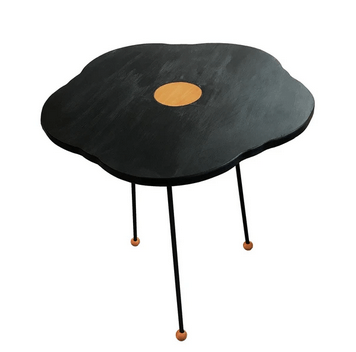

Julie Jenkinson’s The Poppy Table is not the kind of side table that politely fades into the corner while everyone compliments the sofa. It has personality. It has posture. It has three legs that seem to be considering a tiny afternoon stroll. Handmade from wood and steel, inspired by early mid-century modern design and industrial forms, this sculptural table sits at the unusual intersection of furniture, art object, and cheerful domestic mischief.
Created by British-born, Toronto-based multidisciplinary artist and designer Julie Jenkinson, The Poppy Table reflects a larger creative practice built around found materials, functional sculpture, visual humor, and objects that appear more alive than objects are technically allowed to be. It is a side table, yes. But it is also a small performance: a pop of form, a wink of movement, and a reminder that practical furniture does not have to be boring enough to qualify for jury duty.
What Is Julie Jenkinson’s The Poppy Table?
The Poppy Table is a handmade side table by Julie Jenkinson, constructed from wood and steel. Jenkinson’s own furniture page describes it as “solid, functional and Fun,” and that capital “F” feels earned. The table is associated with a 2019 handmade Canadian production, with published dimensions listed around 20 to 22 inches in diameter and 24 inches high, depending on the listing. In practical terms, that makes it large enough for a lamp, book, coffee, small vase, or the emotional support snack bowl every living room deserves.
The design’s most memorable feature is its animated shape. Rather than behaving like a rigid block, The Poppy Table has a biomorphic, almost creaturely quality. A critical description connected to Jenkinson’s work notes that the table appears “ready to walk away on its three legs.” That line is funny because it is accurate. The table’s stance gives it a sense of movement, as though it has been caught mid-step while trying to sneak into a better-lit corner.
Who Is Julie Jenkinson?
Julie Jenkinson is a British-born, self-taught artist and designer living in Toronto. Her work spans sculpture, furniture, photography, jewelry, pattern, surface design, and installation. Across these forms, she shows a consistent interest in material history, object personality, and the strange moment when an ordinary thing starts to feel unexpectedly alive.
Jenkinson has exhibited internationally, with work shown in Toronto, Buenos Aires, Barcelona, New York, and Washington, D.C. In 2018, she held her first solo sculpture exhibition, Continued Existence, at VERSO Gallery in Toronto. Her work is included in public, corporate, and private collections and commissions, with listed connections including Douglas Coupland, Cutler and Gross, Netflix, The Gladstone Hotel, Taylor Hazell Architects, RH Gallery, TAP Art Projects, and Yabu Pushelberg.
That background matters because The Poppy Table is not a random cute table with good balance. It belongs to an artist’s broader vocabulary. Jenkinson’s sculptures often transform salvaged, industrial, or familiar materials into forms that feel witty, mysterious, and slightly theatrical. The Poppy Table brings that same artistic energy into the home, where it can hold your mug without making a speech about it.
The Design Language: Mid-Century Modern Meets Industrial Play
The Poppy Table is described as being inspired by early mid-century modern design and industrial forms. That combination explains much of its charm. Mid-century modern design is known for clean lines, functional shapes, organic curves, and an optimistic belief that everyday objects can be elegant without wearing a tuxedo. Industrial design, meanwhile, brings strength, structure, and material honesty. Put them together and you get a table that is playful but not flimsy, sculptural but not precious.
Mid-century modern furniture grew from a belief that form, material, and purpose should work together. MoMA’s 1940 “Organic Design in Home Furnishings” competition famously emphasized harmony among structure, material, and use. The Poppy Table feels related to that idea, but it does not simply imitate vintage modernism. Instead, it borrows the era’s love of simplicity and organic movement, then adds a contemporary artist’s sense of humor.
Why Three Legs Matter
Three-legged furniture has an immediate visual advantage: it looks balanced and lively at the same time. Four legs often say, “I am a table and I have filed the proper paperwork.” Three legs say, “I am stable, but I also know jazz.” The Poppy Table’s tripod-like stance creates energy. The legs do not simply support the top; they help give the piece its personality.
This is one reason The Poppy Table works well as a side table or accent table. It does not need to dominate a room to be noticed. Its silhouette does the work. In a quiet interior, it becomes a sculptural focal point. In a maximalist room, it holds its own among color, pattern, and collected objects. It is versatile, but not invisible.
Materials: Wood, Steel, and a Sense of Humor
The use of wood and steel gives The Poppy Table a satisfying contrast. Wood brings warmth, tactility, and a natural surface. Steel provides structure and an industrial edge. Together, the materials create a piece that feels grounded but spirited. It is not a delicate decorative prop pretending to be useful. It is built as furniture, while still carrying the visual charge of sculpture.
This material pairing also makes the table easier to place in different interiors. Wood connects it to vintage furniture, bookshelves, floors, and ceramics. Steel connects it to modern lighting, black metal frames, gallery-style interiors, and industrial accents. The result is a handmade side table that can sit near a Finn Juhl chair, a contemporary sofa, a vintage lamp, or a slightly dramatic houseplant named Gerald.
The Poppy Table in Real Interiors
The table has been shown in design-forward settings, including the Dark Horse Coffee Automat in Toronto, a space designed by Mjölk and featured by Remodelista. In that context, the Poppy Table appears alongside carefully selected modern and vintage pieces, including Scandinavian and Canadian design objects. That is an ideal environment for understanding the table’s appeal: it works not because it matches everything, but because it adds life to a curated space.
In a home, The Poppy Table could work beautifully beside a reading chair, near a sofa, in an entryway, or as an artful nightstand. It is especially useful in interiors that need one object with personality. Some rooms need a chandelier. Some rooms need a giant painting. Some rooms just need a small table that looks like it might have opinions about architecture.
How to Style Julie Jenkinson’s The Poppy Table
1. Pair It With Clean-Lined Seating
The Poppy Table shines beside simple furniture. A clean-lined sofa or lounge chair allows the table’s animated shape to stand out. Avoid crowding it with too many competing sculptural pieces nearby. Give it a little breathing room, and it will reward you by looking effortlessly intentional.
2. Add a Small Lamp or Ceramic Vase
Because the table already has strong visual character, styling should be edited. A compact lamp, a handmade ceramic vase, or a stack of two books is enough. The goal is not to bury the table under accessories. That would be like putting a marching band in front of a jazz trio.
3. Use It as a Functional Art Piece
The best way to enjoy The Poppy Table is to let it do both jobs: serve and entertain. Place it where it can be used daily. A functional art object becomes more meaningful when it participates in ordinary life. Coffee cups, reading glasses, flowers, notebooks, and small trays all belong here.
4. Mix It With Vintage and Contemporary Pieces
The Poppy Table has enough mid-century DNA to feel at home with vintage modern furniture, but enough originality to avoid looking like a reproduction. It can bridge eras in a room. Pair it with a 1960s lamp, a contemporary rug, a modern sofa, and a bold print. The table will behave like the friend at dinner who somehow gets along with everyone.
Why Collectors and Design Lovers Notice It
Collectors often respond to objects that carry a clear point of view. The Poppy Table has one. It is handmade, artist-designed, materially straightforward, and visually memorable. It does not rely on ornate decoration or trendy gimmicks. Its appeal comes from proportion, stance, material, and personality.
That makes it different from mass-produced accent tables. A typical side table solves a surface problem: where do I put this cup? The Poppy Table solves that problem and then adds a second question: why shouldn’t the cup have a more interesting life? This is the appeal of artist-made furniture. It improves the room while quietly changing how you look at ordinary domestic objects.
Functional Sculpture: The Sweet Spot
The phrase “functional sculpture” gets thrown around a lot, sometimes at objects that are neither very functional nor very sculptural. The Poppy Table earns the phrase because it can be used as a side table while still reading as an artwork. Its top gives it purpose; its legs give it attitude; its materials give it durability.
This balance is not easy. If a piece leans too far into sculpture, people become afraid to touch it. If it leans too far into utility, the artistic spark disappears. Jenkinson’s table keeps both qualities in play. It can hold a drink, but it also holds attention.
The Poppy Table and Jenkinson’s Larger Artistic Practice
To fully appreciate The Poppy Table, it helps to look at Jenkinson’s broader work. Her sculpture often explores how objects can feel animated, repeated, hybrid, or transformed. Critics have noted the way her constructions suggest motion and life, even when made from manufactured or industrial materials. The Poppy Table brings that sensibility into furniture design.
Rather than treating furniture as separate from art, Jenkinson treats it as another site of possibility. A table can be a table and still have a character. A leg can support weight and suggest movement. A circular top can be practical and still feel like a flower, a creature, or a graphic shape. This is where the name “Poppy” becomes especially fitting. The table has the upbeat energy of something blooming.
Is The Poppy Table Worth It?
For someone seeking the cheapest possible side table, The Poppy Table is probably not the answer. A bargain flat-pack table can hold a remote control perfectly well, and it may only require three hours of assembly, two missing screws, and one small emotional crisis. But for collectors, design enthusiasts, and homeowners who value handmade objects, Jenkinson’s piece offers something more lasting.
It is worth considering if you want a small table that functions as a conversation piece, supports independent design, and brings sculptural energy into a room. It is especially appealing for interiors that already include vintage modern furniture, Canadian design, contemporary art, or handmade objects. In those settings, The Poppy Table does not look like an accessory. It looks like it belongs.
Buying and Availability Notes
The Poppy Table has appeared through Inabstracto, the Toronto vintage and mid-century modern art and design destination associated with Jenkinson. Published listings describe the table as handmade in Canada, with a lead time noted on at least one product page. Because artist-made furniture can be produced in small batches or editions, availability may change. Dimensions and listing details may also vary slightly by edition or source.
For buyers, the practical advice is simple: confirm current dimensions, finish, pricing, production timing, and shipping before purchasing. Handmade objects can vary in the best way, but your room measurements do not care about poetic variation. Measure first. Fall in love second. Ideally, do both before your cat claims the table as a throne.
Experience Notes: Living With a Table Like Julie Jenkinson’s The Poppy Table
Imagine bringing The Poppy Table into a living room that already has the usual cast: a sofa, a rug, a reading chair, a lamp, and that one corner everyone ignores because it has the personality of a printer manual. The first thing a table like this does is wake up the corner. Its rounded top softens the geometry of the room, while the three-legged base adds a little movement. Suddenly, the forgotten corner is no longer a furniture waiting room. It has a pulse.
The second experience is tactile. Handmade furniture changes how people behave around it. Guests notice it. They ask about it. They lean closer. Unlike a generic side table, which often disappears into the background, The Poppy Table invites curiosity. Someone will eventually say, “Is that table walking?” and that is when you know the piece is doing its job.
In daily use, a sculptural side table also changes small routines. Morning coffee feels more deliberate when the cup sits on a piece with character. A book left on the table looks styled even when it was abandoned because someone got distracted by a phone notification. A vase of flowers becomes a full composition. The table does not demand perfection; it simply makes ordinary things look a little more considered.
One of the best ways to use a piece like this is beside a chair devoted to reading or slow evenings. Add a warm lamp nearby, place one favorite book on the table, and resist the urge to clutter it. The table’s charm comes from negative space as much as form. It needs enough room for the eye to read the curve of the top and the stance of the legs. Too many accessories can turn that sculptural clarity into a tiny yard sale.
There is also emotional value in owning artist-made furniture. A handmade table carries evidence of decision-making: why this material, why this proportion, why this form? That sense of authorship makes a room feel less assembled and more collected. Over time, the table becomes part of the household’s visual memory. It appears in photos. It holds birthday flowers. It supports late-night tea. It becomes the small object everyone recognizes, the one that makes the room feel like yours.
The Poppy Table is especially useful for people who want interiors with warmth but not clutter, humor but not chaos, and artfulness without turning the house into a museum where everyone is afraid to sit down. It is approachable. It is functional. It is slightly odd in the best possible way. And in a design world full of objects trying very hard to look expensive, there is something refreshing about a table that looks like it might simply be happy to be here.
Conclusion
Julie Jenkinson’s The Poppy Table proves that a side table can be more than a surface. It can be sculpture, design history, material experiment, and domestic companion all at once. With its wood-and-steel construction, mid-century and industrial influences, handmade Canadian origin, and animated three-legged form, it captures the wit and intelligence of Jenkinson’s broader artistic practice.
For collectors and design lovers, the table offers a rare combination: useful enough for everyday life, distinctive enough to define a room, and playful enough to make people smile. In other words, it does what great design should do. It serves a purpose, improves its surroundings, and quietly refuses to be dull.