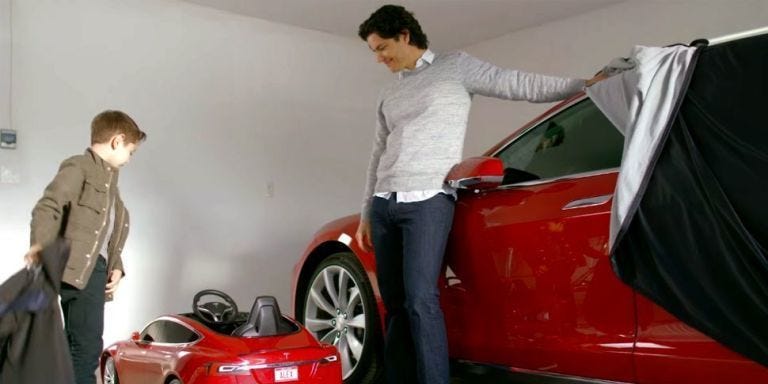

Some children ask for a bike. Some ask for a scooter. And then there is the tiny executive who looks across the driveway, points at a luxury electric sedan, and says, “I’ll take one in red.” Good news for that highly specific child: the Tesla Model S for Kids turned the dream of pint-sized electric driving into a real product, thanks to a collaboration between Tesla and Radio Flyer.
The result was not just another plastic ride-on car with stickers doing their best. The Radio Flyer Tesla Model S for Kids was designed to echo the grown-up Model S experience in miniature form, complete with sleek styling, working headlights, a front trunk, customizable colors, and a lithium-ion battery system. In other words, it was the rare toy car that made parents check the garage and wonder whether their child’s vehicle had better branding than theirs.
But beyond the novelty, this kid-sized Tesla tells a bigger story about modern play, electric vehicle culture, toy safety, and how children learn through imitation. It is cute, yes. It is also a fascinating example of how the electric car revolution drove straight into the toy aisle without even asking whether anyone had room next to the sidewalk chalk.
What Is the Tesla Model S for Kids?
The Tesla Model S for Kids is a battery-powered ride-on car created by Radio Flyer in collaboration with Tesla. It was built for young drivers, generally in the preschool-to-early-elementary age range, and styled after Tesla’s full-size Model S sedan. Unlike many generic ride-on cars, this one leaned heavily into authenticity. The body shape, color options, badging, and design language were meant to make the toy feel like a true miniature Tesla rather than a mystery car wearing a fancy Halloween costume.
When it launched, the Model S for Kids attracted attention because it treated a children’s toy with the same kind of product drama usually reserved for actual vehicles. Families could customize the car through an online design process, choosing options such as paint color, wheel style, personalized license plates, and battery upgrades. It was basically “build your Tesla,” except the final customer might still need help opening a juice box.
The starting price was around $499, which placed it well above many basic ride-on toys. But the product was never trying to be the cheapest electric ride-on car for kids. Its appeal came from the Tesla badge, Radio Flyer’s reputation, and a feature set that made the toy feel more premium than the average backyard cruiser.
Why the Tiny Tesla Became a Big Deal
The excitement around the Radio Flyer Tesla Model S was not only about children driving a cute car. It arrived at a time when Tesla had become a cultural symbol. The adult Model S helped make electric cars feel fast, desirable, and futuristic. For many families, a kid-sized version turned that same energy into play.
Children love copying adults. Give them a toy kitchen, and suddenly they are “making dinner” with wooden carrots. Give them a toy laptop, and they will confidently send emails to stuffed animals. Give them a Tesla Model S for Kids, and they will reverse into the flower bed with the confidence of a Silicon Valley founder.
The ride-on Tesla worked because it connected imagination with real-world technology. It introduced children to the idea that cars can run on batteries, that charging is part of mobility, and that driving is something that comes with rules, awareness, and responsibility. Nobody is saying a four-year-old needs a lecture on regenerative braking, but early exposure to electric vehicles can make cleaner transportation feel normal rather than strange.
Key Features of the Radio Flyer Tesla Model S for Kids
Authentic Tesla-Inspired Design
The strongest selling point was the design. The toy car borrowed the smooth, modern look of the Tesla Model S and scaled it down for children. Available colors included Tesla-style finishes such as red, blue, and silver tones. The result looked sharp enough that neighborhood kids might stop mid-scooter and say, “Wait, is that leased?”
Lithium-Ion Battery Power
One of the most notable features was the use of lithium-ion battery technology. Many traditional ride-on cars have used sealed lead-acid batteries, which can be heavier and slower to recharge. Radio Flyer promoted its FlightSpeed lithium-ion system as a major performance advantage, offering longer play sessions and faster charging compared with more basic battery-powered ride-on toys.
The standard battery offered roughly one to two hours of continuous ride time depending on speed, terrain, and the child’s weight. A premium battery option could extend that play time to roughly one and a half to three hours. Translation for parents: fewer dramatic “my car died” announcements from the driveway.
Two Speed Settings
The Model S for Kids was designed with two driving speeds: a lower setting around 3 mph for beginners and a higher setting around 6 mph for more confident young drivers. That may not sound fast to an adult, but for a small child gripping a steering wheel with serious determination, 6 mph can feel like qualifying at Monaco.
The adjustable speed setup made the toy more flexible. Parents could start cautious drivers on the slower setting, then increase the speed when the child showed better steering, braking, and awareness. This is especially useful because young children do not all develop coordination at the same pace. Some are careful. Some are fearless. Some appear to believe curbs are merely suggestions.
Working Headlights and Front Trunk
The working headlights added realism, while the front trunk gave kids a place to store small treasures. In adult Tesla language, it is a “frunk.” In child language, it is where rocks, action figures, half a granola bar, and one mysterious leaf go to begin a new life.
Custom Accessories
Optional accessories helped turn the toy into a full mini ownership experience. Families could add items such as a custom license plate, silver wheels, a parking sign, and a car cover. These touches were not necessary, but they made the Tesla Model S for Kids feel less like a throwaway toy and more like a small personal vehicle.
Who Is the Tesla Model S for Kids Best For?
The Tesla Model S for Kids was aimed at children roughly ages 3 to 8, with a weight capacity around 81 pounds. That age and weight guidance matters. A ride-on car should fit the child’s body, strength, attention span, and ability to follow basic rules. It should not be used by older children, adults, or ambitious uncles who think “just one lap” is a valid safety plan.
This type of toy works best for families with access to a safe, flat riding area. A driveway, enclosed patio, paved backyard path, or quiet private space can be appropriate when supervised. Public roads, parking lots, steep hills, and areas near moving vehicles are not suitable. The car may look like a Tesla, but it is still a toy, not a transportation plan.
Safety Matters: Cute Does Not Cancel Physics
Any battery-powered ride-on car should be treated as a moving toy with real safety considerations. Parents should follow manufacturer instructions, age recommendations, weight limits, and charging guidelines. The safest place to use a kids electric car is a dry, flat surface away from traffic, pools, stairs, and obstacles.
Supervision is essential, especially for children under 8. Young drivers may understand “turn left” in theory and still enthusiastically drive straight into a lawn chair. A helmet is also a smart habit for wheeled toys, particularly when children are learning balance, speed control, and steering. Knee and elbow pads can help reduce scrapes, especially for adventurous kids who believe every ride requires a finale.
Battery safety also deserves attention. Parents should use the charger supplied or approved for the product, avoid charging near flammable materials, inspect cords and connectors, and keep battery compartments secure. Modern toy safety standards in the United States include requirements for battery-operated toys, but safe use at home still depends on adults reading the manual instead of using it as decorative packaging.
How It Compares With Other Kids Electric Cars
The Tesla Model S for Kids stood out because it combined a premium brand with thoughtful design and better battery technology than many entry-level ride-on cars. Generic ride-on cars can be cheaper and may include popular features such as remote controls, music, opening doors, and SUV styling. However, the Radio Flyer Tesla had a more refined identity. It was not just “a car.” It was “the tiny Tesla.”
Compared with larger ride-on vehicles, the Model S for Kids was more of a smooth-surface driveway car than an off-road adventure machine. It was built for young children cruising in controlled environments, not for mud, grass, gravel, or backyard rally championships. Parents looking for rugged terrain performance may prefer go-karts, dune racers, or newer electric ride-on trucks. Parents looking for style, novelty, and a Tesla-inspired experience would understand the appeal immediately.
Tesla’s Kids Lineup Did Not Stop There
The Model S for Kids helped establish the idea that Tesla-branded children’s vehicles could become collector-worthy toys. Later, Tesla and Radio Flyer expanded the concept with products inspired by other Tesla designs, including the Cyberquad for Kids and Cybertruck for Kids. These newer models brought higher speeds, larger frames, and more rugged styling for older children.
The Cyberquad story also showed why classification and compliance matter. One earlier version was recalled because regulators determined it did not meet federal youth ATV safety requirements. Later versions returned with updates and clearer positioning as toys. That episode is a useful reminder for parents: a famous brand does not remove the need to check safety standards, recalls, and age recommendations before buying any powered ride-on product.
The Real Value: Play, Confidence, and Early Responsibility
At its best, a ride-on Tesla is not only about luxury branding. It gives children a chance to practice coordination, spatial awareness, patience, and decision-making. Steering around cones, stopping before a chalk line, parking in a designated space, and waiting for a turn are all small exercises in self-control.
Parents can turn the toy into a gentle learning activity. Set up a “charging station” in the garage. Create a pretend stop sign. Let kids decorate a parking space. Teach them to check the area before moving, keep both hands on the wheel, and stop when an adult says stop. Suddenly, the toy is doing more than entertaining. It is teaching habits that apply to bikes, scooters, sports, and eventually real driving many years later.
Buying Tips for Parents
If you are considering a Tesla Model S for Kids on the resale market or comparing it with current kids electric cars, start with condition. Check the battery, charger, wheels, steering, body shell, seat, wiring, and any missing parts. Because the original Model S for Kids is not always available new, replacement parts can be important. Radio Flyer has offered parts support for Model 910 components, which can help extend the toy’s life.
Next, confirm that the child fits within the recommended age and weight range. A too-small child may struggle to steer or brake properly. A too-large child can overload the motor, wheels, or frame. Also consider where the vehicle will be used. A beautiful ride-on car is less useful if your only available riding surface is a steep driveway shaped like a ski jump.
Finally, be honest about storage. Electric ride-on cars take up space. They need charging access and protection from weather. If your garage already contains bikes, scooters, sports gear, holiday bins, and one mysterious box nobody has opened since 2019, measure before buying.
Why Adults Love It Almost as Much as Kids Do
Part of the charm is that the Tesla Model S for Kids feels like a wink to adults. Parents understand the joke: here is a luxury electric sedan, reduced to kindergarten scale, complete with options and accessories. It is aspirational, funny, and oddly adorable.
It also taps into the emotional side of car culture. Many adults grew up with pedal cars, Power Wheels, scooters, wagons, or bikes that felt like freedom. A ride-on Tesla is the modern version of that feeling. Instead of pretending to drive a gas-powered muscle car, today’s kids can pretend to glide silently into the electric future. Preferably not into the recycling bin.
Experiences Related to the Tesla Model S for Kids
The first time a child sits in a Tesla Model S for Kids, the experience often becomes a miniature ceremony. There is the careful climb into the seat, the tiny hands on the steering wheel, the serious face of someone who has important errands, and the adult nearby saying, “Slowly, slowly,” with the emotional intensity of an air traffic controller. The car moves forward, the headlights shine, and suddenly the driveway is no longer a driveway. It is a highway, a racetrack, a school drop-off lane, and possibly a moon base.
For many families, the most memorable part is not speed. It is confidence. Children who are shy on bikes may feel more secure in a four-wheeled ride-on car. Children who love cars get to play out what they see adults doing every day. They learn that steering matters, space matters, and stopping before the flowerpot is better than apologizing to the flowerpot afterward.
Parents often discover that a toy electric vehicle becomes a social magnet. Neighborhood kids gather around it. Siblings negotiate turns with the diplomatic skill of tiny United Nations delegates. Someone becomes the “charging manager.” Someone else insists on being the passenger, even if there is not really a passenger seat. The car creates shared play, and shared play creates stories.
There is also a practical rhythm to ownership. Kids learn that batteries need charging and that fun sometimes has a pause button. This can be surprisingly useful. A child who understands that the Tesla must recharge may begin to understand why tablets, phones, flashlights, and even adults need downtime. The lesson is simple: energy is not magic. It has to come from somewhere. That is a pretty good idea to plant early.
The Tesla Model S for Kids can also become a playful gateway into conversations about electric vehicles. Parents can explain that some cars use gasoline and some use electricity. They can show how plugging in a toy car is similar to plugging in a real EV. Children may not understand battery chemistry, but they understand cause and effect: plug it in, wait, drive again. That is the foundation of curiosity.
Of course, the experience is not always showroom-perfect. There will be grass clippings in the footwell. The frunk may contain a rock collection. The custom license plate may be read aloud to every visitor for six months. The car may need new wheels, a charger, or a battery after enough adventures. But those small inconveniences are part of the charm. A toy that gets used will show signs of use. That is not failure; that is evidence of a childhood doing its job.
The best experiences happen when adults set boundaries without draining the fun. A few cones, a safe riding zone, a helmet, and clear rules can turn the driveway into a controlled adventure. Let the child wash the car with a sponge. Let them “park” it after each ride. Let them invite a stuffed bear to inspect the vehicle. These rituals make the toy feel personal and teach care, responsibility, and pride.
In the end, the Tesla Model S for Kids is more than a cute headline. It is a small electric car that captures a big cultural shift. It shows how children’s toys reflect the world adults are building. Yesterday’s dream toy might have been a red wagon. Today’s might be a tiny EV with working headlights and a charging routine. Tomorrow’s may be something even stranger, quieter, and more connected. But the core experience will stay the same: a child moving forward, laughing, learning, and feeling, for a few glorious minutes, completely in charge of the road ahead.
Conclusion
The Tesla Model S for Kids proved that a ride-on car could be more than a backyard novelty. With Tesla-inspired styling, Radio Flyer engineering, lithium-ion battery power, customizable details, and a strong dose of driveway glamour, it became one of the most memorable kids electric cars of its era.
For parents, the appeal is easy to understand: it is fun, stylish, and surprisingly educational when used safely. For children, the appeal is even simpler. It moves, it shines, it looks cool, and it makes them feel like the most important commuter on the block. Just remember the basics: supervise every ride, follow the age and weight limits, use safe surfaces, charge the battery properly, and keep the toy far away from traffic.
The grown-up Tesla Model S helped change how adults think about electric cars. The kid-sized version helped bring that same idea into playtime. And honestly, if the future of transportation begins with a child carefully parking a miniature EV next to a chalk-drawn charging station, that future looks pretty adorable.
Note: Product availability, parts, pricing, specifications, and safety guidance can change over time. Parents should always verify current manufacturer information, recall notices, age recommendations, and battery instructions before buying or using any powered ride-on toy.


