
The U.S. Army’s next reconnaissance aircraft story has all the ingredients of a classic defense-tech drama: sleek prototypes, ambitious speed goals, a missing scout-helicopter gap, a very expensive plot twist, and drones arriving like uninvited guests who somehow know where all the snacks are hidden.
For years, the Army’s big answer to the armed aerial scout mission was the Future Attack Reconnaissance Aircraft, better known as FARA. It was supposed to replace the role once filled by the OH-58 Kiowa Warrior, a small but beloved scout helicopter that could sneak, observe, mark targets, and help commanders understand what was happening beyond the next ridge. FARA promised a faster, deadlier, smarter “knife-fighter” for future battlefields.
Then reality showed up wearing night-vision goggles. In 2024, the Army announced a major aviation rebalance and ended FARA development after prototyping work. That does not mean the recon mission disappeared. It means the shape of the Army’s future reconnaissance capability is changing from “one heroic new chopper” into a networked mix of Apache upgrades, uncrewed aircraft, launched effects, better sensors, digital architecture, and lessons from two very serious prototype contenders: the Bell 360 Invictus and the Sikorsky Raider X.
So yes, the Army’s new recon chopper is beginning to take shapebut not in the old-fashioned way. Instead of a single aircraft rolling dramatically into the sunset, the future is starting to look like a flying team: crewed helicopters staying farther from danger, drones scouting ahead, sensors feeding data back quickly, and commanders getting a sharper battlefield picture without asking pilots to play hide-and-seek with modern air defenses.
Why the Army Wanted a New Reconnaissance Helicopter
The Army’s armed scout gap did not appear overnight. The OH-58 Kiowa Warrior served for decades as a compact reconnaissance helicopter, giving ground forces a nimble eye in the sky. It was not glamorous in the way a heavy attack helicopter is glamorous. It was more like the battlefield’s nosy neighbor: always watching, always noticing, and extremely useful when things got tense.
After the Kiowa’s retirement, the Army leaned heavily on the AH-64 Apache, unmanned systems, and other assets to cover reconnaissance and attack missions. The Apache is powerful, proven, and loaded with sensors and weapons, but it was not originally designed to be a small scout helicopter. Using an Apache for every scouting job can be like using a chainsaw to slice a sandwich: effective in spirit, but perhaps not the most elegant solution.
That is where FARA entered the conversation. The Army wanted a fast, survivable aircraft that could operate in complex terrain, locate enemy forces, coordinate with ground units, and strike when needed. It also wanted an aircraft small enough to maneuver in tight spaces, with the speed and range to survive in a battlefield filled with radar, missiles, drones, and electronic warfare.
FARA: The Program That Almost Became the Army’s New Scout
The Future Attack Reconnaissance Aircraft program was launched as part of the broader Future Vertical Lift effort, a modernization push aimed at replacing or supplementing aging Army aviation platforms. FARA’s job was clear: provide the Army with a next-generation armed reconnaissance aircraft for the 2030s.
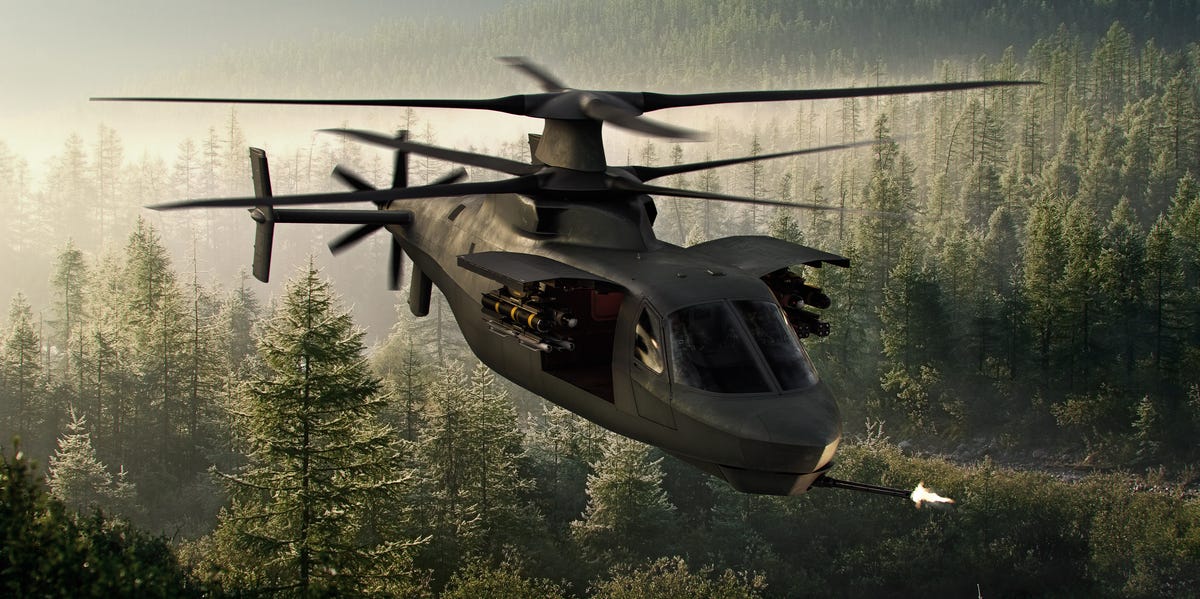
In 2020, the Army selected two industry teams to build competitive prototypes. Bell offered the 360 Invictus, a sleek conventional helicopter design with an emphasis on affordability, speed, and proven technology. Sikorsky, part of Lockheed Martin, offered the Raider X, a compound coaxial design based on its X2 technology, featuring stacked counter-rotating rotors and a rear pusher propeller.
Both designs looked like they had escaped from a defense contractor’s most confident PowerPoint deck. The Bell 360 Invictus looked sharp, compact, and purposeful. The Raider X looked like a helicopter that had discovered espresso and decided tail rotors were yesterday’s news. Each aircraft offered a different answer to the same question: how should the Army scout, fight, and survive in tomorrow’s battlespace?
Bell 360 Invictus: The Practical Speedster
The Bell 360 Invictus was designed around a more traditional helicopter layout, but that does not mean it was ordinary. Bell emphasized proven components, a streamlined shape, a tandem cockpit, integrated weapons, and a rotor system drawing from technology associated with the Bell 525 Relentless. The design was intended to meet demanding Army speed and performance goals while avoiding unnecessary complexity.
Its appeal was simple: give the Army a high-performance scout-attack aircraft without turning the acquisition process into a moon landing with rotor blades. The Invictus aimed to be fast, agile, maintainable, and affordable enough to field in meaningful numbers. In military aviation, “affordable enough to field” is not a boring phrase. It is often the difference between a real fleet and a museum-quality prototype that gets admired, canceled, and eventually remembered by aviation nerds at 2 a.m.
Sikorsky Raider X: The High-Speed Rule Breaker
The Sikorsky Raider X took a more radical approach. Its coaxial rigid rotors and pusher propeller were designed to overcome some of the speed limitations of traditional helicopters. Rather than relying on a tail rotor for anti-torque control, the aircraft used counter-rotating rotors, while the rear propeller provided forward thrust.
This architecture promised speed, maneuverability, and low-altitude performance. It also suggested a future where rotorcraft could behave less like traditional helicopters and more like high-speed aerial predators. The Raider X was not just trying to be a better scout helicopter; it was trying to stretch the definition of what a scout helicopter could be.
For the Army, the competition between Invictus and Raider X was valuable even before a winner was chosen. It generated data, design maturity, digital engineering lessons, and a clearer understanding of how industry could approach future armed reconnaissance. Unfortunately for fans of dramatic fly-offs, the battlefield changed faster than the procurement plan.
The T901 Engine and the Bigger Technology Picture
One of the most important pieces of the FARA puzzle was the General Electric T901 engine, developed under the Improved Turbine Engine Program. The T901 was intended not only for FARA prototypes but also for upgrades to the AH-64 Apache and UH-60 Black Hawk fleets. Compared with older engines, it promised more power, improved fuel efficiency, and better long-term performance.
Engine development matters because modern helicopters are hungry machines. More power can mean better hot-and-high performance, improved payload, stronger margins for electronics, and better survivability options. In plain English: when the air is thin, the gear is heavy, and everyone wants more sensors, power is not a luxury. It is lunch money.
Although FARA was canceled, the engine story did not vanish. The Army still has a strong interest in improving the performance of enduring platforms. Apache and Black Hawk modernization remains central to the service’s aviation plans, and propulsion upgrades could help keep those aircraft relevant while the Army experiments with new reconnaissance and strike concepts.
Why the Army Canceled FARA
The Army’s 2024 aviation rebalance reflected a hard reassessment of modern war. The service pointed to changing battlefield conditions, resource limits, and lessons from conflicts where small drones, loitering munitions, air-defense systems, and electronic warfare have reshaped how forces find and attack each other.
In that environment, sending a crewed scout helicopter deep into danger may not always be the smartest first move. Drones can search, expose enemy positions, jam communications, relay targeting data, or even strikeoften at lower cost and with no pilot at risk. A small uncrewed aircraft can afford to be bold in a way a crewed helicopter cannot. It is much easier to say “go take a look over that hostile ridge” when the aircraft does not contain two highly trained humans and a very expensive cockpit.
The Army did not abandon reconnaissance. It changed the way it wants to perform reconnaissance. Instead of betting heavily on one new crewed scout helicopter, it shifted emphasis toward uncrewed systems, launched effects, Apache modernization, the Future Tactical Unmanned Aircraft System, and the continuing Future Long Range Assault Aircraft program.
The New Recon Shape: Crewed Aircraft Plus Drones
The most important concept now is teaming. The future reconnaissance force will likely rely on crewed aircraft operating as command, control, sensing, and strike nodes while uncrewed systems push forward into the most dangerous areas. In other words, the helicopter may no longer need to be the first thing over the hill. It can send smaller robotic troublemakers ahead.
Launched effects are a major part of this vision. These are small uncrewed air vehicles that can be carried and released by aircraft or ground systems. Depending on payload, they can conduct reconnaissance, electronic warfare, communications relay, decoy missions, or kinetic strikes. For Apache crews, launched effects could become the extra set of eyes, ears, and claws needed to operate in contested airspace.
Recent Army work integrating launched effects with AH-64E Apache helicopters shows where the reconnaissance mission is heading. Rather than replacing every crewed aircraft with a drone, the Army appears to be building a layered approach. An Apache can remain farther back, a launched effect can scout ahead, another system can relay data, and a commander can make faster decisions based on a richer picture.
What Happens to the Apache?
The Apache remains one of the Army’s most important aviation platforms. It brings sensors, weapons, networking, battlefield experience, and a huge support ecosystem. But the Apache also faces the same problem every crewed aircraft faces: modern air defenses are getting better, cheaper drones are multiplying, and the electromagnetic spectrum is becoming crowded and hostile.
That means the Apache’s future is less about flying alone into danger and more about becoming part of a wider combat network. Manned-unmanned teaming, digital connectivity, new sensors, improved engines, and launched effects could help the Apache perform reconnaissance and attack missions without exposing the aircraft as much as older tactics required.
Think of it as a very serious military version of “send someone else to check the noise downstairs.” The Apache still matters, but it does not always need to be the first body through the door.
How FLRAA Fits Into the Future Vertical Lift Puzzle
While FARA ended, the Future Long Range Assault Aircraft program continued. The Army selected Bell’s V-280 Valor tiltrotor design for FLRAA, later moving the program into its next major acquisition phase. FLRAA is not a scout helicopter; it is intended to provide long-range assault and utility capability, eventually replacing or supplementing parts of the Black Hawk mission set.
Still, FLRAA matters because it shows the Army has not given up on Future Vertical Lift. The service still wants aircraft with greater speed, range, and operational reach. In a Pacific-focused defense environment, range is not a nice bonus. It is the price of admission. Islands, distance, logistics, and contested airspace all demand aircraft that can move farther and faster than legacy platforms.
The cancellation of FARA, then, should not be read as “the Army hates new aircraft.” It should be read as “the Army is choosing where new aircraft make the most sense and where drones may now do the dirty work better.” That is a more complicated story, but also a more realistic one.
Lessons from Ukraine and the Drone Revolution
The war in Ukraine has become a brutal classroom for modern reconnaissance. Small drones have shown how quickly cheap aerial systems can locate troops, guide artillery, expose armor, and turn concealment into a temporary suggestion. At the same time, air-defense systems and electronic warfare have made low-altitude aviation more dangerous.
For Army planners, this creates a difficult equation. Reconnaissance is more important than ever, but the aircraft doing it must survive. If a $2,000 drone can find a target, why send a crewed aircraft into the same threat envelope? If the enemy can detect, jam, or shoot down aircraft with increasing speed, the scout mission must become more distributed, less predictable, and harder to disrupt.
That is why the Army’s future recon capability is beginning to look less like a lone helicopter and more like an ecosystem. Sensors, drones, aircraft, software, data links, electronic warfare tools, and commanders all need to work together. The winner will not simply be the platform with the sharpest nose and coolest rotor system. It will be the force that can see first, decide faster, and survive long enough to act.
The Industrial Base Question
Canceling FARA also raised concerns about the defense industrial base. Bell and Sikorsky invested heavily in their prototypes. Engineers, suppliers, software teams, test crews, and manufacturing specialists all built expertise around the competition. When a program ends, the aircraft may stop, but the knowledge does not have to evaporate.
The Army can still benefit from work done on digital design, modular systems, flight controls, advanced rotor concepts, weapons integration, and sustainment planning. Even canceled programs can leave behind useful technology. Defense acquisition history is full of ghosts that quietly haunt later successes. Sometimes the prototype that never enters service still teaches the next program how not to trip over its own landing gear.
What the Army’s New Recon Capability May Look Like
The most likely future is not a simple one-for-one Kiowa replacement. Instead, the Army’s reconnaissance force may include upgraded AH-64E Apaches, future unmanned aircraft, launched effects, ground-launched drones, electronic warfare payloads, and data networks designed to connect sensors with shooters in real time.
In this model, the “new recon chopper” is partly physical and partly digital. It is an aircraft, but it is also a network. It is a cockpit, but also a drone controller. It is a weapons platform, but also a sensor manager. The helicopter becomes less of a lone scout and more of a quarterback, sending smaller assets downfield while staying aware of threats.
That may not satisfy everyone who wanted to see the Bell 360 Invictus and Sikorsky Raider X battle it out in a dramatic prototype fly-off. Aviation fans enjoy a good duel, especially when the contestants look like they were designed by people who drink coffee from titanium mugs. But the Army’s decision reflects a deeper truth: the future battlefield is not impressed by beautiful prototypes. It rewards survivable systems, fast adaptation, and affordable mass.
Specific Examples of the New Direction
One example is Apache-launched effects integration. By giving an AH-64E the ability to launch or control uncrewed systems, the Army can extend the aircraft’s sensor reach and reduce pilot exposure. A drone can fly ahead, confirm a suspected target, relay data, or trigger an enemy response while the crewed aircraft remains at a safer distance.
Another example is the Army’s investment in future tactical uncrewed aircraft. These systems can provide brigade-level reconnaissance without relying entirely on manned aviation. As drones become more capable, modular, and cheaper to replace, commanders can use them more aggressively.
A third example is the continuing modernization of enduring platforms. Black Hawks, Apaches, and Chinooks are not disappearing tomorrow. The Army will keep upgrading aircraft that still have value, especially when those upgrades help them connect with unmanned systems and digital command networks.
Challenges Ahead
The new approach is promising, but it is not magic. Drones need secure communications. Data links can be jammed. Artificial intelligence can misread cluttered environments. Pilots can become overloaded if cockpit interfaces are poorly designed. Maintenance crews need training. Commanders need doctrine. And every new system must survive the budget process, which can be more dangerous than enemy radar and only slightly less mysterious.
There is also the question of trust. Crews must trust drones to provide accurate information. Commanders must trust the data flow. Soldiers on the ground must trust that the aerial network will be there when needed. Technology alone does not create combat power. Training, doctrine, sustainment, and realistic exercises turn equipment into capability.
Experience-Based Perspective: What This Shift Feels Like from the Ground
Anyone who has spent time watching military modernization knows that aircraft programs are never just about aircraft. They are about habits, budgets, doctrine, pride, fear, and the uncomfortable process of admitting that yesterday’s perfect answer may not fit tomorrow’s problem. The Army’s recon helicopter journey is a perfect example. For decades, the image of armed reconnaissance was tied to a small crewed aircraft slipping forward, finding the enemy, and guiding the fight. That image still has emotional power because it is clear, brave, and easy to understand.
But the modern battlefield is not especially sentimental. It does not care whether a concept feels heroic. It cares whether the force can find targets without being found first. It cares whether commanders can receive useful data quickly. It cares whether aircraft can survive in a sky watched by sensors, missiles, drones, and electronic warfare systems. In that environment, the smartest scout may be the one that does not need a pilot on board.
From an observer’s standpoint, the most interesting part of this transition is the cultural change. Pilots are trained to fly, fight, and make decisions under pressure. Asking them to become managers of unmanned teammates is not as simple as adding a new button to the cockpit. It changes workload, tactics, training, and even identity. A future Apache crew may need to think like aviators, sensor operators, mission commanders, and drone wranglers at the same time. That is a lot to ask of two people in a noisy aircraft while the world outside is doing its best impression of chaos.
There is also a maintenance and logistics reality that rarely gets the spotlight. A recon ecosystem filled with drones, launchers, sensors, software packages, batteries, antennas, and electronic warfare payloads creates a different kind of burden. The old question was, “Can we keep the helicopter flying?” The new question is, “Can we keep the entire network functioning?” That includes spare parts, software updates, cyber protection, training pipelines, and field repair. The future may be digital, but someone still has to carry the equipment, charge the batteries, update the systems, and explain why the connector that absolutely should fit does not fit.
Another experience-based lesson is that soldiers usually adapt faster than institutions. Give a unit a useful drone, and troops will quickly figure out new ways to employ it. They will test it, modify it, tape something to it, break it, fix it, and produce a field lesson before the official manual has finished its first committee review. That bottom-up creativity is one reason the Army’s pivot toward unmanned systems makes sense. The technology cycle for small drones moves faster than traditional aircraft acquisition, and the battlefield rewards speed.
Still, crewed helicopters are not obsolete. That is too simple, and simple answers are usually where bad defense takes go to stretch before causing trouble. Helicopters bring judgment, persistence, weapons, sensors, and flexible human decision-making. The better argument is that crewed aircraft should not do every job alone. The future reconnaissance mission will probably belong to teams: humans making decisions, machines extending reach, software sorting data, and commanders using the combined picture to act faster than the enemy.
In that sense, the Army’s new recon chopper really is taking shape. It just does not look like one aircraft sitting under hangar lights. It looks like a changed mission. It looks like Apache crews controlling launched effects, drones scouting ahead, future aircraft carrying better networks, and soldiers learning to treat the sky as a layered system rather than a single platform lane. The shape is messier than a clean prototype reveal, but it may be far more useful.
Conclusion
The Army’s new reconnaissance helicopter story is no longer a simple tale of Bell versus Sikorsky or Invictus versus Raider X. It is the story of a service adjusting to a battlefield where cheap drones, advanced sensors, and deadly air defenses have changed the math. FARA may be gone, but the need it was built to address remains very much alive.
The future of Army aerial reconnaissance is beginning to take shape as a connected force rather than a single aircraft. Apache upgrades, launched effects, uncrewed systems, improved engines, digital architecture, and Future Vertical Lift investments all point toward a more distributed and survivable approach. The next scout may not always be a helicopter. Sometimes it will be a drone. Sometimes it will be a sensor. Sometimes it will be a crewed aircraft commanding a robotic team from a safer distance.
That may disappoint anyone hoping for one shiny new chopper to solve everything. But in modern warfare, the smartest answer is rarely the shiniest one. The Army is learning that the future recon platform is not just what fliesit is what sees, connects, survives, and helps commanders act first.
Note: This article is based on publicly available U.S. Army aviation modernization information, industry prototype details, and current defense reporting through 2026. It is written as original editorial content for web publication.


