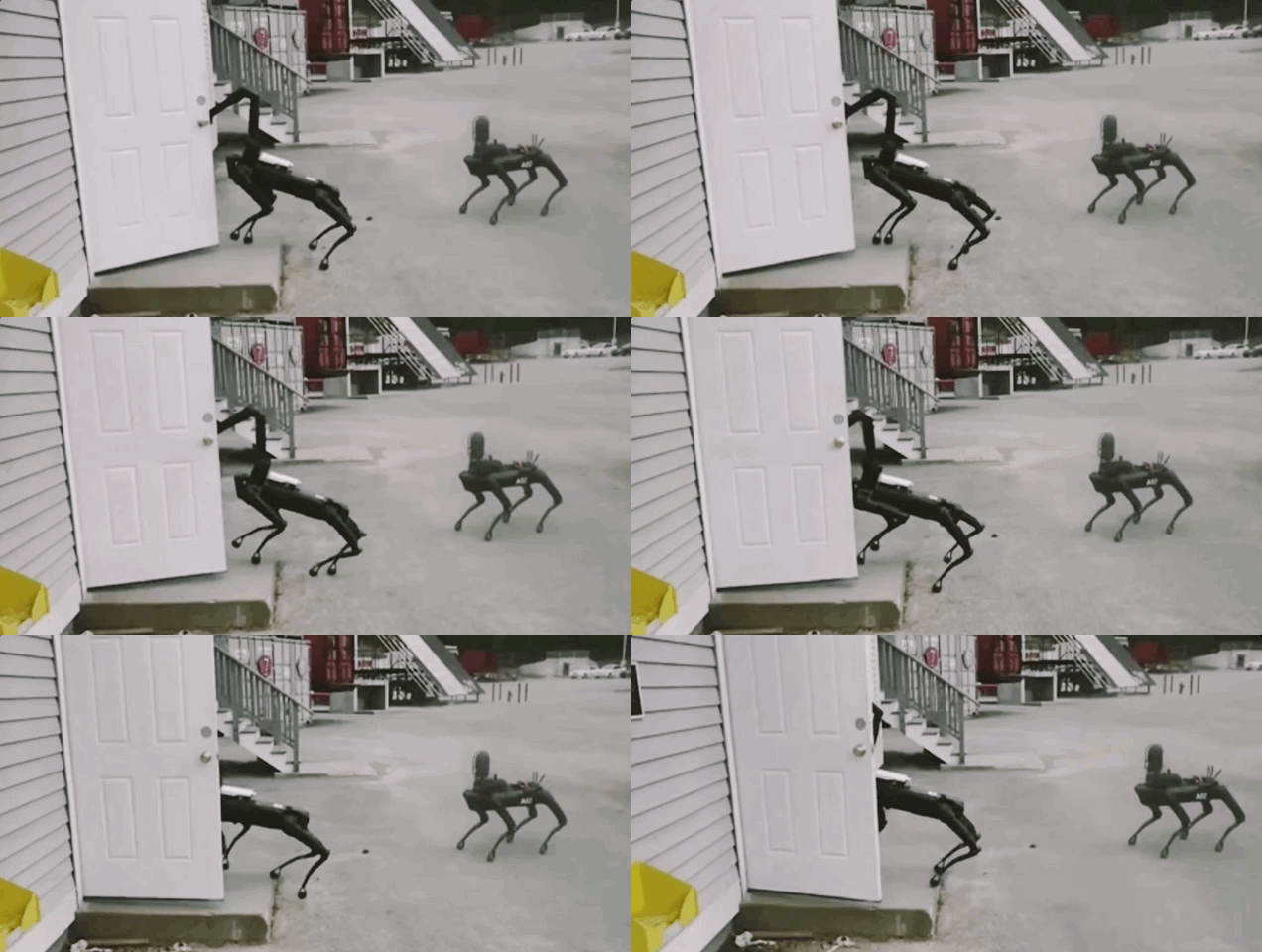

Say the words Boston Dynamics robot and most people immediately picture a yellow robot dog trotting through a factory, a humanoid doing backflips, or a machine moving with the kind of confidence usually reserved for Olympic gymnasts and cats that just knocked a glass off the table. Boston Dynamics has become one of the most recognizable names in robotics because its machines do not simply roll, beep, and politely bump into furniture. They walk, balance, climb, carry, inspect, unload, and occasionally make the internet collectively whisper, “Well, that was both amazing and mildly terrifying.”
But behind the viral videos is a serious robotics company building practical machines for industrial work. Boston Dynamics, headquartered in Massachusetts and now part of Hyundai Motor Group, has spent decades turning advanced research into mobile robots that can operate in places designed for humans, not machines. Its best-known robots include Spot, the agile four-legged robot; Stretch, the warehouse box-handling robot; and Atlas, the humanoid robot designed for the next generation of industrial automation.
This article explores what Boston Dynamics robots actually do, why they matter, how they are used in the real world, and what the company’s technology says about the future of work, automation, and intelligent machines. Spoiler alert: the robots are not here to steal your sandwich. They are more interested in inspections, logistics, data collection, and repetitive industrial tasks. Your sandwich is probably safe.
What Is a Boston Dynamics Robot?
A Boston Dynamics robot is a highly mobile machine designed to move through real environments with balance, awareness, and adaptability. Unlike many traditional industrial robots, which are bolted to factory floors and repeat the same motion thousands of times, Boston Dynamics robots are built to move through changing spaces. They can walk over uneven surfaces, navigate around obstacles, climb stairs, carry sensors, handle boxes, and collect data in locations that may be difficult, dull, dangerous, or expensive for people to access repeatedly.
The company’s philosophy is rooted in dynamic mobility. That means its robots are not just programmed to move from point A to point B like a remote-control toy with a graduate degree. They use sensors, control systems, perception software, and mechanical engineering to balance, adjust, and respond to the world around them. This is why a Boston Dynamics robot can recover from a stumble, walk through a construction site, or unload boxes in a warehouse without needing the entire environment rebuilt around it.
Boston Dynamics has developed many famous machines over the years, including BigDog, Handle, Spot, Stretch, and Atlas. Today, the company’s commercial focus is especially clear in three areas: inspection and data collection with Spot, warehouse automation with Stretch, and future humanoid industrial labor with Atlas.
Boston Dynamics Spot: The Robot Dog With a Real Job
Boston Dynamics Spot is probably the company’s most famous commercial robot. It is a four-legged robot designed to go where wheeled robots often struggle. Stairs, gravel, tight corridors, industrial platforms, construction sites, and uneven floors are all part of Spot’s comfort zone. It looks a little like a dog, moves a little like an animal, and works more like a mobile inspection platform with excellent balance and no need for coffee breaks.
What Spot Does
Spot is used for industrial inspection, remote monitoring, mapping, security patrol support, construction progress tracking, energy facility inspection, research, and public safety support. Companies can equip Spot with payloads such as cameras, thermal sensors, gas detection tools, acoustic sensors, LiDAR, or robotic arms. With these tools, Spot can inspect equipment, read gauges, capture images, build maps, detect anomalies, and send data back to human teams.
For example, in an energy facility, Spot can walk a repeatable route and collect thermal images of equipment. In construction, it can document progress and compare the site against digital plans. In a factory, it can inspect machinery during off-hours. The key benefit is not that Spot is “cute,” although it has the awkward charm of a mechanical Labrador wearing safety goggles. The real benefit is that Spot can help organizations gather consistent information while reducing the need for people to enter risky or repetitive environments.
Why Four Legs Matter
Legged robots are difficult to build because walking is not simple. Humans forget this because we learned to walk before we learned algebra, which was merciful of nature. A robot needs to calculate balance, foot placement, terrain changes, body position, sensor feedback, and motion control in real time. Spot’s four-legged design gives it stability and mobility in spaces that were built for human workers, not robots.
That matters because many industrial sites cannot easily be redesigned around machines. A wheeled robot may work beautifully in a clean warehouse aisle but struggle on stairs, mud, cables, platforms, or cluttered construction zones. Spot’s design makes it useful in places where mobility is the first problem to solve.
Boston Dynamics Stretch: Warehouse Automation With Muscle
If Spot is the robot dog everyone recognizes, Stretch is the robot that warehouse managers may quietly appreciate even more. Stretch is designed for warehouse automation, especially box handling. Its job is less about starring in viral videos and more about doing repetitive logistics work at scale. In other words, Stretch is not trying to look cool. It is trying to unload trailers without complaining about cardboard dust.
Stretch combines a mobile base, perception systems, and a long robotic arm with a smart gripper. It can identify boxes, pick them up, and move them onto conveyors or into warehouse workflows. This makes it useful for trailer unloading and case handling, two tasks that are physically demanding and repetitive.
Why Stretch Matters in Logistics
Warehouses run on speed, accuracy, and consistency. E-commerce growth has placed heavy pressure on distribution centers, where workers may handle thousands of packages in a day. Repetitive lifting can contribute to fatigue and injury risk, especially when boxes vary in weight, shape, and placement. Stretch is designed to help automate some of that work while keeping goods moving through the supply chain.
Unlike fixed industrial arms, Stretch is mobile. That gives it flexibility in facilities where space and workflows change. It can be deployed where boxes need to be moved instead of requiring the entire warehouse to be rebuilt around the robot. That practical approach is important because automation only succeeds when it fits into real operations, not just a showroom demo with perfect lighting and suspiciously cooperative boxes.
Boston Dynamics Atlas: The Humanoid Robot Built for Industry
Atlas is the Boston Dynamics robot that tends to make headlines. Earlier versions of Atlas became famous for running, jumping, flipping, and performing movements that made the average human feel personally attacked by a machine’s flexibility. The newer electric Atlas represents a major shift: from research spectacle toward industrial application.
Atlas is a humanoid robot, meaning it has a body plan inspired by humans: two legs, two arms, a torso, and the ability to move through environments designed around human size and reach. The reason humanoid robots are exciting is simple. If a robot can operate in human spaces, use human tools, and perform human-like manipulation tasks, companies may not need to redesign every workplace from scratch.
Why the Electric Atlas Is Important
The shift to an all-electric Atlas is significant because it supports a cleaner, quieter, and more commercially practical platform than earlier hydraulic designs. Electric actuation can help simplify maintenance, improve control, and make the robot more suitable for industrial environments. Boston Dynamics has positioned Atlas as a robot for real-world work, particularly in manufacturing and material handling.
Hyundai’s ownership gives Atlas a natural testing ground: automotive manufacturing. Car factories include repetitive tasks, heavy parts, complex workflows, and environments where flexible automation could be valuable. A humanoid robot that can handle parts, move through factory spaces, and learn new tasks could become a major step forward in industrial robotics. That does not mean humanoids will appear everywhere overnight. Factories are demanding places, and reliability matters more than cool demo videos. A robot that works once is impressive. A robot that works thousands of times safely and predictably is a product.
How Boston Dynamics Robots Use AI, Sensors, and Software
Mobility gets the spotlight, but software is what makes these robots useful. A Boston Dynamics robot relies on perception systems, onboard computing, cameras, depth sensors, autonomy software, control algorithms, and fleet management tools. The robot must understand where it is, what is around it, how to move safely, and what task it should perform next.
For enterprise customers, software platforms such as Orbit help manage robots, missions, data, and fleet performance. This is important because buying one robot is very different from operating robots across multiple sites. A company needs dashboards, remote visibility, mission planning, data review, and maintenance workflows. Without good software, a robot is just an expensive machine taking a very confident walk.
Artificial intelligence also plays a growing role. AI can help robots recognize objects, detect changes, analyze inspection images, improve autonomy, and learn from real-world data. In the future, AI may help robots adapt faster to new environments and tasks. This is especially important for humanoids like Atlas, where the long-term goal is not just movement but useful decision-making and manipulation.
Real-World Uses of Boston Dynamics Robots
Boston Dynamics robots are used in industries where mobility, safety, and data collection are valuable. The most common real-world applications include industrial inspection, energy and utilities, construction, logistics, manufacturing, research, and public safety support.
Industrial Inspection
Spot can walk repeatable routes through factories, power facilities, mines, refineries, and other industrial environments. It can capture images, thermal data, acoustic readings, or gauge information. This helps teams monitor equipment health and identify issues before they become expensive problems. It also allows people to inspect dangerous or remote areas without always being physically present.
Construction and Site Documentation
Construction sites change daily. Spot can help document progress, capture 360-degree imagery, scan areas, and compare reality with digital building models. That saves time and improves visibility for project managers. Instead of sending someone to walk the same route with a camera every week, Spot can do it consistently and repeatedly.
Warehouse and Distribution Work
Stretch is designed for logistics environments where boxes need to move quickly and predictably. Trailer unloading is one of the clearest examples. The task is repetitive, physically demanding, and common across large distribution networks. Stretch helps automate that process without requiring every trailer to look exactly the same.
Manufacturing
Atlas points toward the future of humanoid robots in manufacturing. The promise is flexibility. Traditional robots are excellent at precise, repetitive tasks, but they often require structured workcells. A humanoid robot could potentially move between tasks, handle objects, and work in spaces designed for people. The challenge is making that reliable, safe, affordable, and easy to deploy.
Are Boston Dynamics Robots Replacing Humans?
The honest answer is more complicated than a dramatic movie trailer. Boston Dynamics robots are designed to automate specific tasks, especially tasks that are repetitive, hazardous, physically demanding, or data-heavy. In many cases, the goal is not to replace an entire person but to change how work is done.
For example, Spot may reduce the need for a human worker to enter a hazardous area for routine inspection. Stretch may reduce repetitive lifting in warehouses. Atlas may eventually support manufacturing tasks that are difficult to automate with traditional equipment. In each case, the robot handles a narrow slice of work while people remain responsible for supervision, maintenance, planning, decision-making, and higher-level operations.
That said, automation does affect jobs. Companies, workers, and policymakers need to think carefully about training, safety, job design, and economic impact. The best robotics deployments are not just about replacing labor costs. They are about improving safety, consistency, productivity, and the quality of work humans are asked to do.
Why Boston Dynamics Became So Famous
Boston Dynamics became famous because its robots move in ways that feel alive. The company’s videos have shown robots running, dancing, jumping, opening doors, unloading boxes, and recovering from pushes. These videos work because they create an emotional reaction. People do not just see a machine; they see motion that looks intelligent, athletic, and strangely familiar.
That public reaction has helped Boston Dynamics become a cultural symbol of advanced robotics. It has also created misconceptions. Some people think the company only makes viral demo robots. In reality, Boston Dynamics has been steadily moving toward commercial robotics, enterprise software, industrial workflows, and practical automation.
The entertainment value opened the door. The engineering is what keeps the door from falling off its hinges.
The Strengths of Boston Dynamics Robots
The biggest strength of Boston Dynamics robots is mobility. Spot can move through complex environments. Stretch can bring automation to warehouse workflows. Atlas aims to bring human-like mobility and manipulation to industrial spaces. Across all three, the company focuses on robots that can work in places that are not perfectly structured.
Another strength is integration. Boston Dynamics is not only building hardware; it is building software, payload support, fleet management tools, and customer deployment systems. That matters because enterprise robotics is not a one-time purchase. It requires training, support, maintenance, workflow design, and data management.
The company also benefits from Hyundai’s industrial scale. Hyundai’s manufacturing experience, capital, and factory environments could help Boston Dynamics move from impressive prototypes to broader deployment. That partnership may be especially important for Atlas, because humanoid robots need real-world testing and large-scale manufacturing discipline.
The Challenges Ahead
Boston Dynamics robots are impressive, but the path to widespread adoption is not simple. Cost is one challenge. Advanced robots are expensive, and companies need a clear return on investment. A robot must save time, improve safety, reduce downtime, or perform tasks that justify its price.
Reliability is another challenge. Industrial customers do not want a robot that works beautifully on Tuesday and then becomes a very expensive statue on Wednesday. Robots must perform consistently in messy, changing, unpredictable environments. They must also be safe around people, easy to maintain, and secure from software risks.
Humanoid robots face even bigger hurdles. Walking is hard. Handling objects is harder. Learning many different factory tasks is harder still. Atlas has enormous potential, but humanoid robotics will require progress in dexterity, perception, AI reasoning, battery performance, safety systems, and cost reduction.
Ethics, Safety, and Public Trust
Robots that move through human spaces raise important questions. How should they be used? Who controls the data they collect? How do companies prevent misuse? How can workers trust robots operating nearby? Boston Dynamics has publicly supported the idea that general-purpose advanced mobile robots should not be weaponized, which is an important ethical position in a field where powerful mobility systems can attract the wrong kind of attention.
Public trust will matter as much as engineering. A robot can be technically brilliant, but if people feel unsafe, watched, or replaced without support, adoption will suffer. Successful robotics companies will need to communicate clearly, design responsibly, and focus on human-centered deployment.
What Makes a Boston Dynamics Robot Different?
A Boston Dynamics robot stands out because it combines mechanical sophistication with real-world mobility. The company’s robots are not built only for clean lab conditions. They are designed to handle the awkwardness of reality: uneven floors, strange lighting, tight spaces, unpredictable objects, and human-designed environments.
That is why Boston Dynamics remains a leader in mobile robotics. It has mastered the art of making robots move with confidence. Now the bigger challenge is making them useful at scale. The next chapter is not just about whether a robot can dance. It is about whether it can inspect a plant every night, unload trucks every day, support factory workers safely, and deliver measurable value without requiring a team of engineers hovering nearby like nervous parents on the first day of school.
Experiences Related to Boston Dynamics Robot
Watching a Boston Dynamics robot for the first time is a strange experience because your brain tries to sort it into a familiar category and fails. Spot looks like a dog, but it has no face. Atlas moves like a person, but not exactly like a person. Stretch works like warehouse equipment, but it sees, reaches, and adjusts in a way that feels more flexible than a traditional machine. The result is a mix of curiosity, admiration, and that tiny internal voice saying, “Please be friendly.”
One practical experience people often describe when seeing Spot in action is surprise at how steady it is. A four-legged robot walking across an industrial floor may sound simple until you think about all the small problems it must solve. The floor may have cables, shadows, grates, stairs, puddles, dust, or narrow passages. Spot does not simply drive forward; it chooses footholds, balances its body, and adjusts its movement. That turns a routine inspection into something that feels almost alive, even though it is fundamentally a machine carrying sensors and software.
For workers in industrial environments, the most meaningful experience is not the “wow” factor. It is the possibility of sending a robot into places that are hot, noisy, remote, elevated, or potentially hazardous. Imagine needing to check equipment at night, in bad weather, or in a facility where shutting down operations would be expensive. A robot like Spot can collect data while the human team stays in a safer location. That does not remove the need for skilled workers. It changes the worker’s role from walking every route manually to supervising, analyzing, and acting on better information.
In warehouses, the experience is different. Stretch is less theatrical than Atlas and less animal-like than Spot, but its value is easy to understand when you picture a long shift unloading boxes. Trailer unloading can be tiring work. Boxes are not always neatly stacked. They can shift, vary in weight, and arrive in endless waves. Stretch brings automation to a task that is physically repetitive and operationally important. For warehouse teams, the best robot may not be the one that makes headlines. It may be the one that quietly keeps the conveyor moving.
Atlas creates the most emotional response because humanoid robots touch a deeper cultural nerve. We are used to machines being shaped like tools. A humanoid robot feels different because it shares our basic body plan. When Atlas stands, turns, reaches, or walks, people instinctively compare it to themselves. That is why humanoid robots inspire both excitement and concern. They suggest a future where machines may work beside humans in spaces we already built for human bodies.
The most realistic way to experience Boston Dynamics robots is not as science fiction characters but as specialized coworkers. They are powerful, expensive, limited, and impressive all at once. Spot is not a pet. Stretch is not a warehouse superhero. Atlas is not a universal human replacement. They are machines designed to solve specific problems, and their success depends on matching the right robot to the right task.
For businesses, the lesson is clear: do not buy a robot because it looks futuristic. Buy it because the workflow makes sense. A Boston Dynamics robot should answer a practical question. Can it reduce risky inspections? Can it improve data quality? Can it unload trailers more consistently? Can it support manufacturing tasks that are difficult to automate today? When the answer is yes, the technology becomes more than impressive. It becomes useful.
For everyday observers, the experience is a reminder that robotics is no longer only about machines hidden behind factory fences. Robots are becoming mobile, visible, and increasingly capable of working in human spaces. That future will need good engineering, smart regulation, thoughtful management, and a sense of humor. After all, if a robot dog walks into your workplace, the least we can do is make sure it has a clear job description.
Conclusion
The story of the Boston Dynamics robot is really the story of robotics growing up. The company’s machines began as research marvels and viral sensations, but they are now moving toward practical industrial work. Spot helps inspect and monitor complex environments. Stretch supports warehouse automation. Atlas points toward a future where humanoid robots may assist with manufacturing and material handling.
Boston Dynamics has shown that mobility matters. Robots are more useful when they can go where work happens, not only where engineers have prepared perfect conditions. The company’s challenge now is to turn world-class movement into dependable business value at scale. If it succeeds, the future of robotics may look less like a movie invasion and more like a safer inspection route, a smoother warehouse shift, and a factory where people and robots each do the work they are best suited to do.
Note: This article is written in original American English for web publishing, based on verified real-world information about Boston Dynamics robots, with no source links embedded in the HTML content.


