
Some movies tell a story. Others grab light by the collar, wrestle it into shape, and make every frame feel like it belongs in a museumpreferably one with very comfortable seats and popcorn. The best cinematographic masterpieces do more than look beautiful; they teach us how to see. They use shadow, color, movement, lenses, framing, natural light, and visual rhythm to turn ordinary screen space into emotion.
This list of the top 10 cinematographic masterpieces celebrates films that changed the language of cinema. Some are desert epics, some are smoky sci-fi nightmares, some are black-and-white psychological bruisers, and one casually sends humanity from prehistoric bones to deep space as if that were a normal Tuesday. Each film here proves that cinematography is not just “pretty pictures.” It is storytelling with light, architecture, texture, distance, and timing.
What Makes a Film a Cinematographic Masterpiece?
A cinematographic masterpiece is not simply a movie with attractive shots. A perfume commercial can look attractive. A great film image carries meaning. It reveals character, creates tension, builds atmosphere, and gives the viewer information before anyone says a word. The camera can make a room feel like a prison, a desert feel like destiny, or a boxing ring feel like the inside of a guilty mind.
Great cinematography also ages well. Decades later, film lovers still study how Gregg Toland used deep focus in Citizen Kane, how Freddie Young captured the vastness of the desert in Lawrence of Arabia, and how Jordan Cronenweth turned rain, smoke, neon, and shadow into the visual DNA of modern science fiction in Blade Runner. These films are not just influential; they are the reason many later movies look the way they do.
Top 10 Cinematographic Masterpieces Every Film Lover Should Watch
1. Lawrence of Arabia (1962)
Directed by David Lean and photographed by Freddie Young, Lawrence of Arabia is the kind of movie that makes widescreen cinema feel like it was invented specifically for sand, sky, and complicated men staring into the distance. Its desert landscapes are enormous, but the cinematography never becomes empty spectacle. The vast spaces reflect T. E. Lawrence’s ambition, isolation, and growing mythic self-image.
The film’s famous mirage-like entrance of Sherif Ali remains one of cinema’s great lessons in patience. Instead of cutting quickly, the camera lets the horizon do the work. A tiny figure slowly becomes a man, then a threat, then a legend. Modern movies often sprint toward impact; Lawrence of Arabia walks slowly across the desert and still gets there first.
2. Blade Runner (1982)
Ridley Scott’s Blade Runner, shot by Jordan Cronenweth, is a smoky, rain-soaked monument to visual world-building. Los Angeles becomes a futuristic labyrinth of neon signs, industrial towers, crowded streets, and permanent bad weather. Apparently, in the future, umbrellas thrive and sunlight has retired.
The film’s cinematography blends film noir with science fiction, using heavy backlighting, shafts of light, silhouettes, and reflective surfaces to create a city that feels both technological and decaying. The visual style tells us what the dialogue does not: this is a world where identity is unstable, memory is suspicious, and humanity is harder to define than a studio executive’s sequel strategy.
3. Apocalypse Now (1979)
Francis Ford Coppola’s Apocalypse Now, photographed by Vittorio Storaro, turns war into a fever dream. The cinematography is lush, terrifying, and psychologically unstable in the best possible way. Helicopters slice through golden haze, jungle darkness swallows faces, and firelight turns human figures into ghosts, idols, or nightmares depending on the scene.
Storaro’s use of color is especially powerful. Warm oranges, deep reds, and dense shadows create an atmosphere where reality seems to melt. The river journey becomes a descent into moral darkness, and the visuals make that descent physical. You do not merely watch the madness grow; you feel it gathering in the frame like humidity before a storm.
4. Citizen Kane (1941)
Orson Welles’ Citizen Kane, shot by Gregg Toland, is one of the most influential visual achievements in movie history. Its deep-focus photography allows foreground, middle ground, and background to remain sharply visible at the same time, giving scenes unusual depth and dramatic complexity. In simpler terms: the movie lets your eyes wander, but it never lets them escape.
The film uses low angles, expressive shadows, ceilings, mirrors, and bold compositions to turn Charles Foster Kane’s life into a visual puzzle. Power is shown through scale. Loneliness is shown through empty space. Childhood trauma is staged in the background while adults make decisions in the foreground. The camera is not decorating the story; it is arguing with it.
5. The Godfather (1972)
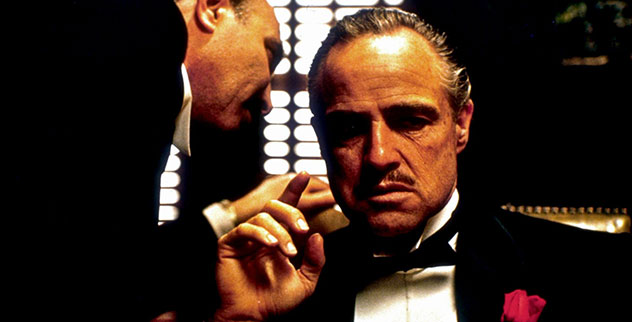
Francis Ford Coppola’s The Godfather, photographed by Gordon Willis, is often remembered for its performances and dialogue, but its cinematography is just as essential. Willis earned the nickname “The Prince of Darkness,” and this film shows why. Faces are frequently half-hidden in shadow, rooms feel heavy with secrecy, and warm amber interiors make family gatherings look both intimate and dangerous.
The visual strategy perfectly suits the Corleone world. Power is not bright and public; it is private, controlled, and often seated behind a desk. The darkness around Vito and Michael Corleone is not merely stylish. It suggests moral compromise, inherited burden, and the price of loyalty. Also, it proves that sometimes the scariest lighting choice is simply refusing to turn on the metaphorical lamp.
6. Raging Bull (1980)
Martin Scorsese’s Raging Bull, shot by Michael Chapman, uses black-and-white cinematography not as nostalgia but as emotional pressure. The boxing scenes are not filmed like objective sports coverage. They are distorted, subjective, brutal, and operatic. The ring becomes a psychological arena where Jake LaMotta fights opponents, insecurity, jealousy, and himselfmostly himself, because he is very committed to being his own worst enemy.
Chapman’s images have a harsh tactile quality. Sweat, smoke, flashbulbs, blood, and slow motion turn the fights into painful rituals. Outside the ring, the compositions often feel cramped and tense, showing a man trapped by his own impulses. The result is one of the greatest examples of cinematography as character study.
7. The Conformist (1970)
Bernardo Bertolucci’s The Conformist, photographed by Vittorio Storaro, is a masterclass in political and psychological visual design. Its images are elegant, geometric, and unsettling. Fascist architecture, angled shadows, patterned light, and carefully controlled compositions reflect the main character’s desire to disappear into order.
Few films use style so intelligently. The beauty of The Conformist is seductive, but it is never innocent. The polished surfaces and precise framing suggest a world where morality has been replaced by appearance. Storaro’s cinematography makes conformity look gorgeous and spiritually rotten at the same time, which is a difficult trick unless you have a camera, genius, and perhaps a suspiciously dramatic window blind.
8. Days of Heaven (1978)
Terrence Malick’s Days of Heaven, photographed primarily by Nestor Almendros with additional photography by Haskell Wexler, is famous for its natural-light beauty. The film often uses “magic hour,” that brief period near sunrise or sunset when the world looks as if it has been personally color-graded by nature.
The wheat fields, drifting clouds, insects, fire, and human faces create a visual poem about labor, love, deception, and fate. Instead of pushing the plot forward with conventional dialogue-heavy scenes, the film lets images carry emotional weight. It feels remembered rather than simply observed, like a childhood memory that somehow came back with perfect lighting.
9. 2001: A Space Odyssey (1968)
Stanley Kubrick’s 2001: A Space Odyssey, photographed by Geoffrey Unsworth, remains one of the most visually audacious science-fiction films ever made. Its compositions are clean, symmetrical, mysterious, and often eerily calm. The movie moves from prehistoric landscapes to spacecraft interiors to cosmic abstraction without ever losing visual control.
The cinematography works hand in hand with production design and visual effects to create a sense of technological realism. Space travel appears graceful, silent, and strangely ceremonial. The film’s famous match cut from bone to spacecraft is not just clever editing; it is visual storytelling on a civilizational scale. Most movies connect scenes. 2001 connects epochs, because apparently Kubrick did not believe in thinking small.
10. The French Connection (1971)
William Friedkin’s The French Connection, shot by Owen Roizman, brings a raw, documentary-like energy to the crime thriller. Its New York streets feel cold, dirty, unpredictable, and alive. The cinematography rejects polish in favor of immediacy, giving the film a realism that still feels electric.
The famous car-and-train chase is often praised for its editing and stunt work, but the camerawork is essential to its impact. The images feel dangerous because they appear physically close to danger. Roizman’s approach helped shape the gritty look of 1970s American crime cinema, proving that a masterpiece does not always need painterly elegance. Sometimes it needs speed, nerve, and a camera that looks like it might need hazard pay.
Why These Cinematographic Masterpieces Still Matter
These films continue to matter because they show different ways the camera can think. Lawrence of Arabia thinks in horizons. Citizen Kane thinks in depth. The Godfather thinks in shadow. Raging Bull thinks in bruises. Blade Runner thinks in smoke, neon, and existential weather reports. Together, they form a visual education in what cinema can do when cinematography becomes more than decoration.
For filmmakers, these movies are textbooks with better lighting. For movie fans, they are reminders that cinema is not only about plot twists, quotable lines, or whether the hero can outrun a fireball in slow motion. The strongest images stay with us because they express what words cannot. A face half-covered in darkness can reveal a moral collapse. A tiny rider crossing the desert can announce an entire mythology. A glowing doorway in a sci-fi city can make the future feel ancient.
Viewing Experience: How to Watch These Films Like a Cinematographer
Watching the top 10 cinematographic masterpieces is a different experience when you stop treating the camera as invisible. The first time most viewers see these movies, they follow the story. That is natural. Stories are shiny bait. But on a second viewing, the real fun begins: you start noticing where the camera sits, how long it waits, what the light hides, and how the frame quietly tells you where to look.
Start with Lawrence of Arabia on the largest screen available. A phone screen is technically possible, just as eating soup with a fork is technically possible. The movie needs width. Watch how the desert is not merely background but a character. Notice how small human figures appear against the landscape, and how that scale changes your understanding of ambition, loneliness, and legend.
Then watch Citizen Kane and pay attention to depth. Instead of focusing only on whoever is speaking, scan the whole frame. Important emotional information often sits in the background. The film rewards active viewing because Toland and Welles designed images with layers. Every room feels like a stage, a memory, and a trap at the same time.
For The Godfather, dim the lights and study the shadows. Notice how the film often withholds full visibility. That darkness is not a mistake; it is the point. The Corleone family lives in a world where truth is negotiated behind closed doors, so the cinematography gives us rooms that feel secretive even before anyone whispers a threat.
With Blade Runner, look for atmosphere. Smoke, rain, glass, neon, and reflection are not just cool design choices. They make the city feel dense and morally blurred. The world seems constantly wet, crowded, and half-readable, which perfectly matches a story about artificial humans, unreliable memories, and identity slipping through everyone’s fingers like expensive cyberpunk soap.
When watching Raging Bull, do not expect the boxing scenes to behave like sports footage. They are emotional events, not neutral records. The camera exaggerates impact, isolation, and rage. The ring changes size and mood depending on Jake LaMotta’s mental state. It is less “Who is winning this fight?” and more “How much damage can one man carry before he becomes the damage?”
Days of Heaven asks for patience. Let the images breathe. Watch how natural light softens the world but does not sentimentalize it. The beauty is almost painful because the characters are fragile inside it. The film understands that a sunset can be romantic, tragic, and mildly judgmental all at once.
Finally, approach 2001: A Space Odyssey as visual music. Do not rush to explain every symbol. Let the symmetry, silence, movement, and scale do their work. Some masterpieces answer questions. 2001 stares calmly at the questions until the questions become nervous.
Conclusion
The greatest cinematographic masterpieces endure because they make images unforgettable. They do not simply show deserts, cities, rooms, rings, fields, or galaxies. They transform those spaces into emotional landscapes. Whether it is the golden vastness of Lawrence of Arabia, the noir future of Blade Runner, the haunted jungle of Apocalypse Now, or the cosmic mystery of 2001: A Space Odyssey, each film proves that cinematography is one of cinema’s most powerful storytelling tools.
If you want to understand film language, these ten movies are essential viewing. They teach composition, contrast, movement, atmosphere, visual metaphor, and patience. More importantly, they remind us why movies are magical in the first place: because sometimes a single image can say what a thousand lines of dialogue would only trip over.


