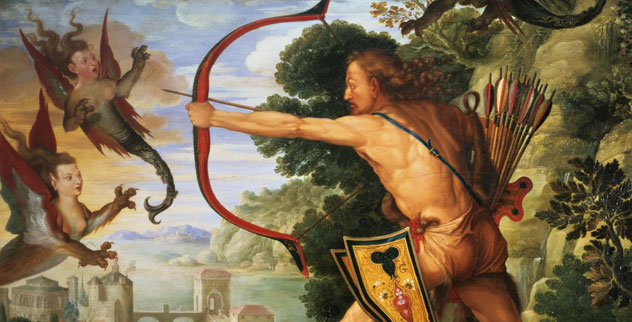

The 12 Labors of Heracles form one of Greek mythology’s greatest adventure cycles. The hero faces an invulnerable lion, a regenerative swamp monster, carnivorous horses, an international cattle-delivery crisis, and even the guard dog of the Underworld. Evidently, ancient Greece did not believe in easing new employees into a position.
Yet the story is much more than a collection of monster fights. The labors follow a deeply flawed hero seeking purification after an unbearable tragedy. They test strength, patience, intelligence, self-control, and the willingness to keep moving when the next assignment is somehow worse than the last. This guide explains all twelve tasks, the major variations in their telling, and why Heracles remains one of the most recognizable heroes in world mythology.
Who Was Heracles?
Heracles was the son of Zeus and the mortal woman Alcmene. He was known to the Greeks as Heracles and later to the Romans as Hercules, the name by which he became more familiar in Western popular culture. In ancient art, he is usually recognized by his wooden club and the skin of the Nemean Lion draped over his body.
From infancy, Heracles possessed extraordinary strength. When Hera, the wife of Zeus, sent snakes to kill him in his cradle, the baby calmly strangled them. That impressive display did not improve Hera’s opinion of him. She continued to persecute Heracles because he was living evidence of Zeus’s latest failure to understand the concept of marriage vows.
Greek sources do not tell every part of Heracles’ life in exactly the same way. In the most familiar version, Hera causes him to fall into a fit of madness during which he kills his wife and children. When his sanity returns, he is devastated. Seeking purification, he consults Apollo’s oracle at Delphi and is ordered to serve King Eurystheus of Mycenae and Tiryns. Eurystheus then assigns him a sequence of apparently impossible tasks. In Euripides’ play Heracles, however, the madness and family tragedy occur after the labors, demonstrating that Greek mythology was a living storytelling tradition rather than a single fixed script.
Why Were There Twelve Labors Instead of Ten?
Eurystheus initially ordered Heracles to complete ten labors. After the hero finished them, the king disqualified two. He rejected the killing of the Lernaean Hydra because Heracles had received help from his nephew Iolaus. He also refused to count the cleaning of the Augean Stables because Heracles had negotiated a reward with King Augeasor, in some interpretations, because rivers did most of the cleaning.
Eurystheus therefore added two assignments: retrieving the golden apples of the Hesperides and capturing Cerberus. The management style was questionable, but the decision produced the famous cycle of twelve.
The familiar order is largely preserved in the ancient mythographic work known as the Bibliotheca, traditionally attributed to Apollodorus. Earlier storytellers and artists sometimes arranged, combined, or emphasized the adventures differently. The cycle became especially prominent in ancient art, including the sculpted scenes associated with the Temple of Zeus at Olympia.
The 12 Labors of Heracles in Order
1. Slay the Nemean Lion
Heracles’ first assignment was to kill a monstrous lion terrorizing the region of Nemea. Its hide could not be pierced by ordinary weapons, making swords and arrows about as useful as strongly worded complaints.
Heracles cornered the lion in its cave, blocked one entrance, and fought it at close range. He eventually strangled it with his bare hands. Afterward, he used one of the lion’s own claws to cut through its invulnerable hide. He wore the pelt as armor and the lion’s head as a helmet, creating the appearance that later became his visual trademark.
2. Slay the Lernaean Hydra
The Hydra lived near the marshes of Lerna. It was a poisonous serpent with multiple heads, including an immortal one. Whenever Heracles cut off a mortal head, new heads grew from the wound. This was less a battle than an aggressive lesson in why some problems should not be handled by repeatedly chopping at them.
Iolaus helped Heracles by burning each severed neck with a torch, preventing replacement heads from growing. Heracles buried the immortal head beneath a heavy rock and dipped his arrows in the Hydra’s deadly blood. Those poisoned arrows later played importantand often tragicroles in other myths.
Hera also sent a giant crab to attack Heracles during the fight. He crushed it, but Eurystheus still disqualified the labor because Iolaus had assisted him.
3. Capture the Ceryneian Hind
The Ceryneian Hind was an exceptionally swift deer with golden antlers. It was sacred to Artemis, so Heracles had to capture it alive without seriously harming it. Brute force was not the answer.
According to a common account, Heracles pursued the hind for approximately a year before finally restraining it. When Artemis confronted him, he explained that Eurystheus had ordered the capture and promised that the animal would be returned. The labor tested endurance and diplomacy rather than destructive strength.
4. Capture the Erymanthian Boar
Heracles next traveled to Mount Erymanthus, where a massive wild boar was devastating the countryside. He drove the animal into deep snow, exhausted it, trapped it, and carried it alive to Eurystheus.
Ancient vase paintings often show the terrified king hiding inside a large storage jar as Heracles approaches with the boar. Eurystheus had designed the assignment, but apparently had not planned for the possibility that the employee might actually complete it.
5. Clean the Augean Stables in One Day
King Augeas owned enormous herds whose stables had not been cleaned for years. Eurystheus commanded Heracles to remove the accumulated filth in a single day.
Instead of attempting the job with a heroic shovel, Heracles used engineering. He opened channels through the stable complex and diverted the Alpheus and Peneus rivers through it. The rushing water carried away the waste before sunset.
Heracles had arranged to receive part of Augeas’ cattle as payment, but Augeas refused to honor the agreement. Eurystheus then declined to count the labor because Heracles had expected compensation. Apparently, being paid invalidated heroism, a principle that would make modern payroll departments extremely powerful.
6. Defeat the Stymphalian Birds
At Lake Stymphalus lived a flock of dangerous birds, often described as having metallic feathers, sharp beaks, or an appetite for human flesh. They nested in thick vegetation where Heracles could not easily reach them.
Athena provided him with bronze clappers, sometimes called krotala. Their thunderous noise frightened the birds into the open. Heracles shot many with his arrows, while the survivors fled the region. The victory combined divine assistance, clever equipment, and the timeless strategy of making such an unbearable racket that everyone leaves.
7. Capture the Cretan Bull
Heracles was sent to Crete to capture a destructive bull associated with King Minos. In many versions, it was the magnificent animal that Poseidon had sent from the sea and that Minos had failed to sacrifice as promised. It was also linked to the story of Pasiphae and the Minotaur.
Heracles overpowered the bull, transported it across the sea, and presented it to Eurystheus. The king released it, after which it continued wandering through Greece and later became associated with another famous hero, Theseus.
8. Capture the Mares of Diomedes
Diomedes, a Thracian king and son of Ares, owned wild mares that had been trained to eat human flesh. Heracles seized the horses and fought Diomedes’ men. In a grimly appropriate reversal, many accounts say Heracles fed Diomedes to his own mares, causing them to become calm enough to control.
Some traditions add a tragic complication. Heracles entrusted the horses to his young companion Abderus while he fought, but the mares killed the youth. Heracles later founded the city of Abdera in his memory.
9. Obtain the Belt of Hippolyta
Admete, the daughter of Eurystheus, wanted the ceremonial belt of Hippolyta, queen of the Amazons. The belt was a symbol of authority and had been given to Hippolyta by Ares.
In one version, Hippolyta meets Heracles peacefully and agrees to give him the belt. Hera then disguises herself and spreads a rumor that Heracles intends to abduct the queen. The Amazons attack, Heracles assumes Hippolyta has betrayed him, and the encounter ends in bloodshed.
Other traditions portray the episode as a battle from the beginning. The differences are important because they show how ancient storytellers could transform the same labor from a diplomatic exchange into a full military adventure.
10. Steal the Cattle of Geryon
Heracles then traveled to Erytheia, an island at the far western edge of the known world. There lived Geryon, a fearsome being usually represented with three connected bodies. His red cattle were guarded by the herdsman Eurytion and the two-headed dog Orthrus.
Heracles killed the guards and defeated Geryon, often with an arrow poisoned by the Hydra’s blood. Bringing the cattle back was almost as difficult as capturing them. Hera sent obstacles, thieves attempted to seize the herd, and a gadfly scattered the animals.
The journey expanded the myth beyond Greece into the distant west. Later traditions connected Heracles with the Strait of Gibraltar and the “Pillars of Hercules,” turning the hero into a traveler who reached the limits of the ancient Mediterranean imagination.
11. Retrieve the Golden Apples of the Hesperides
The golden apples grew in a divine garden at the edge of the world. They belonged to Hera and were guarded by the Hesperides and the dragon Ladon. The first problem was that Heracles did not know where the garden was.
His search generated numerous side adventures. In one popular version, Heracles asks the Titan Atlas to collect the apples. Because Atlas normally holds up the heavens, Heracles takes the cosmic burden onto his shoulders. Atlas returns with the fruit but announces that he would prefer not to resume his old job.
Heracles pretends to agree. He merely asks Atlas to hold the sky for a moment while he adjusts his cloak. The Titan accepts the burden, whereupon Heracles picks up the apples and walks away. In another tradition, Heracles kills Ladon and retrieves the fruit himself. Either way, the labor demonstrates that the hero’s mind could be as useful as his muscles.
12. Capture Cerberus
For the final labor, Eurystheus ordered Heracles to descend into the realm of the dead and bring back Cerberus, the monstrous watchdog guarding the entrance to Hades. Cerberus was commonly described as having three heads, a serpent for a tail, and additional snakes growing from his body.
Before entering the Underworld, Heracles underwent religious preparation. He then traveled among the dead, encountered spirits from earlier myths, and approached Hades. The ruler of the Underworld agreed to let him take Cerberus on the condition that he subdue the beast without conventional weapons.
Protected by the Nemean Lion’s skin, Heracles wrestled Cerberus into submission and carried him to the surface. Eurystheus was predictably horrified and ordered the animal returned. Heracles brought Cerberus safely back to Hades, completing the cycle without permanently violating the boundary between the living and the dead.
What Do the 12 Labors of Heracles Mean?
Atonement Requires Action
Heracles cannot undo his tragedy. The labors give him a path forward, but they do not magically erase the past. His story recognizes a difficult truth: remorse is meaningful only when it leads to sustained action. Purification is portrayed as a process rather than a quick declaration that everyone should please move on.
Strength Alone Is Not Enough
Heracles is famous for physical power, but several labors punish a purely forceful approach. The Hydra requires teamwork and fire. The hind demands patience. The Augean Stables require engineering. The Stymphalian Birds require specialized tools, while Atlas is defeated through a simple trick.
The complete hero is not merely strong. He must adapt when his preferred solution fails.
The Labors Turn Chaos Into Order
Many of Heracles’ opponents represent threats existing outside civilized society: wild predators, poisonous swamp creatures, uncontrolled animals, violent rulers, and monsters at the edges of the world. By defeating or containing them, Heracles makes dangerous spaces accessible to human communities.
Modern readers should be cautious about treating every monster as a simple symbol, but the broad pattern is clear. Heracles repeatedly crosses a boundary, confronts chaos, and returns with proof that the impossible can be managed.
Even Heroes Need Help
Athena supplies tools, Iolaus cauterizes the Hydra’s wounds, Artemis accepts an explanation, and Atlas retrieves the apples. The supposedly self-sufficient strongman repeatedly depends on allies, divine guidance, negotiation, and cooperation.
Eurystheus may refuse to count assisted work, but the myth itself makes assistance essential. That is one reason the labors remain relatable: nobody completes every difficult task alone, not even the man who once carried the sky.
Heracles or Hercules: Which Name Is Correct?
Both names are correct within their cultural settings. Heracles is the Greek form, while Hercules is the Roman form. The stories traveled widely throughout the ancient Mediterranean and were continually reinterpreted by Greek, Etruscan, Roman, medieval, Renaissance, and modern artists.
The hero’s identity also changed over time. He could represent physical power, endurance, kingship, moral virtue, conquest, divine favor, or the triumph of civilization over danger. Ancient rulers adopted his imagery, and later artists continued using the labors as visual shorthand for overwhelming effort. That is why an extremely difficult assignment can still be called a “Herculean task.”
Experiencing the 12 Labors of Heracles Today
Reading the entire cycle in sequence creates a different experience from encountering one famous monster at a time. Most people already recognize the Hydra or Cerberus, but the complete story reveals a carefully rising scale of difficulty. Heracles begins by entering a lion’s cave and ends by entering the land of the dead. The geography grows wider, the enemies become stranger, and the solutions become more complicated.
A rewarding way to experience the myth is to keep a simple record of what each labor actually tests. The Nemean Lion appears to test courage, but it also tests observation because Heracles must recognize that normal weapons do not work. The Ceryneian Hind tests restraint. The Augean Stables test planning. The apples of the Hesperides test judgment and improvisation. Cerberus tests whether Heracles can face death without becoming part of it.
This approach quickly overturns the popular image of Heracles as a muscular fellow who solves every inconvenience by hitting it with a club. He certainly does plenty of hitting, but the cycle repeatedly places him in situations where violence is insufficient or potentially disastrous. Capturing an animal sacred to Artemis requires care. Holding up the heavens requires endurance. Returning Cerberus alive requires control. The most interesting version of Heracles is not the hero who never struggles; it is the hero who must change tactics.
Viewing ancient artwork adds another layer to the experience. Greek vase painters often compressed an entire labor into one instantly recognizable moment. Heracles grapples with the lion, Iolaus approaches the Hydra with fire, or Eurystheus hides in a jar while the boar arrives overhead. The scenes function almost like panels in an ancient graphic novel. Small detailsAthena standing nearby, a distinctive club, the lion skin, or the terrified king’s gesturehelp viewers identify the episode.
The artwork also shows that ancient audiences were not passive consumers of one authorized version. Artists selected the moment they considered most dramatic, humorous, or morally significant. A vase might emphasize divine support, heroic strength, or Eurystheus’ cowardice. Looking at several objects side by side feels like comparing film adaptations made by directors with very different opinions about the main character.
The labors can also be experienced as a reflection exercise. Instead of asking which monster would be hardest to fight, ask which type of challenge feels most familiar. Some people live with Hydra problems: each solved issue seems to produce two more. Others face Augean Stables, where the workload is too large for ordinary methods and the real answer is redesigning the system. A long-term project may resemble the pursuit of the hind, while an uncomfortable but necessary conversation can feel like walking toward Cerberus.
This comparison works because the myth does not promise an easy victory. Heracles becomes exhausted, receives help, makes mistakes, suffers losses, and sometimes succeeds only by improvising. His progress is rarely elegant. That may be the most useful experience the story offers modern readers. Great effort does not always look heroic while it is happening. Sometimes it looks like getting muddy, admitting that the sword is useless, asking a nephew for help, or persuading a Titan to take back his day job.
Conclusion
The 12 Labors of Heracles endure because they combine spectacular adventures with recognizably human struggles. Heracles confronts fear, guilt, exhaustion, unfair authority, complicated teamwork, and tasks that seem designed to make success impossible.
He survives not through strength alone but through persistence, intelligence, restraint, assistance, and the ability to change his approach. From the cave of the Nemean Lion to the gates of the Underworld, each labor expands the meaning of heroism. The result is not a flawless champion but a wounded, determined figure who continues working toward redemptionone monster, river, bird, bull, apple, and extremely unfriendly dog at a time.


