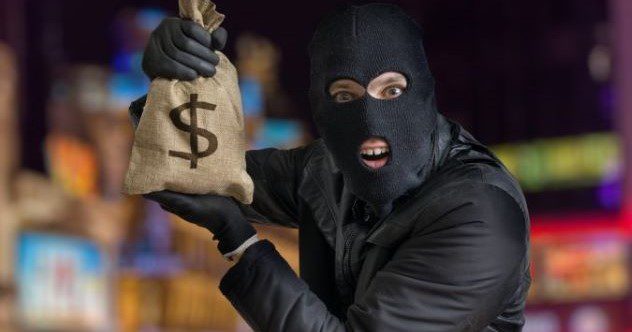

Movie bank robbers arrive with blueprints, synchronized watches, getaway cars, and suspiciously perfect cheekbones. Real-life bank robbers sometimes arrive with a withdrawal slip asking for one cent.
The strangest bank robberies are rarely master classes in criminal strategy. They are stories of tiny hauls, improvised disguises, self-identifying demand notes, extremely slow escapes, and suspects who appear to have planned everything except the part where they avoid being arrested.
This is not a mathematically definitive ranking of the smallest bank robberies in history. Records are incomplete, attempted robberies do not always produce a confirmed loss, and some reported totals exclude recovered cash. Instead, these ten documented cases combine remarkably small amounts with enough bizarre details to make a Hollywood screenwriter say, “That seems unrealistic.”
Why Small Bank Robberies Still Carry Big Consequences
A tiny demand does not make a bank robbery legally tiny. Under federal law, taking or attempting to take money from a protected financial institution through force, violence, or intimidation can qualify as bank robbery. The statute does not include a “but it was only five bucks” exemption.
There is also a human cost. Even when a suspect has no real weapon and escapes with pocket change, employees cannot safely assume the threat is fake. The FBI maintains decades of bank-crime reports, while security professionals emphasize that seemingly absurd robberies can still cause serious stress for tellers, customers, and responding officers.
Ten Tiny and Unusually Strange Bank Robberies
1. The One-Cent “Withdrawal” That Became a Robbery Charge
In June 2024, Michael Fleming entered a Chase branch in Lady Lake, Florida, and completed a withdrawal slip for exactly one cent. He reportedly did not have an account at the bank, and the teller explained that the requested transaction could not be completed.
According to the arrest affidavit, Fleming then made a remark that caused the teller to fear the situation might become violent. Police were called, and they found him still inside the branch. Authorities said he had expected to receive the penny and then wait for officers because his objective was to be arrested.
That makes the attempted haul smaller than the loose change hiding beneath most vending machines. It also demonstrates how quickly an odd request can become a serious criminal allegation when a bank employee reasonably perceives intimidation. Fleming was charged with robbery without a firearm or weapon.
2. The $1 Robbery Intended to Secure Medical Care
James Verone’s 2011 case was unusual for a much sadder reason. The 59-year-old North Carolina man entered an RBC Bank in Gastonia and handed a teller a note demanding one dollar. He claimed to have a gun, although police later found that he was unarmed.
After presenting the note, Verone did not run. He sat on a sofa in the lobby and waited to be arrested. He later explained that he was unemployed, had significant health problems, and believed incarceration would provide access to medical treatment.
The plan did not unfold as expected. Because the amount was so small and no weapon was found, he initially faced a larceny charge that was unlikely to produce the lengthy prison term he had anticipated. It was a one-dollar robbery driven not by dreams of wealth, but by desperation and a deeply troubling calculation about health care.
3. The Nine-Year-Old With a Toy Gun and a $118 Haul
One of the youngest known bank robbers in the United States was a New York boy identified in court records only as Robert. In February 1981, when he was nine years old, he entered a midtown Manhattan branch of the New York Bank for Savings carrying a toy pistol.
The teller believed the weapon was real and surrendered $118. The boy later turned himself in to the FBI and was convicted at age ten. Contemporary reports described him as the country’s youngest convicted bank robber.
The amount was modest even in 1981, but the suspect’s age transformed the case into national news. It also prompted uncomfortable questions about juvenile crime, supervision, and whether a child could fully comprehend the danger created by pointing what appeared to be a firearm at a bank employee.
4. The $400 Robbery Note Written on the Suspect’s Pay Stub
Demand notes are supposed to conceal a robber’s identity. Thomas Infante’s note took a more autobiographical approach.
In December 2008, Infante allegedly entered a Fifth Third Bank in Chicago and passed a threatening message to a teller. The teller handed him approximately $400. He left the note behind, apparently overlooking the fact that it had been written on part of his own pay stub.
Investigators found the matching portion near the bank’s entrance. It included his name, home address, employer, and wage information. Security footage supplied the visual confirmation, and a relative reportedly identified him from the image.
The result was less “mysterious outlaw” and more “customer loyalty profile, but for the FBI.” He was arrested at his home and reportedly admitted to the robbery.
5. The $595 Request That Produced an Acquittaland a Sequel
In 2021, Mohamed Worku entered an Illinois bank and gave a teller a note requesting money. The employee handed him $595, but his defense later argued that the message contained no explicit or implicit threatthe intimidation normally required for a federal robbery conviction.
A jury found him not guilty in January 2024. Three days after the acquittal, according to federal prosecutors, Worku entered another bank and presented another unusually polite note. This one asked for money, suggested he would repay it, and characterized the cash as an advance gift from the banker.
The teller surrendered a little more than $2,000 out of concern that the encounter might escalate. Worku was caught roughly 45 minutes later. Prosecutors charged him with both robbery and bank theft, apparently ensuring that the new case would not rely entirely on proving intimidation.
Most people celebrate a courtroom victory with dinner. Returning to nearly the same alleged conduct before the week is over is a far less conventional choice.
6. The $1,212 Wheelchair Getaway
In June 2015, Kelvin Dennison entered a Santander branch in Queens using a wheelchair. He gave a teller a note claiming that he had a gun and left with $1,212.
He then pushed himself down the street in the wheelchair, producing one of the slowest-looking getaway sequences ever captured by surveillance cameras. The unusual escape attracted widespread media attention, but it did not prevent identification.
Two days later, someone recognized Dennison when he visited a Queens hospital and notified police. He was arrested and charged with robbery. Months later, prosecutors accused him of attempting another wheelchair-assisted bank robbery after leaving a mental health treatment program.
The first escape may have lacked horsepower, but the threat faced by the teller was real enough: employees had no safe way to know whether the claimed gun existed.
7. The $2,701 Demand Note Written on a Traceable Starter Check
Rashad Harris demonstrated some awareness of bank security during a 2017 robbery spree in Virginia. He reportedly requested that tellers avoid dye packs and sometimes retrieved his demand notes before leaving. Unfortunately for him, his choice of stationery defeated the rest of the strategy.
During a Wells Fargo robbery in Chesapeake, Harris wrote his demand on a blank starter check issued by the same bank. The teller handed over $2,701, and Harris escapedbut left the check behind.
An employee entered its account number into the bank’s system, identified the customer connected to it, and then located Harris on Facebook. The profile image reportedly matched the man seen during the robbery.
He was arrested three days later, admitted to multiple robberies, and ultimately received a 15-year federal sentence. His $2,701 haul came with the kind of paper trail accountants usually dream about.
8. The $2,924 Robbery Planned as an Escape From Home
After an argument with his wife in September 2016, Lawrence John Ripple wrote a robbery note in front of her and reportedly said that he would rather be in jail than remain at home.
The 70-year-old then walked to the Bank of Labor in Kansas City, Kansasconveniently located about a block from police headquarters. He gave a teller a note claiming that he had a gun and received $2,924.
Instead of fleeing, Ripple sat in the lobby and informed a security guard that he was the person authorities were seeking. He later pleaded guilty. Evidence presented at sentencing indicated that depression following heart surgery had affected his behavior.
A judge sentenced him to probation and home confinement rather than the prison term he had apparently wanted. As criminal plans go, being sentenced to stay home after committing a robbery to avoid home has the structure of a very dark sitcom ending.
9. The Robbers Who Believed Lemon Juice Defeated Cameras
In 1995, McArthur Wheeler and an accomplice robbed banks in the Pittsburgh area without conventional masks. Wheeler had reportedly covered his face with lemon juice because he believed its use as invisible ink would also make him invisible to surveillance cameras.
According to later accounts, he had attempted to test the theory using a Polaroid camera and somehow produced a photograph in which his face did not appear properly. Rather than suspecting bad film, poor aim, or a camera problem, he concluded that the lemon juice had worked.
It had not. Clear surveillance images were broadcast by local news media, and tips quickly led police to Wheeler. The case later became associated with psychological discussions of overconfidence and the inability to recognize one’s own lack of competence.
The robbers obtained only a few thousand dollars from the documented heist, while the lemon-based disguise earned a permanent place in the history of spectacularly unsuccessful ideas.
10. The Christmas Robber Who Threw Away the Money
In December 2019, David Wayne Oliver allegedly robbed an Academy Bank branch in downtown Colorado Springs after claiming to have a weapon.
Once outside, the white-bearded suspect began throwing bills into the street while wishing people a merry Christmas. Witnesses said the scattered money consisted largely of one- and five-dollar bills. Bystanders collected much of it and returned it to the bank.
Oliver then walked to a nearby Starbucks, sat down, and appeared to wait for the police. Officers arrested him shortly afterward.
Although authorities did not publicly establish a precise total in the initial reports, the effective haul was exceptionally small because the suspect discarded it and helpful strangers returned much of the cash. It was less a successful bank robbery than an unauthorized holiday cash-drop event with terrible legal consequences.
What These Bizarre Bank Robberies Have in Common
The cases differ in motive, age, method, and outcome, but several patterns appear repeatedly.
The Money Was Often Not the Real Objective
Verone wanted medical care. Fleming allegedly wanted an arrest. Ripple wanted separation from his home life. Oliver appeared willing to discard the money almost immediately. In these cases, the bank served as a stage on which a personal crisis became a public emergency.
Ordinary Paperwork Became Excellent Evidence
A pay stub, a government document, and a starter check all carried identifying information. Surveillance systems, account records, witnesses, and social media then helped investigators connect suspects to the crimes. The smallest bank robberies can still generate a very large evidence file.
Confidence Frequently Replaced Competence
The lemon-juice disguise is the classic example, but the same problem appears elsewhere. Waiting in the lobby, leaving a personalized note, returning to similar conduct immediately after an acquittal, or using traceable bank paperwork all suggest a major gap between how effective a plan felt and how effective it actually was.
Experiences From the Other Side of These Strange Heists
Stories about bizarre bank robberies are often told as comedy because the plans are so obviously flawed. A demand for one cent sounds like a sketch. A wheelchair getaway looks like a scene written for television. A lemon-juice disguise practically arrives with its own punchline. However, the experience inside the bank is usually very different from the version that appears in a headline.
The Teller’s Experience: Absurd Details, Real Fear
A teller does not know whether a claimed gun is imaginary, whether a strange note is a prank, or whether an apparently calm person will suddenly become violent. Employees must make decisions in seconds while trying to protect customers, coworkers, and themselves. The amount requested is almost irrelevant during that moment. One dollar presented with a threat can produce the same rush of fear as a demand for thousands.
Guidance for bank employees who become robbery victims warns friends, relatives, and managers not to minimize the incident simply because nobody was physically injured. Victims may experience anxiety, confusion, anger, disrupted sleep, or a lingering fear of returning to the same counter.
The Customer’s Experience: Confusion Before Understanding
Bystanders often do not immediately realize that a robbery is happening. A suspect may stand quietly in line, hand over a note, and leave without shouting. Customers might notice only that employees have become tense or that the doors are suddenly locked.
That uncertainty can be unsettling. In the Christmas robbery, pedestrians encountered money flying through the street before they understood where it came from. Their decision to return the cash helped limit the loss, but approaching stolen money or following a suspect can introduce unnecessary danger. The safest response is generally to create distance, follow employee or police instructions, and report useful observations without attempting to become an action hero.
The Investigator’s Experience: Tiny Clues Can Solve the Case
For investigators, bizarre robberies often turn on ordinary evidence. A partial pay stub provides a name. A starter check reveals an account. A surveillance image reaches someone who recognizes the suspect. An unusual mobility device or distinctive piece of clothing narrows the search.
Banks are required to maintain security programs that help preserve evidence and identify offenders. Modern measures may include recorded video, marked bills, electronic tracking devices, alarm procedures, and trained staff. The FBI has also promoted approaches that help employees remain safe while gathering details useful to law enforcement.
The Reader’s Experience: Humor With a Necessary Limit
It is reasonable to laugh at a robber who supplies his own address or believes citrus juice can outsmart a camera. The humor comes from failed logic, not from the fear imposed on employees. Keeping that distinction matters.
These stories are memorable because they compress human desperation, overconfidence, bad judgment, and coincidence into a few minutes. They also show why “small” is a misleading description. The stolen amount may be tiny, but the criminal penalties, emergency response, emotional damage, and long-term consequences can be enormous.
Conclusion
The smallest and most bizarre bank robberies rarely resemble glamorous heists. There are no underground vault tunnels or fleets of untraceable sports cars. Instead, there are penny withdrawal slips, toy guns, personalized paperwork, questionable science experiments, and suspects patiently waiting for the police.
The stories are entertaining because the plans failed in spectacular ways, but they also reveal serious underlying problems: untreated mental illness, economic desperation, inadequate access to health care, childhood instability, and a remarkable human ability to mistake confidence for preparation.
Ultimately, the amount taken does not determine the seriousness of the experience. A $1 robbery can frighten a teller, trigger an armed response, produce a felony case, and change several lives. The haul may fit in a pocket. The consequences rarely do.
SEO Tags


