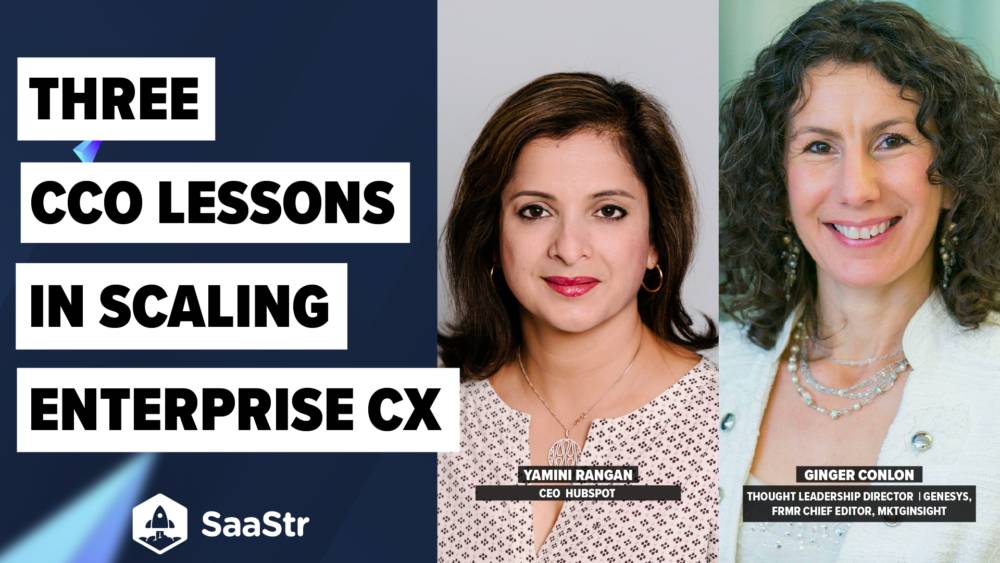
3 CEO Lessons in Scaling Enterprise CX with HubSpot’s CEO: SaaStr Podcast 475 and Video

Scaling enterprise customer experience sounds wonderfully simple until a company actually tries it. At ten customers, the CEO can personally rescue every confused user, answer every late-night email, and remember which customer loves quarterly reports but hates “circling back.” At 100 customers, that heroic approach becomes exhausting. At 100,000 customers, it becomes a sitcom. At hundreds of thousands of customers across global markets, it becomes a serious operating system.
That is why SaaStr Podcast 475, featuring HubSpot CEO Yamini Rangan in conversation with Ginger Conlon, remains such a useful playbook for SaaS founders, customer success leaders, revenue executives, and CEOs who want to move upmarket without accidentally building a maze for customers. Rangan’s perspective is especially valuable because she was HubSpot’s first Chief Customer Officer before becoming CEO. In other words, she did not arrive at customer experience as a decorative slogan on a conference slide. She built around it.
The central idea is clear: enterprise CX is not a department. It is not a help desk. It is not a chatbot wearing a tiny corporate hat. It is the way the whole company attracts, sells, onboards, supports, expands, and learns from customers. As HubSpot evolved from marketing automation into a broader customer platform spanning marketing, sales, service, content, commerce, data, CRM, and AI, the company’s CX challenge became the same challenge facing every scaling SaaS business: how do you keep the customer experience simple while the business becomes more complex?
Why SaaStr Podcast 475 Still Matters for Enterprise CX
The episode focuses on three major lessons: winning in the age of the customer, making digital-first the default, and recognizing that customer experience has multiple “front doors.” These ideas may sound obvious now, but many companies still violate them daily. They bury support behind ticket walls, hand customers from sales to success like a hot potato, and measure internal productivity while customers quietly wonder why buying software feels like applying for a mortgage.
Enterprise buyers today have more information, more choices, and less patience. They read reviews, compare alternatives, ask peers, test free tools, and expect every interaction to feel informed. That changes the CEO’s job. The CEO is no longer only responsible for product vision, revenue targets, and investor confidence. The CEO must also design the conditions for trust: aligned teams, clean systems, clear incentives, fast learning loops, and a culture that treats customers as the engine of growth rather than the end of the funnel.
Lesson 1: Win in the Age of the Customer
The first CEO lesson is that the power balance has shifted. Buyers know more, compare faster, and punish friction sooner. In the old software world, sellers controlled much of the information. Today, a prospect can learn about pricing complaints, implementation pain, product gaps, community sentiment, and competitor promises before ever booking a demo. The buyer does not enter the sales conversation as a blank page. They arrive with a spreadsheet, three peer recommendations, two skeptical executives, and one finance person asking whether this tool will create “platform consolidation” or “another monthly invoice with vibes.”
For CEOs, this means enterprise CX must start before the deal closes. Marketing content, website clarity, pricing transparency, sales discovery, demo quality, security review, implementation planning, and customer references are all part of the customer experience. A company cannot create a confusing buying journey and then expect the customer success team to magically “delight” everyone later. Delight cannot be used as industrial-strength Febreze for a broken process.
What CEOs should do differently
First, define the customer’s desired outcome in plain language. Not “increase platform utilization across cross-functional stakeholders.” Try something a human might say over coffee: “Help the customer generate more qualified pipeline, close deals faster, and support customers without adding chaos.” When the outcome is clear, product teams know what to build, sales teams know what to promise, and success teams know what to drive.
Second, measure customer value, not just customer activity. Logins, tickets, and email opens are useful signals, but they are not the destination. Enterprise customers care about business outcomes: cost reduction, revenue expansion, adoption, retention, efficiency, speed, compliance, and internal confidence. A CEO who wants scalable CX should ask: are customers achieving what they came here to achieve?
Third, keep the flywheel in mind. HubSpot’s flywheel model treats happy customers as a force that drives referrals, repeat sales, advocacy, and trust. That model is especially important in enterprise SaaS because large customers talk. They talk in Slack groups, advisory boards, private founder networks, LinkedIn threads, procurement circles, and industry events. A great enterprise customer experience becomes invisible marketing. A bad one becomes a public service announcement.
Lesson 2: Make Digital-First the Default
The second lesson from the episode is that digital-first is no longer a backup plan. It is the default operating environment. The pandemic accelerated this shift, but it did not create it from scratch. Customers were already moving toward self-service research, digital buying, virtual onboarding, chat-based support, knowledge bases, product-led trials, and online communities. The pandemic simply pressed fast-forward and misplaced the remote.
For enterprise SaaS companies, digital-first does not mean “replace humans with forms.” It means designing a customer journey that works when customers want speed, flexibility, and control. A strong digital experience helps customers learn, evaluate, buy, onboard, troubleshoot, and expand without waiting for someone to schedule a meeting two Tuesdays from now.
Digital-first does not mean human-last
The best enterprise CX blends automation with judgment. AI agents, chatbots, help centers, guided onboarding, usage alerts, and automated workflows can remove repetitive friction. But complex enterprise moments still need human expertise: executive alignment, migration planning, change management, security concerns, renewal risk, product strategy, and high-stakes escalations. The trick is not choosing between digital and human. The trick is knowing which moments need speed and which moments need empathy.
This is where HubSpot’s current AI direction is relevant. Its Breeze AI tools and agents are designed to work across marketing, sales, and service inside the customer platform. That reflects a broader CX trend: AI is most powerful when it is connected to customer context, approved knowledge, and real workflows. A disconnected AI tool may write a nice paragraph. A connected AI system can help qualify leads, summarize customer history, resolve routine inquiries, and surface account risks before they become renewal fires.
However, CEOs should be careful not to confuse AI adoption with CX maturity. Buying an AI tool is easy. Building trustworthy AI-enabled customer experience requires data quality, governance, escalation paths, human review, clear ownership, and customer transparency. Otherwise, a company simply scales confusion at machine speed. Congratulations, the robot is now also lost.
Lesson 3: Customer Experience Has Multiple Front Doors
The third lesson is the most important for scaling: customers do not experience your org chart. They experience the company. A customer may enter through a blog post, sales call, partner recommendation, product trial, support ticket, community thread, invoice question, renewal meeting, AI assistant, implementation consultant, or executive business review. Every one of those moments is a front door.
That is why customer experience cannot sit only inside customer support. Support is critical, but it is often where broken upstream decisions become visible. If marketing attracts the wrong audience, support feels it. If sales overpromises, support feels it. If product ships confusing workflows, support feels it. If billing is unclear, support feels it. If onboarding is rushed, support feels it. The support team becomes the smoke alarm, but the fire may have started three departments away.
The art and science of scalable CX
Rangan’s framing of CX as both art and science is useful. The art is culture: the stories leaders tell, the behaviors they reward, the customers they spotlight, and the instinct to ask, “What does this feel like for the customer?” The science is operating discipline: shared systems, journey mapping, data, processes, feedback loops, incentives, and accountability.
The art without science becomes warm sentiment and messy execution. The science without art becomes dashboards nobody loves. Scaling enterprise CX requires both. Leaders must make customer-centricity emotionally real and operationally repeatable.
One practical example is product accountability. If product teams are measured only on shipping features, they may ship quickly but ignore adoption, usability, and customer outcomes. If product teams also own customer signals such as adoption, feedback, support themes, and satisfaction, they are more likely to build with the real customer journey in mind. This is why cross-functional CX metrics matter. They prevent each team from declaring victory while the customer is still stuck in the hallway.
How HubSpot’s Journey Makes the Lesson Concrete
HubSpot is a useful case study because it grew from an inbound marketing company into a broader CRM and customer platform. That shift required more than adding products. It required a broader promise: helping businesses connect marketing, sales, service, content, data, commerce, and AI around the customer. The bigger the platform becomes, the more important simplicity becomes. Enterprise customers want power, but they do not want a cockpit with 900 blinking buttons and one mysterious lever labeled “sync, maybe.”
HubSpot’s upmarket momentum shows why this balance matters. Larger companies often need enterprise-grade controls, integrations, reporting, governance, support, and scalability. But they also value ease of use because adoption is the real battleground. A powerful platform that nobody wants to use is not a platform. It is expensive shelfware with a login screen.
For CEOs, the lesson is to build enterprise capability without enterprise confusion. That means saying no to unnecessary complexity, simplifying decision-making principles, and designing the product and customer journey around real user behavior. Enterprise customers may have complex organizations, but the experience should still feel clear, guided, and human.
Applying the Three CEO Lessons in a SaaS Business
1. Build the company around customer outcomes
Start with the customer’s goal and work backward. What does success look like in the first 30, 90, and 180 days? What does the economic buyer care about? What does the admin need? What does the end user need? What risks block adoption? What internal change must happen for the customer to see value?
Once those questions are answered, align the company around them. Marketing should attract customers who match the ideal customer profile. Sales should diagnose fit honestly. Implementation should reduce time to value. Product should remove friction. Customer success should drive measurable outcomes. Support should resolve issues quickly and feed insights back into the business. Finance and legal should avoid turning the buying process into a paperwork obstacle course designed by a bored dragon.
2. Design digital journeys that customers actually want to use
Digital-first CX should make life easier. Create self-service resources that are searchable, accurate, and organized around customer questions. Use lifecycle emails that guide rather than nag. Offer onboarding checklists, in-app education, product tours, usage alerts, and AI-powered help that knows when to hand off to a human. Make renewal and expansion conversations data-informed instead of awkwardly ceremonial.
The goal is not to remove people. The goal is to remove waiting, repetition, and confusion. Human teams should spend more time on strategic customer moments and less time answering the same basic question for the 400th time with the emotional range of a printer jam.
3. Align teams, systems, strategy, and incentives
Enterprise CX breaks when each team optimizes locally. Sales optimizes bookings. Success optimizes renewals. Product optimizes roadmap velocity. Marketing optimizes leads. Support optimizes response time. Those metrics matter, but they must ladder up to shared customer outcomes. Otherwise, the customer becomes the only person seeing the whole mess.
Create shared definitions of customer health. Connect CRM, support, product usage, billing, and feedback data. Review customer stories in leadership meetings. Bring customer voices into quarterly planning. Tie incentives to retention, adoption, satisfaction, and expansion quality. Build a customer journey map that shows where handoffs happen and where customers experience friction. Then fix the friction like it owes you money.
Common Mistakes CEOs Make When Scaling Enterprise CX
Mistake 1: Treating CX as a support function
Support is part of CX, but it is not the whole machine. If a CEO delegates customer experience entirely to support, the company will keep treating symptoms while ignoring causes. A high ticket volume may be a product design issue. Renewal risk may be an onboarding issue. Low adoption may be a sales-fit issue. Complaints about value may be a positioning issue. CX leadership requires root-cause thinking.
Mistake 2: Adding process instead of removing friction
As companies grow, they often add rules, approvals, forms, internal meetings, and customer-facing steps. Some structure is necessary. Too much structure slows the flywheel. The better question is: what can we simplify? Can customers get answers faster? Can reps see account context in one place? Can onboarding steps be reduced? Can pricing be clearer? Can handoffs disappear?
Mistake 3: Measuring what is easy instead of what matters
It is easy to count tickets closed, meetings held, emails sent, and dashboards opened. It is harder to measure customer confidence, business value, adoption quality, and executive trust. CEOs should insist on metrics that connect activity to outcomes. The best CX dashboards tell a story: where customers are winning, where they are stuck, and what the business must change.
Practical Experience: What Scaling Enterprise CX Feels Like in the Real World
In practice, scaling enterprise CX often feels less like building a perfect machine and more like tuning a very opinionated orchestra. Everyone may be talented, but if sales is playing jazz, product is playing classical, support is playing emergency drums, and finance is quietly playing a kazoo in the corner, the customer will not hear harmony. The CEO’s job is to create the shared rhythm.
One common experience in growing SaaS companies is the “hero era.” Early customers love the company because the founding team is close to every detail. A customer has a problem, and a senior engineer jumps in. A prospect needs reassurance, and the CEO joins the call. A feature request appears, and the product team ships a workaround by Friday. This creates loyalty, but it does not scale. The danger is that customers fall in love with access to heroes rather than with a reliable system.
The next stage is usually the “process era.” The company hires customer success managers, creates onboarding plans, builds a support queue, introduces customer health scores, and documents playbooks. This is necessary, but it can feel colder if leaders are not careful. Customers who once received instant founder attention may now receive a ticket number. The experience becomes scalable but less personal. This is where the art of CX matters. Process should preserve care, not replace it.
The best companies eventually reach the “platform era.” They combine clear human ownership with digital tools, automation, data, and customer education. Customers know where to go, what happens next, and how to get help. Internal teams see the same customer history. AI handles routine work while humans focus on judgment, strategy, and relationship moments. Leaders review customer outcomes, not just internal productivity. This is where enterprise CX becomes a growth advantage.
Another real-world lesson: segmentation is not optional. A 25-person startup and a 5,000-person enterprise may buy the same platform but need different experiences. The startup wants speed, templates, and affordability. The enterprise wants governance, integrations, security, reporting, and change management. If a company serves both with the same motion, one group will feel neglected. Scaling CX means defining the right experience for each segment without creating twenty different companies inside one company.
Finally, the hardest experience for CEOs is learning that customer feedback is not always convenient. Customers will reveal gaps in the product roadmap, pricing model, onboarding design, partner ecosystem, documentation, and internal alignment. Mature leaders do not treat that feedback as noise. They treat it as market intelligence. The customer may not always prescribe the right solution, but they are often very good at showing where friction lives. Listen closely enough, and customers will draw the map for your next stage of growth.
Conclusion: Scaling Enterprise CX Is a CEO System
SaaStr Podcast 475 is not just a customer success conversation. It is a CEO operating lesson. Yamini Rangan’s three themes point to a bigger truth: enterprise customer experience scales only when the company is designed around the customer. The age of the customer requires trust. Digital-first requires thoughtful systems. Multiple front doors require cross-functional alignment.
For SaaS companies moving upmarket, the challenge is not simply to sell bigger contracts. It is to deliver a bigger promise without making the customer carry the complexity. The companies that win will simplify decisions, connect teams, use AI responsibly, measure outcomes, and treat every customer touchpoint as part of the same experience. That is how the flywheel spins. That is how customers become advocates. And that is how enterprise CX becomes more than a slogan printed on a slide with a suspiciously cheerful stock photo.
Note: This article is written for web publication and synthesizes public information from SaaStr Podcast 475, HubSpot’s customer platform direction, and widely cited customer experience research. Source links are intentionally not included in the body copy to match the publishing requirement.


