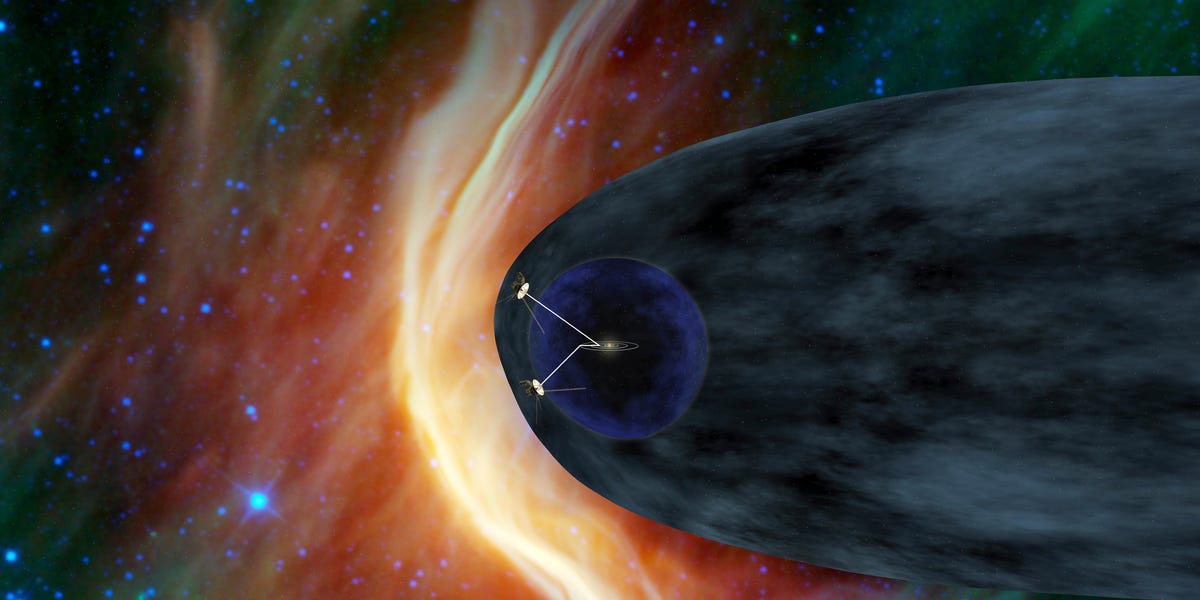

If you grew up picturing the solar system as a tidy lineup of planets, moons, and one overachieving comet doing parkour in the background, the real version is weirder and much cooler. The Sun doesn’t just light the planets; it blows a giant magnetic bubble around them. That bubble, called the heliosphere, stretches far beyond Pluto and acts like a cosmic windbreaker, helping shield the solar system from some of the nastier radiation drifting through the galaxy.
So where does the solar system “end”? That depends on which definition you use. But when scientists talk about the practical boundary of the Sun’s influence, they often mean the heliopausethe place where the outward pressure of the solar wind finally loses a shoving match with the interstellar medium. For decades, this boundary was one of space science’s most frustrating mysteries: too far away to visit easily, too complex to model cleanly, and too important to ignore.
Now researchers have something better than guesswork. By combining data from Voyager, the Interstellar Boundary Explorer (IBEX), and the newer Interstellar Mapping and Acceleration Probe (IMAP), scientists have figured out a powerful way to probe the boundary of the solar system without physically parking a spacecraft everywhere along it. They are using energetic particles like messengers, timing solar wind disturbances like echoes, and planning future missions that could look back at our heliosphere from the outside. In plain English: humanity is finally learning how to map the edge of home without waiting a lifetime for every answer.
What Scientists Mean by the Solar System’s Boundary
First, a small but important cleanup: the heliopause is not exactly the same thing as the absolute end of the solar system if you define that by the Sun’s gravity. The distant Oort Cloud, for example, extends much farther out. But in heliophysics, the heliopause is often treated as the most meaningful frontier because it marks where the Sun stops dominating the local space environment.
Think of the heliosphere as a giant bubble inflated by the solar wind, a nonstop stream of charged particles flowing outward from the Sun. As that wind barrels into the material between stars, several regions form:
Termination Shock
This is where the solar wind, moving faster than the local speed of sound in space plasma, suddenly slows down. It is less “brick wall” and more “cosmic traffic jam.”
Heliosheath
Beyond the termination shock lies the heliosheath, a turbulent outer layer where solar material slows, heats up, and gets messy. If the heliosphere were a castle, this would be the moatexcept the moat is made of superheated plasma and magnetic confusion.
Heliopause
This is the outer boundary, where the solar wind’s influence balances against the interstellar medium. Cross it, and a spacecraft moves into interstellar space, at least in the heliophysics sense.
That distinction matters because the heliopause is not a perfect sphere, not fixed in place, and definitely not calm. It changes with the Sun’s roughly 11-year activity cycle, and scientists still debate whether the heliosphere is more comet-like, more rounded, more croissant-shaped, or something even stranger. Apparently, the solar system did not get the memo that it was supposed to choose one silhouette and stick to it.
Voyager Gave Us Two Historic SnapshotsAnd a Lot of New Questions
Before modern remote-mapping techniques came together, the best evidence we had came from NASA’s Voyager spacecraft. Voyager 1 crossed into interstellar space in 2012, and Voyager 2 followed in 2018. These were landmark moments, not just because the probes went unbelievably far, but because they gave scientists their first direct measurements near and beyond the heliopause.
Voyager 1 found a region where cosmic rays from outside the heliosphere increased while particles from the Sun dropped off sharply. Voyager 2 later confirmed that the plasma outside the heliosphere is denser and colder than the plasma inside. Both crossings showed that the boundary is real, dynamic, and more complicated than earlier textbook cartoons suggested.
But here is the catch: two crossings are still only two points. That is like trying to understand the shape of the entire Pacific Ocean by dipping your toes in twice and saying, “Yep, I’ve got it.” Useful? Yes. Complete? Not even close.
The Voyagers crossed the heliopause at different times, at different locations, and under different solar conditions. That alone told scientists the boundary moves and responds to the Sun’s activity. Yet the spacecraft were never designed primarily to study the heliosphere’s outer edge, and as their systems age and instruments power down, they can no longer answer every question researchers want to ask. The Voyagers opened the door, but they did not hand over a full floor plan.
The Breakthrough: Probing the Boundary with Particle “Echoes”
This is where the science gets especially clever. IBEX helped scientists probe the boundary of the solar system using energetic neutral atoms, or ENAs. These particles are born when fast-moving charged particles from the solar wind interact with neutral atoms near the heliosphere’s edge and steal electrons. Once they become neutral, they are no longer steered around by magnetic fields in the same way charged particles are. That means they can travel in relatively straight lines back toward detectors near Earth.
In other words, the edge of the heliosphere sends us particle postcards.
Researchers realized they could connect changes in ENAs detected by IBEX to earlier disturbances in the solar wind. When the Sun launches a pressure increase outward, that disturbance travels to the heliosphere’s edge, triggers the production of ENAs, and some of those ENAs travel back inward. By measuring the time delay between the original solar wind pulse and the returning ENA signal, scientists can estimate the distance to the boundary in that direction.
This method is often compared to sonar or echolocation. Nobody is literally clapping at the heliopause and waiting for a cosmic echo, but the logic is similar: send out a disturbance, watch what comes back, and use the timing to infer distance and structure. With enough data collected over many years and in many directions, scientists can build a three-dimensional map of the heliosphere’s outer boundary.
That was the real breakthrough. Instead of treating the heliopause as a vague theoretical shell, researchers turned it into something that could be remotely sounded and modeled. IBEX data across a full solar cycle helped produce the first global 3D picture of the heliosphere’s boundary. That is a big deal. Space is large, rude, and not interested in making itself easy to survey.
What the New Maps Revealed
The new mapping work did not magically settle every argument, but it changed the conversation. The heliosphere appears to be asymmetric, with the nose and tail responding differently to changes in the solar wind. Researchers also found signs of small-scale structure, ripples, and variation that suggest the boundary is not a smooth balloon. It is a living interface between our star and the galaxy.
IBEX also uncovered one of heliophysics’ favorite headaches: the IBEX ribbon, a bright, narrow swath of energetic neutral atoms arcing across the sky. Scientists now think this ribbon is closely tied to the direction of the local interstellar magnetic field. That means the heliosphere is not shaped only by what the Sun is doing from the inside; it is also being sculpted by the galaxy from the outside.
That is one reason the heliosphere matters beyond pure curiosity. It is not just our Sun’s puffed-up personal space. It is the meeting point between the solar wind and the broader interstellar environment, and that interaction helps determine how much high-energy radiation gets filtered before reaching the planets. The boundary is part shield, part sensor, part weather front, and part scientific drama machine.
Why IMAP Is Such a Big Deal Right Now
IBEX proved the method. IMAP is built to sharpen it.
NASA launched the Interstellar Mapping and Acceleration Probe in September 2025, and by early 2026 the spacecraft had reached its station near Lagrange Point 1, about a million miles from Earth toward the Sun. From there, IMAP has a clean, continuous view for studying the heliosphere and the incoming particles that reveal what is happening at its boundary.
IMAP carries 10 instruments and is often described as a next-generation mapper of the heliosphere. It measures ENAs with better sensitivity and resolution than IBEX, while also studying solar wind particles, magnetic fields, interstellar dust, and pickup ionsparticles that began as neutral atoms from interstellar space before getting ionized inside the heliosphere. Put all of that together, and IMAP can do much more than draw a prettier map. It can connect what happens at the Sun to what happens at the boundary and beyond.
That matters for both basic science and practical forecasting. The heliosphere is our first line of defense against galactic cosmic rays, and space weather affects astronauts, satellites, communications systems, and power infrastructure. If we want to understand how well our solar bubble protects usand how that protection changes over timewe need better measurements. IMAP is designed to deliver exactly that.
Scientists Also Figured Out the Best Way to Go There
Remote sensing is powerful, but researchers still want a future interstellar probe that can cross the heliopause on purpose and study the heliosphere from outside. That brings us to the second sense in which scientists have “figured out how” to probe the boundary.
A University of Michigan-led study examined multiple possible trajectories for such a mission and found that the most scientifically valuable route may not be the obvious one. Instead of charging straight toward the heliosphere’s nose, the best path may be through the flank toward the tail end. That angle could give a future spacecraft a much better external view of the heliosphere’s overall shape, especially in the tail region, which remains one of the least understood parts of the system.
Why does that matter? Because a future probe will take decades to get there. If you are going to spend half a century sending a machine into deep space, you want it pointed in the direction that answers the biggest questions, not just the direction that feels most heroic. Space exploration may inspire poetry, but trajectory planning still has to survive contact with physics.
Why This Research Matters More Than It First Appears
At first glance, studying the boundary of the solar system can sound like deluxe curiosityscience done because humans enjoy poking the universe with a stick. To be fair, that is part of the appeal. But the work also has real stakes.
Understanding the heliosphere helps researchers estimate how effectively our solar system is shielded from galactic cosmic rays. Those particles are dangerous for astronauts and electronics, and over long periods they also matter for planetary atmospheres and habitability. The heliosphere is one reason Earth’s neighborhood is not exposed directly to the full interstellar environment.
This research also helps scientists understand other stars. Our heliosphere is one example of an astrosphere, the bubble a star blows into surrounding space. If we can understand how our own system works, we can make better guesses about the environments around distant stars and whether their planets have any meaningful protection from radiation. In that sense, probing the edge of our solar system also helps us think more clearly about life elsewhere.
Experiences From the Edge of the Map
One of the most fascinating things about this topic is that the experience of studying the solar system’s boundary is almost the opposite of the usual sci-fi fantasy. It is not all blazing engines, dramatic countdowns, and someone whispering, “This is it.” Most of the time, it is patience. It is waiting for a faint signal that took many hours to arrive. It is comparing one set of particles with another and realizing the answer to a huge cosmic question may be hidden in a time delay of years.
There is something deeply human in that. Scientists working on the heliosphere are trying to understand the shape of the place that has protected every human who has ever existed. Yet they have to do it from inside the bubble, with incomplete tools, scattered data, and a universe that refuses to sit still. The often-used goldfish-bowl analogy fits because it captures the emotional texture of the work as much as the technical challenge. We are inside the thing we are trying to measure.
The Voyager missions added another layer to that experience. Engineers and researchers have spent decades listening to spacecraft that were launched in the 1970s, when disco was alive, computers were bulky, and no one expected the probes to become our interstellar scouts. Every new reading from Voyager became part data point, part family letter from a relative who moved impossibly far away but still calls now and then. There is a reason people feel sentimental about those spacecraft. They are old machines doing young science.
Then there is the experience of scale. The heliopause is so far away that even when the Sun does something dramatic, the consequences unfold like a slow-motion play. A solar wind pressure pulse travels outward. Years later, neutral atoms produced near the boundary make their way back inward. Scientists match those timelines and realize they are, in effect, hearing the solar system answer back. It is not flashy. It is stranger than flashy. It is a conversation conducted in particles, over billions of miles, with long pauses that would make ordinary human small talk collapse in embarrassment.
For students and space fans, the topic has its own peculiar thrill because it changes the way the solar system feels. The planets stop being the whole story. Home becomes less like a shelf of labeled worlds and more like a moving weather system inside the galaxy. The Sun is no longer just the thing that gives us daylight and sunburns; it is also the engine inflating a magnetic shelter around us. Once you see that, space feels both bigger and more intimate at the same time.
And for mission planners, the experience is part optimism, part humility. They know a dedicated interstellar probe may take decades to reach the boundary. The people who design it may not be the people who see it arrive. Yet that has always been part of the best space science: building instruments that outlast your own moment, trusting that future researchers will inherit the question and push it farther. Probing the boundary of the solar system is not only about measuring the edge of the Sun’s influence. It is also about practicing a very human skilllearning how to care about discoveries that unfold on timescales larger than a career, a news cycle, or even a generation.
That may be the most moving part of the whole story. Scientists did not find a neat wall with a giant “You Are Leaving the Solar System” sign. They found a shifting, rippled, dynamic frontier, and they learned how to study it anyway. That is science at its best: not waiting for the universe to become simple, but inventing better ways to understand its complexity.
Conclusion
Scientists have not solved every mystery at the edge of the solar system, but they have made a decisive leap. By using energetic neutral atoms, tracking time-delayed solar wind signatures, interpreting Voyager’s hard-won measurements, and deploying IMAP for higher-resolution mapping, researchers have figured out how to probe a boundary once thought nearly unreachable. Better still, they are learning where a future interstellar probe should go if humanity wants its first real portrait of the heliosphere from the outside.
The result is both elegant and slightly hilarious in the best scientific way: to understand the edge of our solar system, we are studying invisible particles, waiting years for their return, and treating the Sun like a source of cosmic ping signals. It sounds wild because it is. But it is also real, rigorous, and one of the smartest ways humans have ever tried to measure the border of home.
SEO Tags