
Custom indexing sounds like one of those Wall Street phrases that escaped from a conference room and started wearing a quarter-zip. But the idea is surprisingly practical: instead of buying a one-size-fits-all index fund or ETF, an investor owns a personalized basket of individual stocks designed to behave like a chosen benchmark. The investor gets broad market exposure, but with more control over taxes, exclusions, values, and portfolio design.
In plain English, custom indexing lets investors “talk their book.” They can build a portfolio around what they already own, what they want to avoid, what they believe in, and what tax problems they are trying to solve. It is not magic. It does not turn a bad market into a spa day. But for taxable investors with meaningful assets, concentrated positions, or specific preferences, it can be a powerful upgrade from traditional indexing.
The big shift is ownership. With a mutual fund or ETF, you own shares of the fund. With custom indexing, often called direct indexing or personalized indexing, you directly own many of the underlying securities. That one difference opens the door to tax-loss harvesting, stock-level customization, risk management, and a more personal investing experience.
What Is Custom Indexing?
Custom indexing is an investment strategy that creates a separately managed account, or SMA, built to track an index or model portfolio while allowing investor-specific adjustments. Instead of buying a single ETF that tracks the S&P 500, for example, a portfolio manager or software platform may buy a representative mix of individual stocks that approximates the index’s risk and return characteristics.
The goal is usually not to beat the market through heroic stock picking. The goal is to get market-like exposure with more flexibility. Think of a traditional index fund as a pre-made sandwich. It is cheap, reliable, and easy. Custom indexing is still lunch, but now you can hold the pickles, add extra turkey, avoid peanuts, and keep the nutritional profile roughly similar. Finance people call that “portfolio optimization.” Everyone else calls it “finally being able to make a sandwich your way.”
How Custom Indexing Works Step by Step
1. Choose a Benchmark or Model
A custom index usually starts with a benchmark, such as a U.S. large-cap index, total U.S. market index, international equity index, factor strategy, or advisor-created model. The benchmark acts as the map. The custom portfolio does not need to own every single stock in the index, but it should be built to maintain similar exposure across sectors, industries, market capitalization, and risk factors.
2. Apply Investor Preferences
Next, the investor or advisor adds personal rules. These may include excluding a company, limiting exposure to an industry, reducing overlap with employer stock, adding a value or quality tilt, or screening for environmental, social, or governance preferences. For example, an executive who already owns a large amount of company stock might want a U.S. equity portfolio that reduces exposure to that same company or sector.
3. Build the Portfolio
Technology then constructs a portfolio of individual securities. The system attempts to balance two jobs at once: reflect the benchmark and respect the client’s custom rules. This is where the software earns its keep. Without automation, managing hundreds of positions across thousands of client accounts would be like trying to alphabetize confetti during a windstorm.
4. Monitor Tracking Error
Tracking error measures how much the custom portfolio may differ from the benchmark. The more exclusions and tilts an investor adds, the more the portfolio may drift from the index. A portfolio that excludes one stock may still track closely. A portfolio that excludes an entire sector, adds a dividend tilt, avoids certain industries, and favors small-cap value stocks is no longer simply “the market with a haircut.” It is a different animal.
5. Harvest Losses Along the Way
One of the biggest attractions of custom indexing is tax-loss harvesting. Because the investor owns individual stocks, the manager can look for positions trading below their cost basis, sell those losing positions, and use the realized losses to offset capital gains. The portfolio can then buy replacement securities that maintain similar market exposure without violating wash-sale rules.
Why Tax-Loss Harvesting Matters
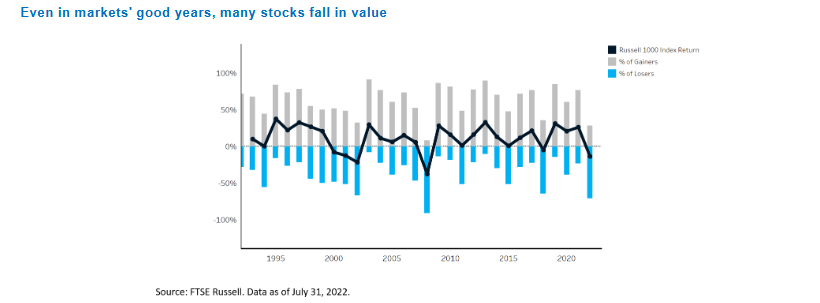
Tax-loss harvesting is often the headline benefit of custom indexing. In a traditional index fund, the investor cannot harvest losses from individual holdings inside the fund. If Apple is down, Microsoft is up, and dozens of other stocks are moving in different directions, the fund shareholder cannot selectively realize losses inside the wrapper. With custom indexing, each stock is its own tax lot, and each tax lot may create an opportunity.
Suppose an investor owns a custom U.S. equity portfolio. The overall portfolio is up 8% for the year, but 40 individual stocks are down. A tax-aware manager may sell some of those losing positions, realize losses, and replace them with similar securities to preserve exposure. Those losses can offset capital gains from other parts of the portfolio. If losses exceed gains, U.S. taxpayers may generally use up to $3,000 of net capital losses to reduce ordinary income in a year and carry forward unused losses.
This is especially useful for investors who regularly realize capital gains, sell a business, rebalance appreciated holdings, receive stock compensation, or unwind a concentrated position. Tax alpha is not guaranteed, and it depends on market volatility, cash flows, tax rates, and future gains. Still, for the right investor, harvesting losses at the individual-security level can make the portfolio more tax-efficient than a pooled fund.
The Wash-Sale Rule: The Tax Speed Bump
The wash-sale rule is the IRS’s way of saying, “Nice try, but no.” If an investor sells a security at a loss and buys the same or substantially identical security within 30 days before or after the sale, the loss may be disallowed for current tax purposes. This rule matters because custom indexing strategies often harvest losses throughout the year.
A good custom indexing system must coordinate trades carefully. If it sells one bank stock at a loss, it may buy a different bank stock or a sector-appropriate substitute rather than immediately repurchasing the same position. The goal is to maintain portfolio exposure while staying on the right side of tax rules. This is why tax-aware implementation is not a casual weekend spreadsheet project. It requires trading discipline, tax-lot tracking, and thoughtful replacement logic.
Custom Indexing vs. ETFs and Mutual Funds
ETFs and index mutual funds remain excellent tools. They are inexpensive, easy to trade, diversified, and simple to hold. For many investors, especially those investing mainly through retirement accounts, a low-cost index fund is still the cleanest solution. Custom indexing is not automatically better. It is better only when its added flexibility is worth its added complexity and fees.
The trade-off is simple. ETFs win on simplicity and often cost. Custom indexing wins on personalization and tax control. An ETF is like a reliable rental car: inexpensive, efficient, and ready to go. Custom indexing is more like a car configured for your height, commute, fuel preference, and strange insistence that cup holders are a personality trait.
Who May Benefit Most from Custom Indexing?
High-Income Taxable Investors
Investors in higher tax brackets with taxable brokerage accounts may benefit most because tax-loss harvesting is valuable only when there are taxes to manage. If all investments are inside a 401(k), IRA, or Roth IRA, the tax-loss harvesting benefit generally does not apply.
Investors with Concentrated Stock Positions
Custom indexing can help investors diversify around a large single-stock holding. Someone with a major position in a technology employer, for example, may want a portfolio that reduces additional technology exposure while still targeting broad U.S. equity returns.
Investors with Values-Based Preferences
Some investors want to avoid certain industries or companies. Others want to emphasize profitability, dividends, quality, or shareholder yield. Custom indexing can make these preferences more precise than broad ESG funds or thematic ETFs, which may not match an investor’s definition of “responsible,” “quality,” or “please keep that company out of my portfolio.”
Advisors Serving Complex Clients
Financial advisors can use custom indexing to make portfolios more personal without building each account manually. Platforms such as Canvas and other direct indexing systems help advisors create scalable, tax-managed portfolios that still reflect each client’s needs, goals, and constraints.
Where Custom Indexing Can Go Wrong
Custom indexing has benefits, but it is not a free lunch. The first risk is over-customization. If an investor excludes too many stocks or sectors, the portfolio may no longer behave like the benchmark. The second risk is cost. Many custom indexing programs charge advisory fees above the expense ratios of basic ETFs. The third risk is tax complexity. Investors need accurate records, coordinated accounts, and tax professionals who understand the strategy.
There is also behavioral risk. Customization can tempt investors to turn a disciplined strategy into a wish list of hunches. Excluding a company because of a legitimate tax, concentration, or values-based reason is one thing. Excluding stocks because a cousin on social media said “vibes are bad” is not exactly institutional-grade portfolio management.
Why 2019 Changed the Conversation
The custom indexing boom did not happen by accident. Several changes made it more practical: zero-commission stock trading, fractional shares, better portfolio software, automated tax-lot accounting, and growing demand for personalized advice. Around this period, platforms built for advisors began making direct ownership more scalable. What once required large accounts and labor-intensive management became available to a wider group of investors.
This is why the modern version of custom indexing feels different from old-school separately managed accounts. It is not just a portfolio manager picking stocks in a fancy binder. It is software, tax rules, portfolio science, and advisor judgment working together. At its best, custom indexing turns the index from a static product into a flexible framework.
A Simple Example of Custom Indexing
Imagine a client named Sarah with $500,000 in a taxable brokerage account. She wants U.S. large-cap exposure but already owns $200,000 of her employer’s stock in the technology sector. She also expects to sell a rental property next year, creating a large capital gain.
A traditional S&P 500 ETF would give Sarah broad exposure, but it might add more technology exposure and offer limited tax-loss harvesting inside the fund. A custom indexing account could track a U.S. large-cap benchmark, reduce technology exposure, exclude her employer’s stock, and actively harvest losses throughout the year. If markets are volatile, harvested losses may help offset future capital gains from the property sale.
The portfolio is still designed to be diversified. It is not built around Sarah’s favorite headlines or dinner-party predictions. It is built around her actual financial life. That is the central promise of custom indexing: the market exposure can be systematic, while the implementation can be personal.
Custom Indexing and Financial Advisors
For advisors, custom indexing changes the client conversation. Instead of saying, “Here is the same fund everyone owns,” an advisor can say, “Here is how we built your portfolio around your taxes, your company stock, your preferences, and your long-term plan.” That is a more meaningful discussion.
It also creates more responsibility. Advisors must explain tracking error, tax trade-offs, fees, and realistic expectations. They must help clients understand that tax-loss harvesting does not eliminate risk, and customization does not guarantee outperformance. The best advisors use custom indexing as part of a broader plan, not as a shiny object to wave around during review meetings.
Is Custom Indexing Worth It?
Custom indexing may be worth it when the investor has a taxable account, meaningful assets, recurring capital gains, concentrated positions, or strong customization needs. It may not be worth it for investors with small balances, mostly retirement accounts, low tax sensitivity, or no desire for additional complexity.
The decision should come down to after-tax value. If the expected tax benefits, personalization, and risk-management advantages exceed the added fees and operational complexity, custom indexing can make sense. If not, a low-cost ETF may do the job beautifully. Boring is not bad. In investing, boring often has excellent hygiene.
Real-World Experience: What Custom Indexing Feels Like in Practice
The most interesting part of custom indexing is not the technology. It is the conversation it creates. In a traditional portfolio review, investors often ask, “How did my fund do?” With custom indexing, the discussion becomes more specific: “What losses did we harvest? Did we reduce my employer-stock exposure? Are my exclusions affecting performance? How much tracking error am I accepting for these preferences?”
That shift matters. Investors are more likely to stick with a plan when they understand why the portfolio looks the way it does. A client who excludes a certain industry, for example, should know the portfolio may perform differently when that industry leads the market. A client who prioritizes tax harvesting should understand that selling losers is not a sign of failure; it is part of the design. Nobody enjoys seeing red numbers, but in a taxable account, some red numbers can be useful ingredients.
Advisors who use custom indexing often describe the onboarding process as part financial planning, part portfolio construction, and part therapy session for old holdings. Clients may arrive with legacy stocks, inherited positions, low-basis shares, company equity, and emotional attachments to investments purchased years ago. The custom indexing process forces everyone to ask better questions. What should stay? What should be sold? What gains are worth realizing? What risks are hiding in plain sight?
A common experience is the “aha” moment around tax lots. Many investors think of a stock as one position. Custom indexing treats it as a collection of lots purchased at different prices and times. One lot may have a gain, another may have a loss, and another may be close to flat. That level of detail can create opportunities. It also reminds investors that tax management is not a once-a-year scramble in December. It can be a year-round discipline.
The emotional experience is also different from owning an ETF. With an ETF, the investor sees one ticker. With custom indexing, the investor may see dozens or hundreds of positions. For some people, that transparency feels empowering. For others, it feels like opening the hood of a car and discovering five hundred tiny engines. The solution is education. Investors do not need to micromanage every holding, but they do need to understand the purpose of the structure.
The best custom indexing experiences happen when expectations are clear from the start. The investor knows the benchmark. The advisor explains acceptable tracking error. The tax strategy is coordinated with the investor’s accountant. The portfolio is customized for real financial reasons, not because customization sounds fancy. When all of that comes together, custom indexing can feel less like a product and more like a portfolio operating system.
In that sense, “Talk Your Book” is the perfect phrase. Custom indexing gives investors and advisors a way to talk about the actual book: the taxes, the risks, the preferences, the legacy holdings, and the goals behind the money. The portfolio becomes less generic. It becomes a reflection of the investor’s real life, with all its quirks, constraints, and opportunities. And yes, sometimes it still goes down, because markets remain markets. But at least the portfolio is doing its job in a way that makes sense for the person who owns it.
Conclusion
Custom indexing is one of the most important evolutions in modern portfolio management. It blends the discipline of indexing with the personalization of separately managed accounts and the tax awareness of individual security ownership. For the right investor, it can provide market-like exposure, better tax control, customized exclusions, and a portfolio that fits more neatly into a broader financial plan.
Still, it is not for everyone. Investors should weigh fees, account size, tax situation, tracking error, and complexity before choosing custom indexing over a traditional ETF or mutual fund. The smartest use case is not “because it sounds advanced.” The smartest use case is “because my financial life is specific, and my portfolio should account for that.”
Custom indexing works best when it is practical, tax-aware, and tied to real goals. Used wisely, it can turn indexing from a generic product into a personalized strategy. Used carelessly, it can become an expensive way to over-engineer simplicity. As always in investing, the tool matters less than the plan behind it.


