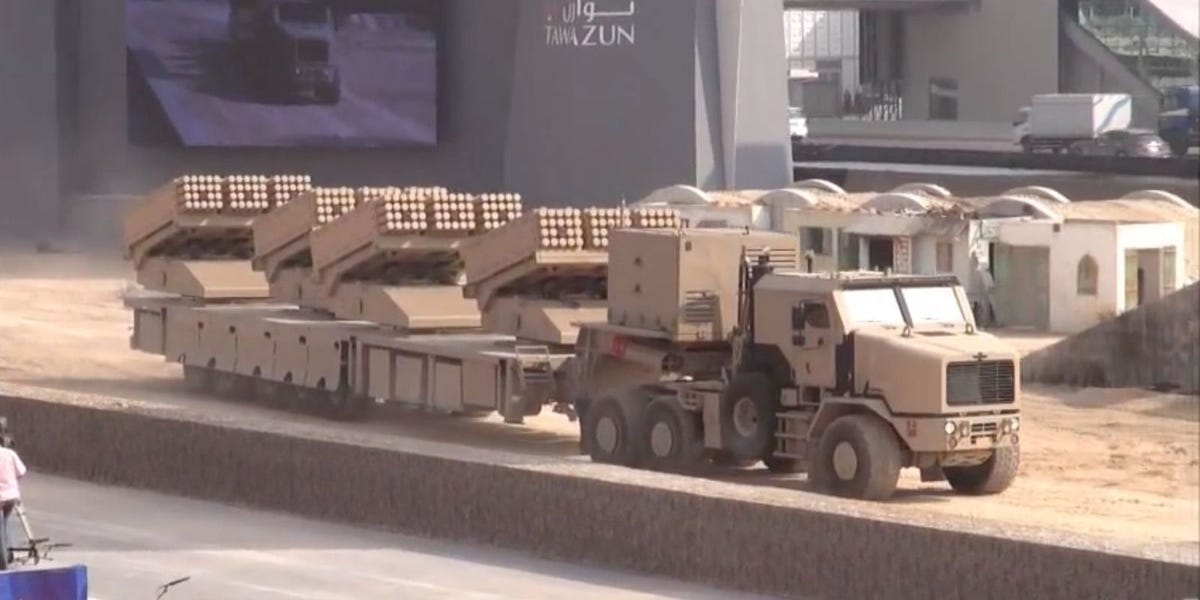

Most semi trucks are built to haul freight, tractors, construction equipment, or perhaps a suspicious number of snack pallets headed for a gas station. The Jobaria Defense Systems Multiple Cradle Launcher, however, looked at that humble trucking formula and asked a very different question: “What if the trailer carried 240 artillery rockets instead?” The result is one of the most dramatic, oversized, and frankly intimidating rocket artillery systems ever displayed: a military semi truck designed to deliver a storm of firepower in less time than it takes most people to decide what to order for lunch.
Known as the Jobaria Multiple Cradle Launcher, or JDS MCL, this United Arab Emirates-developed system combines the brute towing power of an Oshkosh heavy equipment transporter with a massive trailer carrying four separate launcher cradles. Each cradle holds 60 rockets, giving the full system 240 tubes. That number is not a typo. It is not a marketing exaggeration. It is not a “some assembly required” weekend hobby project. It is a real rocket artillery platform built around the idea of replacing several conventional multiple launch rocket systems with one enormous, centralized launcher.
In military terms, the MCL is not about subtlety. It is about saturation fire: placing a large number of unguided rockets over a wide area very quickly. In everyday language, it is the difference between tossing one snowball and backing up a dump truck full of snowballs, raising the bed, and letting gravity make its point.
What Is the Jobaria Multiple Cradle Launcher?
The Jobaria Multiple Cradle Launcher is a mobile rocket artillery system developed in the United Arab Emirates with support from international defense partners. It first drew public attention at the IDEX defense exhibition in Abu Dhabi in 2013, where its size alone made it impossible to ignore. The system is often described as one of the largest rocket artillery platforms in the world by tube count, thanks to its 240 launch tubes.
At its core, the vehicle is built in two main parts. The front is a heavy military tractor based on the Oshkosh Heavy Equipment Transporter family, a type of vehicle associated with hauling tanks and other very heavy military loads. The rear is a specialized semi-trailer carrying four powered launcher cradles. Each cradle contains three blocks of 20 tubes, adding up to 60 rockets per cradle and 240 rockets across the full system.
The design is unusual because most multiple launch rocket systems are mounted on smaller, self-contained military trucks. A common 122 mm launcher, such as systems inspired by the BM-21 Grad concept, typically carries around 40 rockets. Jobaria’s MCL scales that idea up dramatically. Instead of using six launcher vehicles to deliver a similar volume of fire, the UAE system concentrates that firepower on one large launcher operated by a much smaller crew.
Why Put 240 Rockets on a Semi Truck?
The short answer is efficiency. The longer answer is command, control, manpower, logistics, and the desire to deliver a huge salvo from a single firing unit. The UAE has historically placed a premium on advanced military systems that can produce high capability with relatively small teams. A launcher that can do the work of several vehicles naturally fits that logic.
By mounting 240 rockets on one trailer, the MCL reduces the number of individual launch vehicles needed for a large barrage. Instead of coordinating multiple trucks, each with its own driver, launcher crew, fire-control process, and repositioning plan, the MCL places a tremendous amount of firepower under the control of one system. That can simplify certain planning tasks and reduce crew requirements.
Of course, there is a tradeoff. A single massive launcher is impressive, but it is also a large target. Several smaller launchers can disperse, hide, and move independently. One giant semi-trailer full of rockets has a harder time pretending it is not important. In military design, every “wow” feature usually arrives with a “yes, but.” The MCL is no exception.
The Oshkosh Heavy Transporter Connection
One reason the Jobaria launcher works at all is the heavy-duty vehicle doing the pulling. The Oshkosh Heavy Equipment Transporter family was built to move large armored vehicles, including main battle tanks. That means it has the engine power, drivetrain strength, and military-grade durability needed to tow extreme loads across difficult environments.
Depending on the variant, Oshkosh heavy equipment transporters are associated with powerful diesel engines, heavy-duty automatic transmissions, large tires, and off-road-oriented military engineering. The MCL uses that basic heavy-hauler concept as the foundation for a very different mission. Instead of towing a tank, it tows a rocket artillery trailer that looks like someone attached a small forest of launch tubes to the back of a truck.
This is part of what makes the system so visually striking. Many rocket launchers look like military trucks with weapons mounted on the rear. The Jobaria MCL looks like a road train that took a wrong turn into an artillery catalog. It is long, tall, heavy, and unapologetically specialized.
How the 240-Rocket System Works
The MCL’s trailer carries four launcher cradles. Each cradle can be elevated and aimed, while the system uses navigation and fire-control equipment to help position the launchers. Before firing, the trailer deploys hydraulic stabilizers to steady the platform. That is important because rocket artillery produces major vibration, blast, and shifting forces. Even though rockets do not recoil like traditional cannon shells, firing hundreds of them from a trailer still demands a stable base.
The MCL has been associated with 122 mm rockets, including rockets from the Turkish Roketsan family. Publicly reported configurations describe high-explosive warheads and variants designed for area effects. Ranges are often reported in the approximate 35–40 kilometer class, depending on the rocket type and firing conditions. That gives the system the ability to strike targets well beyond direct line of sight.
One of the most widely repeated facts about the Jobaria MCL is that it can fire its full 240-rocket load in less than two minutes. That means the launcher can produce an intense barrage very quickly, then move away before counter-battery fire can be directed at its firing position. This “shoot and scoot” principle is central to modern rocket artillery, although the MCL’s enormous size makes the “scoot” part more complicated than it would be for smaller launchers.
Firepower: The Big Selling Point
The MCL’s defining feature is not precision. It is volume. A 240-rocket salvo can saturate a broad area with explosive effects. In the role of suppressing enemy positions, disrupting troop concentrations, striking staging areas, or overwhelming a zone, the system is designed to bring quantity with a capital Q.
That makes it very different from modern precision rocket systems that fire fewer, guided rockets at specific targets. A platform like HIMARS, for example, is famous for mobility and precision. Jobaria’s MCL is famous because it carries enough tubes to make a spreadsheet sweat. One system is like a surgeon’s scalpel. The other is like a thunderstorm that has been given a military registration number.
Neither philosophy is automatically better in every situation. Precision weapons are valuable when a military wants to hit a specific bridge, command post, ammunition depot, or vehicle. Saturation systems are useful when the goal is to blanket an area, suppress movement, or create shock through massed fire. The MCL belongs firmly to the second category.
Why the Design Is Both Brilliant and Awkward
The Jobaria MCL is brilliant because it solves a real problem: how to deliver a very large rocket salvo with fewer crews and fewer launch vehicles. It centralizes firepower, reduces personnel requirements, and creates a dramatic area-fire capability. For a military with limited manpower but significant funding, that is an attractive combination.
But the same design also creates practical challenges. The system is long and heavy. It needs space to maneuver, suitable roads or terrain, and time to deploy its stabilizers. It is not the kind of vehicle that casually disappears behind a garden shed. Its large physical signature can make concealment difficult, especially in an era of drones, satellites, thermal sensors, and persistent battlefield surveillance.
Reloading is another concern. Public descriptions often mention a dedicated resupply vehicle with cranes and pod-based ammunition handling. That helps, but reloading 240 rockets is still a serious logistical task. In combat, ammunition supply can be just as important as the launcher itself. A rocket system without reloads is basically an expensive parade float with anxiety issues.
How It Compares With Other Rocket Artillery
Traditional 122 mm multiple rocket launchers commonly carry around 40 tubes. The Jobaria MCL carries six times that number. That comparison explains why the vehicle became so famous among military enthusiasts. It takes a familiar rocket artillery concept and scales it up to almost cartoonish proportionsexcept the cartoon has hydraulic stabilizers and a defense exhibition badge.
Compared with smaller launchers, the MCL offers unmatched single-vehicle salvo volume. Compared with more modern guided rocket systems, however, it may lack the same precision, flexibility, and survivability. Smaller systems can disperse across multiple locations, reducing the risk that one strike eliminates a large portion of a unit’s firepower. The MCL concentrates that power, which is useful for command and dramatic effect but risky if the launcher is detected.
The system also highlights an important shift in modern warfare. The old artillery question was often, “How much firepower can we deliver?” The newer question is, “Can we deliver firepower accurately, survive detection, and keep moving?” Jobaria’s giant launcher answers the first question loudly. The second question is more complicated.
The Role of Rocket Artillery in Modern War
Rocket artillery has been important for decades because it can deliver large amounts of explosive power quickly. Unlike tube artillery, which fires shells one at a time from cannons or howitzers, multiple launch rocket systems can fire many rockets in a short burst. This makes them valuable for sudden strikes, suppression missions, and large-area attacks.
However, the modern battlefield has changed dramatically. Drones can locate vehicles quickly. Counter-battery radars can track the origin of incoming fire. Precision munitions can strike targets that would once have been safe behind the front lines. Because of that, rocket artillery systems increasingly need mobility, concealment, electronic integration, and fast relocation.
The Jobaria MCL belongs to an interesting middle ground. It is mobile, but not small. It is powerful, but not discreet. It is efficient in manpower, but demanding in logistics. It is a reminder that military engineering is not just about building the biggest possible machine; it is about deciding which compromises are acceptable for a particular army, geography, doctrine, and budget.
Why Enthusiasts Still Talk About It
The MCL became a favorite topic among military vehicle fans because it looks almost unreal. Many defense systems are impressive because of their sensors, software, or hidden electronics. Jobaria’s appeal is more immediate. You do not need a classified briefing to understand that 240 rocket tubes on a trailer means business.
It also sits at the intersection of several fascinating categories: heavy trucks, rocket artillery, Gulf defense modernization, Turkish rocket technology, and the long history of area-fire weapons. It is both a serious military platform and a machine that seems designed to make people at defense shows stop walking, point, and say, “Wait, how many rockets?”
That visual drama matters. Military technology is often discussed in sterile terms: payload, range, rate of fire, mobility, survivability. The MCL checks those boxes, but it also has presence. It is the kind of machine that makes technical specifications feel like movie dialogue.
Experience Perspective: What a 240-Rocket Semi Truck Teaches Us
To understand why the Jobaria MCL captures attention, imagine encountering it not as a line in a defense catalog but as a physical object. The first impression would be scale. A normal semi truck already feels large when you stand beside it. Add a military tractor, a long specialized trailer, hydraulic stabilizers, and four launcher banks stacked with 240 tubes, and the vehicle stops feeling like transportation. It becomes architecture with tires.
The second impression would be purpose. Some military vehicles hide their role behind antennas, armor plates, or modular containers. The MCL does not. Its purpose is visible from across a parking lot. Every launch tube is a statement. The entire vehicle says, without needing a slogan, that it was created for overwhelming volume. That is part of the psychological effect of large artillery systems. They are not only tools of destruction; they are tools of intimidation.
For engineers, the interesting experience is not just the number of rockets but the problem of making the system practical. How do you keep a trailer stable when so many rockets are fired? How do you route control systems to four separate launcher cradles? How do you reload the pods without turning the process into an all-day industrial ballet? How do you balance road mobility with battlefield usefulness? The MCL invites those questions because it looks simple at firstbig truck, many rocketsbut the engineering behind it is anything but simple.
For military observers, the experience is more analytical. The MCL demonstrates the appeal of concentrated firepower, especially for a force that wants major artillery effects without maintaining a large number of launcher crews. At the same time, it raises questions about survivability. In modern conflict, anything large and valuable attracts attention. A system like this would need careful planning, air defense coverage, camouflage, movement discipline, and reliable logistics. Its greatest strengthconcentrated firepoweris also what makes it so important to protect.
For everyday readers, the experience is simpler: amazement. The Jobaria launcher belongs to that strange category of real machines that sound invented. A 240-rocket semi truck feels like something from a video game, a toy box, or a movie prop department that was told to “make the truck angrier.” Yet it exists because military requirements sometimes produce machines that are more dramatic than fiction. It proves that when defense engineers chase a specific goal with enough funding and confidence, the result can look like a normal vehicle after drinking twelve espressos and joining an artillery regiment.
The broader takeaway is that size still has a role in military design, even in the age of precision weapons. The future may belong to drones, software, sensors, and guided missiles, but mass firepower has not disappeared. The Jobaria MCL is a rolling reminder that sometimes the old idea of “more rockets” remains persuasiveespecially when “more” means 240.
Conclusion
The Jobaria Defense Systems Multiple Cradle Launcher is one of the boldest examples of modern rocket artillery engineering. It turns a heavy semi-truck platform into a 240-tube mobile launcher capable of delivering an enormous salvo in a very short time. Its design reflects a specific military logic: fewer crews, fewer vehicles, and a massive concentration of firepower in one system.
At the same time, the MCL shows the limits of going big. Its size, logistics, visibility, and dependence on support vehicles all create challenges. In a battlefield filled with drones and precision sensors, being enormous is not always a compliment. Still, as a piece of military engineering, it remains unforgettable. Some vehicles whisper capability. This one arrives with 240 rocket tubes and a very firm handshake.
Note: This article is based on publicly available technical reporting and open-source defense information. It is written for general educational and editorial purposes, not as operational guidance.


