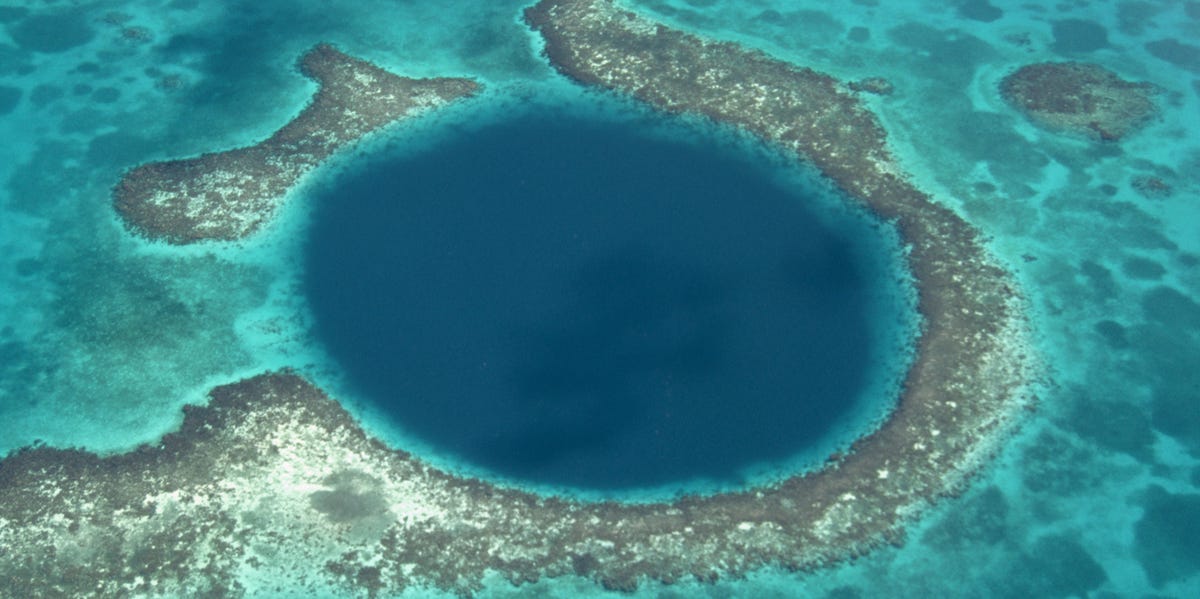

Some places on Earth practically beg for dramatic music. Volcanoes do it. Thunderstorms do it. A giant, dark opening in the seafloor does it without even trying. That is the appeal of a blue hole: a circular or irregular patch of deep navy water that looks as though someone forgot to finish coloring the ocean.
One of Florida’s most intriguing examples is the Green Banana Sink Hole, more commonly called the Green Banana blue hole. Located offshore in the Gulf of Mexico, it is a submerged geological feature with steep walls, unusual water chemistry, and a habit of making scientists say, “Well, that is interesting,” which is the research-world equivalent of yelling.
Blue holes are far more than scenic oddities. They are underwater archives, biological neighborhoods, groundwater clues, and geological time capsules. They can preserve sediments, fossils, microbes, and chemical records that help researchers understand ancient climates, changing sea levels, coastal ecosystems, and even the strange ways life survives where sunlight barely gets an invitation.
What Is a Blue Hole?
A blue hole is generally a water-filled sinkhole, cavern, or vertical shaft formed in soluble rock such as limestone. Many blue holes are found in shallow marine areas, especially around carbonate platforms, reefs, islands, and continental shelves. Others occur inland, where groundwater fills a collapsed cave system or a natural depression in limestone terrain.
The “blue” part is not because somebody poured food coloring into the water. It comes from depth, shadow, and contrast. Shallow water around a blue hole may look turquoise or greenish because sunlight reaches the sandy or rocky bottom. The hole itself absorbs more light and appears deep blue, navy, or nearly black. Nature is very good at branding.
Blue holes are often associated with karst landscapes. Karst forms where water slowly dissolves rocks such as limestone, dolomite, gypsum, or salt. Over long periods, rainwater and groundwater widen fractures in the rock, creating channels, caves, sinkholes, springs, and underground drainage systems.
When one of those underground cavities becomes too large to support the material above it, the roof may collapse. If that depression later fills with freshwater, seawater, or both, a blue hole can form. In short, it is geology’s version of a slow-motion remodeling project that has been running for thousands of years.
The Green Banana Blue Hole: Florida’s Deep Offshore Mystery
The Green Banana blue hole sits roughly 50 miles west of Sarasota, Florida, on the Gulf of Mexico continental shelf. Its rim is about 155 feet below the sea surface, while the bottom reaches roughly 425 feet deep. That makes it a serious underwater feature, not a place for casual sightseeing, spontaneous snorkeling, or someone who thinks a pool noodle counts as technical equipment.
Researchers describe Green Banana as having a challenging, partly hourglass-like shape. Rather than being a simple open shaft, the structure narrows and changes form with depth. That geometry makes scientific sampling more complicated because instruments, divers, and remotely deployed equipment must navigate a confined environment with limited visibility and changing water conditions.
The site became a focus of major scientific interest during Gulf blue-hole research expeditions involving NOAA-supported teams, Mote Marine Laboratory, Florida Atlantic University, the U.S. Geological Survey, Georgia Institute of Technology, and other collaborators. Scientists used specialized tools, including instrument platforms called benthic landers, to measure water chemistry, collect sediment samples, and study life inside and around the hole.
Green Banana is part of a wider cluster of submarine sinkholes and spring-like features scattered across Florida’s Gulf shelf. Nearby sites, including Amberjack Hole, have helped researchers compare how blue holes differ in oxygen levels, nutrient movement, microbial communities, and connections to surrounding seawater or groundwater systems.
How Do Blue Holes Form?
Step 1: Rainwater Begins Dissolving Limestone
The recipe begins with limestone, rainwater, time, and the kind of patience usually reserved for watching paint dry. Rainwater naturally absorbs carbon dioxide from the atmosphere and soil, becoming mildly acidic. As it moves through cracks in limestone, it slowly dissolves the rock.
Over centuries or millennia, tiny fractures can grow into passages, caves, and underground chambers. The process is not fast enough to watch from a lawn chair, but geologically speaking, it is remarkably efficient.
Step 2: Caverns Expand Beneath the Surface
As groundwater continues moving through the rock, the underground voids become larger. Water levels can rise and fall with rainfall, drought, tides, and sea-level changes. The repeated movement of water helps enlarge channels and reshape cave systems.
In places such as Florida and the Bahamas, limestone is common and often highly porous. That makes the landscape especially vulnerable to sinkholes, springs, caves, and other karst features. Much of the action happens underground, which is convenient for geology and mildly unsettling for anyone who likes their ground solid.
Step 3: The Roof Collapses or the Depression Opens
Eventually, the ceiling of an underground cavity may weaken and collapse. The result can be a sinkhole or a vertical opening to a deeper cave system. If rising sea levels flood the feature, the sinkhole becomes submerged and may develop into a marine blue hole.
Many offshore blue holes likely formed during periods when sea levels were lower than they are today. Land that is now beneath the ocean was once exposed or closer to the shoreline. Freshwater could then dissolve limestone and create caves before rising seas flooded the landscape.
Step 4: Water Chemistry Creates Layers
Once a blue hole fills with water, its chemistry can become surprisingly complex. Freshwater may sit above saltwater because it is less dense. In some holes, a transition zone forms where the two water types meet. This layer is called a halocline.
Below that, oxygen levels may decline sharply. Some blue holes contain hydrogen sulfide, a gas associated with low-oxygen environments and the unmistakable aroma of rotten eggs. It is not the sort of place where you would want to host a candlelit dinner, even if the view is spectacular.
Why Is Green Banana Important to Scientists?
Green Banana is scientifically valuable because it may reveal how water, nutrients, sediment, and microorganisms move through the Gulf of Mexico’s offshore karst systems. Researchers have found that the hole does not behave exactly like every other blue hole nearby.
At Green Banana, scientists detected hydrogen sulfide only intermittently in the water column, unlike at some other Gulf blue holes where sulfide-rich conditions can be more persistent. This suggests that the water inside Green Banana may periodically flush or mix with surrounding water.
That movement matters because the hole’s sediments can release nutrients. If those nutrients escape into nearby Gulf waters, they may influence the surrounding food web, microbial activity, or local water chemistry. Scientists are still studying these relationships, but blue holes may play a larger role in coastal ecosystems than their quiet, shadowy appearance suggests.
Researchers also observed unusual changes in chlorophyll-related signals near the bottom. In some observations, these signals increased rapidly after sunset and declined again after sunrise. One possible explanation is that tiny photosynthetic organisms or particles move through the water column in response to light, nutrients, or biological activity. It is a reminder that even dark underwater spaces can be surprisingly dynamic.
Blue Holes Are More Than Deep Holes in the Ocean
It is tempting to think of a blue hole as a dramatic underwater pit, full stop. But that description misses the good stuff. Blue holes can function as natural laboratories because their water layers, enclosed spaces, and sediment records preserve evidence that may be difficult to find elsewhere.
They Can Preserve Ancient Fossils
Inland blue holes in the Bahamas have produced remarkably preserved fossils of birds, reptiles, plants, and other animals. Low-oxygen conditions at depth can slow decomposition and reduce disturbance from scavengers. That means bones, seeds, pollen, and other materials may survive long enough to provide clues about extinct species and prehistoric ecosystems.
For scientists studying island history, blue holes can be like a basement archive that nobody cleaned out for 10,000 years. They hold evidence of animals that lived before major environmental changes and before human activity reshaped local habitats.
They Record Storms and Sea-Level Change
Sediments at the bottom of blue holes can contain layers deposited by powerful storms. In some Caribbean locations, researchers have used these sediment records to study hurricane activity across centuries. The layers can help reveal when severe storms occurred long before weather satellites, radar maps, and people yelling at their phones about a hurricane tracker.
Blue holes may also preserve evidence of changing sea levels. Since many formed when coastlines and water tables were different, their shape, sediments, and mineral deposits can help scientists reconstruct past landscapes.
They Host Specialized Microbial Communities
Some blue holes contain environments with little oxygen, sharp chemical boundaries, and unusual sources of energy. These conditions support microbial communities that may differ significantly from those in normal surface waters.
Microbes in low-light or oxygen-poor environments can use chemical processes instead of photosynthesis to survive. Studying them helps researchers understand how life adapts to extreme conditions on Earth and may offer clues about where life could exist in other watery environments beyond our planet.
Blue Holes vs. Cenotes vs. Ordinary Sinkholes
These terms are related, but they are not always interchangeable.
Blue Holes
Blue holes are usually water-filled karst features with steep sides and deep, dark water. They may be inland, coastal, or offshore. Their water can be freshwater, saltwater, or a mixture of both.
Cenotes
Cenotes are water-filled limestone sinkholes commonly associated with Mexico’s Yucatán Peninsula. Many cenotes are connected to underground cave networks and often contain freshwater. Some are open to the sky, while others are partly enclosed.
The difference is partly geographic and cultural. A cenote is a specific regional term, while “blue hole” is often used for deep, visually striking water-filled holes, especially in marine or island environments.
Ordinary Sinkholes
A sinkhole is a broader term for a depression or collapse in the ground caused by underground erosion, dissolving rock, or structural failure. It may be dry, muddy, shallow, deep, urban, rural, natural, or caused partly by human activity.
A blue hole is essentially a sinkhole with water, depth, and enough visual drama to deserve its own documentary trailer.
Are Blue Holes Dangerous?
Blue holes can be hazardous because they may involve great depth, low visibility, narrow passages, strong changes in water chemistry, overhead cave sections, and limited opportunities to surface directly. They are not beginner dive sites, and they should never be treated like a scenic swimming pool with better lighting.
For scientists, exploration requires careful planning, specialized gear, trained teams, communication systems, and remote instruments. For visitors, the safest and most rewarding approach is to enjoy blue holes from approved viewing areas, guided tours, documentaries, museum exhibits, research videos, or public education programs.
The mystery is part of the appeal. You do not have to enter a deep underwater cave to appreciate the fact that Earth is still full of places that are strange, beautiful, and only partly understood.
What the Green Banana Blue Hole Teaches Us
The Green Banana Sink Hole is a useful reminder that Florida’s natural world is not limited to beaches, mangroves, springs, and theme parks. Beneath the Gulf of Mexico lies a hidden karst landscape shaped by ancient freshwater, shifting sea levels, dissolved limestone, and time on an almost unimaginable scale.
Green Banana also shows why ocean exploration matters. A deep hole in the seafloor can reveal how nutrients move, how microbes survive, how ecosystems connect, and how past environments became the coastlines we know today. It is a natural puzzle box with no instruction manual, except perhaps: “Please do not drop your sandwich in here.”
Blue holes are beautiful because they look mysterious. They are important because they actually are mysterious. Every sediment sample, water measurement, and carefully recorded observation adds another piece to the story of how land, water, life, and climate interact beneath the surface.
Experiencing the Wonder of Blue Holes Without Becoming Part of the Research Equipment
The first experience most people have with a blue hole is visual. You see a photograph of bright turquoise water interrupted by an enormous navy circle, and your brain immediately starts asking unhelpful questions such as, “What is down there?” and “Could a sea monster afford property taxes?” The visual contrast is so dramatic that blue holes often look edited, even when they are completely natural.
Green Banana is different from famous shore-accessible blue holes because it lies offshore in the Gulf of Mexico. That means the experience is less about walking to the edge and more about understanding the hidden geography beneath the water. From the surface, the Gulf can appear calm and endless. Below it, however, are limestone formations, springs, ledges, caves, and sinkholes shaped over thousands of years.
For people interested in the topic, one of the best experiences is following the science. Bathymetric maps, underwater videos, sediment diagrams, and expedition updates make the invisible landscape easier to imagine. A map can show the shelf as a broad, gentle plain, then suddenly reveal a dark depression plunging far below the surrounding seafloor. It feels a bit like discovering that your backyard has a secret basement, except the basement is underwater and older than most human civilizations.
Florida’s coastal museums, aquariums, marine science programs, and educational exhibits can also help visitors connect blue holes to bigger environmental ideas. Learning about karst geology makes springs, caves, sinkholes, groundwater, and offshore habitats feel like parts of the same system rather than unrelated trivia questions.
A visit to the Florida coast can make the story more tangible. Standing near Sarasota’s shoreline, you might see sunlight glittering across ordinary-looking Gulf water. It is strange to realize that far offshore, deep beneath that surface, Green Banana sits in darkness. It is not visible from the beach, but the idea changes how you look at the ocean. The Gulf stops being a flat blue backdrop and becomes a layered world with secrets below.
Nature documentaries and research footage can be equally powerful. Watching divers or scientific instruments descend into a blue hole gives viewers a sense of scale that photographs cannot always provide. The light fades. The walls become steeper. The water darkens. Every movement becomes slower and more deliberate. It is less like swimming in a pool and more like entering a geological cathedral with extremely strict safety rules.
Blue holes also make excellent conversation starters for students, travelers, families, and anyone tired of discussing the weather. They connect chemistry, geology, biology, climate history, and exploration in one spectacular feature. You can begin with a simple question“Why is that water so dark?”and end up discussing ancient sea levels, fossilized birds, nutrient cycling, and microbial ecosystems.
The most meaningful experience may be realizing how much remains unknown. We live in an age of satellite maps, smartphones, and navigation apps that complain if we miss one exit. Yet beneath familiar coastal waters are environments that scientists are still working to understand. Green Banana proves that mystery has not disappeared from the modern world. It has simply gone underwater.
Final Thoughts
The Green Banana blue hole is one of Florida’s most fascinating underwater sinkholes, combining deep geology, unusual chemistry, and ecological mystery in one shadowy Gulf of Mexico landmark. Blue holes form through the slow dissolution and collapse of limestone, often followed by flooding as groundwater or seawater fills the opening.
Whether they preserve ancient fossils, record major storms, support unusual microbes, or reveal the hidden plumbing of coastal aquifers, blue holes deserve attention. Green Banana may not look like much from the ocean surface, but below that surface is a world shaped by water, rock, time, and a little bit of scientific curiosity.


