Damaged Film Repair – How Archivists Saved Damaged WWII Film for ‘The Cold Blue’

Old film does not politely grow old. It shrinks, warps, cracks, smells like vinegar, loses moisture, scratches easily, and occasionally behaves like a dramatic actor refusing to leave its trailer. Yet inside those fragile strips of celluloid can live history no textbook can fully recreate. That is exactly what happened with the damaged World War II film behind The Cold Blue, Erik Nelson’s documentary built from restored footage originally shot by legendary Hollywood director William Wyler for Memphis Belle: A Story of a Flying Fortress.
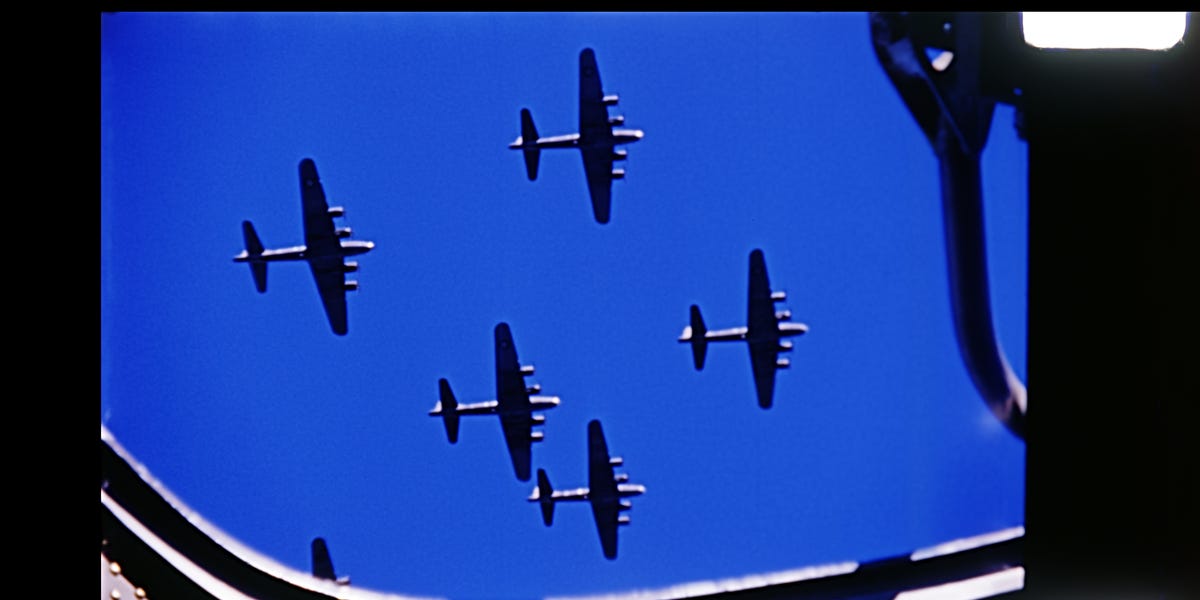
The story is part film restoration thriller, part aviation history, and part reminder that archives are not dusty retirement homes for forgotten objects. They are rescue stations. In this case, archivists and filmmakers helped bring back vivid 16mm Kodachrome footage of B-17 Flying Fortress crews flying combat missions over Europe in 1943. The result was not just a cleaner picture. It was a renewed emotional connection to the men of the Eighth Air Force, the danger they faced, and the young faces hidden for decades inside damaged film.
Why This WWII Film Mattered So Much
William Wyler was not a small name with a camera and a dream. Before World War II, he had already become one of Hollywood’s major directors, and after the war he would go on to direct classics such as The Best Years of Our Lives, Roman Holiday, and Ben-Hur. During the war, however, Wyler served with the U.S. Army Air Forces and took cameras into a place where no director could yell “cut” when things got uncomfortable: actual combat.
In 1943, Wyler and his camera crews flew aboard B-17 bombers with the Eighth Air Force. They filmed missions, airmen, aircraft, contrails, flak, base life, and the eerie beauty of blue skies filled with machines designed for destruction. The footage was used in the 1944 documentary Memphis Belle: A Story of a Flying Fortress, which helped make the aircraft and crew famous in American memory.
The cost of capturing those images was real. One of Wyler’s cinematographers, Harold Tannenbaum, was killed when his plane was shot down during filming. That fact hangs over The Cold Blue like a shadow behind the restored color. This was not “behind-the-scenes” footage in the modern bonus-feature sense. This was front-line visual testimony.
The Problem: Beautiful Kodachrome, Fragile Film
The original footage survived in the vaults of the National Archives, but survival is not the same as health. Film is a physical object, and physical objects age. The 16mm Kodachrome still held remarkable color, which is one reason the restored images look so startlingly alive. But the film stock had also lost moisture and pliability over time. It had shrunk, and shrinkage is one of the great villains of damaged film repair.
When motion picture film shrinks, its sprocket holes no longer align properly with the teeth of traditional film equipment. Imagine trying to button a shirt after every buttonhole has moved slightly to the left. Now imagine the shirt is irreplaceable WWII footage, and the buttons are spinning machinery. Suddenly, the phrase “handle with care” feels a little underpowered.
Why Film Shrinkage Is So Dangerous
Film shrinkage affects registration, stability, scanning, printing, and transport. If archivists attempt to run shrunken film through equipment that grips it too aggressively, the film can tear or suffer new perforation damage. In severe cases, old film cannot be safely copied through traditional photochemical methods because the sprocket pitch no longer matches the machinery.
For the Memphis Belle outtakes used in The Cold Blue, the shrinkage was serious enough that the preservation team needed a digital path rather than relying on older copying methods. This is one reason damaged film repair is rarely a magical “before and after” button. It is more like surgery, data science, and patience all wearing white gloves.
Step One: Inspecting and Respecting the Original
Before old film is scanned, archivists need to understand what they are dealing with. That means identifying the film base, checking shrinkage, looking for warping, examining perforations, noting scratches or broken splices, and determining whether the film can safely move through a scanner. A careless inspection can turn a preservation project into a confetti machine, and nobody wants confetti made from historical evidence.
General film preservation guidance emphasizes clean handling, nitrile gloves, dust control, and avoiding contact with the emulsion. Archivists must treat the film not as an obsolete recording format, but as an artifact. The image, the edge markings, the sprocket holes, and even the damage can contain useful information.
Step Two: Slow 4K Scanning at the National Archives
The National Archives Motion Picture Preservation Lab scanned the original Kodachrome footage in 4K resolution. Because the film had shrunk and was vulnerable to damage, the team used careful handling and slow scanning speeds. This was not a “run it through and grab lunch” job. The scanning process took about 80 hours and produced more than 80 terabytes of data.
That number matters. High-quality film restoration creates enormous digital files because the goal is not simply to make a watchable video. It is to capture as much image information as possible for preservation, restoration, and future access. Each frame becomes part of a long digital chain of custody. The original film is still the artifact, but the digital scan becomes the working preservation master.
Why Overscanning Helped
Overscanning means capturing more than just the picture area. In film preservation, this can include sprocket holes, edge codes, frame lines, and damaged edges. For The Cold Blue, overscanning helped preserve technical context and gave restoration artists more information to stabilize and understand the footage. The edge of the film may not be glamorous, but in archival work, even the “boring” parts can be witnesses.
Step Three: Digital Cleaning Without Erasing History
Once the scans existed, the restoration work could address scratches, dirt, dust, instability, fading, and other visual problems. But film restoration is not the same as making old footage look like it was shot yesterday on a smartphone. That would be dishonest, and frankly, a little weird. The goal is to restore clarity while preserving the character of the original material.
In The Cold Blue, the restoration needed to make the B-17 footage legible, immersive, and emotionally immediate without sanding away its historical texture. Scratches and dirt could be reduced. Color could be corrected. Movement could be stabilized. But the images still had to feel like Wyler’s wartime footage, not a glossy theme-park simulation of World War II.
Color Correction: Bringing Back the Cold Blue Sky
Kodachrome is famous for color, and the restored footage shows why. The blue skies, bomber interiors, faces, uniforms, and metal aircraft skin give viewers a sense of presence that black-and-white newsreels often cannot. Color does not automatically make history more truthful, but it can make it feel less distant. A young gunner in color looks less like a statue in the museum of the past and more like someone who might have borrowed your jacket last week.
That is one of the great achievements of The Cold Blue. The damaged film repair process did not merely clean images. It reduced the emotional distance between modern viewers and the airmen who flew missions in freezing, unpressurized aircraft while anti-aircraft fire filled the sky.
Step Four: Rebuilding Sound for Silent Footage
Wyler’s original combat footage was shot without synchronized production audio. That created a major challenge for Erik Nelson and his team. A modern audience expects a documentary to breathe, rumble, roar, and shake. Silent aircraft footage can be beautiful, but the experience of flying in a B-17 was anything but quiet.
To solve this, the filmmakers reconstructed the sound world of the footage. They used aircraft sounds, careful sound design, interviews with surviving veterans, and an original orchestral score. The result gives the restored images a physical presence. Engines drone, guns rattle, wind presses against metal, and the viewer feels the machinery instead of simply observing it.
Step Five: Letting Veterans Carry the Story
The Cold Blue features interviews with nine surviving members of the Eighth Air Force. Their voices guide the viewer through what the footage cannot explain on its own: fear, cold, routine, boredom, danger, loss, memory, and the strange calm that can appear in men describing experiences that would make most of us spill coffee on ourselves just hearing about them.
This is where archival film restoration becomes more than technical craft. A sharp 4K scan is impressive, but the restored footage becomes truly powerful when paired with human memory. The veterans explain what it meant to fly in aircraft that were not pressurized or heated, to face extreme cold, and to know that every mission might be the last. The repaired film gives us the faces. The interviews give us the weight behind them.
What Archivists Actually Saved
Archivists did not simply save “old footage.” They saved visual evidence of aircraft, procedures, clothing, crew behavior, base operations, wartime filmmaking, and the emotional atmosphere of the air war over Europe. They also saved Wyler’s eye. Even under military conditions, his footage has composition, movement, and visual intelligence. He was not just recording planes; he was shaping a story out of danger.
The restored material also helped renew interest in Memphis Belle itself. Nelson’s project involved both creating The Cold Blue from the outtakes and restoring the earlier documentary. That makes the project unusual: it preserved a classic documentary while also creating a new documentary from the same historical source material.
Why Damaged Film Repair Is Not Just Digitization
A common myth says that once old film is scanned, preservation is finished. Not quite. Digitization is a major step, but true preservation includes inspection, metadata, storage, quality control, backups, file validation, and long-term digital management. Digital files can fail too. Hard drives die. Formats age. Systems change. The cloud is not a heavenly archive guarded by angels with RAID arrays.
For major preservation work, archives create multiple copies and store them in separate locations. They use digital packaging and validation tools to make sure files remain intact over time. The original film may also return to cold storage, where low temperatures slow further deterioration. In the case of the Memphis Belle footage, preservation involved both the physical reels and the massive digital files created from them.
Lessons From The Cold Blue Restoration
1. Start Before the Film Becomes Unscannable
Damaged film repair becomes harder as deterioration progresses. Shrinkage, brittleness, warping, mold, vinegar syndrome, and emulsion damage can eventually make film impossible to safely scan. The earlier archivists act, the better the chance of saving the image.
2. Use the Gentlest Technology Available
The restoration of The Cold Blue relied on careful scanning designed to reduce stress on shrunken film. For fragile material, speed is the enemy. Slow scanning may take longer, but history is not a drive-through order.
3. Preserve More Than the Pretty Picture
Overscanning, metadata, edge information, and documentation all matter. A restoration should not only produce a beautiful viewing copy; it should preserve evidence for future researchers, historians, and archivists.
4. Restoration Requires Taste
Too little repair leaves the image hard to watch. Too much repair can make it artificial. The best restoration work respects the original source while improving access. It cleans the window; it does not repaint the landscape.
Experience Section: What Working With Damaged Film Teaches Us
One of the most important experiences related to damaged film repair is learning that fragile media demands humility. When a reel of old film comes out of a can, it does not care about deadlines, budgets, or how emotionally excited everyone is to see what is on it. The film sets the rules. If it is curled, it must be relaxed carefully. If it is shrunken, equipment must adapt to it. If it smells like vinegar, the warning is not subtle. Old film is basically saying, “I am not well, and I may ruin your afternoon.”
The Cold Blue project is a perfect example of why patience matters. The footage was historically priceless, but that did not make it physically stronger. Archivists had to move slowly, inspect carefully, and use tools that would not tear the film apart. This is a useful lesson for anyone handling family movies, institutional archives, military footage, or old documentary reels: never assume that because a film looks intact, it can be projected. Projection can be brutal. A scanner designed for fragile material is usually safer than a projector built for normal playback.
Another experience from film repair is discovering that damage tells a story too. Scratches may reveal heavy use. Splices may show how footage was edited. Edge codes can help identify film stock and date material. Even shrinkage can tell archivists about the film’s storage history and chemical condition. The instinct may be to think of damage only as a problem, but archivists often read damage as evidence before they attempt to reduce its visual impact.
There is also an emotional experience that comes with restored footage. When damaged images become clear again, the past can feel surprisingly close. In The Cold Blue, restored faces of young airmen appear with startling immediacy. They are not abstract “WWII heroes” frozen in patriotic language. They are tired, young, nervous, funny, brave, ordinary, and extraordinary all at once. Repairing the film repairs a channel of empathy.
For viewers, the experience is almost time travel, minus the usual science-fiction problems of accidentally becoming your own grandfather. The restored footage lets us see color, movement, and atmosphere that were always present but hidden behind decay and technical limitation. For archivists, that is the reward: not just a clean image, but a recovered encounter.
The practical takeaway is simple. If you have old film, do not wait until it is brittle, warped, or fused into a sad little hockey puck. Store it in a cool, dry place. Avoid projecting it casually. Handle it by the edges with clean gloves. Label it accurately. Consult a preservation professional before attempting repair. The past can survive, but it appreciates good manners.
Conclusion
The damaged film repair behind The Cold Blue shows what happens when archival science, documentary storytelling, and historical responsibility work together. William Wyler’s WWII footage could have remained locked away as fragile, shrunken reels known mainly to specialists. Instead, archivists at the National Archives and filmmakers led by Erik Nelson transformed it into a vivid 4K restoration that allows modern audiences to see the Eighth Air Force with new clarity.
This was not just a technical achievement. It was an act of cultural memory. The careful scanning, digital restoration, sound reconstruction, veteran interviews, and long-term preservation planning turned damaged film into living testimony. In a world that often treats old media as disposable, The Cold Blue proves that damaged film can still carry thunder, grief, beauty, and truthprovided someone cares enough to save it before the reels go silent forever.


