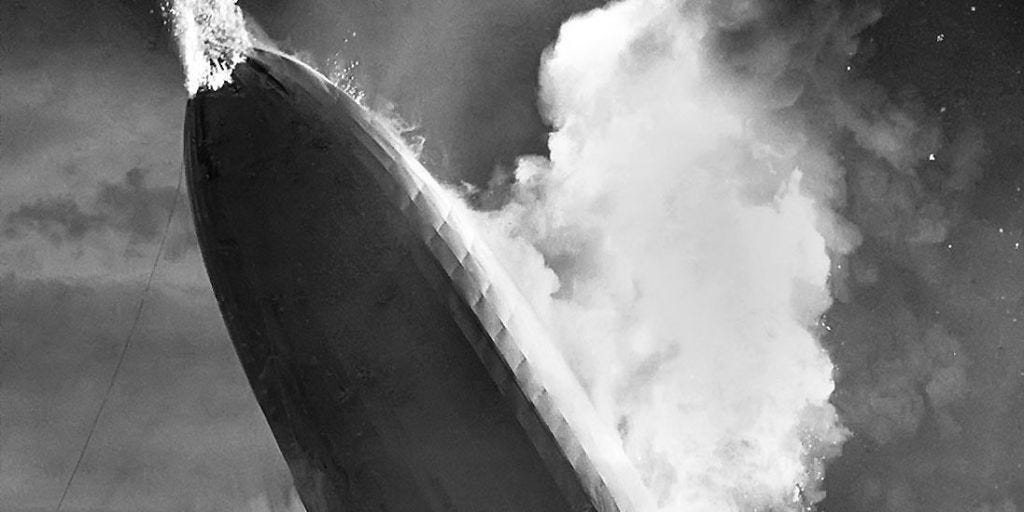

The Hindenburg disaster is one of those historical events that feels frozen in a single terrible image: a massive silver airship, once the pride of luxury aviation, suddenly swallowed by fire above Lakehurst, New Jersey. It happened on May 6, 1937, during what should have been a routine landing. Instead, the German passenger airship LZ 129 Hindenburg burned and crashed in less than a minute, killing 35 people aboard and one member of the ground crew.
Nearly nine decades later, the basic outline is clear. The Hindenburg was filled with hydrogen. It was attempting to moor after a stormy approach. A fire began near the stern. Newsreel cameras captured the horror. Reporter Herbert Morrison’s emotional broadcast turned the accident into one of the first modern media disasters. Yet the deeper question still refuses to sit quietly in its historical chair: what exactly caused the Hindenburg to ignite?
That mystery is why the Hindenburg disaster remains so fascinating. It is not simply a story about a machine that failed. It is a story about weather, engineering, politics, public trust, media shock, and human decision-making under pressure. In other words, history brought receiptsand then left a few pages missing.
What Happened at Lakehurst?
The Hindenburg had departed Frankfurt, Germany, on May 3, 1937, bound for Naval Air Station Lakehurst in New Jersey. It was an enormous rigid airship, about 804 feet long, designed to carry passengers across the Atlantic in comfort. Compared with the noisy, cramped airplanes of the time, the Hindenburg was practically a floating hotel. Passengers could dine, stroll, sleep in cabins, and look down at the ocean as if the Atlantic had politely agreed to become scenery.
On May 6, the airship arrived near Lakehurst behind schedule. Thunderstorms in the area delayed its landing, and Captain Max Pruss maneuvered while waiting for safer conditions. When the weather appeared to improve, the Hindenburg began its final approach. Ground crews prepared to catch the landing lines. Then, at roughly 7:25 p.m. local time, eyewitnesses saw fire near the upper rear section of the ship. Within seconds, flames raced forward. The stern dropped. The bow rose briefly. Then the airship collapsed to the ground.
The disaster unfolded so quickly that many survivors escaped only by jumping, falling, or scrambling from the wreckage at exactly the right moment. The fact that 62 of the 97 people aboard survived is remarkable, considering the scale of the fire. The Hindenburg looked invincible from a distance, but once it burned, its grandeur disappeared with brutal speed.
Why Was the Hindenburg Filled With Hydrogen?
One of the biggest questions people ask is painfully obvious: why fill a passenger airship with hydrogen, a gas famous for being extremely flammable? The short answer is that helium, the safer alternative, was difficult for Germany to obtain. The United States controlled much of the world’s helium supply and restricted exports, especially to Nazi Germany. As a result, the Hindenburg used hydrogen, which provided excellent lift but came with a dangerous personality. Hydrogen is like the guest who brings great snacks to the party but also lights fireworks indoors.
Technically, hydrogen had been used successfully in airships before. German zeppelins had crossed oceans and logged many flights without bursting into flames. Engineers understood the risks and built procedures around them. But the Hindenburg disaster showed that “managed risk” can become “catastrophe” when enough small factors line up in the wrong order.
The Most Accepted Theory: Hydrogen, a Leak, and a Spark
The leading explanation is that hydrogen leaked from one or more gas cells and mixed with air, creating a flammable mixture. Then an electrical dischargepossibly static electricity from the stormy atmosphere or from differences in charge between the airship’s outer skin and its frameignited the gas. Once the hydrogen caught fire, the flames spread rapidly through the structure.
This theory fits many known details. The Hindenburg had flown through unsettled weather. It was approaching after storms had passed through the area. Its landing lines may have helped equalize electrical charge once they touched the wet ground. Some witnesses reported seeing fluttering fabric near the upper rear section, suggesting escaping gas. The fire also appears to have started near the stern, where trim issues had been noticed before the disaster.
Still, “most accepted” does not mean “perfectly proven.” No one recovered a neat little sign reading, “Hello, I am the spark.” Investigators had to work from witness accounts, photographs, wreckage, and engineering logic. That leaves room for debate.
Question One: Where Did the Hydrogen Leak Come From?
If leaking hydrogen was part of the cause, the next question is where the leak began. One possibility is that a bracing wire snapped and tore a gas cell. The Hindenburg made sharp turns during its approach, and some historians have argued that stress on the frame could have damaged internal components. If a wire broke, it might have sliced into a hydrogen cell like a very expensive can opener.
Another possibility is a valve problem. Airships used valves to release gas when needed, and a stuck or improperly functioning valve could have allowed hydrogen to escape. However, evidence for a specific valve failure is not conclusive. Crew reports and instrument readings did not provide a simple answer.
This is one reason the Hindenburg disaster remains open to analysis. We can identify likely mechanisms, but the exact first failure remains uncertain. The leak theory is strong, but the source of that leak still wears a historical trench coat and refuses to give its name.
Question Two: What Created the Spark?
The spark is another unresolved piece. The Hindenburg was landing in an electrically active environment after thunderstorms. Static electricity could have built up on the airship’s skin. When the landing lines dropped and contacted the ground, the electrical conditions may have changed quickly enough to produce a discharge.
Some explanations point to “brush discharge,” a type of electrical phenomenon that can occur when a strong electric field forms around a surface. Others suggest that differences between the charge on the metal frame and the outer covering could have created the conditions for a spark. In modern terms, the ship may have become a giant flying science experiment at exactly the wrong time. Unfortunately, nobody wants their passenger vehicle to become a physics demonstration.
Lightning itself has also been discussed, though most serious explanations favor static discharge rather than a direct lightning strike. The key point is that the atmosphere, the wet landing lines, the airship’s structure, and escaping hydrogen may have interacted in a dangerous sequence.
Question Three: Did the Outer Skin Make the Fire Worse?
One of the more debated ideas is the “incendiary paint” or covering theory. The Hindenburg’s outer fabric was coated with materials designed to protect it from weather and sunlight. Some researchers have argued that these coatings may have helped the fire spread. The theory became especially popular because the coating contained compounds that sounded alarmingly similar to ingredients used in energetic materials. History loves a dramatic plot twist, and “the airship was painted with rocket fuel” is definitely a headline with strong coffee energy.
However, many airship historians and technical analysts caution against overstating this idea. The strongest evidence still points to hydrogen as the main fuel behind the disaster. Photographs and film suggest the fire moved in ways consistent with burning gas cells rather than a uniform surface fire across the skin. That does not mean the covering played no role. It may have contributed to flame spread once ignition occurred. But most experts do not treat the paint theory as a full replacement for the hydrogen ignition explanation.
Question Four: Was Sabotage Involved?
Sabotage was discussed almost immediately after the disaster. In 1937, the Hindenburg was not just a passenger aircraft; it was also a symbol of German technological power during the Nazi era. Its tail fins carried swastikas. Political tensions were high. Some officials and observers wondered whether an anti-Nazi saboteur might have planted a device or otherwise caused the fire.
The sabotage theory has never completely disappeared, partly because it has all the ingredients of a gripping thriller: politics, a famous machine, a dramatic explosion, and incomplete evidence. But official investigations did not prove sabotage. No confirmed bomb, timer, or deliberate ignition device explained the disaster. Over time, the accident theory involving hydrogen and electrical ignition has remained more persuasive.
That said, the persistence of sabotage theories reveals something important about the Hindenburg disaster. When a public tragedy is shocking enough, people often look for intention behind it. Randomness feels unsatisfying. A hidden villain is easier to understand than a chain of technical and environmental failures. But history does not always provide a villain. Sometimes it provides a checklist of bad luck and asks us to learn from it.
The Role of Weather and Human Decision-Making
The weather at Lakehurst mattered. Storms had delayed the landing, and the airship approached in damp, unstable conditions. The crew also faced pressure. The Hindenburg was behind schedule, passengers were waiting, ground crews were prepared, and the return flight to Europe was expected to be full. None of that proves negligence, but it does show how operational pressure can shape decisions.
Large disasters rarely come from one cause alone. They often come from stacked causes: a weather delay, a rushed approach, a vulnerable gas system, static electricity, limited visibility into internal damage, and procedures that may not have fully accounted for every risk. The Hindenburg disaster is a classic reminder that safety depends on systems, not just skill.
Why the Hindenburg Disaster Ended the Airship Era
Airship travel did not vanish only because the Hindenburg burned. Passenger airplanes were already improving. Heavier-than-air aircraft were becoming faster, more practical, and increasingly reliable. But the Hindenburg disaster destroyed public confidence in giant passenger airships almost overnight. The images were too powerful. Once people saw a luxurious airship turn into a fireball, selling tickets on another one became a marketing challenge roughly equal to selling sunscreen on the moon.
The disaster also arrived at a turning point in global history. Europe was moving toward war. Nazi Germany’s image made the Hindenburg politically charged. Aviation technology was evolving quickly. The crash became more than an accident; it became a symbol of an era ending in flames.
Why So Many Questions Still Remain
The Hindenburg disaster remains unresolved in part because the evidence was destroyed by the very event investigators needed to study. The fire consumed much of the airship. Witnesses saw different things from different angles. Newsreel footage captured the disaster, but not the invisible buildup of gas or the precise first spark. Instruments from the time were limited compared with modern flight data recorders. There was no black box quietly recording every system detail like a very serious diary.
Modern researchers can test materials, study photographs, model electrical behavior, and compare witness statements. These methods help narrow the possibilities. They do not erase uncertainty. The best explanation remains a chain reaction involving hydrogen leakage and electrical ignition, but questions remain about the exact leak source, the exact ignition point, and how much the covering contributed to the speed of the fire.
Lessons From the Hindenburg Disaster
The first lesson is that innovation and risk travel together. The Hindenburg was not a foolish machine. It was an advanced aircraft for its time, built by experienced engineers. But advanced technology can still fail when its weaknesses meet the wrong conditions.
The second lesson is that public perception matters. The Hindenburg disaster was filmed, photographed, and broadcast in a way that made it unforgettable. The crash became not just a tragedy but a shared media experience. It showed the world that modern transportation disasters could unfold in front of cameras and become permanent cultural memory.
The third lesson is that uncertainty does not make history weaker. In fact, uncertainty can make history more useful. When we do not know every answer, we keep asking better questions. The Hindenburg disaster teaches engineers, historians, pilots, and ordinary readers to examine systems carefully, respect dangerous materials, and never assume that elegance equals safety.
Experience: What It Feels Like to Study the Hindenburg Today
Learning about the Hindenburg disaster today is a strange experience because it mixes awe with dread. At first, the airship seems almost magical. It was huge, graceful, and ambitious. It represented a version of air travel that feels wildly different from modern airports, where the main luxury is finding an outlet near your gate. The Hindenburg promised comfort, space, and a slower, almost theatrical crossing of the Atlantic. It was not just transportation; it was an event.
Then the story turns. You watch the footage or study the photographs, and the scale of the tragedy becomes immediate. The airship does not simply burn; it transforms from a symbol of human achievement into a warning. That emotional whiplash is part of why the disaster stays with people. It reminds us that technology can inspire confidence right up until the moment it demands humility.
For readers, writers, and history lovers, the Hindenburg also creates an investigative experience. You start with one questionwhy did it burn?and suddenly you are deep in hydrogen chemistry, airship design, storm conditions, international politics, eyewitness psychology, and media history. The topic opens like a set of nesting boxes. Every answer contains another question. Was the stern heavy because gas was leaking? Did a wire break? Did the landing lines change the electrical charge? Did the fabric coating matter? Why did so many people survive? Why did the disaster become more famous than other aviation accidents with larger death tolls?
That last question is especially important. The Hindenburg disaster became legendary not only because of what happened, but because of how the world saw it happen. The cameras were there. The recording existed. The emotional narration gave the event a human voice. In a modern media environment, we are used to disasters being documented instantly. In 1937, that kind of recorded shock was still new. The Hindenburg helped create the template for the televised and replayed catastrophe.
Studying the disaster can also change how we think about safety. It is easy to look backward and say, “They should have known.” But the harder and more useful response is to ask what risks we normalize today because they seem manageable, profitable, or familiar. The people who built and operated the Hindenburg were not cartoon villains twirling mustaches beside a hydrogen tank. They were professionals working within the technology, politics, and assumptions of their time. That makes the lesson more serious, not less.
The Hindenburg disaster remains powerful because it is not fully closed. It asks us to live with uncertainty while still respecting evidence. It encourages curiosity without rewarding wild speculation. Most of all, it reminds us that progress should always bring a safety checklist along for the ride. Preferably one that is not flammable.
Conclusion
Many questions remain about the Hindenburg disaster because the accident sits at the crossroads of evidence and mystery. The most accepted explanation points to leaking hydrogen ignited by an electrical discharge during a stormy landing. Yet the exact leak, the exact spark, and the precise role of the airship’s outer covering remain debated. That uncertainty is not a weakness in the story; it is the reason the story still matters.
The Hindenburg was a marvel of its age, but its destruction showed how quickly confidence can collapse when technology, weather, pressure, and risk converge. Its legacy is not only one of tragedy. It is also a lesson in engineering humility, media power, and the importance of asking uncomfortable questions before disaster supplies the answers.
Note: This article is written for web publication and is based on synthesized historical and technical information from reputable references. Source links are intentionally not inserted into the article body.


