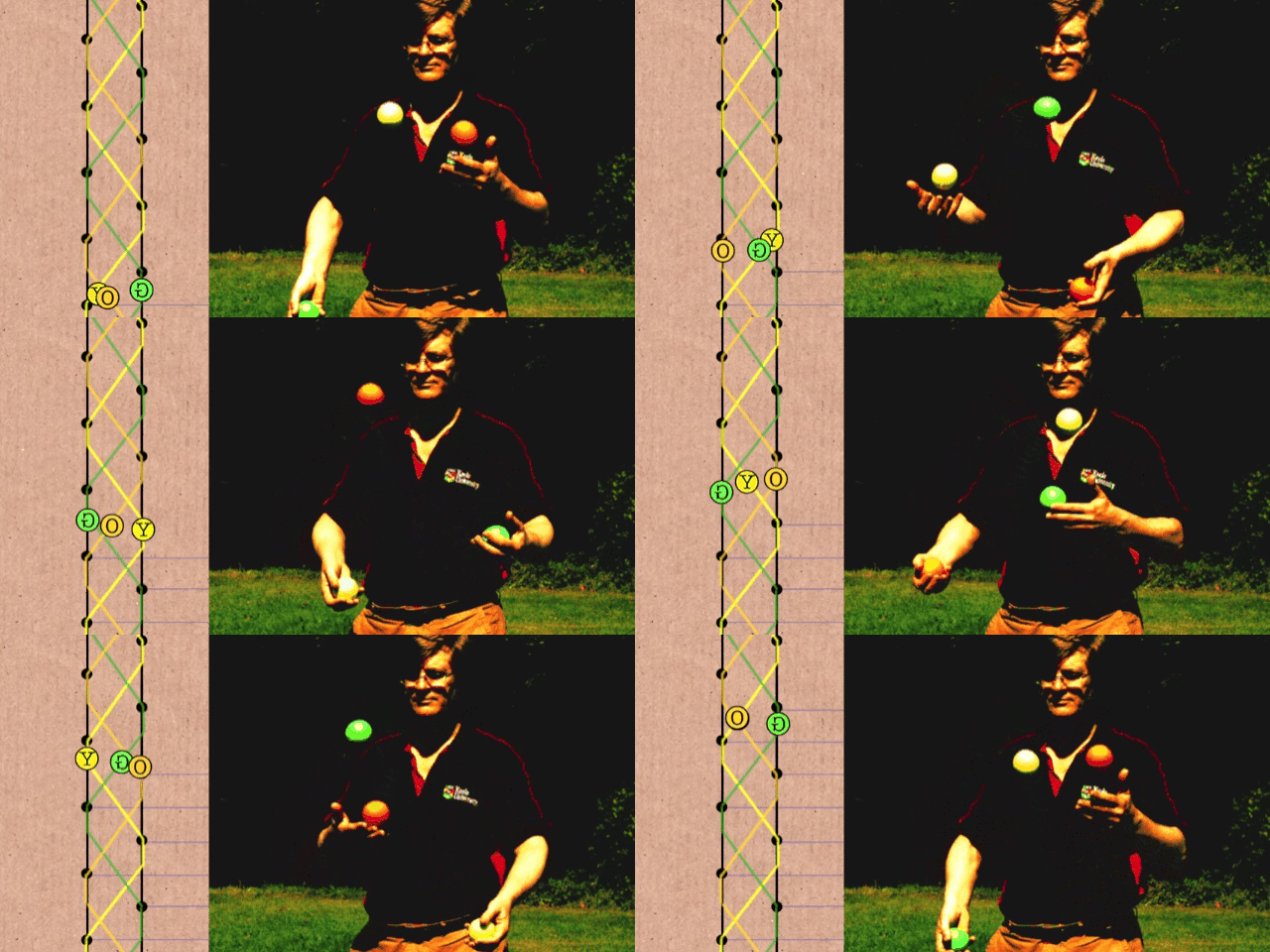

At first glance, juggling looks like a charming argument between a person and gravity. Three balls go up, three balls come down, and somehow nobody gets bonked on the nose. But behind every smooth cascade is a surprisingly rich world of mathematics: parabolas, timing ratios, combinatorics, pattern notation, state graphs, feedback control, and enough hidden structure to make a math professor quietly cancel dinner plans.
The complex math behind juggling is not just a cute party fact. It helps explain why a three-ball cascade feels natural, why five balls suddenly feel like a personal insult, why some patterns are valid while others collapse instantly, and why robots still have a harder time tossing objects than a determined beginner with beanbags and patience. Juggling is physical, rhythmic, visual, and artisticbut it is also a live demonstration of applied mathematics in motion.
Why Juggling Is a Math Problem Wearing a Circus Hat
Juggling is built on a simple requirement: every object must be in the right place at the right time. That sounds easy until you remember that each object is flying through space, each hand is following its own rhythm, and the whole system repeats without crashing. In math language, juggling is a periodic system. A pattern repeats after a certain number of beats, and each throw must fit into that cycle.
When a juggler performs a basic three-ball cascade, the balls are not being tracked one by one in a panic. The juggler learns the pattern as a rhythm. The hands alternate. The throws reach similar heights. The catches happen where the hands already expect them. This is why good juggling looks relaxed: the math has become muscle memory.
That rhythm is what allows juggling to be translated into equations and notation. Once you treat each throw as a timed event, the whole pattern becomes a sequence. Once it becomes a sequence, mathematicians naturally ask: Which sequences work? How many patterns are possible? How high must a ball be thrown? How much error can a juggler survive before the pattern falls apart like a group project with no leader?
The Physics of the Throw: Parabolas Everywhere
Every toss in ordinary juggling is a small projectile-motion problem. After the ball leaves the hand, gravity pulls it downward while its horizontal motion continues. Ignoring air resistance, the path forms a parabola. That means a juggling ball is not wandering randomly through the air; it is following a predictable curve determined by launch speed, launch angle, height, and gravity.
This is why beginners are often told to throw to a consistent height. If the throw is too low, the next hand is not ready. If it is too high, the rhythm stretches awkwardly. If it flies forward, the juggler starts chasing the pattern across the room, which is less “mathematical elegance” and more “emergency furniture avoidance.”
The height of a throw matters because time in the air is connected to vertical speed. A higher throw gives the juggler more time, but it also increases the distance the ball travels and makes accuracy harder. For a throw caught at roughly the same height it was released, the flight time depends on the upward velocity and gravity. More time requires more height, and height grows quickly. That is one reason moving from three balls to five balls is such a dramatic leap. You need faster timing, higher throws, cleaner arcs, and smaller mistakes.
Shannon’s Juggling Theorem: The Famous Equation
One of the most famous mathematical ideas in juggling comes from Claude Shannon, the legendary mathematician and engineer better known as a founder of information theory. Shannon also built juggling machines and studied the timing of juggling patterns. His juggling theorem is often written as:
(F + D)H = (V + D)N
In this equation, F is the time a ball spends in the air, D is the time a ball spends in a hand, H is the number of hands, V is the time a hand is empty, and N is the number of balls. The theorem balances two ways of looking at the same pattern: from the point of view of the hands and from the point of view of the balls.
The beauty of Shannon’s theorem is that it explains why juggling difficulty increases so quickly. With two hands and three balls, there is room for a comfortable rhythm. Add more balls, and the available empty-hand time shrinks unless the balls spend more time in the air. To make that happen, the juggler must throw higher or faster. Either way, the margin for error gets thinner.
In plain English, Shannon’s theorem says juggling is a timing budget. You cannot magically add more balls without paying somewhere. The payment may come in height, speed, precision, or practice. Usually, it comes in all four, plus a few dramatic sighs.
Siteswap Notation: Turning Juggling Into Numbers
Siteswap is one of the most important tools in the mathematics of juggling. It is a notation system that describes juggling patterns using numbers. Each number tells you how many beats later the same object will be thrown again. A basic three-ball cascade is written as 3, because each ball returns after three beats. A common pattern called 441 uses two higher throws and one quick pass or low throw in a repeating cycle.
The most useful rule in basic siteswap is wonderfully simple: the average of the numbers in a pattern tells you how many balls are needed. For example, 441 has an average of (4 + 4 + 1) / 3 = 3, so it is a three-ball pattern. The pattern 531 also averages to 3, making it another three-ball pattern. A sequence like 552 averages to 4, so it belongs to the four-ball family.
However, having a whole-number average is not enough. The throws also need to land at different future beats. If two balls are scheduled to land in the same hand at the same time, the pattern is invalid unless the juggler is doing a special multiplex throw. In standard siteswap, the landing times must not collide.
A Simple Siteswap Example
Take the pattern 441. It has three beats. Label the beats 0, 1, and 2. The first throw, 4, lands four beats later. The second throw, also 4, lands four beats after beat 1. The third throw, 1, lands one beat after beat 2. When you reduce those landing times within the repeating three-beat cycle, they occupy different landing slots. That is why 441 works.
This is where juggling begins to look like modular arithmetic. The pattern loops, so mathematicians study landing times “modulo” the length of the pattern. That may sound fancy, but it is basically clock math. If a clock has 12 hours, then 15 o’clock becomes 3 o’clock. In a three-beat juggling pattern, future landing beats wrap around in the same way.
Combinatorics: How Many Patterns Are Possible?
Once juggling patterns can be written as numbers, combinatorics enters the room wearing a cape. Combinatorics is the branch of mathematics concerned with counting arrangements. In juggling, the big question becomes: How many valid patterns exist for a certain number of balls, beats, and throw heights?
The answer can grow extremely fast. Even with a few balls and a short pattern length, there are many possible sequences. Add higher throws, multiplexing, synchronous throws, passing between jugglers, or movement of the body, and the pattern universe expands dramatically. Juggling becomes not just a physical skill but a searchable mathematical space.
Mathematicians use state graphs to organize this space. A state describes which future beats already have balls scheduled to land. A valid throw moves the system from one state to another. A complete juggling pattern is a closed loop through these states. This idea is powerful because it converts juggling into graph theory. Instead of watching balls fly, you can study nodes, edges, cycles, and paths.
Why Some Patterns Feel Easier Than They Look
Here is a fun twist: the pattern that looks visually more complex is not always the harder one. A cascade can look busy because balls cross from hand to hand, yet it is often more stable than a shower pattern, where balls move in a circular direction. In a shower, the timing and throw accuracy can be less forgiving because the throws often require different types of motion from each hand.
In a cascade, the left and right hands share similar jobs. The rhythm alternates evenly, and the throws are symmetrical. That symmetry helps the body settle into a stable pattern. In the shower, one hand usually makes higher throws while the other hand passes balls quickly across. The pattern may look simple, but it asks the hands to specialize, which can increase difficulty.
This is where physics and motor control meet. A pattern is not only defined by where the balls go. It is also defined by how the human body can repeat the necessary movements without drifting out of phase. A mathematically valid pattern can still be physically awkward, especially if the throws require uncomfortable timing or hand positions.
Why Five-Ball Juggling Is So Much Harder Than Three
Many people can learn a three-ball cascade with practice. Five balls, however, is a different beast. The math explains why. More balls mean less time between throws. To keep the pattern alive, the balls need to spend more time in the air, which means higher and more accurate throws. The hands also need to move faster, but not wildly faster; they must move with precision.
Small errors become more serious in high-number juggling. A throw that is slightly too low may arrive before the receiving hand is ready. A throw that is slightly too wide may force a reach that ruins the next throw. A throw that is slightly forward can pull the whole pattern away from the juggler. With three balls, there is time to correct. With five, the pattern can punish mistakes immediately.
This is why experienced jugglers obsess over clean throws. The goal is not simply to catch everything. The goal is to make the next throw easy. Good juggling is a chain of favors your past self does for your future self.
Robots, Algorithms, and the Challenge of Catching
Juggling has also been used in robotics research because it is a perfect test of dynamic control. A robot must predict where an object will be, move to meet it, apply the right force, and repeat the action. That requires sensing, timing, feedback, and planning.
Some robotic juggling systems use simplified environments, such as bounce juggling, because the objects return in more predictable ways. Others explore toss juggling, contact juggling, or dynamic manipulation. In each case, the math has to connect the object’s motion with the robot’s response. The robot does not merely “catch.” It calculates, adjusts, and stabilizes.
This research matters beyond circus tricks. The same ideas appear in robotic grasping, warehouse automation, sports analytics, prosthetics, and any situation where a machine must interact with moving objects. Juggling is playful, but the math behind it is serious engineering.
The Human Brain: Pattern Recognition in Real Time
Juggling is also a window into motor learning. A beginner often tries to watch every ball, which quickly becomes overwhelming. With practice, the brain stops treating the pattern as separate emergencies and starts recognizing the whole rhythm. The juggler learns where the balls should appear, how the hands should move, and what a bad throw feels like before it becomes a drop.
This shift from conscious control to automatic patterning is one reason juggling is used in studies of learning and coordination. It involves vision, timing, prediction, bilateral movement, and error correction. In other words, juggling asks the brain to run a tiny real-time physics engine while the hands keep a beat.
The funny part is that the brain does not need to know the equations explicitly. A juggler can perform beautiful parabolic motion without saying the word “parabola.” The body learns the math through repetition. The equations describe what the juggler feels.
What the Math Does Not Capture
For all its power, math does not capture everything about juggling. Siteswap tells you the timing of throws, but it does not fully describe style, posture, facial expression, body movement, performance quality, or whether the juggler looks calm or like they are negotiating with airborne fruit.
Two jugglers can perform the same siteswap pattern and make it look completely different. One may throw high and relaxed. Another may keep the pattern tight and fast. A stage performer may add spins, pauses, comedy, or dramatic body movement. The mathematical structure is the skeleton, but the performance is the personality.
This is why juggling is such a satisfying blend of science and art. The math explains what is possible. The juggler decides what is beautiful.
Practical Experience: What the Math Feels Like When You Learn
The best way to understand the complex math behind juggling is to try a simple pattern and notice what your body discovers. A beginner usually starts with one ball, tossing it from hand to hand in a gentle arc. This looks almost too easy, but it teaches the most important rule: the throw matters more than the catch. A good throw lands where the other hand already is. A bad throw turns the learner into a confused goalkeeper.
When a second ball enters the practice, timing becomes visible. You cannot just toss both objects randomly and hope gravity files the paperwork. The second throw must happen when the first ball reaches its peak. That peak is the quiet moment in the parabola, the instant when the ball changes direction from up to down. In experience, this feels like rhythm. In math, it is timing and trajectory.
With three balls, the learner finally meets the cascade. The first few attempts often fail because people pass the third ball across instead of throwing it, or they throw forward and start walking after the pattern. This is where the hidden math becomes surprisingly practical. If every throw has the same height and lands near the opposite shoulder, the pattern begins to stabilize. The juggler is not catching three separate balls; they are maintaining one repeating system.
After the cascade becomes comfortable, siteswap starts to make sense. A pattern like 441 no longer feels like random digits. The two 4 throws feel higher and slower, while the 1 feels quick and low. The numbers become a rhythm: high, high, quick. Learning 531 feels different again: one high throw, one normal throw, one fast pass. The notation becomes a map of sensation.
This is also when mistakes become useful. A drop is not merely failure; it is data. If the ball lands too far forward, the throw had too much forward motion. If two balls arrive together, the timing collided. If the pattern speeds up until it explodes, the throws were probably too low. Each error points back to a mathematical cause.
Experienced jugglers often talk about “cleaning up” a pattern, which is another way of saying they are reducing noise in the system. Cleaner throws create cleaner timing. Cleaner timing creates more space for the hands. More space makes the pattern feel slower, even if the beat has not changed. That feeling is one of the small joys of juggling: the math does not disappear, but it becomes friendly.
In the end, juggling teaches a lesson that applies far beyond beanbags and stage lights. Complex systems become manageable when broken into patterns. Timing improves with feedback. Big goals are built from small repeatable actions. And sometimes, the fastest way to understand an equation is to throw it gently into the air and catch it before it hits the floor.
Conclusion
The complex math behind juggling reveals why this playful skill has fascinated mathematicians, physicists, engineers, neuroscientists, and performers. A juggling pattern is a living equation: each throw follows projectile motion, each beat belongs to a repeating sequence, and each valid pattern obeys strict timing rules. Shannon’s theorem explains the relationship between hands, balls, air time, and empty-hand time. Siteswap notation turns tricks into numbers. State graphs show how patterns connect. Robotics research proves that catching and throwing are much harder than they look.
Yet juggling remains more than math. It is rhythm, patience, coordination, and style. The equations explain the structure, but the juggler brings the structure to life. That is what makes juggling so delightful: it is one of the rare activities where abstract mathematics, human movement, and comedy-level dropping can all occupy the same room.
SEO Metadata


