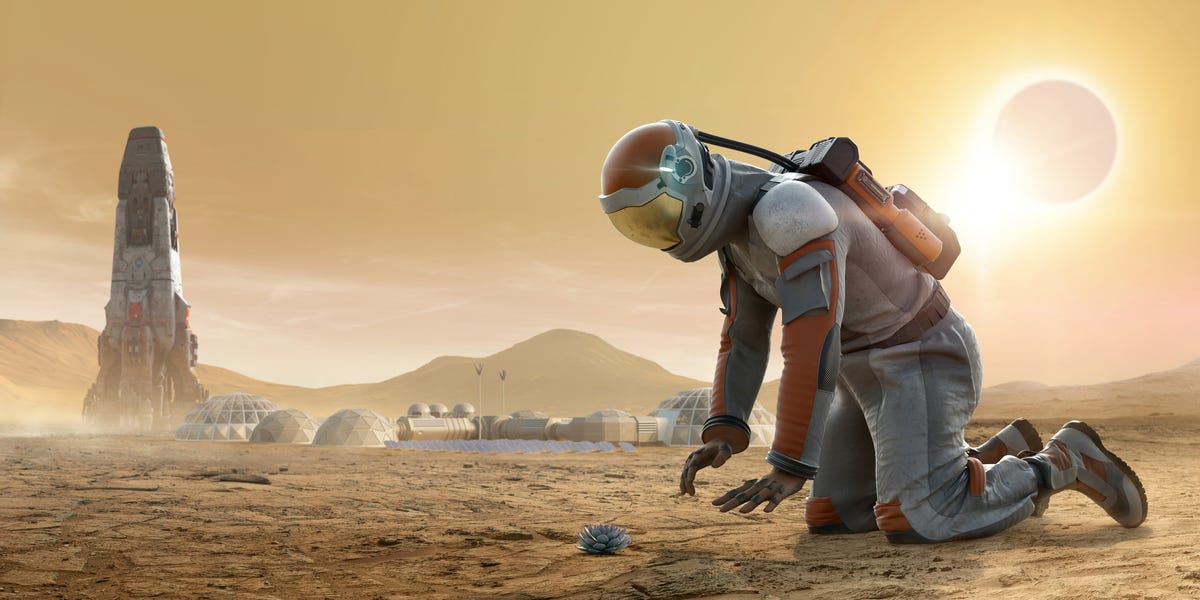

Some heroes arrive wearing capes. Others arrive as tiny green cushions clinging to desert rocks, minding their own business while quietly laughing at drought, cold, radiation, and the general drama of existence. Meet Syntrichia caninervis, a desert moss so tough that scientists now consider it a promising “pioneer plant” for future Mars colonization research.
The idea sounds like science fiction with a gardening budget: a humble moss from Earth survives conditions similar to the Red Planet and may one day help prepare harsh extraterrestrial environments for more complex life. Not tomorrow. Not with astronauts sprinkling moss over Mars like lawn seed before lunch. But as a serious scientific clue? Absolutely.
Recent research has shown that this moss can tolerate extreme dehydration, deep freezing, intense radiation, and simulated Martian conditions. That makes it one of the most exciting organisms in astrobiology, space agriculture, and long-term human settlement planning. If Mars ever gets a starter kit for biology, Syntrichia caninervis may be one of the first items in the box.
What Is Syntrichia caninervis?
Syntrichia caninervis is a desert moss found in some of Earth’s harshest environments, including dry regions of China, Tibet, the Middle East, Antarctica, polar areas, and deserts such as parts of the American Southwest. In other words, it does not exactly demand spa conditions.
This moss belongs to a group of organisms that help form biological soil crusts, thin living layers made of mosses, lichens, cyanobacteria, fungi, and other microorganisms. These crusts stabilize soil, reduce erosion, hold moisture, and gradually improve nutrient cycles. On Earth, they are small but mighty ecosystem engineers.
That is why space scientists are interested. Mars is not a welcoming place for roses, tomatoes, oak trees, or that basil plant many people accidentally kill on the kitchen counter. A pioneer organism must be able to survive before it can improve the environment around it. This desert moss has the résumé.
Why Scientists Think This Moss Could Survive on Mars
Mars is beautiful, mysterious, and wildly unfriendly. Its atmosphere is thin and mostly carbon dioxide. Surface temperatures can swing from tolerable to dangerously cold. Liquid water cannot remain stable on the surface for long. Radiation is a major problem because Mars lacks a strong global magnetic field and has only a thin atmosphere for protection.
For most plants, this combination is a hard “no.” But Syntrichia caninervis is not most plants. In laboratory experiments, researchers tested the moss against several brutal stressors: extreme dryness, freezing temperatures, gamma radiation, and Mars-like atmospheric conditions. Dried moss samples were especially impressive, showing the ability to regenerate after being exposed to simulated Martian conditions for short periods.
The Moss Can Survive Extreme Dehydration
One of the moss’s most important talents is desiccation tolerance, which means it can dry out severely and later revive when water returns. Researchers reported that the moss could lose more than 98% of its cellular water content and then recover photosynthetic and physiological activity after rehydration.
That matters because Mars is brutally dry by Earth standards. Water exists there, mostly as ice and possibly salty brines in limited conditions, but the planet does not offer friendly rain showers or cozy ponds for plant roots. A Mars-ready organism needs to treat water like a rare luxury, not a daily expectation.
It Can Handle Deep Freezing
The moss also showed extraordinary cold tolerance. In experiments, intact plants regenerated after storage at −80°C for years and after exposure to liquid nitrogen temperatures near −196°C for days. That does not mean moss would casually enjoy a Martian winter, but it suggests that its cells have protective strategies that keep them from falling apart under conditions that would destroy many other organisms.
Prior dehydration appeared to help. That is a fascinating twist: being dry before freezing may reduce cellular damage. For desert moss, dryness is not only a hardship; it is part of the survival playbook.
It Resists Radiation Better Than Many Organisms
Radiation is one of the biggest obstacles for life on Mars. Earth’s magnetic field and atmosphere protect life from much of the damaging radiation coming from space. Mars has much less protection, so future habitats, greenhouses, and biological systems would need shielding.
Syntrichia caninervis demonstrated strong resistance to gamma radiation in laboratory tests. Some radiation doses that would devastate many plants did not prevent the moss from recovering. Researchers even observed that certain lower radiation doses appeared to stimulate growth, although that does not mean radiation is “good” for the moss in general. Biology loves exceptions, and scientists love putting those exceptions under microscopes.
Could Moss Really Colonize Mars?
The word “colonize” needs careful handling. This moss is not going to leap from a rover, spread across Valles Marineris, and turn Mars into a green velvet carpet. Mars remains too cold, too dry, too irradiated, and too chemically challenging for ordinary open-air plant growth.
However, the moss could become a pioneer species in controlled or semi-controlled environments. A pioneer species is one of the first organisms to establish itself in a barren or damaged environment. On Earth, pioneer organisms help create conditions that allow other life forms to follow. They may stabilize surfaces, trap dust, contribute organic matter, influence moisture, and begin early soil-building processes.
On Mars, that role would likely happen inside protected systems: experimental growth chambers, pressurized bioreactors, shielded greenhouses, or habitat-linked ecological modules. Think less “wild Martian forest” and more “carefully monitored moss lab with excellent security and probably a clipboard.”
How Moss Could Help Future Mars Habitats
Long-term Mars settlement will require more than rockets and brave astronauts. It will need life-support systems that recycle air, water, nutrients, and waste. Plants and microbes may play an important role in those systems because they can perform biological work that machines would otherwise need to do alone.
Oxygen Production
Like other photosynthetic organisms, moss can use light, carbon dioxide, and water to produce oxygen. A small patch of moss would not provide enough oxygen for a city on Mars, but biological oxygen production could become part of larger life-support networks. In future habitats, moss might work alongside algae, crops, cyanobacteria, and engineered systems.
Carbon Sequestration
Photosynthetic organisms also capture carbon. Since Mars’s atmosphere is mostly carbon dioxide, organisms that can use CO₂ efficiently are scientifically interesting. Again, moss alone will not terraform Mars, but it could contribute to small-scale closed ecosystems.
Soil Improvement
Martian surface material is not soil in the Earth-garden sense. It is regolith: mineral material with little organic matter and several chemical challenges. Some studies of extraterrestrial agriculture focus on adding nutrients, using microbes, reducing toxic compounds, or growing crops in amended simulants.
Moss could help build early biological layers by adding organic material over time. On Earth, biological soil crusts help improve fragile landscapes. On Mars, a similar concept would need strict environmental control, but the principle is attractive: use hardy organisms to begin the slow work of making barren material more biologically useful.
The Big Problems: Why Mars Is Still Not a Moss Vacation Resort
The excitement is real, but so are the limits. A moss surviving simulated Mars conditions for a short laboratory period is not the same as moss thriving permanently on the Martian surface. Mars is not simply “a cold desert.” It is a planet with multiple overlapping stressors that make life difficult from every angle.
Survival Is Not the Same as Growth
One of the biggest distinctions is survival versus active growth. An organism may endure extreme conditions in a dormant or dried state, then recover when returned to better conditions. That is very different from growing, reproducing, spreading, and performing useful ecological work in the extreme environment itself.
For Mars colonization, scientists need to know whether the moss can complete life cycles under realistic Martian conditions or within practical habitat systems. Can it grow using Martian resources? Can it reproduce reliably? Can it handle repeated stress cycles? Can it contribute meaningful oxygen or organic matter? Those are the next big questions.
Martian Soil Chemistry Is Complicated
Martian regolith may contain perchlorates, salts that create problems for humans and plants. Future agriculture will likely need cleaning, dilution, microbial treatment, chemical processing, or alternative growing systems such as hydroponics and aeroponics. Moss may help in some biological preparation strategies, but it is not a magic eraser for every toxic compound.
Water Is a Dealbreaker
Even a drought-tolerant moss needs water at some stage. The ability to dry out and revive is powerful, but growth still requires hydration. Any Mars moss project would need controlled water delivery, recycling, and protection from rapid evaporation or freezing.
Planetary Protection Matters
There is also an ethical and scientific issue: humans cannot simply scatter Earth organisms on Mars without thinking carefully. Planetary protection policies exist to reduce forward contamination, meaning contamination of other worlds by Earth life. If Mars has or once had native life, careless biological introduction could confuse scientific investigations or damage environments we do not yet understand.
So even if a moss is technically capable of surviving Mars-like conditions, using it on Mars would require serious oversight, international discussion, containment planning, and scientific caution. The Red Planet is not an empty flowerpot waiting for our landscaping opinions.
Why This Discovery Matters for Astrobiology
Astrobiology asks a thrilling question: how does life survive beyond the comfortable conditions we know? Extremotolerant organisms like Syntrichia caninervis help scientists understand the biological limits of life. Every organism that survives extreme dryness, cold, radiation, or low pressure gives researchers clues about cellular protection, DNA repair, metabolism, dormancy, and revival.
This moss is especially important because it is a whole plant, not just a microbe, spore, or lichen fragment. Previous studies have tested microorganisms and hardy biological structures in space-like conditions. Testing a complete moss plant expands the conversation. It suggests that some small land plants may be tougher than expected.
That does not prove plants can naturally live on Mars. It does suggest that future space ecosystems may not need to begin only with bacteria or algae. Mosses, lichens, and other compact organisms may become part of the biological toolkit for off-world habitats.
Could Moss Help Terraform Mars?
Terraforming Mars means transforming the planet to make it more Earth-like. That would require enormous changes: thickening the atmosphere, warming the climate, stabilizing liquid water, reducing radiation exposure, and creating breathable air. Current science does not support the idea that moss, or any plant, could quickly terraform Mars.
Still, moss could contribute to tiny steps in controlled environments. Instead of imagining global terraforming, it is better to think in terms of micro-terraforming: creating small, protected, biologically active spaces where life can function. A habitat wall, a greenhouse tray, a regolith experiment, or a bio-crust module may sound less dramatic than “turn Mars green,” but it is much more realistic.
Great space exploration often begins with unglamorous details. Before there are forests under domes, there may be trays of moss under sensors. Before astronauts harvest Martian salads, scientists may study whether a desert moss can survive another week in a simulated chamber. Progress wears tiny shoes.
What Future Research Should Test Next
The next phase of research should move from “Can it survive?” to “Can it function usefully?” Scientists will need to test longer exposure periods, repeated stress cycles, growth under low-pressure conditions, reproduction, nutrient exchange, and interactions with Martian regolith simulants.
Researchers may also examine whether the moss works better with microbial partners. On Earth, biological soil crusts are communities, not solo acts. Mosses often live alongside bacteria, fungi, algae, and lichens. A future Mars bio-crust may need a carefully designed community where each organism performs a specific job.
Another key area is genetic and biochemical analysis. Understanding how Syntrichia caninervis protects itself could help scientists develop more resilient crops for space agriculture. If researchers learn which genes, proteins, pigments, sugars, or cellular repair systems make the moss so durable, those insights could influence crop breeding, synthetic biology, and life-support design.
Experiences and Lessons From Imagining a Moss-Powered Mars
Thinking about a wonder moss on Mars changes how we imagine exploration. The usual picture of space colonization is loud and metallic: rockets roaring, habitats unfolding, robots drilling, astronauts bouncing heroically across red dust. Moss introduces a quieter kind of adventure. It suggests that the future of Mars may depend not only on engines, shields, and solar panels, but also on tiny organisms that know how to wait.
Anyone who has tried to grow plants in difficult conditions can understand the lesson. A houseplant wilts because the room got too dry. A garden fails because the soil is poor. A seedling dies because the temperature swings too sharply. Now multiply those problems by an entire planet. Mars is not just “bad gardening weather.” It is gardening on expert mode, with the tutorial removed and the atmosphere set to nearly impossible.
That is why Syntrichia caninervis feels so inspiring. It does not survive by being large, fast, or flashy. It survives by being patient, efficient, and structurally prepared for hardship. When water disappears, it shuts down. When better conditions return, it wakes up. There is a practical wisdom in that biology. It reminds us that resilience is not always about constant activity. Sometimes resilience means knowing how to pause without giving up.
For future astronauts, this kind of moss could become more than a laboratory specimen. Imagine a Mars habitat where sealed growth panels contain moss, algae, and microbial communities. The panels are not decorative in the ordinary sense, although after months of red dust and gray machinery, even a square foot of green might feel like a luxury hotel. These living systems could help recycle air, study stress biology, test regolith treatment, and support mental well-being by bringing a visible piece of Earth into an alien world.
There is also a humbling experience built into the topic. Humans often imagine colonizing Mars through dominance: build bigger rockets, dig deeper tunnels, engineer stronger domes. The moss suggests a complementary approach: learn from organisms that already mastered extremes on Earth. Desert mosses, lichens, microbes, and soil crusts have been solving survival puzzles for millions of years without press releases. They are tiny professors with no office hours.
The story also teaches patience. If moss ever plays a role on Mars, it will likely happen through careful experiments, contained systems, and gradual scaling. There will be failures. Some samples will not grow. Some simulated regolith mixtures will be wrong. Some habitat designs will need revision. That is how real exploration works. It is less like a movie montage and more like a spreadsheet with stubborn optimism.
Most importantly, this moss makes Mars feel both closer and more mysterious. Closer, because life from Earth can sometimes endure conditions we once considered almost impossible. More mysterious, because survival is only the first chapter. To truly live, grow, reproduce, and build an ecosystem beyond Earth is a much larger challenge. A wonder moss may not conquer Mars, but it may help us ask better questionsand in science, better questions are often the first green shoots in the dust.
Conclusion: A Tiny Plant With Planet-Sized Possibilities
Syntrichia caninervis is not a miracle cure for Mars colonization, but it is one of the most fascinating biological candidates in the search for sustainable off-world living. Its ability to withstand dehydration, freezing, radiation, and simulated Martian conditions makes it a serious subject for future research in astrobiology and space agriculture.
The real promise is not that moss will instantly transform Mars into a second Earth. The promise is that small, hardy organisms may help humans design better life-support systems, prepare regolith, recycle resources, and understand how life can persist beyond our home planet. Mars colonization will not be built by moss alone. But one day, when humans begin creating the first sustainable habitats on the Red Planet, a little green survivor from Earth may deserve a surprisingly large thank-you.


