
Note: This article is written as original, SEO-optimized web copy based on real astronomy and artificial intelligence research. No source links are inserted in the body so the content can be published cleanly on a website.
Space is not exactly known for keeping things small. Galaxies contain billions of stars, telescopes collect oceans of data, and somewhere in a quiet archive, a lonely image file is probably waiting for an astronomer to notice that it contains something spectacular. The problem is simple: the universe is producing more visual evidence than human beings can realistically inspect by eye.
That is why the claim that a new AI can analyze astronomical images 10 million times faster than traditional human-led methods sounds less like a tech headline and more like a survival strategy for modern astronomy. In the most precise scientific sense, this speed comparison comes from artificial intelligence research on gravitational lenses, where neural networks learned to analyze complex distortions in space-time at a pace that would make old-school modeling workflows look like they were walking through wet cement.
But the larger story is even more exciting. AI is no longer just helping astronomers sort pretty space pictures. It is identifying gravitational lenses, scanning Hubble archives, flagging cosmic anomalies, classifying supernovae, and preparing the science community for the huge data waves expected from next-generation observatories. In other words, artificial intelligence is becoming the universe’s most overqualified intern: fast, tireless, and weirdly good at noticing things humans might miss after their third coffee.
Why Astronomical Image Analysis Needed an AI Upgrade
For much of modern astronomy, human expertise has been the gold standard. Astronomers examine images, compare models, look for unusual shapes, and decide whether a faint smudge is a boring background galaxy or a clue to something much bigger. This careful work is still essential, but it does not scale well when telescopes produce millions of images and catalogs containing billions of objects.
Astronomical images are also not simple snapshots. A single image may contain stars, galaxies, cosmic rays, detector noise, gravitational arcs, diffraction spikes, faint background sources, and artifacts caused by the instrument itself. To a casual viewer, many of these features look like space confetti. To an expert, they can reveal dark matter, galaxy evolution, exploding stars, or the shape of the early universe.
The challenge is volume. Hubble alone has built a decades-long archive of observations. Newer and upcoming surveys will multiply the problem. The Vera C. Rubin Observatory’s Legacy Survey of Space and Time, for example, is designed to repeatedly scan the sky and generate massive nightly data streams. When astronomy becomes a data-deluge science, the old method of “let’s have a small team inspect everything manually” starts to sound charming but impossible.
What Does “10 Million Times Faster” Really Mean?
The headline phrase refers to a breakthrough in using neural networks to analyze strong gravitational lenses. A gravitational lens appears when a massive foreground object, such as a galaxy or galaxy cluster, bends the light from a more distant object behind it. The result can be a stretched arc, a ring, or multiple distorted images of the same background galaxy. It is one of the most visually dramatic confirmations of Einstein’s general relativity, and it is also a powerful tool for mapping mass, including dark matter.
Traditionally, analyzing a gravitational lens could require sophisticated simulations, expert modeling, and a great deal of computing time. A single detailed analysis might take days, weeks, or longer depending on the complexity of the system. Researchers trained deep convolutional neural networks to estimate lensing parameters directly from images. Once trained, the model could process lensing systems in seconds, achieving performance described as roughly 10 million times faster than conventional modeling methods.
That does not mean AI has replaced astronomers. A better way to understand it is this: AI can do the first heavy computational pass at extreme speed, while scientists remain responsible for interpretation, verification, and turning results into reliable physics. The AI is the turbocharged searchlight; the astronomer still decides what the light is showing.
How Neural Networks Learn to Read the Universe
Neural networks learn by example. In astronomy, researchers often train models using large collections of simulated and real images. The model sees many examples of what a gravitational lens looks like, what a non-lens looks like, and how different physical parameters affect the image. Over time, it learns patterns that are difficult to describe with a simple rulebook.
Convolutional neural networks are especially useful for image analysis because they are built to recognize spatial patterns. They can detect curves, edges, brightness gradients, symmetry, and subtle distortions across an image. That makes them a natural fit for astronomical image analysis, where important signals can be faint, stretched, blended, or buried in noise.
Think of it like teaching someone to spot cats in photographs, except the cats are warped galaxies, the photos are full of cosmic static, and the reward is a better understanding of dark matter. Not exactly a normal Saturday afternoon, but astronomy has never been accused of being ordinary.
AI and the Hubble Archive: Finding Weird Things Humans Missed
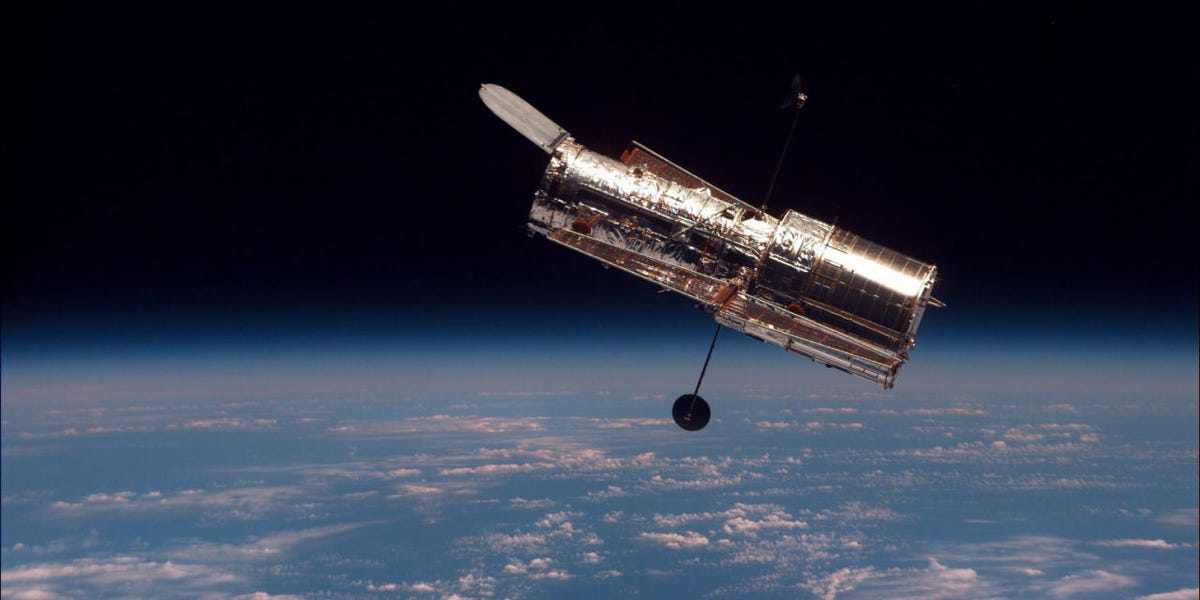
The speed revolution is not limited to gravitational lenses. Recent AI-assisted work on the Hubble Legacy Archive shows how machine learning can uncover rare objects hidden in old data. Researchers used an AI method called AnomalyMatch to search through nearly 100 million Hubble image cutouts. The system flagged unusual objects, and researchers then reviewed the candidates to confirm which were scientifically interesting.
The results included more than a thousand unusual cosmic objects, many of which had not been documented before. The discoveries included merging galaxies, gravitational lenses, jellyfish-like galaxies with trailing gas, clumpy star-forming galaxies, and odd objects that resisted easy classification. That last category is especially fun because “we do not know what this is yet” is one of science’s most productive sentences.
This is one of AI’s most valuable roles in astronomy: not merely confirming what scientists already know, but finding the strange outliers. Humans are excellent at curiosity, but terrible at manually reviewing 100 million tiny image cutouts without sleep. AI does not get bored, does not need snacks, and does not silently skip frame 72,418 because its eyes hurt.
Why Gravitational Lenses Matter So Much
Gravitational lenses are more than beautiful cosmic accidents. They work like natural telescopes, magnifying distant galaxies that might otherwise be too faint to study. They also reveal how mass is distributed in foreground galaxies and clusters. Because much of that mass may be dark matter, gravitational lensing gives astronomers a way to map something that does not emit light.
AI-powered gravitational lens analysis could accelerate several major areas of research. It can help scientists identify promising lens candidates, estimate physical properties faster, and prioritize targets for deeper observation with telescopes such as Hubble, the James Webb Space Telescope, Roman, Euclid, and major ground-based observatories.
Speed matters because the next generation of surveys is expected to find far more lensing systems than traditional methods can comfortably analyze. If tens of thousands of lenses appear in survey data, scientists need automated tools to separate the most valuable targets from the cosmic crowd. AI becomes the first filter, ranking and measuring candidates so experts can focus their attention where it matters most.
The Coming Data Flood from Rubin, Roman, and Other Telescopes
The future of astronomy is not just bigger mirrors and sharper cameras. It is bigger datasets. The Vera C. Rubin Observatory is built to image the sky repeatedly over a 10-year survey, creating a time-lapse view of the universe. This kind of survey can reveal asteroids, supernovae, variable stars, galaxy changes, and other transient events that appear, disappear, brighten, or move.
NASA’s Nancy Grace Roman Space Telescope is also expected to produce wide-field infrared observations that will support research into dark energy, exoplanets, galaxy evolution, and gravitational lensing. With instruments capable of surveying large areas of sky, Roman will add another major stream of high-value astronomical data.
The practical question is not whether telescopes can collect the data. They can. The harder question is whether scientists can process, classify, and interpret it quickly enough. AI and machine learning are increasingly becoming the answer. Without automation, important discoveries could sit unnoticed in archives for years. With AI, those hidden signals can be flagged in days, hours, or even seconds.
AI Is Not Replacing AstronomersIt Is Changing Their Job
Whenever AI enters a scientific field, the same nervous question appears: will it replace experts? In astronomy, the better answer is that AI changes the workflow. It handles repetitive scanning, fast classification, and early-stage pattern recognition. Astronomers still design the research questions, build the training data, validate the results, check for bias, interpret the physics, and decide what deserves follow-up observation.
AI can say, “This image looks unusual.” A scientist asks, “Why?” That second question is where discovery begins.
This partnership is already visible in citizen-science projects such as Galaxy Zoo. For years, volunteers have helped classify galaxies by shape, giving researchers valuable human pattern recognition at scale. AI extends that idea into automated systems that can process enormous datasets while still benefiting from human review and scientific judgment.
Specific Examples of AI in Astronomical Image Analysis
1. Strong Gravitational Lens Modeling
Deep learning models can estimate lensing parameters from images far faster than conventional modeling. This allows researchers to process large samples of gravitational lenses and identify systems worth detailed study.
2. Hubble Archive Anomaly Detection
AI-assisted anomaly detection can search historical telescope archives for rare and unusual objects. Instead of relying only on planned observations, scientists can extract new discoveries from data that already exists.
3. Supernova Classification
Machine learning systems used in time-domain surveys can help classify exploding stars and other transient events. Rapid classification matters because some cosmic events fade quickly and require immediate follow-up.
4. Galaxy Shape Recognition
AI can help classify galaxies by morphology, identifying spirals, ellipticals, mergers, irregular systems, and unusual structures. These classifications support studies of galaxy formation and evolution.
5. Survey Alert Filtering
Large sky surveys can generate millions of alerts when objects move or change brightness. AI helps filter the noise so scientists can focus on the most interesting events.
The SEO-Friendly Big Picture: AI Astronomy Is a Discovery Engine
The phrase AI astronomical image analysis may sound technical, but its impact is easy to understand. It means scientists can search more sky, analyze more images, and discover more rare cosmic events than ever before. It means old archives become active research mines. It means gravitational lensing AI can speed up the hunt for dark matter clues. It means machine learning in astronomy is no longer a futuristic extra; it is becoming basic infrastructure.
The most exciting part is that AI does not need the universe to be neat. In fact, it thrives on the messy parts. Odd shapes, strange arcs, unexpected brightness changes, and objects that refuse to fit a known category can become the beginning of new research. Astronomy has always advanced when better tools made the invisible visible. The telescope expanded the eye. The camera preserved the sky. AI now expands attention itself.
Limitations: Why AI Still Needs Careful Human Oversight
Of course, AI is not magic. A model is only as good as its training data, assumptions, and validation process. If the training examples are biased, incomplete, or unrealistic, the model may miss important objects or flag too many false positives. Astronomical images also contain instrumental artifacts that can fool automated systems if researchers are not careful.
There is also a difference between detection and understanding. An AI can locate a candidate gravitational lens, but understanding what that lens says about mass distribution, cosmology, or galaxy evolution requires deeper analysis. Similarly, an anomaly-detection system can find a strange object, but scientists must determine whether it is a rare astrophysical phenomenon, a processing artifact, or something else entirely.
The best future is not AI alone or humans alone. It is a layered system: AI scans and ranks, automated pipelines measure, citizen scientists and experts review, and professional astronomers turn the results into knowledge. That is how speed becomes science instead of just a flashy benchmark.
Why This Matters Beyond Astronomy
The same pattern applies far beyond space science. Many fields now face the same problem: too much data, not enough human attention. Medical imaging, climate modeling, materials science, satellite monitoring, and environmental research all involve large datasets where rare signals matter. Astronomy is becoming a testbed for how humans and AI can collaborate responsibly on discovery at scale.
There is something poetic about that. We are using artificial intelligence, one of the most advanced technologies humans have built, to study light that may have traveled for billions of years before landing on a detector. Ancient photons meet modern algorithms. The universe sends postcards, and AI helps us read the mail.
Experiences and Reflections: What It Feels Like to Watch AI Change Astronomy
One of the most fascinating experiences related to this topic is realizing how much astronomical discovery depends on patience. Anyone who has ever tried looking through a telescope knows that space does not always deliver instant drama. Sometimes you wait, adjust, refocus, check a star chart, and then realize the “amazing object” you were chasing is a faint blur that looks suspiciously like a fingerprint on reality. Professional astronomy is far more advanced, of course, but it shares that same spirit: careful attention, repeated observation, and the willingness to search through subtle clues.
AI changes that experience by shifting the bottleneck. In the past, a researcher might spend enormous time preparing data, running models, inspecting candidates, and eliminating false leads. With machine learning, the first stage can become dramatically faster. Instead of asking, “Can we even look through this much data?” researchers can ask, “Which of these AI-flagged patterns deserves our deepest attention?” That is a major emotional and practical change. It turns overwhelming archives into navigable maps.
For students, amateur astronomers, and science fans, this development also makes the universe feel more accessible. You do not need to be sitting at a mountain observatory to participate in modern astronomy. Citizen-science projects have already shown that people with laptops can help classify galaxies and support real research. AI adds a new layer: it can pre-sort the cosmic haystack so humans spend more time examining the needles. That is not less human. In many ways, it is more human, because it saves curiosity for the moments where curiosity matters most.
There is also a humbling lesson here. AI can scan millions of astronomical images, but it does not feel wonder. It does not gasp at a ring galaxy. It does not laugh when a planet-forming disk looks like a hamburger. It does not stay up late thinking about dark matter because the idea is too strange to put down. Humans bring meaning to the pattern. AI brings speed to the search. The combination is powerful because each side does what the other cannot.
Imagine a future astronomy classroom where students explore AI-flagged objects from real telescope archives. One group investigates a possible gravitational lens. Another studies a merging galaxy. Another checks whether an unusual streak is a cosmic event or an artifact. Instead of reading only about discoveries made years ago, students could participate in the discovery process itself. That kind of experience turns astronomy from a museum of facts into a living investigation.
The biggest takeaway is that AI is not making the universe smaller or less mysterious. It is making the mystery searchable. There will still be false alarms, confusing images, and objects that refuse to behave politely for our classification systems. Good. Those are often the best parts. A faster tool does not remove the adventure from astronomy. It gives the adventure a better map, a brighter flashlight, and maybe a much-needed filter for all the cosmic noise.
Conclusion
The claim that AI can analyze astronomical images 10 million times faster than traditional methods is more than a headline. It represents a major shift in how scientists study the universe. Neural networks can speed up gravitational lens analysis, anomaly-detection tools can uncover hidden objects in the Hubble archive, and machine learning systems can help astronomers prepare for the enormous data streams of future sky surveys.
Still, the real breakthrough is not speed alone. It is the partnership between fast machines and careful humans. AI can scan the sky at a scale no individual could match, but scientists provide the judgment, skepticism, and imagination needed to turn flagged pixels into cosmic understanding. The result is a new era of astronomy where discovery is faster, archives are more valuable, and the weirdest corners of the universe have a better chance of being noticed.


