
Note: This article is for educational reading only. High-voltage experiments can be fatal and should not be attempted without professional training, proper equipment, and controlled safety procedures.
A Sparkling Title With a Very Serious Shock
“Pour Yourself A Glass Of 100,000 Volts” sounds like the kind of drink a comic-book villain orders after a long day of monologuing. In reality, the phrase points to a fascinating corner of high-voltage science: a water-based Marx generator capable of producing enormous electrical pulses. It is not a cocktail, not a party trick, and definitely not something to serve with ice and a tiny umbrella.
The idea became popular among electronics enthusiasts because it flips expectations. We are used to hearing that water and electricity are a terrible combination. That warning is still absolutely true for everyday life. Yet in controlled high-voltage systems, water can be used in clever ways: as a resistor, as part of a capacitor-like structure, and as an insulating or energy-handling medium in much larger pulsed-power machines. The magic is not that water “creates” electricity. The magic is that water’s electrical behavior changes depending on purity, dissolved ions, geometry, and voltage.
At the center of this story is the Marx generator, a circuit that charges capacitors in parallel and then discharges them in series to create a much higher voltage pulse. Think of it like lining up a group of polite electrical squirrels, giving each one a tiny acorn of charge, and then asking them all to throw their acorns at the same time. That is not exactly how Maxwell’s equations would phrase it, but it gets the spirit right.
What Does “100,000 Volts” Actually Mean?
Voltage is electrical pressure: the push that can drive electric current through a path. A 100,000-volt pulse is an enormous potential difference compared with household electricity, but voltage alone does not tell the whole danger story. Current, energy, duration, body resistance, and the path electricity takes through the body all matter. That is why a tiny static shock from a doorknob can be thousands of volts and still be mostly a surprise, while a lower-voltage power source with enough current can be deadly.
This distinction is important because high-voltage demonstrations often look like science fiction. A spark snaps through air, purple-white plasma appears, and the room suddenly smells like a thunderstorm’s dramatic cousin. But behind the visual drama is a real transfer of energy. OSHA treats voltages at or above 50 volts as hazardous in many workplace contexts because the current through the human body is what causes injury, and that current depends on resistance and conditions such as moisture, skin condition, and contact points.
In nature, lightning is the celebrity version of the same theme. A typical lightning flash can reach about 300 million volts and about 30,000 amps, according to the National Weather Service. Compared with that, 100,000 volts is small in the same way a backyard firework is small compared with a volcanic eruption. Still, “small compared with lightning” is not the same as “safe.” A high-voltage pulse can burn, startle, damage electronics, puncture insulation, trigger arcs, or stop a heart under the wrong conditions.
The Science Behind a Water-Based Marx Generator
A Marx generator is a pulsed-power circuit. It does not make energy out of nowhere; it stores energy and releases it quickly. In a classic design, several capacitors are charged through resistors. While charging, the capacitors sit side by side electrically, each receiving a manageable voltage. Then spark gaps act like switches. Once the first gap breaks down, the next stage sees a higher voltage, then the next, and the circuit “erects” itself into a series stack that produces a high-voltage output pulse.
Why Water Can Act Like a Resistor
Pure water is actually a very poor electrical conductor. The trouble is that pure water is rare outside a lab. Tap water contains dissolved minerals and ions, and those charged particles allow current to flow. Add salt, and conductivity increases sharply. Remove ions through distillation or deionization, and conductivity drops. This is why water can be tuned, at least roughly, for certain high-voltage demonstrations.
In a water-based Marx generator, tubes or channels of water can behave like high-value resistors. They allow capacitors to charge while limiting current flow. Unlike many solid resistors, a long column of water can also spread heat and voltage stress across a physical distance. That does not make the setup “safe,” but it explains why water appears in high-voltage laboratories and hobby demonstrations.
Why Salt Water and Plastic Can Behave Like a Capacitor
A capacitor stores energy in an electric field between two conductors separated by an insulator called a dielectric. A simple capacitor can be made with conductive surfaces on either side of a nonconductive layer. In the water-based design, salt water can act as a conductor while plastic can serve as the insulating barrier. That arrangement resembles the old Leyden jar, one of the earliest devices used to store static electricity.
The Leyden jar was historically built from a glass container with conductive materials on the inside and outside. Early experimenters thought the water inside stored the electricity, but later work showed that the real action involved opposite charges separated by the glass dielectric. In modern terms, the jar was a capacitor. The water-based Marx generator borrows that old idea and gives it a mischievous garage-lab makeover.
Why Sparks Jump Through Air
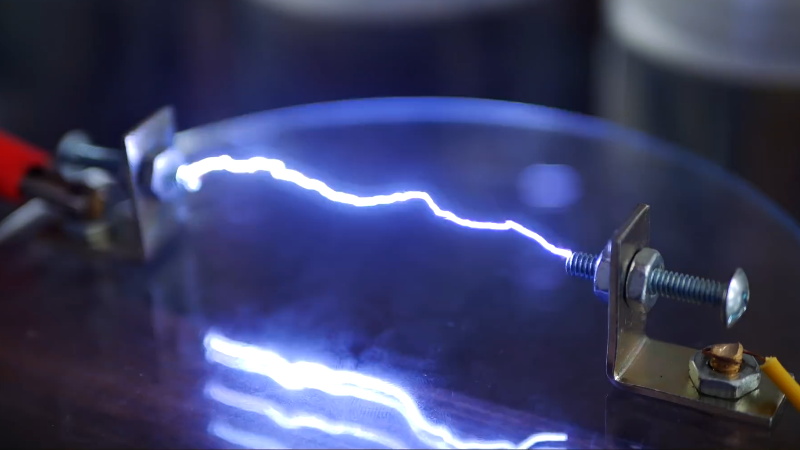
Air is usually an insulator. That is fortunate, because if air were a good conductor, every light switch would come with a weather report. But when the electric field becomes strong enough, air molecules ionize. Electrons are knocked loose, charged particles multiply, and a conductive plasma path forms. This is electrical breakdown, and it is what allows a spark to leap across a gap.
The breakdown voltage of air depends on gap size, pressure, humidity, electrode shape, and surface conditions. Sharp points concentrate electric fields, which is why sparks often begin at needle-like edges or rough metal surfaces. Rounded conductors are used in high-voltage engineering to reduce unwanted corona discharge and arcing. In other words, electricity loves drama, but engineers spend a lot of time persuading it to calm down.
Once a spark forms, it can produce light, sound, heat, electromagnetic noise, ozone, and a smell that many people associate with thunderstorms. That sharp “snap” is not merely theatrical. It is the sound of air rapidly heating and expanding as the discharge punches a temporary conductive tunnel through a gas that was minding its own business a millisecond earlier.
Where High-Voltage Pulses Are Used in Real Life
The 100,000-volt water experiment is eye-catching, but pulsed power is not just for viral science videos. Engineers use controlled high-voltage pulses in research, testing, medicine, manufacturing, defense, and energy systems. The basic idea is always similar: store electrical energy, shape it, and release it at the right time.
Lightning Simulation and Equipment Testing
Aircraft, power equipment, surge protectors, and insulation systems must survive harsh electrical events. High-voltage impulse generators can simulate lightning-like stress in a controlled test environment. This allows engineers to learn whether a device fails gracefully, fails loudly, or fails in a way that makes everyone in the lab suddenly remember an appointment elsewhere.
Pulsed-Power Research
Large facilities use pulsed power to create extreme conditions for physics research. Sandia National Laboratories’ Z machine, for example, uses stored electrical energy released in powerful pulses to create intense radiation and magnetic pressure for scientific experiments. Some of its systems are insulated by water and oil, showing that fluids can play serious roles in high-energy electrical engineering, not just in kitchen sinks and questionable science fair projects.
Medical and Industrial Applications
Capacitors and pulsed discharge systems appear in devices such as camera flashes, defibrillators, pulsed lasers, X-ray equipment, and plasma systems. Not all of these operate at 100,000 volts, but many rely on the same principle: accumulate energy, then release it quickly and precisely. The difference between useful technology and chaos is control.
Why Water and Electricity Are Still a Dangerous Pair
The water-based generator is scientifically interesting because water can be part of an electrical component. That does not mean water makes electricity harmless. Quite the opposite: water often lowers resistance, increases contact area, and helps current find a path through the body. The CDC advises avoiding contact with water during thunderstorms because lightning can travel through plumbing. That includes showering, bathing, washing dishes, or using running water while lightning is nearby.
Tap water’s conductivity comes from dissolved ions such as sodium, calcium, magnesium, chloride, sulfate, and other minerals. The EPA uses conductivity as a water-quality indicator because dissolved inorganic substances increase water’s ability to carry current. So the phrase “water conducts electricity” is a simplification, but it is a useful safety rule. In normal homes, shops, yards, bathrooms, and garages, treat electricity plus water as a red-alert combination.
High-voltage systems introduce additional hazards. Arcs can jump farther than expected. Capacitors can retain charge after power is disconnected. Insulation can fail silently. Metal tools can become accidental conductors. Even a startled reaction can cause injury if someone jerks away, falls, or touches something else. The safest DIY high-voltage project is often the one you admire from a distance while keeping both hands in your pockets and your eyebrows attached to your face.
Common Myths About 100,000 Volts
Myth 1: “High Voltage Is Safe If the Current Is Low”
Low current can reduce risk, but it does not automatically make a system safe. Current limits can fail, capacitors can dump stored energy, and arcs can create burns or secondary injuries. The phrase “it is only low current” should never be used as a permission slip for careless contact.
Myth 2: “Rubber Shoes Make You Invincible”
Rubber is an insulator, but ordinary shoes are not rated protective equipment. Moisture, dirt, thin soles, punctures, and voltage level can defeat the protection people imagine they have. Real electrical safety uses tested gear, grounding rules, lockout procedures, barriers, and trainingnot lucky sneakers.
Myth 3: “Water Is Always a Conductor”
Pure water is an excellent insulator, while ordinary water conducts because of dissolved ions. This is why distilled water behaves differently from seawater, tap water, or salt water. The more ions available, the easier it is for current to move.
Myth 4: “A Spark Shows the Whole Amount of Danger”
Sparks are visually impressive, but they do not tell you everything about stored energy, current, pulse duration, or risk. A tiny spark can be harmless; an invisible charged capacitor can be deadly. Electricity does not care whether it looks cinematic.
How to Appreciate the Experiment Without Becoming the Experiment
The best way to enjoy “Pour Yourself A Glass Of 100,000 Volts” is to treat it as a science story, not a recipe. The real lesson is not “grab water, plastic, wires, and build lightning.” The lesson is that basic physics can be rearranged in surprisingly creative ways. Conductivity, capacitance, insulation, breakdown voltage, and energy storage are not abstract textbook words; they are the ingredients behind sparks you can see and hear.
If you want to learn this field safely, start with low-voltage electronics, circuit simulation, and reputable educational kits. Study Ohm’s law, capacitor energy, grounding, insulation ratings, and safe measurement practices. Learn why one hand is often kept away from circuits, why bleeder resistors matter, why enclosures exist, and why professionals test before touching. The boring safety details are what make the exciting science possible.
For classrooms, museums, and science communicators, the topic is a gift. It connects Benjamin Franklin’s Leyden jars, modern power grids, lightning safety, plasma physics, and high-voltage engineering in one crackling narrative. It also gives readers a memorable phrase. “Pour yourself a glass of 100,000 volts” is weird enough to click, but deep enough to teach.
Experience Notes: What It Feels Like to Watch 100,000 Volts Behave
Watching a high-voltage demonstration is a strange mix of curiosity and self-preservation. The first thing you notice is not always the spark. Sometimes it is the silence before the spark. The circuit charges, the room seems to hold its breath, and thensnapthe air becomes a wire for an instant. Everyone jumps, even the people who knew it was coming. Especially the people who pretended they knew it was coming.
The visual effect is beautiful in a slightly alarming way. A spark gap does not look like a smooth neon tube. It looks alive. It branches, flickers, and chooses a path based on electric fields, air conditions, electrode shape, and chance. One discharge might be short and sharp; the next might crawl farther, brighter, and louder. It is like watching a tiny thunderstorm audition for a role in a superhero movie.
There is also the smell. High-voltage arcs can produce ozone and other reactive compounds, giving the air that crisp “after lightning” scent. It is memorable, but it is not perfume. Good demonstrations are ventilated, controlled, and brief. Nobody should be leaning over the apparatus like they are sniffing soup.
The most useful experience, though, is the mental shift. A water-based Marx generator makes familiar materials feel unfamiliar. Water stops being just water. Plastic stops being just packaging. A metal nail stops being a hardware-store afterthought and becomes an electrode with geometry, spacing, and field concentration. Suddenly, everyday objects are participating in physics that usually hides inside power supplies, laboratories, and storm clouds.
That is the charm of the topic. It turns invisible forces into visible behavior. You see charge storage become motion, pressure become a spark, and an insulating gap become a temporary conductor. It is dramatic, but it is not magic. It is physics with the lights turned up and the safety rules printed in bold.
For writers, makers, and curious readers, the phrase “100,000 volts” is a doorway. Step through it carefully and you find capacitance, dielectric breakdown, conductivity, pulsed power, lightning, safety engineering, and the history of electrical discovery. Step through it carelessly and you may find a hospital bill. The difference is respect. High voltage rewards curiosity, but it punishes swagger. So pour yourself a normal glass of water, keep it far from outlets, and enjoy the science from the safe side of the spark gap.


