
Research note: This article synthesizes product specifications and guidance from Hawos, Happy Mills, SCHOTT, DWK Life Sciences, Remodelista, Mills and Flakers, the FDA, USDA, EPA, Whole Grains Council, Utah State University Extension, and Penn State Extension.
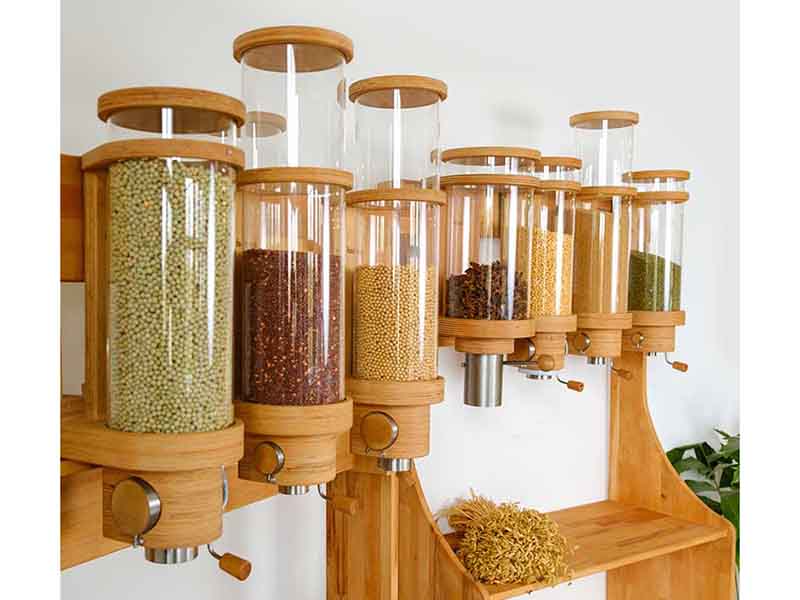
The Hawos Glass Tube Silo looks like something a thoughtful German designer created after becoming deeply offended by an untidy bag of oats. Tall, transparent, and framed in warm beech wood, it turns everyday dry goods into part of the kitchen or store design rather than something that must be hidden behind a cabinet door.
At its core, the Hawos silo is a wall-mounted bulk food dispenser. A removable glass cylinder holds grains, rice, beans, cereal, nuts, pasta, or other free-flowing foods. A stainless steel dispensing mechanism at the bottom releases the contents directly into a bowl, container, bag, or flour mill hopper.
That sounds simple, but the details distinguish it from an ordinary cereal dispenser. Hawos offers multiple glass capacities, several outlet diameters, expandable mounting arrangements, and commercial accessories. The system can serve a home baker who keeps five pounds of wheat berries on hand or a package-free store displaying an entire wall of colorful ingredients.
What Is the Hawos Glass Tube Silo?
The Hawos Glass Tube Silo is a modular dry-food storage and dispensing system manufactured by Hawos, a German company known for grain mills, flakers, sprouters, and other whole-food kitchen equipment. It is designed for homes, hotels, cafés, bakeries, mobile stores, and zero-waste retail environments.
The main structure combines four materials:
- A clear DURAN borosilicate glass tube
- A beech multiplex frame
- Stainless steel dispensing components
- An oiled wood surface, typically treated with boiled linseed oil
Hawos markets the system as plastic-free and BPA-free. The manufacturer also emphasizes modularity: one silo can occupy a narrow strip of unused wall, while several units can be installed in a row to create a full bulk-food station.
Unlike a countertop canister, the silo uses gravity. Food enters through the top and leaves through the bottom. This encourages natural stock rotation because older contents remain near the outlet instead of being buried beneath each new refill. Your rice does not need a project manager, but the silo gives it one anyway.
Why the Design Stands Out
A transparent display with a practical purpose
The glass cylinder lets users see the ingredient, check the remaining quantity, and notice obvious changes in appearance. In a home kitchen, that reduces the number of half-empty bags multiplying in dark corners. In a store, the visible food becomes merchandise, signage, and decoration at the same time.
Transparency also makes inventory checks almost immediate. There is no lid lifting, bin opening, or mysterious shaking of containers. A glance tells you whether Saturday’s bread-baking plan is fully supplied or about to become an emergency trip for wheat berries.
A narrow, wall-mounted footprint
The vertical format is particularly useful in small kitchens. Instead of consuming counter space, the silo uses the wall. Hawos states that an individual unit can be mounted with two screws, while an optional retaining plate allows units to be attached, removed, or repositioned more conveniently.
Commercial users can arrange multiple silos on a custom backing wall or install them on a freestanding gondola. The manufacturer offers a gondola configuration capable of holding several dispensers, allowing retailers to build a complete self-service station without permanently covering a wall.
Materials that feel more like furniture
The combination of clear glass, beech wood, and stainless steel gives the Hawos grain dispenser a warmer appearance than typical commercial plastic bins. It fits naturally into Scandinavian, farmhouse, minimalist, rustic, and modern organic interiors.
DURAN is a well-known borosilicate glass brand. Borosilicate glass is valued for transparency, chemical resistance, low thermal expansion, and resistance to sudden temperature changes. Those properties do not make the tube indestructible, but they make it a durable, stable material for a reusable food-storage system.
Product construction, glass properties, mounting, dispensing, and capacity claims are based on current manufacturer and supplier information.
Hawos Glass Silo Sizes and Capacities
Hawos offers several combinations of tube diameter and length. Capacity is listed in liters, while approximate food weight is commonly calculated using wheat. Actual weight will vary because quinoa, rolled oats, pasta, rice, and walnuts do not have the same bulk density.
| Volume | Tube Diameter | Tube Length | Approximate Wheat Capacity |
|---|---|---|---|
| 2.6 liters | 12 cm | 23 cm | 2 kg / 4.4 lb |
| 6.5 liters | 15 cm | 37 cm | 5 kg / 11 lb |
| 8.8 liters | 15 cm | 50 cm | About 7 kg / 15.4 lb |
| 11.6 liters | 20 cm | 37 cm | 9 kg / 19.8 lb |
| 15.7 liters | 20 cm | 50 cm | 12 kg / 26.5 lb |
Not every configuration may be offered by every retailer. Some listings feature only the smaller household sizes, and older versions may show slightly different wheat-weight estimates. Buyers should therefore choose according to the tube volume and physical dimensions rather than relying only on a product title.
Choosing the Correct Outlet Size
The outlet is not a minor accessory. It determines whether an ingredient flows smoothly, trickles too slowly, or forms a tiny edible traffic jam above the opening.
Current Hawos configurations include outlet diameters of approximately 30, 45, 64, and 89 millimeters. The lever allows the user to regulate the flow between fully closed and fully open, but the outlet still needs to be large enough for the ingredient.
30 mm outlet
The smallest outlet works well for compact ingredients such as quinoa, amaranth, couscous, sesame seeds, flaxseed, bulgur, and some small lentils. It provides better control when only modest portions are needed.
45 mm outlet
This is a versatile choice for wheat berries, rye, spelt, buckwheat, popcorn kernels, sunflower seeds, peas, many types of rice, and medium-size lentils. Home grain-milling enthusiasts will often find this diameter suitable for their everyday grains.
64 mm outlet
A larger opening is better for bulky or irregular ingredients, including muesli, rolled oats, kidney beans, chickpeas, trail mix, almonds, hazelnuts, cashews, and flaked grains.
89 mm outlet
The largest standard option is intended for especially bulky foods such as pasta. It is more relevant to commercial displays than to a household that mainly stores wheat or rice.
Particle shape matters as much as size. Flat oat flakes can bridge across a narrow outlet even though each flake appears small. Nuts and pasta also settle unpredictably. When uncertain, choosing a slightly larger opening is usually safer than expecting gravity to negotiate with a stubborn almond.
How the Dispensing System Works
The standard system uses a stainless steel bracket with an integrated spring and automatic stop. Pressing the lever opens the outlet, while releasing it stops the flow. This permits controlled dispensing without removing the entire container.
Hawos also offers a deluxe mechanism with a side handle, positioning nozzle, automatic stop, and magnetic locking arrangement. This configuration is particularly useful in busy retail environments because the dispensing assembly can be removed more quickly for cleaning.
The best technique is to position the receiving container before pressing the lever. Start with a partial opening, observe the flow, and increase it gradually. Dense wheat berries behave predictably; lightweight flakes may arrive with considerably more enthusiasm.
What Can You Store in a Hawos Silo?
The silo is intended for dry, free-flowing products. Common choices include:
- Wheat, rye, spelt, einkorn, emmer, and oat groats
- White rice, brown rice, jasmine rice, and basmati rice
- Quinoa, buckwheat, millet, bulgur, and couscous
- Lentils, chickpeas, peas, and dried beans
- Rolled oats, muesli, cereal, and granola
- Coffee beans, nuts, seeds, and trail mix
- Selected pasta shapes
Avoid wet, oily, sticky, or highly perishable foods. Products coated with syrup, soft dried fruit, oily nut mixtures, and ingredients containing melting chocolate can cling to the glass or clog the outlet. Flour may also behave differently from intact grain because fine particles compact, create dust, and travel into mechanical gaps.
Food Storage Considerations
The Hawos silo is best understood as a convenient dispensing system for actively used dry goods. It should not automatically be treated as a hermetically sealed container for multi-year emergency storage.
Whole-grain storage guidance consistently emphasizes protection from heat, moisture, oxygen, pests, and excessive light. Intact grains generally remain fresh longer than flour because the outer structure of the kernel protects the oils in the germ. Once grain is milled, oxygen can reach more of the grain and quality declines faster.
For that reason, the silo pairs especially well with a home grain mill. Users can store intact wheat or spelt in the tube and grind only the amount required for current baking. This routine can produce fresher flour while reducing the number of open packages in the pantry.
Place the silo in a cool, dry area away from direct sunlight, a hot oven, a steamy dishwasher, or a frequently boiling kettle. Clear glass provides excellent visibility but does not block light, so a sunny window is not the ideal installation location.
Inspect new ingredients before refilling. Pantry pests are often introduced inside purchased food rather than marching dramatically through the front door. Watch for webbing, damaged kernels, insects, unusual dust, or off odors. Keep the surrounding area clean and rotate stock regularly.
Storage, rotation, pest prevention, light exposure, and whole-grain freshness guidance was cross-checked against USDA, Whole Grains Council, USU Extension, Penn State Extension, and USDA FoodKeeper-related resources.
Installation and Placement
Although Hawos describes installation as requiring only two screws, the wall and fasteners must support the fully loaded dispenser. A large model can contain up to 12 kilograms of wheat in addition to the weight of the glass, frame, and mechanism.
Drywall anchors suitable for a picture frame may not be suitable for a heavily loaded food silo that is operated repeatedly. Whenever possible, mount the system into studs, masonry, structural backing, or another load-bearing surface. Commercial installations should be reviewed by a qualified installer.
Leave enough space above the unit to remove the top and pour in food. Leave sufficient clearance below the outlet for the largest jar, bowl, bag, or mill hopper you expect to use. Test the reach as well. A beautiful dispenser mounted too high becomes an elegant device for storing grains nobody can comfortably access.
Households with young children should consider height, glass protection, and supervision. The lever may be easy to operate, which is convenient until a curious child discovers that four pounds of quinoa can create an indoor beach.
Cleaning and Maintenance
The glass tube can be removed from the frame for cleaning. Hawos also sells a microfiber-based cleaning accessory and, for commercial installations, equipment intended to simplify removal and refilling.
Before cleaning, empty the silo completely and detach the glass according to the manufacturer’s instructions. Wash food-contact components with an appropriate mild cleaning solution, rinse thoroughly, and allow every part to dry completely before reassembly.
Moisture trapped inside a grain dispenser can encourage mold, spoilage, or clumping. Never refill a tube that still contains droplets or damp corners. The wood frame should not be soaked or treated like a dishwasher-safe cutting board. Wipe it carefully and maintain the oiled surface according to Hawos guidance.
Commercial operators should establish a written cleaning schedule and follow local health-department requirements. Bulk self-service products may also require ingredient identification and prominent allergen information. In the United States, businesses should check the rules adopted by their state or local jurisdiction rather than assuming that an attractive dispenser automatically completes the compliance paperwork.
Advantages of the Hawos Glass Grain Silo
- Attractive presentation: The ingredient becomes part of the room’s visual design.
- Clear inventory: Users can see the contents and approximate quantity immediately.
- Space efficiency: The vertical wall-mounted form preserves counter and shelf space.
- Controlled dispensing: The spring-loaded lever makes portioning easier than pouring from a large bag.
- Modular expansion: Additional silos can be added as storage needs grow.
- Material quality: Glass, oiled beech multiplex, and stainless steel create a durable, furniture-like system.
- Package-reduction potential: It supports reusable-container shopping and bulk purchasing.
Potential Limitations
- It requires secure installation: The dispenser becomes heavy when filled.
- Glass can break: Borosilicate glass is durable, not magical.
- Clear storage admits light: Placement away from direct sunlight is important.
- It may not be fully airtight: Long-term storage may require a separate sealed container.
- Outlet selection matters: An opening that is too small can clog.
- Cleaning involves disassembly: This is more work than wiping the outside of a sealed jar.
- The premium construction costs more: It competes with ordinary bins on function but with kitchen furniture on price.
Is It Worth Buying?
The Hawos Glass Tube Silo makes the most sense for people who use dry ingredients frequently. Home bread bakers, grain-mill owners, serious meal preppers, small cafés, boutique hotels, organic food stores, and zero-waste retailers can benefit from its combination of access, visibility, and presentation.
It makes less sense for someone who buys a small bag of rice twice a year or needs airtight emergency storage. A conventional sealed container will be simpler and less expensive in those situations.
The key question is not whether the silo can hold grain. Almost any food-grade bucket can do that. The real question is whether you value a permanent, visible dispensing station that makes bulk ingredients easier and more enjoyable to use.
Practical Experience: Living With a Hawos Glass Tube Silo
The first-day experience
A realistic ownership experience begins with planning rather than pouring. The silo appears slim in photographs, but the user must account for its full height, wall clearance, refill access, and loaded weight. The first meaningful decision is therefore not “Which grain looks prettiest?” It is “Where are the studs?”
Once installed, the visual effect is immediate. Wheat berries, black rice, red lentils, or striped pasta become a vertical display. A previously blank wall starts resembling a tiny European bulk-food shop. Even one unit can make a kitchen feel more organized because the ingredient has a fixed home instead of migrating between bags, jars, and clips of questionable structural integrity.
The everyday dispensing experience
Daily use is satisfyingly direct. Place a bowl or mill hopper under the outlet, press the lever, and release it when the required amount has fallen. There is no heavy bag to lift, no narrow package to shake, and no small avalanche escaping across the counter because the bag opened much more enthusiastically than expected.
The first few uses teach the owner how quickly a particular food moves. Dense, rounded grains usually produce a steady stream. Rolled oats and muesli can be less predictable because flat pieces overlap and bridge. Nuts make more noise, while tiny seeds flow so quickly that a cautious lever movement is wise.
The dispenser does not measure by weight or volume, so recipes still require a scale or measuring cup. However, it reduces the friction between deciding to cook and accessing the ingredient. That small improvement matters for people who bake regularly. The grain is visible, available, and ready to move directly into the mill.
The refilling experience
Refilling feels more deliberate than tossing a new bag onto a shelf. The user can inspect the remaining food, check for dust or pests, wipe the top area, and add the new batch. Because dispensing occurs from the bottom, older product tends to leave first, supporting a practical first-in, first-out routine.
Still, endlessly topping off the tube is not ideal. Periodically allowing the level to run low makes it easier to inspect and clean the system. It also prevents an ancient handful of grain from quietly applying for permanent residency around an interior edge.
A wide funnel or controlled pouring container makes refilling neater. Large commercial users may appreciate Hawos accessories that allow the silo to be removed and placed on a dedicated filling station. At home, a step stool and steady hands may be the entire refilling department.
The cleaning experience
Cleaning is straightforward but not instant. The glass tube must be removed, washed, rinsed, dried, and reinstalled. The outlet needs attention because crumbs and fine particles can collect around moving parts. Users who alternate between allergens, such as wheat, nuts, and sesame, must be especially careful about residue.
The most important lesson is patience during drying. A sparkling tube that is still slightly damp is not ready for grain. Waiting until every component is completely dry prevents condensation, clumping, and quality problems.
The transparent glass also keeps owners honest. Smudges, flour dust, and oily fingerprints remain visible. This can mean more frequent wiping, but it also means cleanliness is easier to evaluate than with an opaque plastic bin.
The long-term experience
Over time, the silo changes how users buy food. Instead of purchasing another package because nobody remembers what is in the pantry, they can check inventory from across the room. Bulk shopping becomes easier because the available capacity is obvious.
The system may also encourage experimentation. A second tube might hold rye after the household discovers sourdough. A third might hold oats, rice, or lentils. This modular growth is useful, although it can become the kitchen-storage equivalent of collecting houseplants: one unit is functional, five units are a lifestyle, and twelve units may indicate that you have accidentally opened a store.
The best long-term experience comes from matching the silo to a frequently used ingredient, selecting the correct outlet, mounting it securely, and maintaining a sensible cleaning routine. When those details are right, the Hawos silo becomes more than attractive storage. It becomes part of the kitchen workflow.
Sustainability and bulk-purchasing observations reflect EPA guidance that reducing packaging, using reusable containers, and purchasing only needed quantities can reduce waste. Commercial allergen guidance reflects the FDA Food Code framework and local adoption requirements.
Conclusion
The Hawos Glass Tube Silo succeeds because it combines storage, dispensing, organization, and interior design in one system. Its DURAN glass tube displays food clearly, the stainless steel mechanism controls portions, and the beech frame gives the unit a warmer appearance than conventional bulk bins.
It is not the cheapest way to store grain, nor is it a substitute for sealed long-term food storage. It is a specialized solution for ingredients that are used and replenished regularly. For active home bakers and package-free retailers, that specialization is precisely the attraction.
Choose the capacity according to actual consumption, match the outlet to the ingredient, install the silo on a properly supported surface, and keep it away from direct sunlight and moisture. Do those things, and the Hawos Glass Tube Silo can turn a practical pantry necessity into one of the most distinctive features in the room.
Editorial note: Product configurations, accessories, warranties, dimensions, and retailer availability may change. Listed food weights are approximate and depend on ingredient density. Commercial users should verify current local food-safety, cleaning, labeling, and allergen requirements before installation.


