
Some restaurants try very hard to impress you. They arrive wearing a monocle, speaking in riddles, and serving a foam with emotional backstory. KUL, in Copenhagen, takes a different route. It walks in wearing charcoal gray, smells faintly of fire, and says, in effect, “Relax, dinner is going to be delicious.” That is part of its charm. In a city famous for high-concept dining and New Nordic precision, KUL feels like a stylish exhale: polished, yes, but also warm, direct, and gloriously grounded in the universal language of flame.
Located in Copenhagen’s ever-cool Meatpacking District, KUL has long stood out for marrying Scandinavian design discipline with a more playful, globally minded food philosophy. The restaurant’s name means “coal,” and it is not being subtle about it. Fire is the headline here. The look is dark and dramatic. The mood is social rather than stiff. The menu identity, as described across years of reviews and travel coverage, leans toward grilled dishes, sharing plates, seafood, meat, bright sauces, and punchy international influences that dodge the more austere stereotypes of Nordic dining.
That combination helps explain why KUL continues to be such an interesting subject. It is not just another pretty Copenhagen dining room, though it is undeniably pretty. It is not just another grill restaurant, though the live-fire setup is central to its identity. KUL matters because it captures a larger shift in Copenhagen dining: away from one-note definitions and toward a more relaxed, hybrid, cosmopolitan way of eating. In other words, it is the kind of place that makes you feel clever for booking it, even if your original reason was simply, “Ooh, that looks good.” A valid strategy, honestly.
Why KUL Fits Copenhagen So Well
Copenhagen has earned a global reputation as one of Europe’s most influential food cities, but that reputation is no longer built on one movement alone. For years, international coverage centered on New Nordic cuisine and its devotion to locality, seasonality, and technical rigor. That story still matters, but recent reporting from major travel and food publications shows a broader, more exciting picture: the city now thrives on diversity, mid-range creativity, global flavors, shared plates, sustainability, and restaurants that feel more social than ceremonial.
KUL fits squarely into that newer Copenhagen story. It does not reject the city’s food culture; it sidesteps its clichés. Instead of presenting Nordic cuisine as a solemn laboratory experiment, KUL makes dining feel energetic and worldly. Reviews have described its style as a fusion of Southern Californian, Asian, Danish, Mediterranean, and broader international influences. That sounds like a lot, and it is, but KUL’s trick is that the concept feels cohesive once you understand the core idea: cook boldly over fire, use strong flavors, and make the meal feel alive.
That matters in a city where diners increasingly want excellence without theatrical overexplanation. KUL’s personality is less “observe this fermented moss” and more “pass the plate, then order another one.” It gives visitors a taste of Copenhagen’s design intelligence and culinary ambition without demanding that dinner become a dissertation. For many travelers, that sweet spot is exactly the point.
The Meatpacking District Backdrop
Location does a lot of heavy lifting for KUL. The restaurant sits in Kødbyen, Copenhagen’s Meatpacking District, one of the city’s most visually distinctive and socially magnetic neighborhoods. Once a utilitarian industrial zone tied to the meat trade, the district has transformed into a nightlife and dining hub full of bars, restaurants, creative businesses, and cultural energy. It still wears its industrial history proudly, which is ideal for a restaurant built around charcoal, heat, and a little bit of swagger.
KUL’s setting gives it a built-in narrative before the first plate hits the table. There is something wonderfully appropriate about a fire-driven restaurant living inside a former butcher’s quarter. It feels contextual rather than gimmicky. The rawness of the neighborhood supports the restaurant’s identity: less polished marble palace, more urban den where flavor comes first. That edge keeps the place from drifting into generic upscale territory.
For visitors, the district also adds practical appeal. Dinner at KUL can slide naturally into a full evening out, whether that means cocktails before, a walk after, or drifting toward the neighborhood’s bars and late-night scene. In other words, KUL is not just a restaurant reservation. It is a smart anchor for a Copenhagen night that feels current, local, and a little bit cooler than your average vacation itinerary.
A Design Story Written in Charcoal
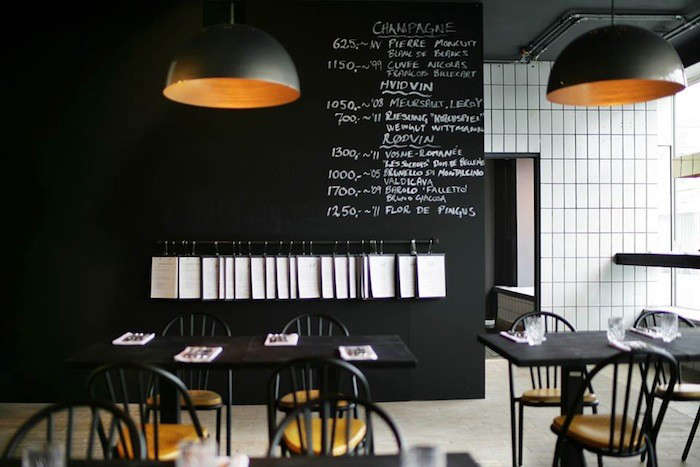
If KUL’s food story begins with fire, its design story begins with color. The restaurant is famous for its charcoal-toned interior, a choice that sounds obvious on paper but works because it is handled with discipline and restraint. The effect is moody without being gloomy, minimal without being cold, and theatrical without crossing into theme-park territory. This is not a restaurant that shouts. It glows.
Designed by Space Copenhagen, the interior plays with contrast: dark tones against white tiles, industrial bones against softer lighting, clean lines against the unruly life of flame and food. Coverage of the restaurant’s design has highlighted how the setting echoes the mechanics of grilling itself, with linear elements and strong graphic structure. That gives the room coherence. Nothing feels random. Even the darkness feels intentional, as though the space were built to let the food and the fire do the talking.
Just as important, KUL avoids the common trap of design-forward restaurants that look incredible in photos and vaguely uncomfortable in real life. The atmosphere is often described as casual, cozy, and relaxed. That is a bigger compliment than it may sound. Plenty of stylish restaurants nail “photogenic” and completely forget “pleasant.” KUL manages both. It looks like somewhere a design editor would recommend, but it also feels like somewhere normal people can enjoy themselves without worrying about whether they are holding the wrong fork. A triumph.
The Food Philosophy: Fire First, Borders Second
KUL’s culinary identity has always been tied to live-fire cooking. Reports on the restaurant’s concept emphasize a Spanish Josper oven and a Japanese yakitori grill, which together form the practical and symbolic center of the kitchen. That detail matters because it explains both the flavor profile and the broader mood. Fire does not just cook food; it edits it. It adds smoke, texture, edge, and a kind of primal honesty. A grilled ingredient has nowhere to hide, which is exactly why it can be so satisfying when done well.
What makes KUL especially interesting is how that fire-based approach supports a menu style that is not locked into one national tradition. Past reviews have pointed to combinations that jump between Asia and the Mediterranean while still drawing on Nordic ingredients and Danish produce. Seafood, meat, vegetables, acidic notes, creamy elements, smoky undertones, and bright garnishes all show up in the restaurant’s identity. This gives KUL a restless, modern energy. It is not pretending borders do not exist; it just refuses to let them become boring.
That globally minded approach feels especially smart in Copenhagen, where diners have grown used to precision and quality but increasingly want more expressive flavor. KUL’s idea of sophistication is not minimalism for its own sake. It is balance. You get the rigor of a serious kitchen, but also the pleasure of food that actually wants to flirt with your taste buds. Sometimes dinner should challenge you. Sometimes dinner should just be really, really good at being dinner. KUL wisely chooses both.
What Diners Can Expect From the Menu Style
Because restaurants evolve, the exact menu at KUL can change, but the overall pattern is clear. Expect a sharing-friendly format with plates designed to keep the table active. This is not a one-plate-and-goodbye sort of place. It is a “let’s add one more” restaurant, which is often how the best evenings happen.
Historically, dishes associated with KUL have included combinations such as seafood with fruit and miso, tempura textures paired with cured meat, barbecued ribs with Asian accents, grilled asparagus finished with richer toppings, and desserts that lean playful rather than solemn. Drinks have also been part of the fun, with cocktails and wines often described as creative, eclectic, and capable of matching the menu’s international rhythm.
In practical terms, that means KUL works well for diners who like variety. If your ideal meal includes a little smoke, a little brightness, a little crunch, and the happy confusion of deciding whether to steal another bite from your friend’s plate, you are in the right place.
KUL Versus the New Nordic Stereotype
One of the most compelling things about KUL is how neatly it complicates the lazy international stereotype of Copenhagen food. Too often, outsiders imagine the city’s dining scene as a parade of tiny portions, foraged herbs, muted colors, and menu descriptions that sound like they were translated from a philosophy seminar. KUL reminds diners that Copenhagen can also be generous, darkly glamorous, and a little messy in the best possible way.
That does not mean KUL is anti-Nordic. Far from it. The restaurant still belongs to Copenhagen’s culture of quality ingredients, strong culinary technique, and considered atmosphere. What it does reject is narrowness. Reviews have noted that KUL steers away from the more rigid versions of the New Nordic formula and instead embraces bolder international flavors. In that sense, it feels less like a rebellion and more like the next chapter: a restaurant shaped by Nordic standards but liberated from Nordic orthodoxy.
For travelers, this makes KUL especially appealing. Not everyone wants their Copenhagen meal to be a once-in-a-lifetime tasting marathon booked six months in advance. Some people want a place that feels stylish, local, memorable, and easier to understand at first bite. KUL delivers that without becoming predictable. It is approachable, but it is not ordinary. That is a harder balance than it looks.
Who Should Book a Table at KUL
KUL is a smart pick for several kinds of diners. It works for design lovers who choose restaurants partly with their eyeballs. It works for food-focused travelers who want a break from ultra-formal tasting menus. It works for couples, groups of friends, and anyone who enjoys the social chemistry of shared plates and open kitchens. It also works for people who hear the words “charcoal grill” and immediately start making emotionally significant eye contact with the nearest steak knife.
It may be especially appealing to travelers who want Copenhagen flavor without Copenhagen fuss. KUL offers a sense of place through neighborhood, design, and culinary ambition, yet it remains welcoming. You do not need a crash course in Danish gastronomy to enjoy it. You just need curiosity, appetite, and perhaps the maturity to admit that ordering an extra dish was the correct choice all along.
If your dining priorities include atmosphere, strong grill technique, creative cross-cultural flavors, and a setting that feels both urban and intimate, KUL belongs on the shortlist.
An Evening at KUL: The Experience That Stays With You
Walk into KUL on a cool Copenhagen evening and the first thing you notice is not a plate. It is the room. The charcoal-gray palette wraps around you in a way that feels cinematic but not silly, like someone designed the space specifically to make everyone look a little more interesting. The neighborhood outside is industrial and energetic, but inside, the mood tightens into something warmer: flickers of light, soft shadows, clean surfaces, and the faint suggestion that something delicious is currently sizzling on the other side of the room.
Then the soundscape starts to matter. Glasses clink. Chairs scrape lightly. A server glides by with a dish that makes three nearby tables pause mid-conversation. From the open kitchen comes the unmistakable perfume of grilling: smoke, caramelization, heat, and anticipation. It is the kind of aroma that bypasses polite thought and goes directly to appetite. Your brain may still be admiring the design, but your stomach has already made its decision.
Sitting down at KUL feels less like entering a ceremony and more like joining a scene already in motion. That is part of the pleasure. The service style, based on long-standing descriptions of the restaurant, tends to feel informed without turning into a lecture. There is room for recommendations, room for wine, room for curiosity, and room for the wonderfully universal ritual of looking at the menu and immediately wanting more than one thing. As you should.
The meal itself unfolds in that ideal shared-plate rhythm where every arrival slightly improves the mood of the table. A grilled dish lands and releases a little cloud of heat. Something bright and acidic cuts through the richness. A texture you expected to be heavy turns out to be light. A sauce you meant to taste politely becomes something you are suddenly chasing across the plate with bread, spoon, or whatever dignity allows. KUL is the kind of restaurant that rewards enthusiasm, not restraint.
And then there is the visual pleasure of contrast. Dark room, vivid food. Simple surroundings, layered flavors. Industrial shell, surprisingly intimate evening. The restaurant never feels trapped by one identity. It is elegant, but not hushed. Casual, but not careless. International, but still unmistakably Copenhagen. That complexity is what gives the experience staying power. You do not leave thinking only about one dish; you leave thinking about the whole composition.
Maybe that is why KUL lingers in memory more effectively than flashier places. It is not trying to overwhelm you with novelty at every turn. Instead, it builds a coherent atmosphere where food, design, and neighborhood all speak the same language. Fire is the center of the story, but not the whole story. The real appeal is how everything around that fire has been edited, sharpened, and balanced so carefully that the evening feels effortless. Which, of course, is usually the best sign that a lot of thought went into it.
If Copenhagen dining at its most famous can sometimes feel like a rarefied performance, KUL feels like the after-hours conversation that people actually remember. It has style, confidence, and flavor to spare, but it also has ease. And that ease is powerful. It lets the city’s creativity feel human-sized. It lets a restaurant with serious culinary pedigree behave like a place where pleasure still gets top billing. In travel, as in life, that is often the difference between something you admire and something you genuinely love.
Final Thoughts
KUL earns its reputation not because it tries to outdo every restaurant in Copenhagen, but because it knows exactly what kind of restaurant it wants to be. It uses charcoal and fire as more than branding. It turns design into atmosphere instead of decoration. It borrows global flavors without losing its local footing. Most importantly, it offers an experience that feels distinctly Copenhagen while remaining refreshingly free of culinary self-importance.
For diners who want a restaurant that captures the city’s creativity, cosmopolitan energy, and design intelligence without disappearing into fine-dining theater, KUL is a compelling choice. It is stylish but not icy, ambitious but not exhausting, and modern without being mechanical. In other words, it is cool in the way people wish the word “cool” still worked: quietly, confidently, and with excellent food.