
Note: This article uses “ruined” in the playful, internet-culture sense. Casting criticism is subjective, and many of the actors below are talented performers who simply landed in roles that did not match the character, tone, source material, audience expectation, or basic laws of human believability.
When Great Roles Meet the Wrong Casting Choice
Hollywood casting is a bit like seasoning soup. The right actor can turn a good script into comfort food. The wrong actor can make the whole thing taste like someone dropped a car key into the bowl. A fantastic role is not just a costume, an accent, or a famous name on a poster. It is rhythm, chemistry, presence, timing, and that mysterious “yes, that is exactly who this character is” feeling audiences recognize instantly.
Sometimes the problem is not talent. In fact, some of the most famous miscast movie roles involve Oscar winners, box-office legends, beloved stars, and performers who later proved they could absolutely crush the right part. But a brilliant actor in the wrong role can feel like a luxury sports car trying to plow a cornfield: impressive machine, terrible assignment.
Below are 30 fantastic roles that many critics, fans, and pop-culture watchers believe were weakenedor in some cases steamrolledby casting that never quite fit. Grab popcorn. Maybe a helmet.
30 Miscast Movie Roles That Still Make Audiences Argue
1. John Wayne as Genghis Khan in The Conqueror
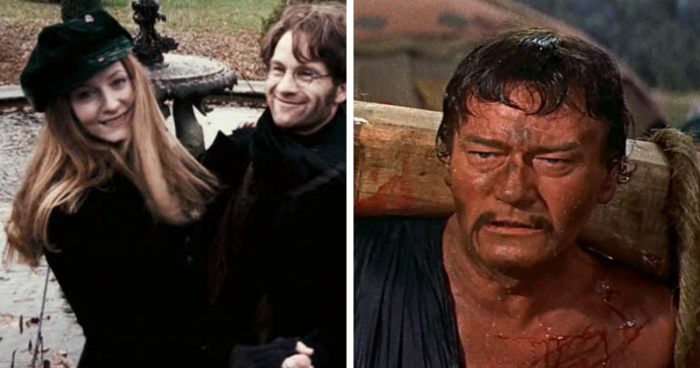
John Wayne was an American screen icon, but casting him as the Mongol emperor Genghis Khan remains one of Hollywood’s most baffling decisions. His cowboy swagger, American accent, and unmistakable persona overwhelmed the role. Instead of historical menace, audiences got “Genghis Wayne,” which sounds less like an empire builder and more like a steakhouse mascot.
2. Mickey Rooney as Mr. Yunioshi in Breakfast at Tiffany’s
Few casting choices have aged as badly as Mickey Rooney’s caricatured performance as Mr. Yunioshi. The role is now widely criticized for racial stereotyping, exaggerated makeup, and cartoonish behavior that clashes with the elegance of the rest of the film. Audrey Hepburn floats through the movie like champagne; this casting choice crashes in like a cymbal monkey.
3. Sofia Coppola as Mary Corleone in The Godfather Part III
Mary Corleone should have been the emotional center of Michael Corleone’s tragic final chapter. Instead, Sofia Coppola’s inexperienced performance became one of the most discussed weak points in the trilogy. The awkward line readings made the character feel less like a doomed daughter of a crime dynasty and more like someone wandered onto set during a family reunion.
4. Keanu Reeves as Jonathan Harker in Bram Stoker’s Dracula
Keanu Reeves has given us iconic roles in The Matrix and John Wick, but his Jonathan Harker remains a textbook example of accent trouble. Surrounded by gothic atmosphere, wild costumes, and Gary Oldman chewing scenery like a gourmet meal, Reeves’ stiff British accent pulled viewers out of the spell. The movie wanted Victorian dread; the performance delivered “excellent adventure abroad.”
5. Denise Richards as Dr. Christmas Jones in The World Is Not Enough
A nuclear physicist named Christmas Jones already sounds like something written on a cocktail napkin after three martinis. Denise Richards had screen presence, but many viewers struggled to buy her as a scientific genius defusing Bond-level nuclear danger. The role became infamous not because Bond movies are realisticthey are notbut because even Bond fantasy has a silliness limit.
6. Jesse Eisenberg as Lex Luthor in Batman v Superman: Dawn of Justice
Lex Luthor is usually imagined as cold, controlled, brilliant, and terrifyingly composed. Jesse Eisenberg’s version was twitchy, manic, and closer to a chaotic tech billionaire who accidentally drank eleven espressos. The concept might have worked in a different movie, but against the operatic gloom of Batman v Superman, the performance felt imported from another cinematic universe.
7. Ben Affleck as Daredevil in Daredevil
Before Affleck became a more convincing Batman, he played Matt Murdock in 2003’s Daredevil. The script did him no favors, but the casting never captured the agile, tortured, street-level intensity of the Marvel hero. The result felt more like a handsome lawyer attending a leather convention than the “Man Without Fear.”
8. George Clooney as Batman in Batman & Robin
George Clooney has charm for days, but Batman requires a certain haunted weirdness. Clooney’s Bruce Wayne looked like he might leave Gotham early to host a dinner party. The movie’s neon chaos, ice puns, and infamous suit design did most of the damage, but Clooney’s relaxed movie-star energy never made audiences fear for the soul of Gotham.
9. Jared Leto as the Joker in Suicide Squad
The Joker is one of cinema’s most dangerous playgrounds. Jared Leto entered with tattoos, grills, method-acting stories, and a laugh that seemed focus-grouped by a nightclub villain. The performance was not helped by limited screen time and choppy editing, but the final result felt more like “crime influencer” than agent of chaos.
10. Halle Berry as Catwoman in Catwoman
Halle Berry is a magnetic performer, but Catwoman did not give her Selina Kyle, Gotham, Batman, or much of a coherent identity. Technically, she played Patience Phillips, a new version of the character, but the role was trapped between superhero fantasy, beauty-product thriller, and leather-clad music video. Berry did not ruin Catwoman; the casting and concept put her in a cinematic litter box.
11. Topher Grace as Venom in Spider-Man 3
Eddie Brock is typically imagined as physically intimidating, bitter, and dangerous. Topher Grace brought a smirky, lightweight rival energy that made sense as Peter Parker’s annoying mirror image but not as Venom’s terrifying host. The idea had clever potential, yet the execution made one of Spider-Man’s scariest villains feel oddly snack-sized.
12. Hayden Christensen as Anakin Skywalker in the Star Wars Prequels
Anakin Skywalker’s fall should have been mythic heartbreak. Hayden Christensen certainly had the look, but the performance was weighed down by stiff dialogue, rushed romance, and emotional beats that often landed with a thud. In fairness, later reassessments have been kinder to him, but the original reaction showed how badly fans wanted Anakin to feel tragic rather than whiny.
13. Jake Lloyd as Young Anakin in The Phantom Menace
Young Anakin was a nearly impossible role: innocent child, future villain, sci-fi chosen one, podracing prodigy, and emotional anchor all at once. Jake Lloyd was a child actor handed a mountain of expectations. The casting and writing made the character too cute and too convenient, turning Darth Vader’s origin into something that felt closer to a space-camp brochure.
14. Noah Ringer as Aang in The Last Airbender
Aang from the animated series is playful, soulful, strange, and deeply expressive. The live-action version flattened that spark. Noah Ringer was inexperienced, and the film’s wooden dialogue and grim tone buried the character’s charm. When your Avatar has less bounce than a wet yoga mat, something has gone very wrong.
15. Dev Patel as Prince Zuko in The Last Airbender
Dev Patel is a strong actor, and he may be the best part of the movie. Still, the role was tangled in controversial casting decisions and a script that stripped Zuko of much of his animated complexity. The result was not a bad actor failing, but a talented actor fighting a losing battle against a misguided adaptation.
16. Dane DeHaan as Valerian in Valerian and the City of a Thousand Planets
Luc Besson’s sci-fi world needed a swaggering space adventurer. Dane DeHaan brought intensity, but not the breezy rogue charisma the role demanded. The movie looked expensive, colorful, and imaginative, yet its hero often felt like a moody graduate student pretending to be Han Solo during a group project.
17. Cara Delevingne as Laureline in Valerian and the City of a Thousand Planets
Laureline should have been sharp, dynamic, and magnetic enough to match the film’s visual madness. Cara Delevingne had attitude, but the chemistry with DeHaan rarely sparked. In a movie full of alien worlds, the strangest thing was how little romantic voltage the leads generated.
18. Russell Crowe as Javert in Les Misérables
Russell Crowe can command a battlefield, a courtroom, and a Roman arena. A demanding musical role, however, is a different beast. Javert needs vocal power and moral thunder. Crowe’s restrained singing made the character feel less like an unstoppable force of law and more like a tired manager delivering bad news through song.
19. Cameron Diaz as Jenny Everdeane in Gangs of New York
Martin Scorsese’s epic is packed with huge performances, especially Daniel Day-Lewis as Bill the Butcher. Cameron Diaz, though talented in the right roles, seemed slightly out of sync with the film’s brutal historical atmosphere. Her accent and presence did not fully blend into the mud, blood, and theatrical menace surrounding her.
20. Vince Vaughn as Norman Bates in Psycho
Anthony Perkins made Norman Bates frightening because he seemed fragile, lonely, and unknowable. Vince Vaughn’s version in the 1998 remake felt too physically imposing and self-conscious. Since the remake copied Hitchcock’s original so closely, every difference stood outand Vaughn had the impossible task of replacing a performance that should have been left in the museum.
21. Kevin Costner as Robin Hood in Robin Hood: Prince of Thieves
Kevin Costner’s Robin Hood is beloved by some and mocked by others, mostly because of the accent situation. Or lack of accent situation. The movie has adventure, Alan Rickman going gloriously overboard, and real entertainment value, but Costner’s modern American delivery makes medieval England feel suspiciously close to California.
22. Colin Farrell as Alexander in Alexander
Alexander the Great should be larger than life: brilliant, frightening, seductive, impossible to ignore. Colin Farrell is talented, but the blond wig, uneven accent choices, and overstuffed historical drama made his Alexander feel less like a world-conqueror and more like a stressed nightclub promoter with an army.
23. Ashton Kutcher as Steve Jobs in Jobs
Ashton Kutcher physically resembled Steve Jobs, and he clearly worked hard on the walk and mannerisms. Still, many viewers felt the performance leaned toward imitation rather than revelation. The role needed volcanic genius, cruelty, charm, and obsession. Too often, the movie delivered a museum animatronic that occasionally said “innovation.”
24. Johnny Depp as Tonto in The Lone Ranger
Johnny Depp’s Tonto became controversial for its eccentric presentation and cultural baggage. The role was meant to reinvent a dated sidekick, but the performance pulled attention away from the story while raising questions about representation. It was quirky, yes, but quirky does not automatically mean thoughtful. Sometimes it just means there is a bird on your head.
25. Emma Stone as Allison Ng in Aloha
Emma Stone is one of her generation’s most appealing actors, but casting her as a character described as having Asian and Hawaiian heritage triggered immediate criticism. Director Cameron Crowe later apologized for the choice. The controversy became bigger than the movie, proving that even a likable star cannot charm her way out of a role audiences see as fundamentally mismatched.
26. Zoe Saldaña as Nina Simone in Nina
Nina Simone’s identity, appearance, voice, politics, and pain were central to her legacy. Zoe Saldaña’s casting drew backlash, especially because makeup and prosthetics were used to alter her appearance. Saldaña later expressed regret for taking the role. This was not simply “wrong actor” discourse; it became a larger conversation about colorism, authenticity, and who gets to portray cultural icons.
27. Scarlett Johansson as Major Mira Killian in Ghost in the Shell
The live-action Ghost in the Shell faced whitewashing criticism after Scarlett Johansson was cast in a role rooted in Japanese manga and anime history. Johansson has proven action-star presence, but the casting debate overshadowed the film before it opened. The movie wanted cyberpunk philosophy; the audience conversation became about representation.
28. Gerard Butler as Set in Gods of Egypt
Gods of Egypt had many problems, but its casting of mostly white actors as Egyptian gods became the headline controversy. Gerard Butler brought brawny villain energy, but the broader casting choices made the mythological world feel culturally disconnected from its own setting. Even before release, the studio and director apologized for the lack of diversity.
29. Mark Wahlberg as Cade Yeager in Transformers: Age of Extinction
Mark Wahlberg as a rugged inventor could have worked in a smaller, goofier movie. In Transformers, the character felt like someone wrote “genius mechanic dad” on a whiteboard and then asked Wahlberg to solve alien robotics with biceps and concern. The casting leaned so hard on star persona that the inventor part never fully booted up.
30. The Leads in Fifty Shades of Grey
Dakota Johnson and Jamie Dornan are capable actors, but the central fantasy of Fifty Shades of Grey depends almost entirely on chemistry. Many viewers felt the pairing lacked the dangerous spark needed to sell the story’s romance. When a movie is built on erotic tension and audiences mostly notice awkward pauses, that is not a red room. That is a beige conference call.
Why Wrong Casting Hurts a Great Role
Miscasting hurts because audiences do not watch characters as checklists. They watch for believability. A role can be physically wrong, vocally wrong, emotionally wrong, culturally wrong, or tonally wrong. Sometimes the actor is too famous, and the audience sees the celebrity instead of the character. Sometimes the actor is not famous enough, and the role demands authority they have not yet developed. Sometimes the whole production is broken, and the actor becomes the visible crack in the wall.
The most fascinating thing about the worst casting choices in movies is that they often teach the same lesson as the best casting choices: fit matters. Robert Downey Jr. as Tony Stark worked because actor and character fused. Heath Ledger as the Joker shocked people before release, then became legendary because he transformed skepticism into electricity. Hugh Jackman was considered too tall for Wolverine by comic standards, then owned the role for decades because he captured the spirit. Great casting is not always obvious. Bad casting, unfortunately, usually announces itself with a marching band.
Experiences Related to Miscast Roles: What Viewers Actually Feel
Anyone who loves movies has experienced the strange discomfort of watching the wrong actor in a promising role. It starts quietly. You want to enjoy the film. You bought snacks. You cleared your evening. You may even have defended the casting online before release because optimism is cheaper than therapy. Then the actor appears, says one line, and a tiny alarm bell rings in your brain.
At first, you negotiate with yourself. Maybe the performance will settle. Maybe the accent will improve. Maybe the character is supposed to feel awkward. Maybe the wig is not as distracting as it looks. Ten minutes later, the alarm bell has become a full church service. Instead of following the story, you begin watching the performance as a separate object. You notice every pause, every line reading, every facial expression that does not belong in the scene. The movie is still playing, but your immersion has packed a suitcase and left.
This is why miscasting is so powerful. A weak visual effect can be forgiven if the emotion works. A plot hole can be ignored if the characters are compelling. But the wrong actor sits at the center of the frame. You cannot edit around them forever. They are the face of the story. When they do not fit, the audience feels it in real time.
There is also a social experience to miscasting. Some performances become inside jokes among friends. Someone says “nuclear physicist Christmas Jones,” and the whole table understands. Someone mentions Keanu’s Dracula accent, and suddenly everyone is doing terrible British voices over fries. Bad casting choices become part of movie culture because they are easy to remember. They give audiences a shared language for disappointment.
Yet the experience is not always cruel. Sometimes a miscast role becomes oddly lovable. Kevin Costner’s Robin Hood may not sound like Sherwood Forest, but plenty of people still enjoy the movie. Russell Crowe’s Javert may not satisfy musical purists, but his seriousness has defenders. Even Batman & Robin has fans who appreciate its neon toy-box insanity. Time can soften a bad casting choice into camp, nostalgia, or cult pleasure.
The real lesson for viewers is that casting is invisible only when it works. When it is right, we stop thinking about the actor and believe in the person on screen. When it is wrong, the movie becomes a guessing game: Who would have done this better? That question is fun, but it is also fatal. The moment audiences start recasting the film in their heads, the spell is broken.
Conclusion
Bad casting does not always mean bad acting. Often, it means the wrong energy met the wrong material at the wrong time. Some actors on this list are brilliant. Some later redeemed themselves in roles that fit like custom armor. Others became cautionary tales for casting directors everywhere.
The best movie roles feel inevitable. The worst casting choices feel like alternate-universe glitches. Whether it is John Wayne as Genghis Khan, Sofia Coppola in The Godfather Part III, Jesse Eisenberg as Lex Luthor, or Zoe Saldaña as Nina Simone, these examples prove that performance is not just about skill. It is about alignment. The actor must serve the character, the story, the world, and the audience’s suspension of disbelief.
When that alignment fails, even a fantastic role can collapse. And when it collapses spectacularly, the internet will be there forever, holding popcorn and typing, “Who approved this?”


