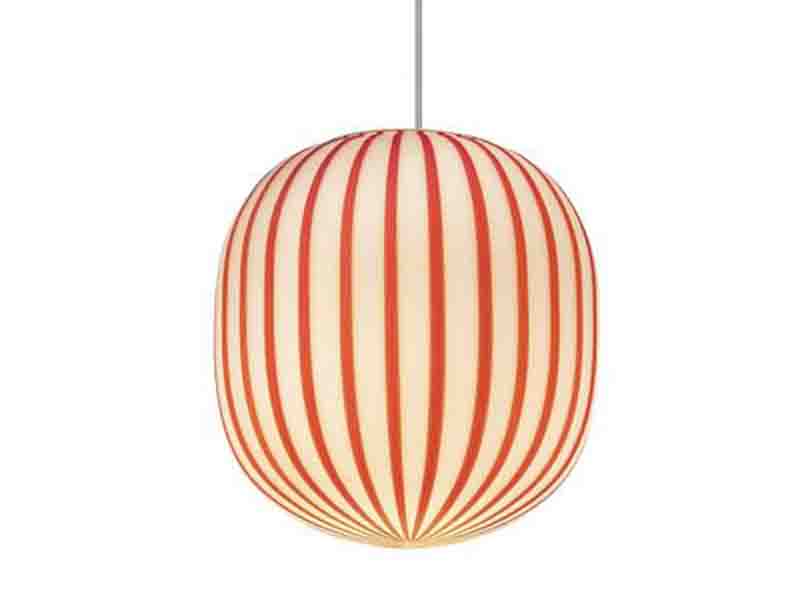

The Filigrana S2 Cylinder Pendant is the sort of light that makes a room look more considered before anyone has even found the dimmer switch. Designed by Sebastian Wrong for Established & Sons, it combines a compact cylindrical silhouette with striped, mouth-blown glass inspired by the centuries-old Venetian filigrana tradition. The result is playful but not childish, decorative but not fussy, and small enough to work in places where a giant statement chandelier would feel like a parade float parked over the breakfast table.
Its charm comes from contrast. The shape is simple; the glassmaking is complex. The shade looks soft and almost powdery because its surface is acid-etched, yet colored glass canes remain clearly visible as vertical candy stripes. When illuminated, the pendant becomes warmer and more atmospheric. When switched off, it still behaves like a small piece of sculptural glass. That ability to earn its keep during both daylight and dinner is a major reason the Filigrana S2 has lasting appeal.
What Is the Filigrana S2 Cylinder Pendant?
The Filigrana S2 Cylinder Pendant is the smallest cylindrical suspension light in the broader Filigrana family. The official size is 220 millimeters in diameter by 230 millimeters high, or roughly 8.7 inches wide by 9.1 inches tall. That modest footprint makes it especially useful above kitchen counters, compact dining tables, bedside surfaces, reading corners, and reception desks. It can stand alone, but its scale also invites repetition in pairs or rows.
The design debuted in 2018 and has continued as part of the Filigrana collection. In the United States, the S2 is commonly offered with black, blue, or red glass canes. The base shade is pale and translucent rather than crystal clear, so the stripes appear embedded in a softly glowing body. This is not a pendant that tries to blast every corner of a room with stadium-level brightness. Its strength is focused, diffused illumination with a decorative presence.
Key Specifications at a Glance
| Designer | Sebastian Wrong |
|---|---|
| Brand | Established & Sons |
| Original design year | 2018 |
| Shade dimensions | Approximately 8.7 inches in diameter by 9.1 inches high |
| Primary material | Acid-etched, mouth-blown glass |
| Hardware | Powder-coated steel fixings and suspension components |
| Typical U.S. bulb specification | One 9-watt E26 LED bulb, sold separately |
| Color options commonly listed | Black, blue, or red canes |
| Approximate weight | About 4.2 pounds |
A Modern Interpretation of Filigrana Glass
The name “filigrana” refers to filigree glass, a method associated with Murano beginning in the 16th century. Traditional filigrana uses clear, white, or colored glass canes to create delicate linear, twisted, or netlike patterns inside blown glass. It is an old technique with a surprisingly contemporary visual language. Stripes, grids, repetition, and optical rhythm were cool long before a branding agency called them “modern.”
For the S2 pendant, that heritage is translated rather than copied. The cylinder is deliberately plain, allowing the glass canes to become the main graphic feature. Colored lines travel vertically through the rounded shade, producing a pattern that feels orderly from a distance and handmade up close. Slight variations are part of the character of mouth-blown production. The lines may not behave with the machine-perfect obedience of a printed lampshade, and that is precisely the point.
It is also worth distinguishing inspiration from origin. The Filigrana S2 draws on Venetian and Murano glassmaking traditions, while current U.S. retail specifications identify the finished fixture as made in China. Buyers should therefore view it as a contemporary designer light that applies historic glass techniques, not as an antique or a pendant necessarily manufactured on Murano.
Why the Glass Looks So Good When Lit
The shade is mouth-blown and then acid-etched. Acid etching creates a matte, frosted surface that softens the visible bulb and spreads light more gently than clear glass. Instead of staring into a tiny artificial sun, you see a calm glow with the colored canes floating through it. The pendant still directs useful light downward, but the shade adds ambient brightness around the fixture.
This balance matters in rooms that serve more than one purpose. Over a kitchen island, the S2 can support casual food preparation while making the room feel warmer after the cutting boards are put away. Over a dining table, it offers enough visual focus to define the eating area without turning every meal into an interrogation scene. A compatible dimmer improves that flexibility, although the LED bulb and dimmer must be designed to work together.
For most residential settings, a warm-white LED in the 2700K to 3000K range will flatter the frosted glass and reinforce its cozy character. A cooler bulb can make the shade appear crisper and more graphic, but it may reduce the candlelike mood many people expect from decorative pendant lighting. Brightness should be selected according to room function rather than wattage alone; LED output is better compared in lumens.
Where the Filigrana S2 Works Best
Above a Kitchen Island
The S2 is well suited to a row of two or three pendants above a modest island. Its 8.7-inch diameter is substantial enough to be noticed but narrow enough to preserve open sightlines. The colored stripes can introduce personality into an otherwise quiet kitchen of wood, stone, stainless steel, or painted cabinetry. Black canes create the most architectural look, blue feels clean and slightly coastal, and red adds cheerful contrast without requiring an entire red kitchenwhich is a commitment roughly equivalent to naming a boat.
Over a Small Dining Table
A single S2 can work above a bistro table or breakfast nook, particularly where the goal is intimacy rather than broad room illumination. General guidance often places a pendant roughly 28 to 32 inches above a tabletop, but the final height should account for ceiling height, sightlines, the user’s height, and the brightness of the bulb. The shade should feel connected to the table without blocking conversation.
Beside a Bed or Reading Chair
Installed as a bedside pendant, the S2 frees space on the nightstand and adds a boutique-hotel effect. The frosted shade is visually softer than exposed-bulb designs, although the downward light can still be too bright for late-night use unless dimmed. Beside a reading chair, it works best as one layer in a broader lighting plan rather than the room’s only source of illumination.
In Commercial and Hospitality Interiors
The pendant’s compact size and memorable pattern also suit cafés, hotel bars, retail counters, and reception areas. Repeated fixtures can create rhythm without relying on an oversized centerpiece. Because each shade has handcrafted variation, a group feels coordinated rather than cloned. Designers should still verify electrical listings, local code requirements, ceiling support, and maintenance access for the specific project.
Choosing Black, Blue, or Red Canes
Black is the safest option for minimalist, industrial, monochrome, and modern interiors. It visually connects with black faucets, window frames, chair legs, cabinet pulls, and other dark details. Because the shade itself remains pale, the result is graphic rather than heavy.
Blue works particularly well with white oak, walnut, navy cabinetry, terrazzo, soft gray stone, and rooms with plenty of natural light. It reads as fresh and artful without demanding attention every second. Red is the boldest choice. It pairs effectively with warm woods, brick, burgundy accents, colorful art, and playful postmodern interiors. In a neutral room, one red pendant can act as a controlled jolt of colorespresso for the décor, not an energy drink spilled across the floor.
When using several pendants, matching colors creates calm repetition. Mixing colors makes the installation more expressive, but the rest of the room should give that combination room to breathe. A trio of red, blue, and black canes already has plenty to say; it does not need twelve competing throw pillows serving as backup singers.
Installation, Bulb Selection, and Everyday Care
The Filigrana S2 requires hardwired ceiling installation and assembly. Because glass is fragile and the fixture weighs a little over four pounds before considering installation hardware, professional installation is the sensible route for most homeowners. An electrician can confirm the junction box, canopy fit, grounding, dimmer compatibility, and final hanging height.
U.S. listings generally specify one E26 LED bulb, often at 9 watts, with the bulb sold separately. Choose a dimmable bulb only when the wall control is also LED-compatible. Mismatched bulbs and dimmers can cause flickering, buzzing, a limited dimming range, or a dramatic little strobe effect nobody ordered. An enclosed-fixture-rated bulb is a prudent choice because decorative glass shades can retain heat differently from open fixtures.
For cleaning, switch off the fixture, allow the bulb and glass to cool, and dust the shade with a clean microfiber cloth. Avoid abrasive cleaners, rough sponges, and aggressive scrubbing that could alter the etched finish. If fingerprints or kitchen residue require more attention, use a lightly dampened soft cloth and follow the manufacturer’s care instructions. Support the shade carefully rather than twisting or pulling on the suspension components.
Is the Filigrana S2 Cylinder Pendant Worth It?
The S2 makes the most sense for buyers who value craft, design history, and atmosphere as much as raw brightness. Less expensive striped glass pendants exist, but they may not offer the same combination of mouth-blown construction, acid-etched diffusion, balanced proportions, and recognizable designer authorship. The Filigrana is not simply a socket wearing a pretty hat; the glass process is the product.
It may be less suitable for someone seeking maximum task light from one fixture, a large centerpiece for a grand room, or a perfectly uniform factory-made shade. Handcrafted variation is an advantage only when you actually like handcrafted variation. It is also an indoor decorative fixture, so buyers should not assume suitability for damp bathrooms, covered patios, or outdoor locations unless the exact model’s rating explicitly permits it.
Living With the Filigrana S2: A Realistic 500-Word Experience
The first thing people tend to notice is not the size but the surface. In product photos, the Filigrana S2 can look almost like a neatly printed cylinder. In a room, the mouth-blown glass has more depth. The colored canes appear to sit within the shade rather than on top of it, and the acid-etched finish catches daylight without becoming shiny. During the day, the pendant behaves like a small graphic object. It adds vertical rhythm to the room even when it is switched off.
Imagine installing two black-cane S2 pendants above a six-foot kitchen island. Before installation, their compact dimensions may seem almost too restrained. Once suspended, that restraint becomes useful. The fixtures do not compete with upper cabinets or block the view into the next room. Their stripes echo black cabinet hardware, while the milky glass softens a kitchen dominated by hard stone and metal. They make the island feel like a destination instead of merely a countertop that happens to be floating in the middle of the floor.
The evening experience is where the design earns its reputation. With warm 2700K LEDs at full brightness, the pendants provide a practical pool of light for serving food, checking homework, or locating the snacks someone definitely did not hide behind the cereal. Dimmed to roughly half output, the glass shifts from practical to atmospheric. The stripes remain visible, but the shade develops a warmer, lanternlike presence. Because the bulb is screened by etched glass, glare is reduced compared with a clear globe or exposed filament lamp.
There are practical lessons, too. Hanging height matters more than expected. Too high, and the S2 looks disconnected from the surface below; too low, and it interrupts eye contact or becomes a target for enthusiastic hand gestures. Starting near the usual tabletop or counter guidelines and adjusting for the room produces a better result than treating one measurement as sacred law. A cardboard template or temporary balloon of similar size can help test scale before the electrician arrives.
Bulb choice also changes the character dramatically. A high-output, cool-white bulb can make the pendant feel clinical, emphasizing the stripes but flattening the warmth of the glass. A warm, high-quality dimmable LED generally creates a more flattering effect. Good color rendering is valuable above food, wood, art, and skin tones. Nobody buys a carefully crafted glass pendant hoping dinner will look vaguely gray.
Maintenance is uncomplicated but more visible in kitchens. The matte surface disguises minor dust better than clear glass, yet cooking residue can gradually dull it. A gentle microfiber wipe keeps the shade looking fresh. The key is patience: support the glass, avoid abrasive chemicals, and do not clean it while hot. In a bedroom or dining area, cleaning will usually be less frequent.
Over time, the most satisfying aspect is versatility. The S2 does not depend on a loud trend or an elaborate silhouette. Its cylinder is quiet enough to coexist with changing furniture, while the striped glass prevents it from becoming anonymous. It can move from a kitchen to a reading nook or from a single installation to a grouped arrangement. That adaptability helps justify choosing a designer pendant over a disposable fixture selected during a late-night scroll.
The possible disappointment is scale. In a double-height foyer or above a very large dining table, one S2 may look lonely. That is not a failure of the design; it is a mismatch between object and architecture. The S2 is at its best when used intimately, repeated rhythmically, or placed where people can appreciate the glass at close range. Treat it like a beautifully made cup rather than a monumental vase, and its proportions make perfect sense.
Conclusion
The Filigrana S2 Cylinder Pendant succeeds because it turns a historic glassmaking idea into a compact, approachable contemporary light. Sebastian Wrong’s design lets striped canes, frosted texture, and a clean cylinder do the work without decorative clutter. It offers soft diffusion, useful downward illumination, and enough visual personality to anchor a small table, kitchen island, bedside area, or hospitality setting.
Choose it for craftsmanship, atmosphere, and the pleasure of an object that still looks intentional when switched off. Plan the hanging height carefully, pair it with a warm dimmable LED, and respect its modest scale. Do that, and the Filigrana S2 becomes more than a pendantit becomes the room’s quietest conversation starter.


