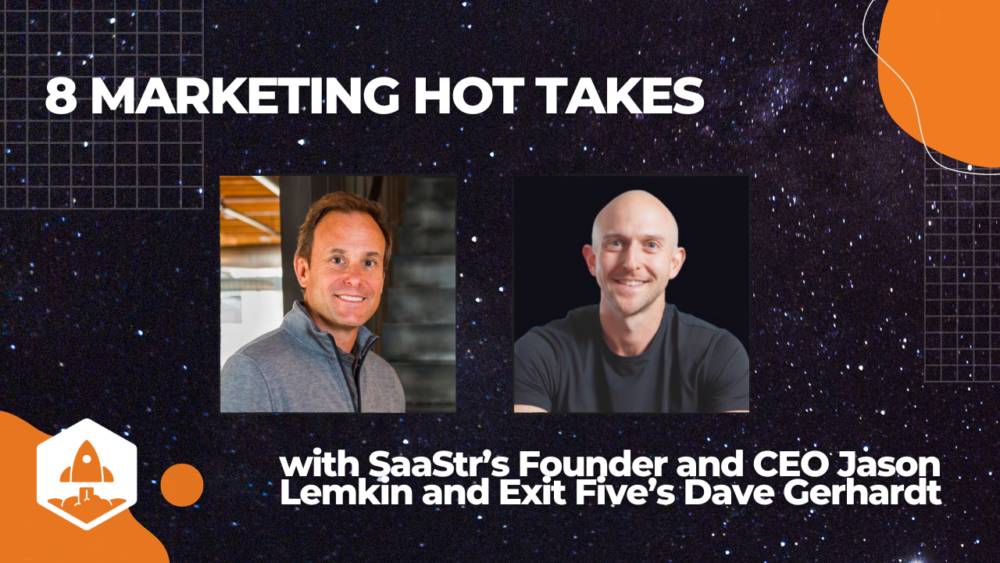
7 Marketing Hot Takes with SaaStr Founder and CEO Jason Lemkin on the Exit Five Podcast

Marketing in SaaS has always been a strange little circus: part math lab, part psychology experiment, part “please explain why pipeline is down before the board meeting.” When SaaStr founder and CEO Jason Lemkin joined Dave Gerhardt on the Exit Five Podcast, the conversation delivered exactly what B2B marketers love and fear: blunt opinions, practical startup wisdom, and just enough uncomfortable truth to make every CMO quietly open a spreadsheet.
The episode explored how SaaS marketing has changed since 2020, what makes a great VP of Marketing, why content still works, and why having marketing report to the CRO may sound tidy on an org chart but can become a very expensive way to remove healthy tension from the business. In other words, it was a marketing therapy session with a revenue dashboard.
This article breaks down the seven biggest marketing hot takes from Jason Lemkin’s Exit Five appearance and translates them into practical lessons for SaaS founders, CMOs, demand generation leaders, content marketers, and anyone who has ever asked, “Should we do another webinar?” The answer, annoyingly, is often yesif it is actually good.
Why This Conversation Matters for SaaS Marketing Teams
Jason Lemkin has a rare vantage point in the SaaS world. He founded EchoSign, which was acquired by Adobe, built SaaStr into one of the best-known communities for SaaS executives and founders, and has spent years advising, investing in, and arguing with startup leaders about what really drives growth. Dave Gerhardt, through Exit Five, brings the operator’s lens: messaging, content, community, and the real-life chaos of building marketing systems that do not collapse the moment one person goes on vacation.
The result is a conversation that goes beyond generic “build your brand” advice. The hot takes are useful because they are not designed to make everyone feel cozy. They poke at common SaaS assumptions: that everyone wants to hustle, that solopreneurship is always freedom, that a VP of Marketing should mainly be a strategist, that content needs to be perfect, and that putting sales and marketing under one revenue leader automatically creates alignment.
Spoiler: alignment is not the same as silence. Sometimes the best marketing organization needs constructive friction, clear ownership, and people willing to do the unglamorous work. Yes, that includes list building. No, the spreadsheet will not fill itself.
Hot Take #1: SaaS Sales and Marketing Changed After 2020
The first big takeaway is that the SaaS labor market, buyer behavior, and team expectations changed dramatically after 2020. During the growth-at-all-costs era, many companies hired quickly, spent aggressively, and treated abundant capital like a permanent weather pattern. Then the climate changed. Budgets tightened. Investors wanted efficiency. Teams had to do more with less.
Lemkin’s point is not simply that people became lazy or that companies became cruel. The reality is more layered. Burnout is real. Remote work changed expectations. The tech boom attracted people who wanted the upside of SaaS but not always the messy operator work that makes early-stage companies grow. Meanwhile, founders still need pipeline, customers, renewals, and revenue. The market does not pause because the team is “recalibrating its energy.”
What SaaS Marketers Should Do
Marketing leaders should design teams around ownership, not titles. A startup does not need five “strategists” who can discuss narrative architecture for two hours but cannot ship a campaign. It needs people who can identify a customer segment, build the list, write the copy, launch the email, analyze the result, and improve the next version.
This does not mean hiring robots with laptops. It means looking for what Lemkin calls the passionate, quirky buildersthe people who enjoy the craft enough to keep improving it. In SaaS marketing, those people are gold. They do not just “manage content.” They notice customer language. They talk to sales. They improve landing pages. They care when a webinar title is boring enough to make a browser tab fall asleep.
Hot Take #2: Motivation Changes, But Builders Keep Building
Another memorable theme from the Exit Five Podcast conversation is motivation. Why do founders and marketing leaders keep going after they have already had success? Why build another company, another community, another event, another media engine?
Lemkin’s answer can be summarized simply: builders build. In the early days, the motivation may be survival, meaning, or proving something to yourself. Later, it may become intellectual stimulation, community, customer impact, or the sheer fun of solving a hard puzzle. For many SaaS founders, the company becomes a living system. Every pricing change, campaign, hire, product update, and customer conversation moves a piece of the puzzle.
For marketers, this matters because motivation affects consistency. Great marketing rarely comes from one heroic launch. It comes from repeated, thoughtful execution: publishing, testing, interviewing customers, improving positioning, refining offers, and building trust over time. The marketing team that only performs when inspiration arrives is like a gym membership in Januaryfull of promise, suspicious by March.
The Practical Lesson
Build marketing programs that people can stay excited about. If your content lead hates podcasts, forcing a weekly show may create 12 episodes and one resignation letter. If your founder loves writing punchy LinkedIn posts, turn that into a repeatable distribution system. If your customers love deep technical webinars, make those webinars excellent instead of chasing every shiny channel on the internet.
Motivation is not fluffy. It is operational fuel. When a team likes the work enough to keep doing it, consistency becomes easierand consistency is one of the most underrated advantages in B2B marketing.
Hot Take #3: Solopreneurship Is Not Always the Dream
Solopreneurship has become one of the internet’s favorite fairy tales. Quit your job, start a newsletter, sell a course, post screenshots of revenue, and enjoy artisanal coffee while passive income rains gently from the cloud. Lovely story. Occasionally true. Frequently missing 47 important details.
Lemkin’s hot take is that solopreneurship can have a toxic edge when it convinces talented people that any normal job is failure. Not everyone needs to leave a strong role to chase a creator business. Not everyone wants the loneliness, uncertainty, and constant self-promotion that come with building alone. A six-figure SaaS job may look boring compared with a viral post, but boring can also pay the mortgage and come with health insurance. Revolutionary concept.
For marketers, the lesson is especially relevant because content creators often make independence look effortless. But behind every successful solo media business is a stack of invisible work: audience research, editing, sponsorship sales, customer support, product creation, bookkeeping, and the emotional thrill ride of wondering why last Tuesday’s post got 19 likes.
How This Applies to SaaS Teams
Marketing leaders should not dismiss creator energy. In fact, SaaS companies can learn a lot from solo creators: speed, voice, audience intimacy, and distribution discipline. But companies should also help marketers find ownership inside the organization. Give strong people a lane. Let them build a newsletter, run a community, own a content series, or lead a campaign from idea to revenue impact.
When employees can create, experiment, and see results inside the company, the “I must quit to do meaningful work” feeling becomes less intense. Sometimes the best retention strategy is not another perk. It is letting talented people build something they are proud of.
Hot Take #4: Content Creation Works When It Is Natural, Repeatable, and Useful
Jason Lemkin’s content process is one of the most practical parts of the conversation. He has been prolific for years, but the lesson is not “write 365 days a year or you are doomed.” The lesson is to find the format that feels natural enough to repeat.
For Lemkin, writing is fast because many ideas are already formed in his head through years of operating, investing, and answering founder questions. He can turn lived experience into concise, useful content. That is very different from staring at a blank document and asking a content calendar to please become a personality.
He also updates older content rather than treating every post as disposable. That is a powerful SaaS content marketing lesson. Many B2B companies sit on years of valuable material that has become outdated, buried, or slightly dusty. Refreshing strong content can be more effective than producing endless new articles that say the same thing with different stock photos of people pointing at glass walls.
The Better Content Strategy
Great SaaS content should do three things: answer real buyer questions, reflect a clear point of view, and improve with time. That may include founder-led LinkedIn posts, SEO articles, customer stories, webinars, newsletters, podcasts, or product education. The format matters less than the quality and distribution.
Modern B2B buyers are doing more research before talking to sales. That means content is no longer just “top of funnel.” It is sales enablement, objection handling, category education, competitive positioning, and trust building. Your blog post may be read by a champion building an internal business case. Your webinar may be watched by a CFO who never fills out a demo form. Your podcast may influence a future buyer six months before attribution software wakes up and takes credit.
Hot Take #5: A Great VP of Marketing Generates Pipeline and Rolls Up Their Sleeves
One of Lemkin’s clearest points is that the core job of B2B SaaS marketing has not changed as much as people think. Tools evolve. Channels shift. AI enters the chat wearing a very confident blazer. But in most sales-led SaaS companies, marketing still has to put qualified demand into the funnel and help move it through.
A great VP of Marketing understands brand, demand generation, field marketing, content, events, lifecycle, product marketing, and sales alignmentbut they also understand stage. A $3 million ARR company does not need the same marketing structure as a $300 million ARR company. Early teams need leaders who can think strategically and execute directly. If the webinar platform breaks, they do not stare at it like it is a haunted toaster. They fix the problem.
This is where many hiring mistakes happen. Founders hire a big-company marketer too early, expecting magic. The marketer expects a team, budget, infrastructure, clean data, and three agencies. Instead, they find one overworked sales rep, a CRM with mysterious fields, and a homepage last updated during a product pivot. Everyone is disappointed by Wednesday.
What to Look for in a SaaS Marketing Leader
Look for stage fit. The right VP of Marketing can explain how they would create pipeline with your current budget, current ACV, current sales cycle, and current team. They should know which channels are worth testing now and which should wait. They should be able to talk about numbers without needing a three-day spiritual retreat inside Salesforce.
Most importantly, they should not be allergic to execution. Strategy is essential, but in SaaS, strategy without shipping is just a nicely formatted wish.
Hot Take #6: Founders and Marketers Must Align on the Top Three Priorities
Lemkin argues that founders often ask the wrong questions when hiring marketing leaders. Instead of starting with vague expectations like “make us famous” or “fix demand,” founders should ask what the candidate’s top three marketing priorities would be. Marketers should ask founders the same question in reverse.
This sounds simple because it is simple. It is also rarely done well. A founder may want category leadership, enterprise pipeline, and better product messaging. A marketing candidate may want to rebuild the website, launch a podcast, and hire a brand agency. None of those are automatically wrong, but if the priorities do not match, the relationship is already carrying a piano uphill.
In founder-led SaaS companies, the CEO often acts as the real CMO, especially in the early stages. The founder has strong instincts about market, product, audience, and story. A marketing leader does not need to become an order taker, but they do need to understand the founder’s vision and decide whether they can support it.
The Interview Question That Saves Everyone Time
Ask this: “What are the three most important marketing outcomes we need in the next 12 months?” Then compare answers. If one person says pipeline, positioning, and enterprise credibility while the other says TikTok, swag, and a brand manifesto, congratulationsyou have discovered the mismatch before it became an expensive calendar invite.
Alignment does not mean identical thinking. It means shared priorities. Healthy disagreement can improve decisions, but strategic mismatch drains energy, slows execution, and usually ends with someone posting a reflective LinkedIn update about “new chapters.”
Hot Take #7: Having the CMO Report to the CRO Is Usually a Bad Idea
Few topics in SaaS org design create more debate than whether marketing should report to the CRO. On paper, it sounds efficient. Sales and marketing share revenue goals, so why not put them under one leader? One team, one number, one neat little org chart. What could possibly go wrong besides everything?
Lemkin’s argument is that marketing reporting to the CRO can remove necessary checks and balances. Sales is naturally focused on near-term revenue. That is not a flaw; it is the job. But marketing also needs to protect longer-term investments: brand, category creation, customer education, community, content, events, and market perception. If everything is filtered through this month’s number, marketing can become a short-term lead machine with no strategic memory.
The same issue can appear when customer success reports into revenue leadership without enough independent focus on customer health. Sales wants to close. Marketing wants to create and convert demand. Customer success wants customers to achieve value and renew. These functions should collaborate intensely, but they are not the same function.
The Better Model
Marketing should have a strong seat at the executive table and a direct relationship with the CEO. The CMO and CRO should be deeply aligned on pipeline definitions, conversion rates, campaign priorities, account strategy, and revenue targets. But alignment does not require subordination. In many SaaS companies, the best model is productive tension: marketing challenges sales, sales challenges marketing, and both teams are forced to improve.
When the tension is healthy, leads get better, follow-up improves, messaging sharpens, and the company learns faster. When the tension disappears, bad habits hide politely in dashboards.
What These Hot Takes Reveal About Modern SaaS Marketing
Taken together, these seven hot takes point to a bigger truth: SaaS marketing is becoming more human and more operational at the same time. Buyers want trust, clarity, expertise, and proof. Companies want efficient growth. Teams want meaningful work without burning into a crisp. AI is accelerating production, but it is also making generic content easier to ignore.
The winning SaaS marketers will not be the ones who chase every trend. They will be the ones who understand their audience, ship consistently, build strong points of view, partner with sales without becoming sales, and connect marketing activity to revenue outcomes. They will use AI where it helps, but they will not outsource judgment, taste, or customer empathy to a machine that has never sat through a procurement call.
In practical terms, that means the fundamentals still matter. Events still work when the audience is right. Webinars still work when the topic is useful. Outbound still works when the targeting is sharp. Content still works when it teaches something buyers actually care about. Brand still matters because trust compounds. The tools change. The human brain stubbornly remains involved.
Experience Notes: Applying These Lessons in Real SaaS Marketing Work
Here is where the rubber meets the revenue road. In real SaaS marketing teams, the hardest part is rarely knowing what should be done. Most teams already know they need clearer positioning, better sales alignment, more customer proof, cleaner attribution, stronger content, and campaigns that produce qualified pipeline instead of decorative MQL confetti. The hard part is choosing what matters most and doing it consistently.
One useful experience from SaaS marketing work is that “top three priorities” alignment can prevent months of confusion. In one common scenario, the founder wants enterprise pipeline, the sales team wants more demo requests, and the marketing team is busy redesigning the blog. All three may be reasonable goals, but if they are not ranked, the team becomes a buffet of half-finished initiatives. A better approach is to pick three outcomes for the quarter: for example, improve enterprise messaging, generate 40 sales-qualified opportunities from target accounts, and create five customer proof assets for late-stage deals. Suddenly, the work has gravity.
Another experience: founder-led content often performs better when it sounds like the founder, not like a committee wearing a cardigan. Many SaaS companies over-polish executive content until it becomes safe, smooth, and completely forgettable. The best founder content usually has a point of view. It says what the company believes, what the market gets wrong, what customers should stop doing, and where the category is going. It may not please everyone, and that is fine. Content that pleases everyone usually motivates no one.
Pipeline generation also improves when marketing spends more time with sales calls and customer conversations. A demand generation manager who listens to five sales calls will often write better ad copy than one who only studies competitor landing pages. Customer language is full of usable gold: objections, emotional triggers, buying criteria, internal politics, urgency, and the phrases buyers use when they finally understand the value. The customer is the copywriter. Marketing just edits for clarity and removes the “umms.”
Events and webinars offer another practical lesson. The average webinar fails because it is built around what the company wants to say, not what the audience urgently wants to learn. A strong webinar title should feel like it solves a specific problem for a specific person. “Modernizing Digital Transformation in the Enterprise” sounds like it was assembled in a conference room with no windows. “How RevOps Teams Cut Forecasting Chaos Before Q4” is clearer, sharper, and more useful. Specificity is a kindness.
The CMO-versus-CRO reporting debate also shows up in daily decisions. When marketing reports entirely through short-term sales pressure, long-term programs often get sacrificed first. Community, thought leadership, organic content, analyst relations, customer storytelling, and brand campaigns may not create instant pipeline, but they influence trust and conversion over time. On the other hand, marketing cannot hide behind “brand” forever while sales stares at an empty pipeline. The best organizations create shared revenue accountability while preserving marketing’s ability to invest beyond the current month.
Finally, the most durable SaaS marketing teams build systems around energy. If someone is excellent on camera, build video into the strategy. If the founder writes well, create a publishing workflow. If customers love in-person workshops, invest in field marketing. If technical buyers need proof, build deep product education. The goal is not to copy Jason Lemkin, Dave Gerhardt, or any other operator exactly. The goal is to learn the principle: pick the thing you can do unusually well, distribute it intelligently, measure it honestly, and improve it every month.
That is the unsexy secret of SaaS marketing. Growth is usually not one magical campaign. It is a series of useful, well-timed, well-distributed messages delivered by people who understand the buyer and care enough to keep improving. Glamorous? Not always. Effective? Very often. And yes, someone still has to build the list.
Conclusion
The seven marketing hot takes from Jason Lemkin on the Exit Five Podcast are valuable because they cut through the fog of modern SaaS advice. They remind founders and marketers that growth still requires hard work, clear priorities, useful content, stage-appropriate leadership, and honest alignment between the CEO, CMO, CRO, sales team, and customer reality.
SaaS marketing is not dead. Content is not dead. Events are not dead. Outbound is not dead. The only thing that may be dead is the fantasy that a company can hire one “strategic” marketer, give them no resources, skip customer research, avoid sales alignment, and still generate beautiful pipeline by Tuesday.
The best takeaway is simple: do the real work. Hire builders. Pick channels that fit your strengths. Create content that helps buyers. Ask better interview questions. Protect healthy tension between sales and marketing. And when in doubt, choose clarity over complexity. The funnel will thank you. Quietly, of courseit is still a funnel.
Note: This article is original, publish-ready content synthesized from reputable public SaaS, B2B marketing, podcast, and industry research sources. External source links were intentionally excluded from the article body per publishing requirements.


