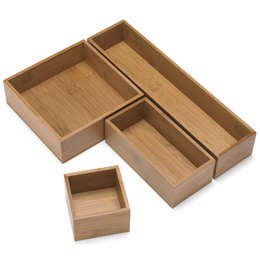

Some drawers open with a polite little glide. Others launch a spatula, hide the measuring spoons, and make you question every decision that led to owning fourteen takeout soy sauce packets. Modular bamboo drawer organizers are designed for the second kind.
Unlike a rigid tray with compartments chosen by someone who has never met your utensils, a modular system lets you combine individual bins, dividers, trays, and stackable pieces according to the drawer you actually have. The result is storage that looks custom without requiring a cabinetmaker, a renovation budget, or an emotional farewell to your favorite oversized whisk.
What Are Modular Bamboo Drawer Organizers?
Modular bamboo drawer organizers are separate storage components that can be arranged into a personalized layout. A set may include narrow rectangular trays, small square containers, long utensil compartments, adjustable dividers, expandable inserts, or shallow organizers that stack inside deeper drawers.
The word modular is the important part. Instead of forcing everything into one fixed configuration, you build a system from individual modules. You can place a long tray beside two shorter bins, create a grid for office supplies, or combine an expandable cutlery organizer with separate compartments for cooking tools.
This adaptability is why modular storage is useful beyond the kitchen. Professional organizing advice frequently recommends adjustable or removable compartments because they can be rearranged as belongings and storage needs change. Modular bins are also particularly efficient when they have straight sides that sit closely together, reducing the awkward gaps created by round containers.
Common components in a modular system
- Long, narrow trays for pens, knives, chopsticks, or cooking utensils
- Small square bins for clips, jewelry, batteries, or condiment packets
- Medium rectangular organizers for cosmetics, gadgets, or flatware
- Expandable trays that adjust to the width of a drawer
- Spring-loaded dividers for clothing, dishes, lids, or bulky tools
- Stackable inserts that use the vertical space in deep drawers
You do not need every shape ever invented. The goal is not to turn your drawer into a tiny bamboo apartment complex. The goal is to create a few logical zones that make frequently used items easy to see, grab, and return.
Why Bamboo Works So Well in Drawers
Bamboo has a warm, furniture-like appearance that makes even an ordinary junk drawer feel more intentional. It coordinates easily with wood cabinets, white drawers, stainless-steel utensils, and most bathroom finishes. Clear plastic may disappear visually, but bamboo brings a decorative element to a space that is normally treated as storage Siberia.
Bamboo is technically a fast-growing fibrous grass and is widely used in manufactured household products. It is often described as a renewable bio-based material, although the environmental impact of a finished organizer also depends on manufacturing methods, adhesives, coatings, packaging, transportation, and how long the product remains in use.
Key advantages of bamboo organizers
They look polished. Bamboo organizers can make an inexpensive drawer upgrade resemble a custom insert. That matters in open shelving, glass-front storage, guest bathrooms, and other places where practical items occasionally become visible.
They feel substantial. A well-built bamboo tray generally has more visual and physical weight than a thin disposable bin. The added weight can help an organizer feel stable, although slippery drawer interiors may still require a liner or removable putty.
They are available in many configurations. Current bamboo systems include stackable boxes, expandable flatware trays, tension dividers, knife inserts, and mixed-size modular sets. Tested product guides have highlighted bamboo organizers for their appearance, capacity, durability, and ability to accommodate bulky kitchen tools.
They work in nearly every room. The same narrow tray that stores teaspoons can hold eyeliner pencils, paintbrushes, charging cords, or sewing tools. This makes modular pieces easier to repurpose after a move or a change in routine.
Where to Use Modular Bamboo Drawer Organizers
Kitchen drawers
The kitchen is the obvious starting point because it contains dozens of objects that are similar enough to become tangled but different enough to need separate homes. Use long trays for wooden spoons and spatulas, narrow compartments for chopsticks, and smaller modules for bottle openers, vegetable peelers, bag clips, and measuring spoons.
An expandable bamboo silverware tray is useful when you want a central flatware section with additional room along the sides. Independent modules offer even more control in unusually wide, narrow, or shallow drawers. Deep-drawer dividers can also create sections for plates, bowls, food-container lids, or rolled kitchen linens.
Bathroom vanities
Bathroom drawers tend to collect small objects with remarkable reproductive abilities. One hair tie becomes twenty-seven, and somehow none of them is available when needed. Modular bamboo bins can separate dental supplies, cosmetics, grooming tools, skincare products, hair accessories, and travel-size toiletries.
Keep products that may leak inside a washable secondary container rather than directly against bamboo. A small removable plastic cup inside a bamboo module provides the visual warmth of bamboo without asking the material to absorb an escaped bottle of facial oil.
Home-office drawers
Create individual zones for pens, pencils, sticky notes, stamps, charging cables, flash drives, scissors, and paper clips. Longer compartments suit rulers and writing tools, while small square modules work well for thumbtacks and binder clips. Organizing experts also recommend placing daily supplies in the most accessible drawers and less frequently used items lower down.
Bedroom dressers
Adjustable bamboo dividers can separate socks, underwear, scarves, belts, workout clothes, and accessories. They work especially well with file folding, in which garments stand vertically instead of being stacked. This arrangement improves visibility and eliminates the archaeological excavation required to retrieve a shirt from the bottom of a pile.
Craft and hobby storage
Use modular pieces for beads, thread, brushes, carving tools, stamps, markers, model-building supplies, or small hardware. Grouping materials by activity can be more practical than grouping them solely by type. For example, keep the tools needed for gift wrapping together rather than making tape live in one drawer, scissors in another, and ribbon somewhere behind the holiday decorations.
Entryway and junk drawers
A junk drawer is not a failure. It is simply a drawer with a broad job description. Give it several categories: keys, batteries, tape, writing tools, small hardware, flashlights, and items waiting to be returned somewhere else. The modules provide boundaries without demanding museum-level perfection.
How to Choose the Right Modular Bamboo Organizer
Measure the usable interior, not the drawer front
Measure the drawer’s inside width, length, and height. Watch for screw heads, curved corners, side rails, handles, and other obstructions. The impressive twelve-inch exterior of a drawer may conceal considerably less usable space inside.
Check vertical clearance carefully when buying stackable organizers. A stack may fit inside the drawer when empty but collide with utensils once filled. Leave enough clearance for the tallest item and for fingers to lift the upper tray comfortably.
Measure what you plan to store
The drawer is only half the equation. Measure your longest spatula, widest serving spoon, largest cosmetic compact, and tallest office supply. A beautiful grid of tiny compartments is not helpful when the potato masher must live diagonally like a disgruntled houseguest.
Choose between bins, trays, and dividers
Individual bins are ideal for mixed collections of small objects. Expandable trays provide an all-in-one solution for flatware and kitchen gadgets. Dividers are better for clothing, cookware, food-container lids, and oversized utensils that do not need a solid container beneath them.
A hybrid layout is often best. You might use one expandable cutlery tray, two loose bamboo boxes, and a tension divider in the remaining space. Modular organization does not require loyalty to one product style.
Look at the base material
Not every product marketed as a bamboo organizer is made entirely from solid bamboo. Some have engineered-wood bases, laminated panels, plastic feet, metal springs, or glued joints. These construction choices are not automatically bad, but they affect weight, water resistance, maintenance, and long-term durability.
Inspect edges and joints
Choose smooth edges, tight corners, and a consistent finish. Rough surfaces can snag fabric or make the organizer unpleasant to handle. On expandable models, slide the moving sections several times and make sure they travel evenly without pinching or wobbling.
Check for anti-slip features
Some bamboo trays lack non-slip feet. If the organizer shifts every time the drawer opens, add a high-grip drawer liner, small silicone pads, or removable museum putty beneath the corners. Professional organizers frequently recommend these simple stabilizers because a moving organizer quickly becomes a reorganizerand nobody asked it to freelance.
Buy for flexibility, not maximum compartment count
A twenty-piece set is not automatically better than a six-piece set. More modules can mean more options, but they can also create unused containers and an overly fussy layout. Select shapes that match real categories in your home and leave a little room for future changes.
How to Organize a Drawer Step by Step
- Empty the drawer completely. Yes, even the mystery key and the birthday candle shaped like a number you no longer need.
- Clean the interior. Vacuum crumbs and dust, then wipe the surface according to the drawer manufacturer’s care instructions.
- Sort everything into categories. Group similar objects and remove duplicates, expired products, broken tools, and items that belong elsewhere.
- Place the largest items first. Long utensils and wide tools determine the basic structure of the layout.
- Test modules before loading them. Rearrange the empty organizers until gaps are minimized and every section can be reached easily.
- Assign one purpose to each zone. Categories should be obvious enough that other household members can follow the system without an orientation seminar.
- Add anti-slip support if necessary. Secure any pieces that move when the drawer opens.
- Load daily items near the front. Store occasional-use objects toward the back or in a lower layer.
- Leave a little breathing room. An organizer packed to its molecular limit will become disorganized again quickly.
Cleaning and Maintaining Bamboo Drawer Organizers
Remove loose crumbs and dust regularly with a soft cloth or handheld vacuum. For routine cleaning, wipe the organizer with a lightly damp cloth and dry it promptly. Avoid leaving bamboo pieces soaking in water or placing them back into a drawer while wet.
For kitchen organizers, remove the modules periodically and clean underneath them. This prevents crumbs from establishing a small but confident civilization beneath the flatware tray.
Follow the manufacturer’s care instructions before using soap, disinfectants, oils, or abrasive cleaners. Finishes vary, and a treatment suitable for an unfinished bamboo product may not be appropriate for a sealed, laminated, or composite organizer.
Inspect spring-loaded dividers and expandable joints occasionally. Remove trapped debris, confirm that protective end pads remain attached, and replace modules that develop sharp splinters, loose joints, swelling, or persistent odors.
Common Mistakes to Avoid
Buying organizers before decluttering
Storage products do not reduce the number of objects you own. They merely help the objects stand in straighter lines. Sort first, then purchase modules for what remains.
Ignoring drawer height
Tall bins can prevent shallow drawers from closing, while low organizers may waste valuable vertical space in a deep drawer. Measure in three dimensions rather than treating the drawer like a flat rectangle.
Creating too many tiny categories
A separate compartment for every individual gadget may look impressive on day one but can become tedious to maintain. Broad, intuitive zones such as “baking tools” or “charging accessories” are often more practical.
Using bamboo for frequent spills
Bamboo can tolerate ordinary household use, but a drawer filled with wet sponges, leaking cosmetics, or uncovered art paint needs washable liners or removable containers. Choose materials according to the mess level, not only the mood board.
Forgetting the rest of the household
A system succeeds only when people can understand it. Keep frequently used categories visible and use simple labels when the location is not obvious. The best drawer organizer is the one people actually use after the first week.
Are Modular Bamboo Drawer Organizers Worth It?
They are especially worthwhile when you value flexible layouts, warm natural styling, and the ability to reuse components in different rooms. They can also be a practical middle ground between cheap fixed trays and expensive custom-built inserts.
They may be less suitable for drawers exposed to constant moisture, households that prefer dishwasher-safe storage, or anyone who wants every compartment molded into a single lightweight unit. Plastic and metal organizers remain sensible alternatives in those situations.
For most kitchens, offices, dressers, and vanities, however, a thoughtfully selected modular bamboo set can improve visibility, reduce wasted space, and make everyday routines smoother. That is a respectable achievement for a collection of small rectangles.
Real-Life Experiences With Modular Bamboo Drawer Organizers
The most noticeable change after installing modular bamboo organizers is not that the drawer looks prettier, although it usually does. The larger benefit is the disappearance of tiny daily annoyances. A measuring spoon can be found without lifting three spatulas. Scissors stop migrating beneath the tape. Charging cables remain separated instead of forming a knot that appears to have developed its own legal identity.
In a typical kitchen-utensil drawer, the first layout is rarely the best one. A long bamboo tray may initially seem perfect for spatulas, only to reveal that its tapered handle ends waste space. Rotating the tray or moving it beside a shorter box can create a better fit. This trial-and-error stage is where modular organizers outperform fixed inserts: nothing has to remain in the position chosen on the first attempt.
One useful approach is to live with a temporary layout for several days before adding labels or non-slip putty. Daily use exposes problems that are hard to predict while standing over an empty drawer. Perhaps the can opener belongs closer to the front. Maybe the cooking thermometer needs a protective compartment. The attractive little square bin reserved for corn holders may prove absurdly generous for an item used twice a year.
Stackable bamboo organizers can be excellent in deep drawers, but they require honest planning. The upper layer should contain lightweight items used occasionally, while daily essentials remain visible below or in a tray that lifts easily. A tightly packed upper organizer becomes irritating when it must be removed every morning to reach the bottle opener. Vertical storage is valuable only when access remains simple.
In bathroom drawers, modular pieces make morning routines feel calmer because each category has a visible boundary. A long bin can hold toothbrush supplies, another can contain everyday cosmetics, and a small square tray can catch hair ties. The system works best when products are wiped before being returned and anything likely to leak is placed in a washable insert.
Desk drawers often show the greatest improvement. Office supplies are small, visually noisy, and easy to scatter. Creating separate zones for writing tools, adhesive notes, cables, and clips turns the drawer into a working inventory. It also reveals unnecessary duplicates. Discovering nine nearly identical black pens is less charming when six of them do not write.
Dresser dividers produce a different kind of benefit. They do not necessarily increase capacity, but they stop one category from invading another. Socks remain with socks, workout clothes stay upright, and belts no longer tunnel beneath folded shirts. The organizer acts less like a container and more like a boundary dispute mediator.
Maintenance is generally simple when the original categories are broad and logical. A five-minute reset every few weeks is usually more effective than waiting for the drawer to collapse into complete disorder. Remove items that have drifted into the wrong section, wipe away dust, and reconsider any module that remains mostly empty.
The experience also demonstrates that attractive storage can encourage better habitsbut only to a point. Bamboo does not possess magical behavioral powers. It cannot force family members to return the vegetable peeler to its assigned tray. What it can do is make the correct location so visible and convenient that putting an item away requires less effort than abandoning it elsewhere.
Over time, the best modular systems evolve. A bin that once held baby supplies may later store art tools. A cutlery insert can move into a craft room, and a narrow kitchen tray can become a watch organizer. That ability to reconfigure and migrate is one of the strongest reasons to choose individual bamboo modules rather than an insert cut for a single drawer and a single stage of life.
Conclusion
Modular bamboo drawer organizers combine customizable storage with a warm, finished appearance. By measuring carefully, selecting useful shapes, stabilizing loose pieces, and creating simple categories, you can transform cluttered kitchen, bathroom, office, or dresser drawers into spaces that are easier to use and maintain.
The secret is not achieving a flawless social-media drawer. It is building a layout that supports real routines, fits real belongings, and can change when life changes. When every tool has a sensible home, opening a drawer becomes pleasantly uneventfulwhich is exactly what a drawer should be.


