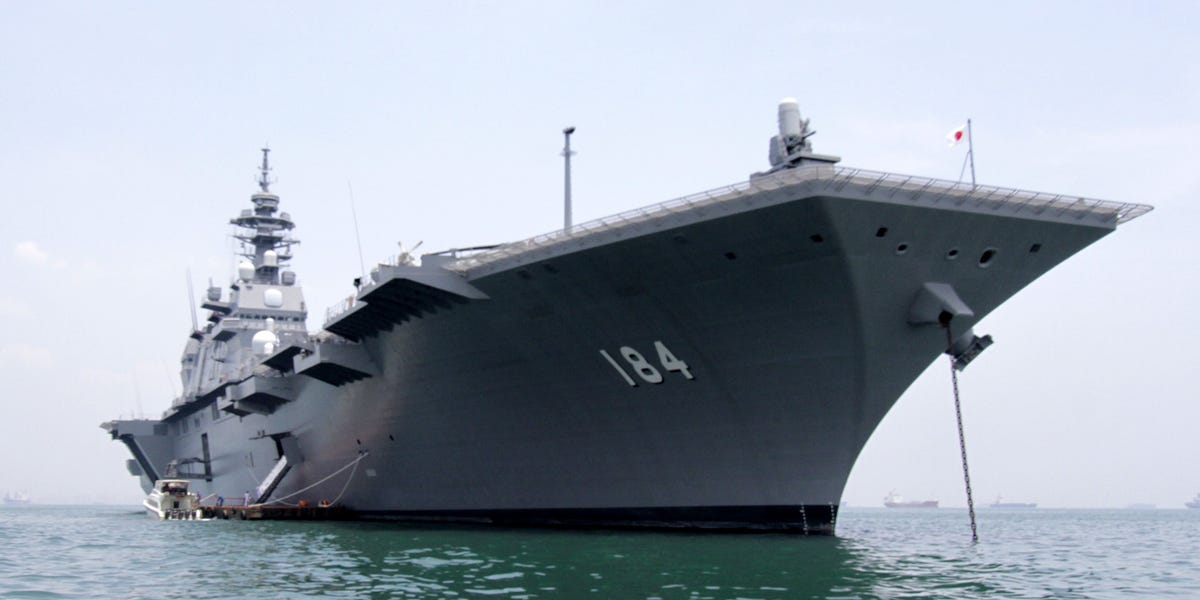

For decades, calling a Japanese warship an “aircraft carrier” was politically awkward, historically sensitive, and generally avoided with the enthusiasm of a sailor avoiding mystery meat in the galley. That changed when Japan approved plans to modify its two largest warships for F-35B stealth fighters, restoring a fixed-wing naval aviation capability not seen in the country since World War II.
A Historic Decision Hidden Behind Careful Language
In December 2018, Japan’s government approved defense guidelines that allowed the Japan Maritime Self-Defense Force to modify the Izumo-class helicopter destroyers JS Izumo and JS Kaga. The ships would receive the equipment needed to support short-takeoff-and-vertical-landing aircraft, particularly the Lockheed Martin F-35B Lightning II.
Technically, Tokyo continued describing the vessels as “multi-purpose operation destroyers” rather than aircraft carriers. This was not merely a naval branding exercise. Since the end of World War II, Japan has carefully framed its armed forces as defensive organizations operating within the restrictions associated with Article 9 of its constitution.
Aircraft carriers have traditionally been associated with long-range power projection. They carry aircraft toward distant shores, extend military influence beyond national territory, and arrive with enough geopolitical symbolism to make diplomats reach for stronger coffee. For Japan, a country whose wartime carrier fleet included famous ships such as Akagi, Kaga, and Shokaku, the terminology carries unusually heavy historical baggage.
The 2018 policy therefore emphasized that the converted ships would support defensive missions, including protection of Japan’s remote islands and reinforcement of air defenses over vast stretches of the Pacific where conventional runways are limited.
What Are the Izumo-Class Ships?
JS Izumo and JS Kaga were originally built as helicopter-carrying destroyers. Each is approximately 814 feet long and displaces roughly 27,000 tons at full load. Their long, uninterrupted flight decks, aircraft elevators, hangars, command facilities, and aviation-support systems made them look suspiciously carrier-shaped long before Japan officially approved fixed-wing operations.
Izumo entered service in 2015, followed by Kaga in 2017. Their initial aviation groups consisted mainly of anti-submarine warfare and search-and-rescue helicopters. In that role, they could protect Japanese shipping, hunt submarines, assist disaster-relief operations, and serve as command ships for naval task groups.
Their designs also left room for future adaptation. Elevators and internal aviation spaces were large enough to accommodate aircraft substantially heavier than the helicopters normally assigned to the ships. That did not mean an F-35B could simply arrive, park near the island structure, and ask where the coffee machine was. Significant modifications were still necessary.
Why Japan Chose Conversion Instead of New Construction
Building an entirely new aircraft carrier would have been expensive, politically controversial, and slow. Converting ships already in service offered a more practical route. Japan could add a limited sea-based fighter capability without committing to the cost and complexity of a nuclear-powered supercarrier or a large conventional carrier.
The result is closer to the light-carrier model used by navies operating amphibious assault ships and compact STOVL carriers. The ships have no catapults, arresting wires, or angled landing decks. They are not Japanese versions of the U.S. Navy’s massive Gerald R. Ford class, and nobody should expect dozens of aircraft launching in a choreographed cloud of jet exhaust.
Why the F-35B Changes Everything
The F-35B is the short-takeoff-and-vertical-landing version of the Joint Strike Fighter. Unlike conventional fighters, it can launch from a relatively short flight deck and land vertically using a swiveling engine nozzle and lift fan.
This capability allows it to operate without a catapult or runway-length deck. It is already used from U.S. amphibious assault ships and British and Italian carriers, making it the natural choice for Japan’s converted vessels.
The F-35B also brings stealth, advanced sensors, electronic warfare capabilities, and secure data-sharing systems. It can detect threats, exchange information with ships and other aircraft, and contribute to a wider air-defense network. In practical terms, the jet is not merely a bomb truck with futuristic bodywork. It is also a flying sensor node capable of helping an entire task force understand what is happening around it.
Japan plans to acquire 42 F-35Bs alongside 105 conventional F-35As. The B-model aircraft are operated by the Japan Air Self-Defense Force, while the ships belong to the Japan Maritime Self-Defense Force. That arrangement requires close cooperation between two services with different command structures, maintenance systems, training cultures, and preferred styles of paperwork.
Turning a Helicopter Ship Into a Light Aircraft Carrier
F-35B operations require much more than painting a few landing lines on the deck. During a vertical landing, the fighter directs extremely hot exhaust downward. A deck designed primarily for helicopters can suffer serious damage unless it is reinforced or covered with heat-resistant material.
Japan’s conversion work has included heat-resistant flight-deck treatment, new deck markings, improved lighting, updated aviation-control equipment, and changes to internal support spaces. The ships must also accommodate specialized maintenance tools, spare parts, weapons, fuel-handling procedures, and safety systems suitable for a fifth-generation fighter.
The bows of the ships are being changed from a tapered, trapezoidal shape to a wider rectangular configuration. This provides more usable flight-deck space and reduces undesirable airflow around the forward deck during aircraft operations. The modified profile also makes the ships look considerably more like light carriers, proving that naval architecture sometimes says the quiet part out loud.
Kaga completed a major stage of its initial conversion in March 2024. Its reshaped bow, strengthened deck, new markings, and nighttime lighting were then tested with an F-35B off the coast of California. Izumo, which had undergone earlier deck treatment, later received its own rectangular bow as part of continuing modifications visible in 2026.
From Political Approval to Real Flight Operations
The 2021 Izumo Tests
On October 3, 2021, U.S. Marine Corps F-35Bs conducted the first fixed-wing aircraft operations aboard a Japanese ship since World War II. Two jets from Marine Fighter Attack Squadron 242 landed on and departed from JS Izumo during tests off Japan.
The event provided more than a dramatic photograph. It confirmed that the modified deck could support basic F-35B operations and gave Japanese personnel direct experience working with an established STOVL operator. U.S. Marines and sailors helped with deck procedures, flight operations, safety practices, and technical coordination.
Kaga’s Developmental Trials in 2024
On October 20, 2024, a U.S. F-35B landed aboard JS Kaga off Southern California to begin developmental sea trials. Test pilots and engineers evaluated how the aircraft interacted with the modified ship under real operating conditions.
The trials examined deck temperatures, airflow, ship motion, landing procedures, lighting, communications, and the physical loads produced by repeated operations. Engineers installed sensors to collect data needed for certification. It was a reminder that naval aviation is built less on cinematic flybys and more on thousands of measurements taken by people carrying clipboards.
Japan Receives Its Own F-35Bs
The program moved into a new phase on August 7, 2025, when Japan’s first three F-35Bs arrived at Nyutabaru Air Base in Miyazaki Prefecture. Additional aircraft were scheduled to follow as Japan established its initial training, maintenance, and operational infrastructure.
The aircraft are intended to operate from land bases as well as the converted ships. This gives Japan flexibility during a crisis. Fighters could disperse from vulnerable main runways, operate from shorter facilities, or temporarily deploy aboard an Izumo-class vessel when geography, runway damage, or mission requirements make sea-based aviation useful.
Why Japan Wants Carriers Again
Defending Remote Islands
Japan consists of thousands of islands stretching across a wide maritime area. The southwestern island chain extends toward Taiwan and includes territory relatively far from Japan’s major air bases. In a conflict, those bases could face missile attacks or become temporarily unavailable.
A mobile flight deck cannot replace a full air base, but it complicates an opponent’s planning. A carrier can relocate, change operating areas, and provide temporary aviation support where land-based coverage is weak.
China’s Expanding Naval Power
China’s rapid military modernization is an important part of Japan’s calculation. The People’s Liberation Army Navy operates a growing carrier fleet, increasingly capable surface ships, submarines, long-range missiles, and large numbers of military aircraft.
Chinese coast guard and military activity near the Japanese-administered Senkaku Islands, which Beijing claims as the Diaoyu Islands, has also increased concern in Tokyo. The converted carriers provide another layer of air defense and surveillance around contested or remote areas.
Japan’s ships cannot match China’s large carriers aircraft for aircraft. Their value lies in mobility, distributed operations, alliance cooperation, and the ability to place advanced fighters in locations an opponent cannot safely ignore.
North Korean Missile Threats
North Korea’s ballistic and cruise missile programs create another strategic concern. Sea-based aircraft cannot eliminate the missile threat, but they can contribute to surveillance, interception planning, and the defense of naval forces operating beyond the coverage of land-based fighters.
Closer Integration With the United States
The carrier program also deepens cooperation between Japan and the United States. Both countries operate the F-35, and U.S. forces have already supported Japanese ship trials. In an emergency, Japanese ships could potentially support allied aircraft, while Japanese F-35Bs could exchange data with U.S. ships, aircraft, and ground units.
This cross-deck capability gives alliance planners more options. It also reduces the pressure on a small number of major airfields during a regional crisis.
Are These Ships Offensive or Defensive?
The answer depends partly on mission, weapons, geography, and political intent. A carrier is a platform, not a foreign policy. The same flight deck can protect shipping, provide disaster relief, defend islands, support allied forces, or launch strikes against land targets.
Japan argues that its ships are intended for defensive use and will not resemble the large strike carriers operated by the United States. Their compact size limits the number of fighters, fuel, weapons, and support aircraft they can carry. They also lack the dedicated airborne early-warning planes and large carrier air wings associated with sustained offensive campaigns.
Critics nevertheless note that an F-35B can carry precision-guided weapons and conduct missions far from the ship. The conversion therefore expands Japan’s ability to project airpower, regardless of the terminology used on official nameplates.
The most accurate description is that the Izumo class gives Japan a limited light-carrier capability optimized for regional defense and allied operations. It is militarily meaningful without being equivalent to a traditional carrier strike force.
Limits of Japan’s New Carrier Capability
Aircraft carriers are expensive ecosystems. The ship is only the most visible component. Effective operations require trained pilots, deck crews, maintainers, weapons specialists, escorts, supply ships, communications networks, and a steady flow of spare parts.
The F-35B also sacrifices some range and internal fuel capacity compared with the conventional F-35A because its lift system occupies valuable internal space. Vertical landings consume fuel and expose the deck to intense heat. Maintenance demands at sea can be challenging, particularly on a ship not originally designed around the aircraft.
Japan must also balance fighter operations with the ships’ existing helicopter missions. Anti-submarine helicopters remain vital because submarine activity in the western Pacific is increasing. Filling the hangar with fighters could reduce space available for rotorcraft, so commanders will have to tailor each aviation group to the mission.
Most importantly, two light carriers cannot be available continuously. Ships require maintenance, training periods, and refits. One vessel may be in port while the other is deployed, and occasionally both may be unavailable. The capability is valuable, but it is not magicand it does not come with an “always operational” button.
Experience-Based Lessons From Operating Small Aircraft Carriers
Operational experience from Japanese trials and other F-35B fleets shows that converting a ship is only the opening chapter. The harder task is turning hardware into a dependable combat capability.
Deck Heat Is a Daily Engineering Problem
The F-35B’s downward-directed exhaust places extraordinary thermal stress on a flight deck. Engineers must understand not only the highest temperature reached during a landing but also how heat spreads through steel, coatings, joints, wiring, and spaces below the deck.
Repeated landings can create cumulative damage that one successful demonstration will not reveal. Japanese and American teams therefore used extensive sensors during Kaga’s trials. The experience demonstrates why certification requires repeated approaches, landings, takeoffs, and deck-position tests rather than one photogenic arrival followed by enthusiastic handshakes.
Airflow Can Decide Whether a Landing Feels Routine or Exciting
Air moving around a ship’s bow and island structure can create turbulence over the landing area. Conditions change with ship speed, wind direction, aircraft weight, and sea state. Reshaping the bows of Izumo and Kaga increases deck area while helping create more predictable airflow for approaching pilots.
For aviators, predictable airflow reduces workload during one of the most demanding phases of flight. For everyone watching from the deck, it also reduces the likelihood of discovering new and unpleasant interpretations of the word “vertical.”
Joint Operations Require a Shared Language
Japan’s arrangement places Air Self-Defense Force aircraft on Maritime Self-Defense Force ships. That means air personnel must understand shipboard routines, while sailors must learn the operating requirements of stealth fighters.
Even simple activitiesmoving an aircraft, loading a weapon, scheduling maintenance, or deciding whether weather conditions permit flightrequire clearly defined authority. Successful carrier operations depend on shared terminology, standardized hand signals, reliable communications, and commanders who understand both aviation and maritime risk.
Maintenance Space Matters as Much as Flight-Deck Space
A carrier’s combat value is determined by how many aircraft it can keep flying, not how many it can arrange neatly for a publicity photograph. Mechanics require access to engines, lift-system components, electronics, tires, coatings, weapons interfaces, and diagnostic equipment.
Compact ships have limited workshops and storage areas. Every spare part competes for space with fuel, weapons, food, helicopter equipment, and the many mysterious boxes that navies apparently need to carry everywhere. Japan must develop realistic aircraft complements that can be maintained for extended deployments rather than chasing the largest possible headline number.
Sortie Generation Is the Real Measure of Success
A light carrier may embark fewer aircraft than a supercarrier, but it can still be effective if it launches the right missions at the right time. Defensive patrols, reconnaissance flights, anti-ship missions, and support for remote islands may require only a small number of aircraft airborne simultaneously.
The challenge is sustaining those flights. Pilots need rest, aircraft need inspections, weapons must be moved safely, and damaged deck coatings must be repaired. Operational experience consistently shows that tempo falls when logistics and maintenance cannot keep pace with ambitious flight schedules.
Interoperability Multiplies a Small Fleet
Japan’s work with U.S. Marine Corps and Navy personnel illustrates the greatest advantage of operating a common aircraft. Allied F-35Bs can use similar deck procedures, exchange data, and potentially operate from one another’s ships under agreed conditions.
That does not make every F-35B and every flight deck instantly interchangeable. National rules, software configurations, weapons clearances, maintenance responsibilities, and command arrangements still matter. However, common equipment provides a foundation that would be far more difficult to build with unrelated aircraft.
These experiences suggest that Japan’s carrier program will mature gradually. The ships may first conduct limited training deployments and mixed helicopter-fighter operations before attempting more demanding missions. That methodical approach is less dramatic than declaring the birth of a new carrier fleet overnight, but it is how safe and credible naval aviation is actually built.
What Japan’s Carrier Return Means for the Indo-Pacific
Japan’s return to fixed-wing naval aviation marks a major change in the regional balance, although not because two converted ships will suddenly dominate the Pacific. Their importance is strategic rather than numerical.
The vessels strengthen Japan’s ability to defend distant islands, disperse advanced aircraft, support U.S. forces, and operate within multinational naval groups. They also demonstrate how countries can gain meaningful sea-based airpower without building enormous carriers.
Other Indo-Pacific governments will watch closely. China is likely to portray the program as evidence of Japanese remilitarization, while U.S. allies may see it as a welcome increase in Japan’s contribution to regional security. South Korea and other neighbors will assess the development through the complicated lens of history, current security threats, and domestic politics.
The phrase “first aircraft carriers in 70 years” is a catchy headline rather than a precise technical definition. When the policy was approved in 2018, more than 70 years had passed since Japan’s wartime carrier fleet disappeared in 1945. The modern ships are also far smaller and are being developed under a democratic government, a defensive military doctrine, and a close alliance with the United States.
Still, the symbolism is impossible to miss. A country that once treated carriers as politically forbidden is now training pilots, reshaping flight decks, installing heat-resistant surfaces, and learning how to operate stealth fighters at sea.
Conclusion
Japan’s decision to convert Izumo and Kaga represents one of the most consequential changes in its postwar defense policy. The ships are not supercarriers, and their relatively small air groups will not transform Japan into a globe-spanning naval power. They do, however, provide mobile runways for some of the world’s most advanced combat aircraft.
The program combines practical military needs with powerful historical symbolism. It responds to vulnerable airfields, remote-island defense requirements, China’s expanding forces, North Korean missiles, and the growing importance of alliance interoperability.
Japan has not simply brought back the aircraft carrier. It has redesigned the concept for a modern, politically cautious, highly networked defense strategy. The result is a capability that is modest compared with America’s carrier fleet but significant enough that every military planner in the Indo-Pacific will be paying attention.
SEO Metadata


